
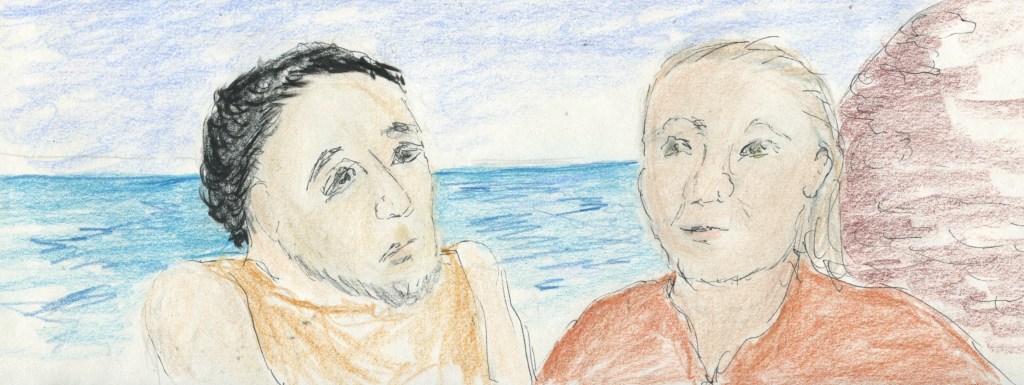
Historical Setting: The Great Skellig in an unknown time
The Abbot took compassion on my frailty and answered the brothers as best he could, then dismissed them to their daily tasks with a prayer. Now he sits here beside me on this step.
I say, “These monks are so very young.”
“Yes. Here they are, astounded by their first awakenings so maybe this community of brothers will be here for many years to come and there will always be someone here welcoming pilgrims and rescuing the shipwrecked sailors. So many ancient stories of this place are of the bleak isolation of elders. [Footnote] But this time, what is now a new start will last long into the future.”
“So, you are expecting the youthfulness of these current monks to insure the longevity of this community?”
“I know they are impetuous now, but when they settle in to the patterns of this haven, becoming established here, growing wise with age, this will become a forever community.”
“Forever is measured in generations not by one man’s lifespan, even a young man’s.”
The notion of choosing only young men for this arduous commitment in order to ensure the longevity of the community appears to me as a ludicrous and doomed plan. From the perspective of a forever man, the wonder of youth is not the guarantee of a lifelong adherence to a singular gift or commitment, though that is often assumed to be forever. With a relationship to God, and even within marriage the bond may be true throughout a lifetime, but the relationship is constantly changing and rebuilding anew. So, expecting young monks to always value the trials of this vertical isolation, and a singular way of meeting God, as I see from the long view, may not be realistic.
It is a fallacy that youthfulness assures a long future simply by assuming it is only old age that has a shortened span of life. Of course, people die in all stages of life. This community is already grieving for one of these young men. It is tragic. But when the mortal promise excludes the aged and creates a youth culture, longevity still isn’t promised. In fact, the blunders of age are often rooted in the whimsies of youth. And that rumored “wisdom” of age is often grounded in the nature of the teen’s normal penchant for rule testing.
[Footnote] This story of this community filling the ancient cloches of this monastery is fictional as are other stories of the lives of the people who lived on these particular rocks, until and unless documented or archeological history of the people who established the monastery on the Great Skellig becomes available. Geoffrey Moorhouse authors two books in one title, Sun Dancing (San Diego: Harcourt Brace & Co. 1997) Part I, The Tradition (the fictional story) and Part II, The Evidence.
Another written from research historical fiction is Haven by Emma Donoghue (New York: Back Bay Books/Little Brown and Company 2022).
Now called Skellig Micheal, it was also made famous as the launching pad for a Star Wars sequel.
(continues tomorrow)

