
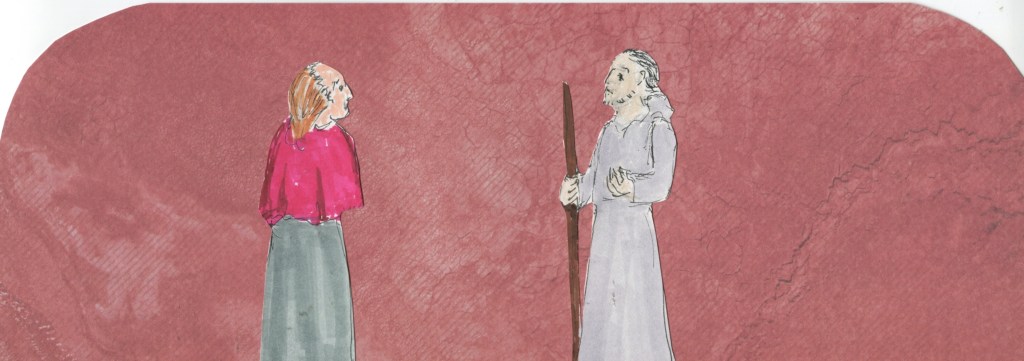
Historical Setting: The Great Skellig in an unknown time
In this rare circumstance I’ve allowed myself the luxury of revealing the nature of my redundant healing as the intended earthly sign for the spiritual life. Probably, I mistakenly expected they would recognize the holy purpose of the sign. But no signs in the gospel of John answer the questions these youths are asking. God’s punitive judgement of sin is not affirmed in the signs in John. It may not be the nature of God at all.
The Youthful stage of life, just as in the youthful stage of all of monotheistic history, has a habit of observing everything sorted as either goodness or evil. And in another humanly twisted way, the Creator is said to perceive her own spawn as basically evil. The original biblical proof-text for this is the Genesis allegory of the first people eating from the forbidden fruit giving them the knowledge of good and evil. Then in Romans 5:12 Adam gets all the blame for original sin, so that the Christian “Christ” can deliver all goodness.
The abbot recognizes my immediate need.
“You are probably wanting to make your way back down to the hermitage to rest.”
“Yes, but I think Brother Timothy has had quite enough of me, now that I am healing and not depending on him for the shear breath of life. I think Sister Brigid is hoping I can find a place here, at least until St. Brenden’s boat comes by to whisk me off to Paradise.”
He smiles and rummages through a shelf of stored clothing behind the altar in the church. He finds a hooded robe to suit me. I am grateful.
“You can stay with us here. Right now, mine is the only fleece spread at night in this larger cloche we use as our church, or we could make room for another in one of the novices’ cells.”
“Sister Brigid had it in mind I would be a cellmate to Brother Lugh, since he is struggling with his personal grief at this time and may need the company.”
“Grief? We are all grieving for the monk who was among us and now is lost. And Brother Lugh shouldn’t be grieving for his father now that he has dedicated himself to God as a monk.”
“Grief follows no rule, even a monastic rule. I’ll ask him if he wants to share his cell.”
“You don’t have to ask him. It is his duty to welcome the stranger.”
“Of course. But I will ask.”
(Continues tomorrow)

