
Historical Setting: The Great Skellig, 924 C.E.
Brother Lugh, like a bird in springtime, only knows one song, and he wants to hear it incessantly — the lyric is St. Brigid. He treasures the name that he hears all packaged up with a beautiful face, and the gentle kindness and the mission of feeding the hungry, and all the monks in between the fasting and the fed.
The homely Lugh requested could be said from the heavenly view of a saint’s goodness. Brigid was a legend among the people who knew the name first, as a three-part goddess of this Celtic land, then, there lived a girl Brigid and the legend of her is the vitae (the life) of a Saint. That is what Lugh wants to hear.
— “Now there never hath been anyone more bashful or more modest or more gentle or more humble or sager or more harmonious than Brigid. She never washed her hands or her feet or her head among men. She never looked at the face of a man. She never would speak without blushing. She was abstinent. She was innocent. She was prayerful. She was patient. She was glad in God’s commandments. She was firm. She was humble. She was forgiving. She was loving. She was a consecrated casket for keeping Christ’s body and blood. She was a temple of God.” — [footnote 1]
And when Abbott Mactyre spoke all these qualities of the saint, Brother Lugh was rightfully reminded that an abbess, like St. Brigid of Kildare, or a simple sister, like Sister Brigid have kept their vows also, and are setting a fine example for all the brothers of the Skellig. Brother Lugh felt lectured. He made the request for the topic of the homely. What did he expect?
I am pretty sure Brother Lugh was hoping the homely he requested would be filled with the fun stories often shared among people throughout the generations — funny stories told like gossip of goodness. Instead, the abbot read from church pages, a lecture listing her virtues and particularly — abstinence.
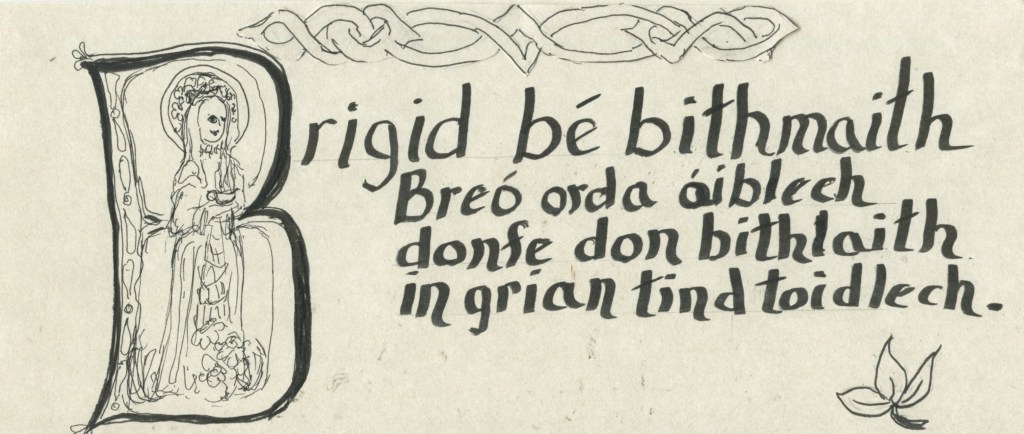
We went out singing the hymn: “Broccán’s hymn”, composed by St Broccán Clóen (died c. 650)
Brigid bé bithmaith
Breó orda óiblech
donfe don bithlaith
in grian tind toidlech.
Translation:
Brigid, ever good woman
A sparkling golden flame
May she lead us to the eternal realm
The shining bright sun.[Footnote 2]
Saint or goddess, maybe God doesn’t worry over the name of the sacred as long as it is love.
[footnote 1] Author Justin R. McCarthy, in his book Saint Brigid: the Celts & the Early Irish Church attributes this quotation to Book of Lismore, Passage 1689, a later medieval manuscript. p. 77. This blogger, taking the liberty of fiction, knowing that the Hagiographies of Brigid, and the legends were already common in the 10th century and might have been the source of the Book of Lismore https://en.wikipedia.org/wiki/Brigid_of_Kildare (retrieved 3-16-26) this blog includes this quotation for the purposes of a storyline of unrequited love.
[Footnote 2] https://en.wikipedia.org/wiki/Brigid_of_Kildare (retrieved 3-16-26)
(Continues tomorrow)

