
Historical Setting: The Great Skellig, 924 C.E.
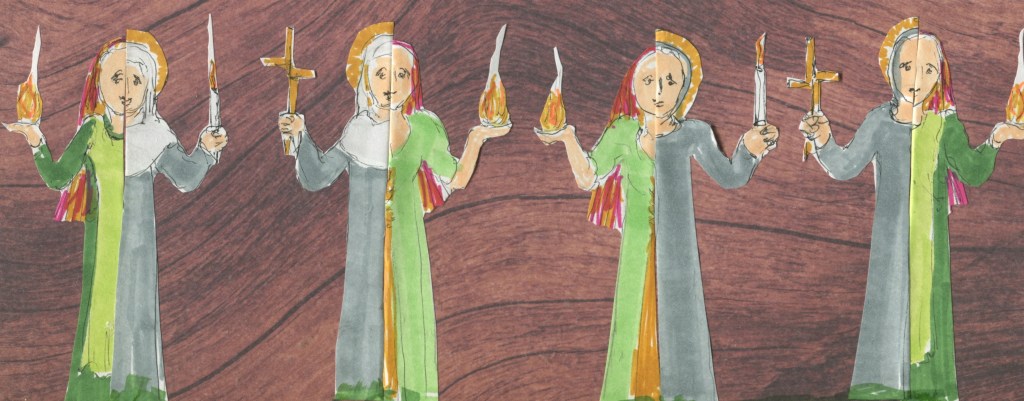
Brother Lugh is telling me the stories of a saint, a woman, who lived centuries ago and is the namesake of Sister Brigid. He compares Sister Brigid to Saint Brigid, not just because they share a name, but because both made it their common practice to feed the hungry, or at least the Sister provides for us who would be hungry without her continual gifts.
The lore of the saint’s childhood tells of her connections with a Pagan mother, and that her Christian father sold her into the home of a Druid.
“So, Brother Lugh, you are telling me Saint Brigid was a Christian saint who was also a Pagan?”
“That is the way of this whole land.
“St Brigid was always the between — between Christian and Pagan, between rich and poor, between holy and profane, between the power of man, and the gentleness of woman, between goddess and saint, between heaven and earth. It was said that she was born in the doorway of the house, both inside the house and outside the house. [Footnote]
“Now she is a saint and yet she isn’t just in spirit. There is a shrine where her bones were buried. So, she can still be found both on earth and in heaven. She is still between.”
“Have you visited that shrine?”
“When I was a child, my father took me along to Dublin, and on the way we visited the shrine at Kildare.”
“Really? What kind of monastery is Kildare?”
“It is Christian.”
“Of course. But what is the rule?
“It is a double monastery with a section for women, and a part for men. And the rule is they don’t live together in the same cells.”
“But, I mean, is it Celtic or Roman?”
“All Christian is Roman, is it not?”
“But I’m finding so many Celtic monasteries have given over to the Rule of Benedict in the Roman way. Yet here, we are Christian also, but under the Celtic rule. And if I am to be sent away when the boat comes, I would like to find a monastery that also has the Celtic Rule, you know, where the tonsure is Irish.”
“You would choose a community by the hair style?”
“No, no, I’m just using that as an example of the difference in rule.
[Footnote] McCarthy, Justin R. “Saint Brigid: the Celts & the early Irish church, Chapter 7.
(Continues tomorrow)

