#62.3, Thursday, Nov. 7, 2024

Historical Setting, cold unknown

“Do you know what this is?” the raging man asks Os.

         Us doesn’t answer.

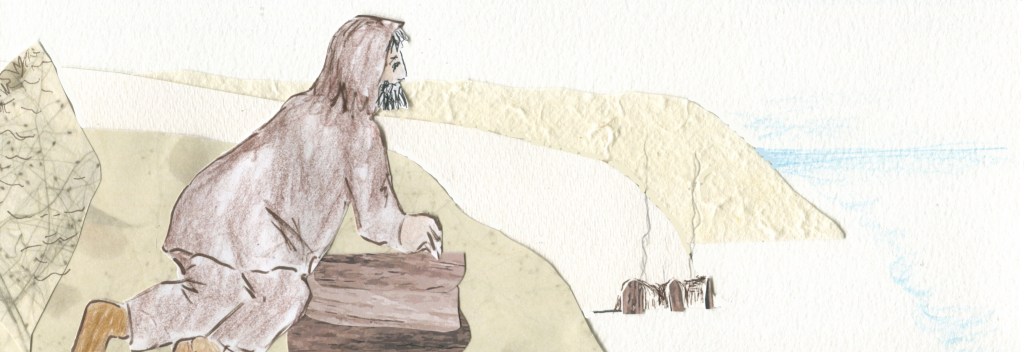
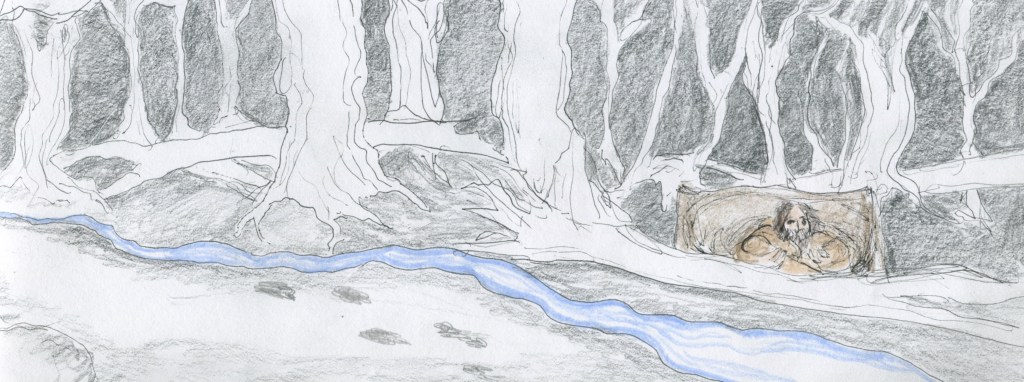
         “It’s a bog body! A pagan priest chooses a glamourous or youthful perfect specimen, and leaves the burn of the rope or the mark of the blade nearly hidden when a sacrifice is given to their gods — then it is buried in a peat bog so it may never rot and can be food for the gods forever. [Footnote] And you, detestable rat of the death pits, you have gone and dug in the bogs! The gods will be very angry! Do you see what you have done to me?”

         The other, the Oos, doesn’t answer, only cowers more deeply.

         “What do you take me for, Oos? An idiot? I am the smartest man in the world.”

         Still Us does not to answer.

         “I’d have to be a fool to think you could dig the grave of three spies and find no gold, only two skulls, and this… this nearly living man!”

         Now the raging brut slithers the circumference of the hovel to get his boot wedged for a kick to the whimpering bundle of Os; and the Us is upended spilling the dregs of the dig and exposing its tender underbelly.

         “You’ve got my gold and the third suit of mail, haven’t you?  You dug up this peat bog body and expect me to believe there were three bodies and only two byrnies. You are a thief!  The stash was supposed to be mine!”

         I have no strength. Dead as I was for a decade or a century or a thousand years, I have no voice to say ‘Os was right.’ I was buried with them but I wore no chain mail and the gold was already stolen from us while we lived.  I’m thirsty now and hungry and tired, so tired, I can’t speak. But the stinking russet giant is relentless.

         He looks this way. Maybe he saw me watching him. I close my eyes, but now he is speaking to me as though he assumes I see him.

         “So bog man, it is your good fortune to be unearthed and found among my treasures! I, a better lover than Thor, am your best hope.”

         Am I supposed to laugh?  He has no resemblance to any Pagan god or Christian saint, or even has he the lesser glow of a king. He is simply a raging braggadocious idiot.

         Dear God let me not forget trust and truth in all of this.

 [Footnote] https://www.smithsonianmag.com/science-nature/europe-bog-bodies-reveal-secrets-180962770/ retrieved, 4-27-24

(Continues Tuesday, Nov. 12)


#62.2, Wednesday, Nov. 6, 2024

Historical Setting, unknown

         This morning, the hides over the entrance are drawn aside for those I heard talking outside. Light spills in. Now I look up into the crossbeams and I see clearly what is hanging on the center support. Here is Greg’s familiar byrnie, rusted and rotted, clumped with soil. It has a distinctly more rusted and rotted ring where a repair was once done badly. My own grief is renewed for the generations left in another time. I can see this byrnie that was supposed to keep my son safe on earth in wars has been buried in the earth a very long time. There was no rescue.

         I know it is far future because of the aging to the chains mail and now

here are two strangers, living in the likeness of human, as do I. 

My senses aren’t yet dulled enough by life; the human stink of them fills this little space. And the heavy boot of the larger one steps back toward my arm. I draw it away — he doesn’t seem to notice me here.

         He goes on and on shouting empty orders as though he commanded an army. I hear no army clacking and rattling armor or swords outside this hovel. There is only this one whimpering bundle of fear that seems as though it may be human. It is called Oos, or Us. But the larger one is a mad man shouting orders into a void.

         “I’m asking you for the gold!  Surely you found gold!”

         The answer from Oos is mumbled.

The raging wild man—burly, russet, with trousers of leather, no shirt, howls, “the journal said there was gold with the three.”

         Again, Us answers with a human whimper.

         The hollow giant is taking a long look at the byrnie hanging in the middle here, admiring it, as though the filthy rusted metal were a treasure, and yet no one seems to notice me, a human person spread out nearly under his feet. He steps back. I draw my hand away from his foot.

         Now he takes notice of me. “What is this?” He kicks back the pelt that warms me, so I shiver.

         “Is this the third spy mentioned in the journal? Was this naked man in the pit with the deaths?”

         No one answers.

         He goes on. “Yes, I’ve heard of such a thing as this – it’s a bog body.”

(Continues tomorrow)

#62.1, Tuesday, Nov. 5, 2024

Historical Setting, cold and dark, unknown

         It’s another time and a dark place. Waking happens every day to each person in a little way, but this awakening is a whole unknown future.

         What future means for those who suffer is a shinning promise hoping for something better. So, you would think that those who dread the future would be those whose lives are complete in the present. But it turns out that people who are satisfied with their lot in life in a present time don’t dread the future at all. The terror comes to those who cling relentlessly to what is past. Apparently, nostalgia makes the future seem grim. Or is nostalgia simply something made of grief and it is the grief that is grim?

         Time traveling as I do, with my strange circumstance of life and life again, I find the mystery of future is so often a bright starry path into a strange unknown world of new longing to savor familiar. Always we move from known into imagination. Those with oldness — or those restored into life, as I am — know this. Age is the folding crease of grief for what was once — the reckless abandonment — into a new adventure called future.

         Now that I am here in the future, I can only wonder what is this place and time.  Last in my memory, I’d been traveling with my son Greg, and his lover, Gaillard, soldiers and spies for the Frankish kingdom. I rode with them on their visit to the Rhine River markets. They’d been releasing birds with messages back to King Dagobert in Paris telling him, “Beware the tribes of the north that are building ships for war and also consider the Angles and the Saxons migrating from east to west.” Greg and Gaillard were preparing to buy swords and armor with the bag of gold the king had given them.        

         Now I am laid out under a pelt of some other creature in a storage hovel made of sticks and skins. I hear people talking outside. Enough is said in the language of Gaul that I am aware this dark place is a grave robber’s cache.

         “What are you doing to me, Oos?  The Wrankle Journal said there was a sack of gold with those spies! It’s mine! You give me a fake excuse and you will be investigated! Do you hear me Kings of earth? Oos is a criminal! Take her down!”

(Continues tomorrow)


#61.15, Thursday, Oct. 31, 2024

Historical Setting, Samhain in an unknown time and darkness

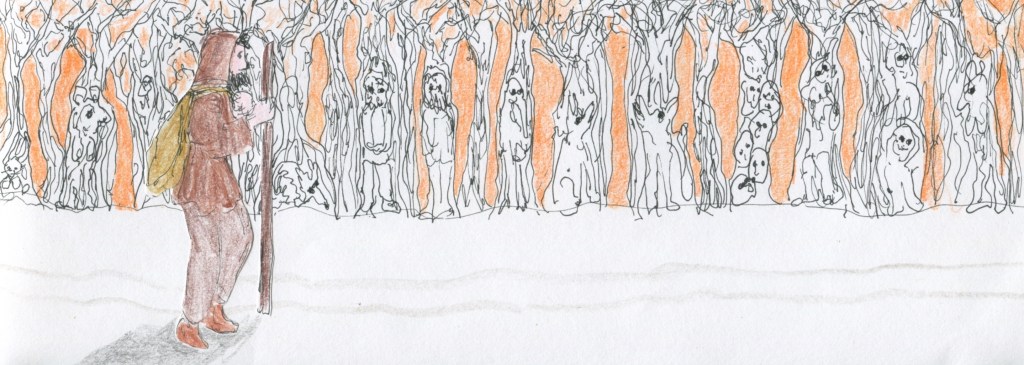
         It is a dark hovel with an earthen floor and no fire though there is the damp smell of decay. Life before must have been long ago. My hair and beard are spread all around me, long and unruly like long dark flickers of corona such as the sun would wear in the total void of fire and light. My covering is a badly scrapped pelt of an unknown beast.        

         Stretching, looking around, I see in the dim light leaking between the covering hides and I know it is nighttime beyond this hovel. 

         I hear night sounds outside, howls of winter wolves, an owl, the critters of wilderness… I’ve probably slept in death for generations. When last I was of earth all of the arts and all of the treasures and all of the voices of people spoke of war. So now I can suppose the wars have come and gone, leaving the earth as nothing at all but a cold, dark wilderness.

         I have human pangs returning, hurts of life, thirst, tiredness, hunger, worry, and always, the Psalmist’s ancient song crying for our distant God. “My God, My God, why have you forsaken me.” [Psalm 22]

         Or am I not forsaken? My prayer is silent. You are with me here, God? Even here? Even now? Please stay close. Thank you for this breath of life. Thank you.

         I am too tired to move… and were I to move, where would I go and what would I do?  I seem to be alone, here wherever here is. As my eyes adjust, I see no sleeping place and no cooking place. This hovel seems not to be a home at all, but a storage cellar. In this dark is a heap of celtic metal works with torques such as a soldier would wear on his neck when his chest is bared for battle – and golden bands for gifting.  I can catch shadows rising here in the center, like ghosts.  Something is hanging down from the center beams…

         Human voices outside, call me awake again.

         “They said you found the pit of the three spies spoken of in the Wrankle journal?”

         An inaudible answer.

         Morning light is pouring in the loose places in the hovel covering where pelts are laid one over the other.

         Now I see what is hanging here from the center poles above me. 

(Continues Tuesday, Nov 5.)

#61.14, Wednesday, Oct. 30, 2024

Historical Setting, 631 C.E. Alehouse near Dorestad
 

         We are at the public board at an alehouse near the marketplace where Greg and Gaillard visited the armor smiths. We are enjoying pots of ale, and now we are served bowls of stew. Gaillard left the table but hasn’t returned and it has been a long while. Greg worries. He goes to find him. Now Greg has not come back here either, and more ale has been served; the stew bowls have been taken away.

         The young man who is the collector of fees, I spoke with earlier, comes to me and tells me I am needed in the stable. I believe this is a robbery and can only hope that Greg and Gaillard are safe. What can I do?  I tell this fellow I have nothing valuable. He doesn’t answer. Now with a dagger at my chin he pushes me behind the stables where I am bound and gagged at dagger point then led on a long walk into darkness climbing the bluff edging the flood plain where a few bare trees are clinging to earth.

         I would expect to see the pagan fires of Samhain on a night such as this. But there are no fires, no ritual, no pagan gods of any kind.  I do feel the closeness though, of the one God who is present, always, with us. Wherever they have taken Greg and Gaillard may the boys feel the warm presence of Spirit this night. My prayer is silent.

         They can see I have nothing to rob. I’m sure they already have Gaillard’s bag of the king’s gold, so this probably isn’t about gold.  Now I see. They have Greg and Gaillard captured and are preparing ropes in the tree limbs. The earth was already wounded with a gapping pit to receive our deaths.  This is not something easily solved by handing over the King’s gold. There is a rope around my neck now. I see on the ground in front of Greg and Gaillard is that last bird they sent, dead, and nearly plucked clean of its feathers. It was intended to warn the Franks of the dangers from the north. Greg calls me his brother and begs for my life. He says I know nothing at all, and his “brother” should be released.

         Two men hold a barrel steady under my feet while a noose is laid around my neck and tied to a tree branch overhead. The barrel rolls from my feet.

(Continues tomorrow)


#61.13, Tuesday, Oct. 29, 2024

Historical Setting, 631 C.E. A public stable at a market in Dorestad

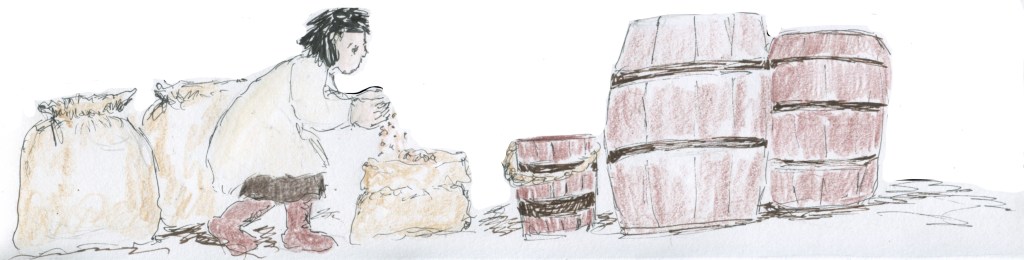
         With the spying complete and the birds let go, we take the horses and the mule to a public stable. The stable hand here is a young fellow sitting at the far end of the first row of stalls. He sees us come in, but he doesn’t seem particularly interested in the stable customers, apparently distracted with his inks. My assignment will be easy, since all I have to do is make sure no one is watching when Gaillard retrieves the sack of the king’s gold from the oat bag on the pack mule.

         Tomorrow, Greg wants to ride directly to the swordsmith on the river, and return to Gaul only with swords from Vlfberht. He complains that the repair to his chain mail was done with an inferior iron ring and he wants a more trusted swordsmith to make the new weapons.

         I take the coins for the stable fee to the man with the inks. He drops our coins in the box by rote habit, without looking up or even counting.  I stand by the little writing bench with this young fellow, still so deep in his writing — surely it is a love letter.

         I ask the prying question, “Is she also literate, that she can read your love letters?”

         Blushing now, he looks up from his work, “It is a journal, the Wrankle Journal.” He shows me a fine book’s binding of blank pages. “Posterity is literate.”

         “So how is it that a stable hand is literate?”

         “I’m not a stable hand. I am the keeper of the count and the collector of the fees.”

         He shows me the tally sheet for the stable business, nothing at all like his finely made journal.  A quick glance, I see he has taken our coins for fees for four beasts, and has marked us as two, which is the number of stalls we are using. It seems a subtle robbery his employer endures to have a literate fee collector.

         I ask him if he was schooled by the monks.

         “My father hired tutors to live in our midst.”

         “You must, yourself, be a nobleman?”

         He doesn’t affirm my assumption.  He just looks up from his writing. He looks right at me, staring in silence — a blankness which says to me, “ask no more questions of this thief.” But it leaves me curious.

         With the beasts in for the night, Gaillard hides the king’s gold, now fastened to his belt under his cloak. We go on to the alehouse.

(Continues tomorrow)

#61.12, Thursday, Oct. 24, 2024

Historical Setting, 631 C.E. The armor markets at Dorestad

         We are at a market for armor and helmets. The overt mission of Greg and Gaillard is to purchase swords and helmets. The covert mission is to listen and learn who is outfitting armies in these times.

         Greg and Gaillard don’t work together. Greg goes to a smithy to negotiate a repair to his byrnie reenforcing a weak link in the mail. While Gaillard studies the displays of helmets available.

         I just watch the artist decorating a helmet. He pounds a thin sheet of copper over a form to make borders that look like a line of braid or a nalbinding of wool. It is as though a helmet for war could pretend to be a warm knit cap made by a mother’s own hand. I watch for hours, as a labyrinth of perfect curves becomes a pair of serpents intertwined, each gripping the other in a fanged reptilian clasp. How close must the enemy be to this helmet to see the terror in this image? I imagine any enemy warrior would need very good eyesight to appreciate these skills.

         As I think about it, I am grateful the boys brought me on this journey with them. I’ve seen things I never would have sought and I actually have learned less of the simplicity in the bleeding howls of wars I complain about ceaselessly, and more of the arts.

         Maybe these bits and pieces of trims for warriors are made to endure the rotting of the grave and are really only intended to speak to the people of the future. Maybe they are intended for the heroes’ burials to keep memories of ancient courage for the mortal earth.

         History is made of bits and pieces of wars turned up in a field by some far future ploughman. But may we not forget, that life of future isn’t just made of relics it comes with generations of loves and losses. Yes, I do still grieve for Ana. Yet, here, in Greg, is her living courage and her smile and her eyes. His whole being affirms her tender guidance. It is how a mother manages our brood is how a good captain manages his men. May a copper-trimmed helmet not be needed to mark his place in time.

         Greg and Gaillard release the bird with the feather marked in blue, to warn of wars to come from the north. The message is, “Beware the Anglos and the Saxons, and know also that the Norsemen are studying war now.”

(Continues Tuesday, Oct. 29)

#61.11, Wednesday, Oct. 23, 2024

Historical Setting, 631 C.E. Dorestad

         We follow until the river reaches the bluff edging the flood plan. From here the Rhine is laid out on the smooth land splitting into branches as a great tree with many limbs. We ride on to the place where these waters meet the sea.

         Here the wild-eyed galleys with their rows of oars and a sail, to boost them, are armed for sea battles. And also, mooring in these waters, are merchant ships, strong in keel–sailing the seas with the depths of their hulls laden with beverages in barrels and chests of treasures from every corner of the wind. The boats that are of most of interest to the spies from Metz have rowers, but hardly a keel for mounting the mast. Gaul has yet to meet the Wends and their cavalry of warriors preparing to arrive at the northern shores in boats with keels for sailing that can also be towed over the land and ice as easily as a currach.

         Here, is a vast market place for all the world to gather and trade. Armorers hawk helmets and shields.  Heavy metals can be forged to breastplates and all varieties of armor offered here.

         As the father of one of these boys my secret wish is that they have full suits of armor—so stout and weighty that once they are fastened in, they will be completely safe and maybe even stifled from moving to fight. I fear they are in danger now from those who watch from the shadows. They only wear the byrnie (suit of mail) and over that, a panel of silk bearing the Frankish mark. Maybe they can resist arrows. But for spies, the piercing would come with the intimacy of the blade.

         We stop to watch an artisan of helmets using standard conical form for the structure then reinforcing it with a cross of metal on the outside of the helmet. It seems not to matter if the helmet is metal or leather it is the same construction. There is a circle of metal work around the edge, catching each end of the cross pieces. The front arm of the cross is extended under the bracing circle to be protection for the nose thus sheltering the eyes as well.  The use of this metal cross design allows a true artist in helmets an opportunity for adding aesthetic decoration.

         “With all this decoration it is not just a utilitarian object of war.” Greg is quick to point that out. If I could see it as art, it might appeal even to an obstinate pacifist.

(Continues tomorrow)

#61.10, Tuesday, Oct. 22, 2024

Historical Setting, 631 C.E. Dorestad

         At this forge, we watch a master smithy and several apprentices at work. No one speaks — neither the smiths nor Greg and Gaillard. And I know better than to speak also. The silence doesn’t mention the king’s gold that is hidden with oats on our pack mule. Silence doesn’t mention the one bird remaining with the blue-dyed feather that will tell the king if the tribes in the north are preparing for war. Silence doesn’t tell us if the master artist and his assistants know of the powerful kingdom of the Franks, rising. And it doesn’t tell us if these artisans know who we are.

         Greg takes a blade in hand, the one here for market that has the simple hilt of a warrior. He feels the weight of it and tests the blade on a leather strap, then returns it to the display. Gaillard studies the charcoal sketches, diagrams of hilts with jewels set into them.

         We leave and go on our way but no more in silence. As we ride along an open roadway following the river with no places for hiding any other army’s spies, Greg and Gaillard are imersed in their rapturous chatter over nothing more than the simple artistry of the smithy. How can they be so enamored by a piece of metal?

         “Let’s just go back now and take him some gold so they can start right away on the king’s swords.”

         Gaillard is always the adult voice of the two of them. “I plan to draw up a design for the jewels on the hilt. And you know, as soon as we open that oat bag and retrieve any of the king’s gold, the watchers, spies and robbers all around us will know we were assigned by the king. I say we go on now to the armor-smiths and buy nothing until we know all we need to know and only after the last bird has been released will we use the gold.”

         “Very well, I will try to wait. Maybe I was smitten by the balance and the heft of that simple warrior’s sword. Maybe you share my whimsy. And I doubt you can wait either.”

         “It’s not like they can’t make another fine sword at that place if that one should be sold. It is the work of that artist that appeals to you, not just that one sword.”

         “But I’m pretty sure I really liked that one sword.”

         Greg has to wait despite his childish impatience.

(Continues tomorrow)


#61.9, Thursday, Oct. 17, 2024

Historical Setting, 631 C.E. Rhineland marketplace

         Greg and Gaillard are including me on their so-called “pleasure” journey to purchase swords as a King’s gift.

         “You’re grieving, still.” Greg notices in my constant kvetching.

         “I suppose so. But always in grief it is one sadness upon another, so now, even my pacifistic nature sets me grieving for wars that haven’t happened yet. They are rumors.”

         “Must you always make it about pacifism? Can’t you see that unfought wars are a source of great wealth for our royalty, thus, with a good king, this kind of preparation for wars that don’t happen is wealth for all the Franks.”

         “I only see the luxury of warfare goes to the kings. It is the common people on both sides of every war, and all of the critters and lands that pay the price.”

         I yammer on, “And didn’t I warn you if you brought me along you would just have to listen to my rants. An obstinate pacifist is who I am.”

         “Who you are, Papa, is obstinate! Pacifism is optional.”

         Gaillard intervenes, “We are coming to the shop of a well-known swordsmith. Maybe the fine art of it could be appreciated even without giving any consideration at all for the tensile strength of the blade.”

         “Making peace between father and son is good too. Thank you, Gaillard.”

         Roman roads still bring us here.  These lands, now risen from the floods, are perceived as trade routes even for far travelers. Even in Egypt, Baltic amber is treasured. So, the old roads with the forever of Rome are still a pathway for horses when they aren’t sinking in the bogs. It is still called the “Amber Road”, not because the roads are made of amber but because that is the treasure trade carries from this place. It is still an important network for trade. All this commerce makes the town of Nijmegen a very good place for the master smiths — the artisans of swords and armor.

         The seller who visited King Dagobert in Paris with these wares brought samples from a particular smith, Vlfberht.[Footnote] We visit that smithy first. He made the swords Greg and Gaillard were sent to purchase. But this journey is really not about walking up to the swordsmith and trading the stash of king’s gold for the swords and helmets. This is about finding out who else is fitting out armies in these times.

[Footnote] https://en.wikipedia.org/wiki/Ulfberht_swords (Retrieved 7-20-24)

(Continues Tuesday, Oct.22)