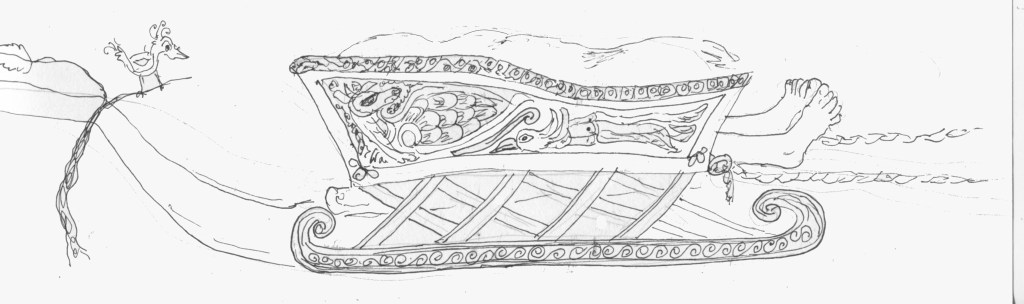
#61.8, Wednesday, Oct. 16, 2024

Historical Setting, 631 C.E. Traveling northward on the Rhine
 

         This next stopover is in another Roman city on the Frankish edge. Here a river crossing with horses can be done with a boat made by the Wends to transport war horses on these northern rivers. Theoretically, these boats can also be carried or dragged over land to the next river. How many of these boats would it take to move an army? Gaillard is figuring that out. An army traveling by river is fast and quiet. [Footnote]

         Each of these two boats ferries two horses and the riders, so dividing ourselves, Greg’s and Gaillard’s horses go with Greg on the first boat, and Gaillard and I and my horse and the pack mule follow.  Gaillard uses this crossing to chat with the oarsmen who aren’t hurried right now, since the heavier boat is ahead of us rowing slowly.  Gaillard spends the whole crossing chatting in small talk about boats – “Small talk” that is actually pointed with lots of little questions of detail for the oarsman. That’s how he’s learned of the portage possibilities for these boats. He’s found people glad to share details, like how the keel is protected when the boat is dragged over land, and how the loading and unloading is quick and quiet.

         By the time all three of us and our horses are on the other side of the river Gaillard knows the Wends are fully prepared to maneuver the rivers with a large army on horseback. And also, he knows the Wends aren’t doing all this preparation just to visit Metz on the Moselle. Greg releases the bird with the yellow feather, and the code for the king says not to worry about the Wends.

         So why all this preparation for wars that aren’t happening?  It is “rumors of wars” that pay for the boats that carry war-horses. It is “rumors of wars” that send the artisans in metalwork to work as the armorer and not the plough-smith. It is the “Rumors of wars” that are the spies’ domain.  This fear of war is the source of riches. But actual wars offer no profit. The riches are found in the rumors and the robbers.  The royal price is paid for fear.

         And with “no fear in love” [I John 4:18] is it any wonder the peaceable garden gate is narrow and yet, welcomes poverty?

         “You seem so grim from your prayers, Papa?”

         “I thought my prayer was silent. I guess listening and looking for that love in all this war stuff must give me a grim face.”

[Footnote] The history of the warring Baltic region, like most histories of Europe, is not as faithfully recorded for English speakers in this early medieval period, but a You-Tube Video, “Wends, the Slavic Pirates that the Vikings Feared” (retrieved 7-20-24) is packed with historic detail, and the source of this information about boatbuilding. Also, the sparse bibliography, and more of this basic information is found at https://en.wikipedia.org/wiki/Wends# (retrieved 7-20-24)

(Continues tomorrow)

#61.7, Tuesday, Oct. 15, 2024

Blog Anniversary, In Memorial

This day is the fifth anniversary of this blog which I started and continue as a memorial to my father, Milton Heitzman, who was born on October 15, 1917. His spiritual presence affirms my blather here. He loved history and reading stories, promising always to write one, but he was busy following that love thread Jesus commanded. He was a wanderer and a mystic, always a pastor, sometimes a father. In the 1950’s he intended to visit every church in the United States, counting every person for the National Council of Churches.  I’ve seen the flyer he left now in many old church archives. My mother, Rosie, was a poet and a very fine artist who left me lots of art supplies. Milt and Rosie died together in a car crash on May 14, 1997.

Historical Setting, 631 C.E. A stopping place in the travels
 

         Greg explains, the three birds will return to Paris with information gleaned by spying. While we seem to pretend ourselves into the roles of travelers from Gaul as our “cover,” it is also who we actually are. Here we visit the ancient life of the Romans, enjoying all the amenities of the baths — the games — a good stretch after the traveling days — the drenching in the waters — the spa — the food and drink. Greg and Gaillard enjoy massage. I’m too recent in grief to allow myself the healing touch of a stranger.

         It will be a good sleep. Except in the privacy of this little room I hear Greg and Gaillard whispering their finds. What have they learned here from small talk with the servants about the other travelers at the marketplace buying swords and armor? Tomorrow the boys will release the first bird with its feathers dyed as code for armies from the East.

         Heraclius’s war against the Persians left those armies beaten three years ago, but now the Persians are rising with a new monotheism driving their religious fervor. The vanguard of their mighty soldier’s visits to armorers, fitting out the army of Allah but for the time being they are only warring in Arabia.

         Three birds are nestled here in the bird box each marked with a different color: yellow for the Wends, the Slavs, our near neighbor; green for the East; and blue for the North. The bird marked with green signals no threat from the East just now. There is no bird for the South since Iberia is already at war with Gaul.

         This morning, the bird is released that signals no worries from the armies against Christ in the East.

         Dear God, are you listening too? Do you see us here traveling to find the swordsmith? Where is the armorer for that unbounded love Jesus taught? I know you embrace the whole world in your love; what more can a prayer ask? It is the human numbness that can strategize warring obliteration and yet we still have no imagination for an all-encompassing love. The creatures we drag to our wars, the birds, the horses, the tinies, the unnoticed critters and growing things, all burn up the same as people do in war fires, and yet you are, for all of us, our breath of life. Why do people choose war and fail to breath? Teach us. Amen.

(Continues tomorrow)

#61.6, Thursday, Oct. 10, 2024

Historical Setting, 631 C.E. The pasture at the farm in the Vosges

         Maybe Inky the cat will miss me. As for my children, I’m just the reminder of their loss. Do they need to be reminded to grieve? As the dark of winter closes in, I know they will remember their mother even if I am off visiting a new land.

         “Thank you, Greg, I appreciate your invitation.”

         The extra horses in the pasture are here for the King’s assignments for soldiers.  Greg says I can have my pick of them. I have an apple in my hand, and here is one that looks at the man who is handing the apple before he sees only the apple and takes it from me. He even offers a little nod of gratitude. How else does a man choose one horse for a journey, from the herd?  I try this horse.  Just riding off in the frosty autumn makes this the best day ever, at least the best thing in this year of grief.

         I ride up to see Brandell and Gaia to borrow their little soldier’s tent.  It is for two, and the two of them shared it on their journey with Vizsla. I kind of have a guess at the sleeping arrangements Greg and Gaillard plan, with a two-person soldier’s tent and an extra person along. So having my own tent will be useful. I borrow an extra oat bag and tethers for this third horse as well. By the time I’m given my instructions from Greg I’m already well-prepared.

         We leave at dawn with the rising sun illuminating a way forward. With three horses and a pack mule, we follow the Moselle to the bend, then we cross through the Vosges to the Rhine. We are able to make good time, even over the hills. In only a few days and we are already at the old Roman Baths of Baden. I’m learning that Greg and Gaillard travel in the style of nobility. When we take the packs from the mule and lead the beasts into the stable there is a groom ready to brush them down and fill the feeding trough with plenty of fresh hay and maybe even some oats. 

         Gaillard secures a small sleeping room where we leave our packs. We’ve carried a large bird box on the mule with three messenger birds in need of food and water at each overnight stop. I ask Greg, why three birds? He reminds me, this is a mission to gather information to send to the King. 

(Continues Tuesday, Oct. 15)

#61.5, Wednesday, Oct. 9, 2024

Historical Setting, 631 C.E. a place where only flowers may grow
 

         Greg and I are here in this place where I have chiseled Ana’s name on a stone to mark the burial of her bones one year ago. Now, our children believe this grieving year is supposed to end. I know it will not. I know grief is always tainting memory. Our children will find their threads of grief are deeply woven into all of life now, even though they assume we grieve no more. They look for hiding places in the depths of their hearts to hide the pangs.

         We are standing here at the wall between that place for flowers and the pastureland for war horses and Greg is telling me his plan.  Greg is seeing the warriors off to Iberia then planning his own journey with Gaillard to a new land rising from the North Sea. 

         “Papa, I just had a wonderful thought!  Why don’t you come along with us to the Rhine River valley? We’ll just be in a new place with a market and alehouses welcoming strangers. We’ll have some new good times for ourselves.”

         He hasn’t thought this through. I ask, “Would you really want to travel with a patriarch mouthing platitudes of pacifism when you are on a journey to buy new swords?”

         He laughs. “Our new swords will be our gratuity from the King for the last mission well-done. In one way it is a celebration. But also, this journey will hide our spy mission. And for that, we can use your help. It is the work of keeping peace in our land.”

         “How does spying keep peace? It could be a tool for making strategies for wars.”

         “It is you, Papa, who tells us wars are made of empty rumors and lies that turn one God beloved people against another — never winning — always wounding.”

         “You’ve listened to my tirades?”

         “Of course, I listened and I always listen.  Our assignment from the King is to go to the market place for armor and to listen — listen to the hopes and fears of various tribes and peoples all spread out in the open in the tavern talk. We can be the first to hear the rumors and lies that set neighbors at war.”

         It’s tempting to imagine a new journey just now. This season doesn’t require an extra man for the farm work. And I’m the only man here who sleeps alone, with only a cat to warm my bed.

(Continues tomorrow)


#61.4, Tuesday, Oct. 8, 2024

Historical Setting, 631 C.E. the family farm in the Vosges

         Greg is explaining a perspective of a world that can be laid out on a table as a sheet of velum, marked with strategies in doted lines. It has X’s for various peoples distinguishing one from another with color codes for possible enemies — “others.”  He tells me the King is cautiously regarding the growing powers of the Wends who are Slavs. Then new concerns for the Avars here at our eastern boundary now that the Persian wars in the east are not roiling. Also, amid the rumors of wars are the intrusions by the Angles, and the Saxons. And who knows what others are waiting on the edge of the map to swoop down on the north winds in the dark of night and burn our houses and fields?

         “What are you assigned to do about the dangers?” I ask him.

         “While the Burgundian soldiers are off with all these horses and mules, Gaillard and I will be traveling east to the valley of the Rhine. An artisan, an armorer, sent a messenger with swords samples. This marketer told the King tales of a flood, as great as in the days of Noah, or maybe even as great as the flood Gilgamesh faced when floods covered the whole earth. And now the forty days and forty nights have passed or was it forty years, and people have gone into that place where the river runs into the sea to make a great trading center for all the soldiers of the world to come and buy their arms.” [Footnote]

         The pack-load for soldiers is weighty when the byrnie for saving the soldier is added to the weight of weapons. A soldier wears that weighty byrnie made of links of chain to cover him nearly to the knees. That isn’t warm and wooly like a gambeson. Trimmings for the battle itself require a shield, a helmet, and a breastplate. To outfit an army, then send them on a long journey across all of Gaul requires the wealth of a king. And add to that the need to move an army from Burgundy to Iberia with so many horses and mules. 

         While the King’s men march into war to the south, Greg and Gaillard will go east on a covert mission to learn which kingdoms are purchasing arms. The cover for the spy mission is to purchase new swords. Greg and Gaillard are being sent to gather information for the King.

[Footnote] How could this blogger forfeit this moment seeking a truth? Among the Rhineland lowlands with flooding ending mid-7th Century, traces of metal works and trade with Mediterranean artifacts have been identified in this region. https//:www.Scientedirect.com/science/article/abs/pii/S2352409x23411x  Journal of Archeological Science: Reports Vol. 53, Feb. 2024 104236 (Retrieved, Feb. 7, 2024)

(Continues tomorrow)


#61.3, Thursday, Oct. 3, 2024

Historical Setting, 631 C.E. the family farm in the Vosges

         This morning more horses were delivered to the pastures and I asked one of the young soldiers, who was it who ordered this.  Of course, he names “Captain Greg.” I asked if this was preparation for a military operation or for escorting a journey of dignitaries. The soldiers with orders from Greg were probably not privy to such information and I know they wouldn’t be allowed to tell me even if they knew.  I will have to wait to hear it from Greg himself. There are mules for packing for a journey and here are some large and powerful war horses amid the geldings and trail horses.

         It is no secret that Greg and Gaillard will arrive here soon making their preparations for whatever it is that is happening. Haberd’s wife is baking extra, and Haberd and young Sam are walking among the sheep choosing a beast to butcher for a feast.

         Greg and Gaillard arrive with no entourage, just the two of them on their own horses as they always come home for these stopovers. We haven’t seen them since Ana’s death, so it’s been a while.

         “Do we have a war coming?” I ask.

         Greg knows I’m not a loyal patriot wishing our “side” lots of “wins.” He knows this papa is a stubborn pacifist. He answers tactfully.

         “The war is not here and it isn’t even our assigned mission this time.   Dagobert is in a Frankish dispute in Iberia at the distant edge of Gaul.”

         “Then why are the war horses here in Burgundy?”

         “King Dagobert knows something of military might and he sees that Burgundy has the best military. He is right, you know.”

         I know any other papa would be so proud of this son. But I only want to hear of his great works in taking charity to the needy and words of peace to a would-be enemy.

         “So” I surmise, “the king is sending the military of Burgundy all the way beyond the Pyrenees to the far ends of earth for battle?  Why not call up the army of Aquitaine?”

         “Because the soldiers of Burgundy will win the war.  But Gaillard and I aren’t assigned to that war. With our military elsewhere it would be an opportune time for the tribes to the east to rally against Metz. The Wends are on their haunches showing their fangs just now, not to mention the intrusions of the Anglos and the Saxons in the East.”

(Continues Tuesday, Oct. 8)

#61.2, Wednesday, Oct. 2, 2024

Historical Setting, 631 C.E. The loft of the Creek Cottage
 

Everyone tries to fix grief.  I know they miss their mother and grief is not mine alone splayed out here for their mending. But, like an old wear-softened tunic, grieving should be worn underneath everything now, always close and always present, but best kept hidden under the new garments.  Old clothes to rags, new fabrics stitched for wearing – continual change is the one thing that never changes.  Only those who grieve for the once-was, ever seem to notice the loss. Mostly, everyone celebrates the new, the new song, the new fabric, the new wins of wars, the new king.

         Dagobert is popular, even though in the usual Merovingian power shake up, Metz was not assigned a new mayor after the death of Warnachar a few years ago.  Instead, Dagobert, ruling Nuestra, moved the court for Burgundy to Luxeuil, maybe a move to empower bishops. Leudegar was raised to the see of Autin. Obviously, empowering nobility through Church office just goes on, even with a more powerful King over Nuestra. [Footnote] Probably, only a few of us are disappointed in that. 

         So, what becomes of the old nobility of Metz? There is no power vacuum. Greg and Gaillard are officers in an ever more powerful military now of Burgundy. I expect the boys will be back here very soon. Military horses have been delivered to Haberd’s pastures.  Something is afoot.  More soldiers always become more people grieving.  Wars may sort out old and new, and good and bad, the weak and strong, but always people grieve.  Why do we fear the crab when there are so many ways of destruction at human hands just by choosing war?

         Inky the cat is a big fellow now. He makes a weighty warmth on the covers of Ana’s place in our bed. But I should be finding my own place in the sleeping loft now, so that Hannah and Vizsla can have a proper bed.  Maybe the child Hannah is carrying will be a daughter too.  Daughters are good.

         Tonight, I can’t sleep well. I’ve put this new straw tick in the loft. It might take some getting used to. Apparently Inky found the bed down there crowded with Vizsla and Hannah. When it was Ana and I, he didn’t seem to mind the crowd, and slept right there on the wool blanket.

         Here he is now. It is good that he came up here with me. He is warm and living, purring softly…

[Footnote] Fouracre, Paul and Richard A. Gerberding, Late Merovingian France: history and hagiograghy, 640-720, pp 14-15.from materials noted to be Fredegar’s Chronicales, IV

(Continues tomorrow)

#61.1, Tuesday, Oct. 1, 2024

Historical Setting, 630 C.E. a place where only flowers may grow
 

         The anniversary of a loss is always hard.  Practice doesn’t make grief perfect. There is no perfect grief. It is always soaked in tears and etched with markings of “should haves” and “could haves.” Even with a death by cancer to a woman who understood the warning and the threat and brought us through it, we still grieve. Even when she gifted us all, who loved her, with time for our good-byes, we still grieve.

         I know our children and their spouses and our grandchildren see me here at this named stone and they know I keep no secret of my grief. So, whenever I expect no one is worrying over it, I slip away to come up here on this hill where only flowers grow. I feel a closeness with Ana in the quietude of prayer. Somewhere in the Spirit, in the wide love of God the love we had together all through those years, she still lingers.  I don’t even try to sort out the differences of new thoughts of her from the memories. If anyone asks, I say I am keeping memories. If no one asks it’s just good thoughts.

         I brought with me the ash root harp that has been passed through our family and now just strum a song that Ana played on her clay flute.  In those days we played and sang this – and there was always a place in that song that didn’t have a note hole on her flute. She always filled the hollow spot with a giggle, and I sang that note alone.  Maybe I miss the giggle of the missing note most now. But playing the song again seems fine.

         Now Brandell has come here with his Kithara.

         “Papa, do you want to play some music together?”

         “I was just remembering an old song. We used to sing it when you were so little. You probably don’t remember it.”

          Brandell remembers and plays every note with none missing. There is nothing ever missing when he plays. We play it straight through, and there is no one to giggle through the empty parts.

         “That’s a very old song now. And I have some new ones. This is one Gaia likes.” And he plays a beautiful song.

         “I can understand why Gaia would like it.”

         I know he came here to mend my grief. “Later, now Ana, I will send the old song off again, for the heavens to hear. Giggle boldly then, my love. I won’t forget.”

(Continues tomorrow)

#60.12, Thursday, Sept. 26, 2024

Historical Setting, 629 C.E. Creek House in the Vosges Mts.

         A precious generation of our own lives is lost when an illness robs us of old age. Ana argues her wish to keep the cat when Hannah offers to relieve her mother of the stress of caring for Inky. Apparently, Hannah thinks this cat was dumped on her mother at a time when Ana’s own need was what should be central. Maybe Hannah expected her mother to sit on a bench all day and do nothing.

         “Hannah, the circumstances of our own family left you with no grandparents in our household, so how would you know aging is not simply a bad health condition, but it is like all other stages of life? It comes in many different ways to different people.”

         “So,” Hannah asks, “you are saying that all the old ladies who claim they need cats may not be practicing witchcraft?”

         “Do I need to say that?”

         “What is it you are trying to tell me, Momma?”

         “I’m telling you watch and learn, dear child. When you find your golden tresses are white, and your fingers too stiff to manage the blade or even wind a spindle, or perhaps it will be your eyes that dim, or perhaps no affliction will come to you except your children will think you too old to feed a cat, then you will remember sitting and staring at nothing is not the only option for the aged. True it may be that standing up from the bench is slower, and staring isn’t at nothing, rather at things never noticed before. And a cat that chooses the warmth of your lap is a lovely gift. It’s purring song is more of touch than hearing. Beautiful is the cat.”

         That hidden eight-legged sea monster, cancer, creeps through Ana’s body. No one knows how or when it will rise up and swallow a whole ship with a beloved soul. All of these physicians, Vizsla, Hannah and Ana herself, all know the tragic pattern in this. What is the experience of it: Terror? Courage? Ignorance?

         Maybe we have all of them.

         Dear God, we journey across a calm and beautiful sea ever toward the horizon, never knowing an ending, just a continuing. Help us to unwind the terrors and the fears into a simpler splaying of monster parts: here a fang and there a claw. May we let them pass, and escape from fears one by one. Give us courage, not born in ignorance, but in love, beauty, peace, whatever we can find of your hand always reaching to out us.

(Continues Tuesday, October 1)

#60.11, Wednesday, Sept. 25, 2024

Historical Setting, 629 C.E. Creek House in the Vosges Mts.
 

         Vizsla would be much more at ease with a building project if he were told to use a surgeon’s blade. He is clearly befuddled by the ax.  The first tree he chased down wasn’t felled so much as wounded, tenderly, so there wouldn’t be a scar. I made a joke about his fine surgical technique and then I asked what tool he preferred for cutting wood. He said he doesn’t chop living things, he “gathers” firewood. He never slaughters trees. But he seems a fast learner. He’s gone from barely scraping the tree to raising up the ax overhead gripped in a two-handed hold, then bringing it down onto the earth near the tree with the power of Zeus. Three whacks like this, and the tree would be down, if the ax were to actually touch the tree.  But the earth still reverberates and surely any bears in the wood have gone into hiding. Maybe he can refine his technique so that this loft-build can proceed.

         Harvesting the beams may not be Vizsla’s specialty, but planing the wood floor planks is.  He splits and smooths the logs, then planes them clean, quickly and efficiently while I prepare the ladder.

         It isn’t two day’s more work and two nights of crowded sleep before Vizsla and Hannah have a proper place in a loft under our roof.  But he does sleep noisy.

         From a vantage point of timelessness, I see the spanning of lifetimes. People come to us in generations finding themselves to be children and believing that those who are not children are a different species altogether. Then each fumbles from child to teen, believing always, childhood is someone else it never could have been who I am. And always, out there is that constant older person. The grandpapas and the ancient mothers of moms seem to be the never changing vestiges of aging. They are nothing to do with us, youngers, but for our names. When we turn generations into “others” in the same way we make strange tribes into “others” for warring, we make ourselves our own enemy of who we will inevitably become if we are gifted with long life.

         In youth, the same person who grows old, has heaped upon the image of aging all of the infirmities of all oldness en masse. Oldness is stiff knees, weak eyes, deaf ears, mindless syllables, memories of forgetfulness, creeping spiders of darkness, … every collection of woes. No child would claim it could become her. But…

(Continues tomorrow)