#74.10 Tuesday, November 25, 2025

Historical Setting: Jarrow, 793 C.E.

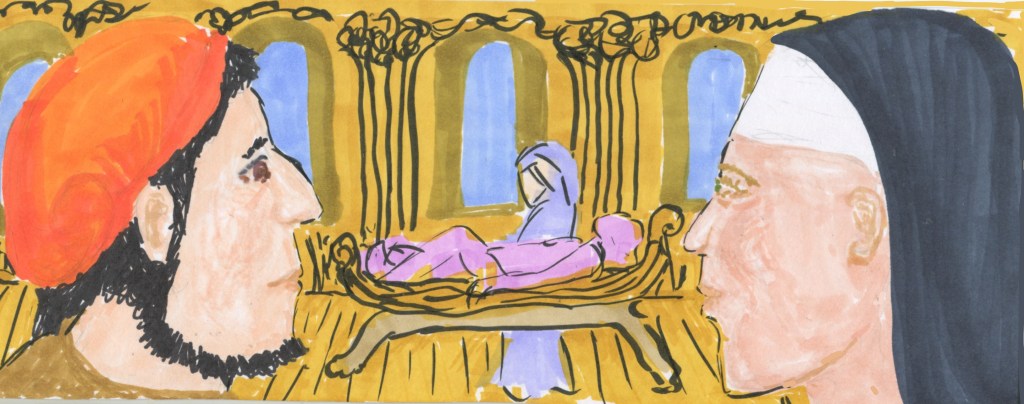
         A technique to practice love in the work of learning to love God and neighbor and self, and even love for “enemy” is a technique of working through words of fear and hate, then widening the disparaging words to be positive words.  This exercise doesn’t pretend love, rather it discovers honest love through more complete understanding.

         1. The first step is easy: name the narrow angry hate words — those adjectives of blame and hurt that define the enemy and make the unlovable “other” appear as evil. Afterall, enemies are made of words — hostile; hurtful; greedy; lying; snooty; deceitful… hate words are everywhere. They are narrow and definitive.

         2.  A word cloud expands and broadens the narrow word. “Greedy” can  be said as “selfish” “inconsiderate of others” or maybe even “needy.” This expanding collection of synonyms widens in all directions, even into empathetic understanding like “needy.”

         3. Grab onto this thread of understanding, and when the reach for love emerges the pattern of escalating hatred loses power.

         When “needy” is a wider word for “greedy,” “the need” offers an opening to understand and care for an enemy. Perceiving the “greedy” as “empty” “longing” “needy” “grasping at anything to fill his void” “starved” “hollow.” Compassion for the suffering nature of greed emerges from the wider words until it becomes possible that honest love can overwhelm the hate. So, this one labeled, “enemy” mostly needs to share my pot of porridge with me.  Maybe he doesn’t even know that; but I know it.

         “Dear beloved enemy, come and eat with me.”

         And so I offer him the nourishment over and over again, until he sits at my table.

         This tool, widening the hate words into understanding realizes the Jesus command to “love neighbors as self.” It even works for the loving of self. In this way it is honestly acceptable to know that God loves me. It takes practice. Loving and being loved is a truth and not a hollow aspiration demanded in fear of judgment. Love is asked of all of us by God who is love. This tool for broadening hate words to caring, widens the possibility. It is actual love, not just an “ought to.” Love of self and others makes real the relationship with God who is love.

         The love sermon is still a hard one because the simplicity ignores and over powers the fearsome control of hatred.  No wonder the Romans crucified Jesus. They just couldn’t bear the love.

(Continues tomorrow)

#74.9 Thursday, November 20, 2025

Historical Setting: Jarrow, 793 C.E.

         Both styles of monks, the Irish and the Roman, are beloved by God. And maybe God answers the argument when a monk from the Roman Rule happens to lose his hair without even shaving it, but only in the front, giving this Roman Christian the Irish tonsure. And the Irish monk goes bald in the top, back of his head, so any hair he may have seems to be a crown. Our Creator judges with humor.

         This little joke told by nature in the ways men loose hair is an earthly metaphor for a heavenly truth. It is possible for a thoughtful, prayerful person to learn empathy for another they might deem as enemy, or more lightly, unlikable. This intentional thought pattern can offer an honest window on fearless love.

         Here, I am visiting a monastery staying in cell for travelers, in a less than hallowed hall of this community. Just outside this door I hear two novices dredging up old secular hates.

         “Arrogance! That’s what it takes to copy off my tablet then lay it before Brother Cowen and claim it was your own thought, Brother!”

         “Who’s to say it wasn’t my thought also? Obviously, my work was superior, with each letter perfect and nothing overwritten or scraped off as was yours. I handed our teacher a far better display of writing.”

         “May your demon friends curse your whole deceitful tribe!”

         As a stranger here, I don’t know what to make of these people. There may be a deep animosity already between them. Apparently, one novice had reason to call the other “arrogant and deceitful.” And the other eluded to the first fellow’s imperfections — poor lettering and strikeovers. Only God can intrude with the missing love here. And maybe one day these two novices will be brothers together and will find that love.

         But there are ways to find human understanding that releases the hurt, prayerfully, relentlessly begging for the power of love. One way I find for understanding is an intentional technique for widening narrow words of hate. The hate words between the novices, “arrogant” and “deceitful,” are narrow and negative apparently drawn from a history of tribal hatred.  But by searching for synonyms for these rigid hate words, little glimpses of understanding can emerge. “Arrogance” is a neediness and “deceitful” longs for forgiveness. There can be a wedge of understanding instead of rehearsed, on-going hatred. Actually, even this word “hate” widens into the word “fear” and “perfect love casts out fear.” [I John 4:18]

(Continues Tuesday, November 25)

#74.8 Wednesday, November 19, 2025

Historical Setting: Jarrow, 793 C.E.
 

         I’ve come to Jarrow following my own curiosity about what I, as a mere lay person, judge as wrong-headed. Obedience to the papal edict is demanded when it is actually the voice of God that calls us in the dark of night.

         I came here to argue against Bede’s historical writings that barely excuses the Irish founders of Lindisfarne for holding on to the traditions of Celtic Christianity. What I found here, visiting this library is Bede’s student, Brother Wilbert, still grieving for his beloved teacher. He is telling me of Bede’s life, while I came, only to measure Bede by his judgmental verbiage in his history of the neighboring community.

         My hackles, were I a bird or a wolf with actual hackles, are riled up whenever I read this style of religious authoritarianism, calling one with different traditions an “open adversary of the truth.” [Footnote] Judging  each little external difference of religious practice as divisive among Christians. Yet, here I am, judging the judge. I came here looking for an argument, but I found a human person in Bede simply doing his best to straddle the line between the voice of God calling him in the darkness and the obedience to the religious head, a pope. He would never even meet the pope. For Bede, the pope was mythical — more than mortal human —acclaimed to be infallible. I came to find Bede, an imagined adversary, and now I find a better understanding of Bede, the person.  The mysterious Jesus way of love washes over diminishing narrow divisions, not with better rules and stricter obedience, but with a simple, broader understanding.

         The monk with the Irish tonsure, with shaven forehead back to a line center from ear to ear, looks at the tonsure of the Roman Christian monk, and judges that the little circle of hair he wears as a crown, as a prideful flaunting of royalty. Then the monk with the crown looks at the Irish tonsure, and judges that man flawed, disobedient and unwilling to wear Christ’s crown of thorns. So where is God in all this so-called “truth”?

         I only see with human eyes, but God sees from the vantage point of Creator, all-loving.

         Dear God, grant me a wider view of your own beloved “others.”  Amen.

[Footnote] Bede, Ecclesiastical History of the English Oxford University Press.  pp 153

(Continues tomorrow)

#74.7 Tuesday, November 18, 2025

Historical Setting: Jarrow, 793 C.E.

         Perhaps Samuel, in particular, caught Bede’s interest as he, like Samuel, was dedicated to the priests at a young age.

         Samuel, whose mother, Hannah, gave him to the temple priest to fulfill her promise to dedicate her child to serve God. As young Bede served Ceolfrith, young Samuel also served an elderly priest, Eli.

         My own house with children was a simple house with few rooms, and a sleeping child is near enough that he can call out in the night for his mother, and my wife or, at times, I would go to him and take him in my arms to comfort him, wipe away his tears and promise the sun will rise again on a new day.

         But in this story, young Samuel awakens alone in the darkness, and he is the one called from sleep with no parent answering, comforting, he stumbles through the darkness alone to answer the summons of the blind old priest and finds Eli still snoring. The child touches him to ask what he needs.  He awakens, probably annoyed at first, then aware of the child asking him what he needs. Why did Eli call him?

         “I didn’t call you. Go back to bed.”

         I expect little Samuel goes back to that strange dark room again that echoes the emptiness, maybe thinking of his own mother, who we know from the story was also thinking of him. Every year she made him a new little robe to wear in these cold dark times. That was what she could do when she couldn’t rock him in her arms and sing promises of morning to him throughout each dark night.

         He was probably less able to fall asleep again, when he very clearly heard that priestly voice once more calling his name. Again, he went to the old man’s bedside. And again, he awakened Eli and asked what he needed. This time, the old man realized that the child was answering someone.  The old priest told little Samuel to listen to the voice of God calling him in the night.

         Surely, Bede’s commentary on I Samuel was impacted by his own relationship as the once small child, serving the Abbot Ceolfrith, answering the call, himself. Bede was at work on his commentary on Samuel when he was so deeply pierced by the accusation of heresy, and Ceolfrith was no longer available to answer his fears.

(Continues tomorrow)

#74.6 Thursday, November 13, 2025

Historical Setting: Jarrow, 793 C.E.

         I stand before the book stand that holds Bede’s ecclesiastical history, considering eschatology or thoughts of end times as a circle. History tries to be linear with a beginning and an end, a head and a tail, as a line, with only an untapped option to circle for eternity, biting its own tail. 

         Notions of end times are, by the mortal nature of living beings, always just guesses. Whether creative guessing or hypothetical calculation with the guesswork in the premise, the imaginary begs for validation in reality. Prophets of end times can never say, “see I was right after-all” because if end times are an end, there is no after-all. There is no need for fact, only for followers of the prognosticators. [Footnote 1]

         This becomes significant for Bede and his writings because he had to answer to a critic, Plegwin, accusing him of the heresy of putting Christ in the end times, and not in the linear now, in the argued calculation for “the sixth age” (which is the now). To Bede, historian who looks to papal decree for the facts of calculating epochs of history, his critic’s accusation of the heresy of getting Christ in the wrong epoch must have been devastating. That’s what happened. He answered the accusation of heresy with a letter. [Footnote 2]

         Heresy, or unfounded here-say, would be a horrific charge for anyone who names every opinion as either righteous or flawed depending on its source. If a pope said it, it is infallible. If it was spoken by a monk with an Irish haircut, it can’t be trusted. How then, does Bede hear God speaking? And how is he a trusted authority on God’s truth?

         The old man who once sat with Bede at his death comes back now to further guide my understanding of his mentor. I thought Wilbert’s intentions were to instruct me on the proper reading of the Venerable Bede, but actually, he wants someone to be an interested visitor who will listen to his own reminiscences of his saint. Maybe he doesn’t even mean to pester me by defending the writings.

         Wilbert says, “Bede’s teacher was Abbot Ceolfrith. This first abbot at the founding of Jarrow was Bede’s guardian and teacher from childhood, on through this crisis over an accusation of heresy. In Bede’s commentary on I Samuel he references the departure of Ceolfrith, considering his own first childhood teachers.”

[Footnote 1:]  https://en.wikipedia.org/wiki/Six_Ages_of_the_World

Retrieved: 5-8-25

[Footnote2:] https://blogs.bl.uk/digitisedmanuscripts/2018/05/the-real-venerable-bede.html  “The accuser claimed that in Bede’s Chronica Minora, he denied that Christ had lived in the sixth age of the word, as was commonly believed. Instead, Bede argued that Christ had lived in the seventh age. In the letter to Plegwin, Bede wrote: ‘If I had denied that Christ had come, how could I be a priest in Christ’s Church?’ (translated by F. Wallis, Bede: The Reckoning of Time, p. 405).”

Retrieved 2-20-25

(Continues Tuesday, November 18)

#74.5 Wednesday, November 12, 2025

Historical Setting: Jarrow, 793 C.E.

         My thoughts stray from Bede’s commentary on the history of Church among the Anglia. He wrote in a room with narrow walls. I was expecting to find in this history of the Lindisfarne the actual beating heart and spiritual energy of the creation of that community. It was stolen from them in the deaths of its monks and burials in the earth with saints sharing their earth space with sinners and this driving love force was overlooked in the history of the politics of rule and obedience.

         Dear God, is it all vanity to look for you in the closed circles of eternal repetition? Recently I’ve been gathering stones together with the survivors of Lindisfarne.  And they were chiseling a gravestone with a raw circle for sun and a raw arc for moon where time is measured against notions of a doomsday. It’s an eternity of wandering paths in a labyrinth, circles within circles and the other way around again, longing for clarity but not for conclusion.

         I’ve also been to the casting away. I’ve been to death and back again. In the sorrow lies the promise of joy. In the cruelty of greed, lies the promise of empathy, lifting up the lowly. Time is measured in the repetitious pattern of circles — the tail grabbing. Help me, guide me, release me from the futility of circle into to the vast unknowable eternity of Creative Love. With each circle expanding we find an eternal newness in pattern, restoring, resurrecting from earth stuff to life stuff to unstuffed spirit. Guide me, let me walk the labyrinth free of stagnation that confines imagination. Amen.

         Is it a longing or an observation: eschatological time, or the “end times” or “doomsday” or “the seventh and the eighth ages of the world or Word or “Ragnarök” which can never be now. It always must be then, and never visited by the living. If God speaks of it, human discernment of those utterances are as deeply personal and subjective as any mystical encounter. It isn’t actual prophecy. Time in human understanding is linear. Eternity is circular. This is a very ancient wisdom. In time, one thing happens after, or before another. But in a circular pattern of eternity the now is also the then, and maybe it is a present fullness, not so much an after and done kind of event — a circle — the endless tail grab. Always, by its very nature, the eschaton is unknown and unknowable. It is a page un-written.

(Continues tomorrow)

#74.4 Tuesday, November 11, 2025

Historical Setting: Jarrow, 793 C.E.

         Now, as I contemplate my own motives for searching Bede’s writings, I find myself clinging to the losing side in a petty debate over haircuts and calendar calculations. I’m still arguing matters of political opinion while I claim my reasons for studying Bede are purely for learning the history.

         The thing the Vikings didn’t steal from Lindisfarne was the Gospel. In another time, the same as this time, a monk inked each letter of St. Jerome’s translation of the familiar words “in the beginning was the Word, and the Word was …” and the contemplation of Word put that monk’s mesmerized spiritual state at work on the page marked with the grid of dots awaiting illumination. Dots and dots were laid out for guiding the wandering inks into a maze of creatures, patterns of human labyrinth, an uncountable continuous pattern of circles of birds with folded wings and grid-dot eyes, with their beaks grasping tails in an eternal grounding of more circles than could become a cross if a cross could be of circles.

         When I read Bede’s ecclesiastical history it is the frustrating sameness of politics– flightless birds grabbing their own tails in eternal repetitions. The serpent politics is always taking superficial issues like hairstyle and calendar days to chop up the universal holy love of God. There was this slicing and dicing into a threesome, the human concept of one God who is eternally beyond human comprehension, and setting anyone outside the law who doesn’t conform to the edict that attempted to define God. The relentless repetition of tail biting makes ancient circles of eternity. It is the Ouroboros. [Footnote]

         It wasn’t the Viking raid, as earth time was nearing the 9th century, that made Lindisfarne the vanguard of Doomsday. This notion of Ragnarök (a legendary end of times from Norse tradition) was woven into the art of the gospel inked at Lindisfarne well before the raid.

         Our human approach to the ouroboros is as we read Ecclesiastes. With each event of human existence offered as a time — “a time to reap and a time to sow, a time we may embrace, and a time to refrain from embracing,” [Ecclesiastes 3:1-8] with all these cycles perceived as “vanity,” is a human pointlessness, futility, observed by the poet. But there is a human point of view, and from this viewpoint a time of sorrow also promises a time of joy. Therefore, in the bliss of joy, there is always that sorrow when the circle turns again.

Footnote: https://www.petmd.com/reptile/conditions/behavioral/ouroboros-snake-bites-its-own-tail

retrieved 3-10-25

An article by Nick Keppler explains the legend of the tail-eating serpent, the Ouroboros in many cultures from ancient times. One is Norse mythology, the serpent is Jörmungandr, an enormous sea beast and one of the monstrous children of the god Loki; a being so large it encircles the whole world, holding its tail in its mouth. One day, prophecy says, it will release its tail from its mouth and rise from the ocean depths to harken Ragnarök—the end, and rebirth, of earth.

This is posted on PetMD.com along with articles like “How to tell if your lizard is sick” and “How much do turtles cost” including ads for reptile creams to sooth an itchy tail.

(Continues tomorrow)

#74.3 Thursday, November 6, 2025

Historical Setting: Jarrow, 793 C.E.

         I have a personal stake in this history, because, in all my years, I’ve felt the sense of belonging in monastic communities before there was a Benedictine Rule at Tours and at Ligugé. Then my need for community for sharing faith was met with the Irish missionary, Columbanus, who eventually established eight monasteries throughout Burgandy and the Italian Alps.

         St. Columbanus finally accepted the Benedictine tonsure and the Roman Rule for the Easter date as a concession for the blending of rules to include things that he felt were more essential to the depths of faith than hairstyle. For example, for Columbanus, obedience to God was first and foremost, over the obedience to the human hierarchy of Church.

         This is where the time-freeze of Bede’s writing frustrates me. In a world where scribes and authors pay homage to saints with fantastic stories of miracles and signs, the historical record of political controversies also becomes tainted with subjective opinions.  I call them subjective opinions, but when an opinion is accepted as fact, even wars can arise over seemingly meaningless differences. Opinion serves people better in debate where all sides are said with the fulcrum of the balance posting the resolution.

         Bede mentions the Arian controversy, not a controversy in these times. It was said to be settled once and for all at the Council of Nicaea in 325 when it was made official that God came in three parts. Trinity perfectly suited Christians, newly received from paganism where many gods do seem to rule. It also offered a decisive explanation made of functional human words, which, to the rising earthly emperor, Constantine, was a perfectly reasonable way to explain an invisible God with an unspeakable name. 

         Well, actually it was settled again and again and not really once and for all even at the Council of Chalcedon in 451, when nuances of the relationship of “Father” and “Son” seemed a worthy reason for clobbering unbelievers with wars. The wrong-headed, or losers in the wars that followed, divided people who were all nurtured in the teachings of Jesus, into the righteous and the flat-out wrong. Arians were the wrong, because they followed the wrong guy at the Council of Nicaea, and Arians didn’t accept the interpretation ruled by the “one universal Church.” Arians were anathema, and viewed as worse than pagan.  Since it was the Church that owned the vellum, the Church’s edicts of righteousness became facts of history.

(Continues Tuesday, November 11)


#74.2 Wednesday, November 5, 2025

Historical Setting: Jarrow, 793 C.E.

         Bede lived his life in the monastery confined by walls with books as his window on the world. His doorways were the travelers to and from Rome as he always kept current with papal decree and edict. He valued the pope’s intention to bring unity to the whole wide Church. Bede put the highest priority on papal rule, which I suppose is how a child nurtured in monastic Rule, once designed to fill the void of parental guidance, would grow. “Truth” [Footnote1]  as Bede called the pope’s proclamation of a proper date for Easter, was not simply a choice to make among human traditions; but this date for Easter was a defining foundation stone of “righteousness.”

         The first chapters weren’t tainted by his personal judgement, since they had the objective distance of time. He named ancient traditions and Roman rulers over these islands, including Ireland. Ireland was never Roman but it was Christian. Even the grasses of Ireland sprout Trinitarian.  So, in times when the sorting of peoples as Christian or heretic based on acceptance of the Trinity, the Irish were clearly not the heretics. But in matters of monastic rule, where the Irish and the English differed, as in the tonsures of monks and the calendar date for celebrating Easter, Bede’s words are flavored with his own Roman warp.

         Aiden, the founding first bishop of Lindisfarne, came to Northumbria with the Celtic Rule. But his supposed erroneous observance of the Easter date was “patiently tolerated” while he was alive, “because” as Bede said, “they had clearly understood that although he could not keep Easter otherwise because of the manner of those who had sent him, he nevertheless laboured diligently to practice the words of faith, piety, and love, which is the mark of all the saints. He was therefore deservedly loved by all, including those who had other views about Easter.” [Footnote 2]

         So, Bede’s grace toward Aiden didn’t extend to his successors, also from Iona with the Irish tradition. This apparently had gone too far when the King had Easter one day, and the Celtic Queen on another.

         He spent a whole chapter of his Ecclesiastical History on these lurid details of Lindisfarne’s sin. [Footnote 3]

            My own opinion, this was not without his personal bias.

[Footnote1] Bede Ecclesiastical History of the English Oxford University Press. Book III, 25 pp.153

[Footnote 2] Ibid.

[Footnote 3] Ibid.

(Continues tomorrow)

#74.1 Tuesday, November 4, 2025

Historical Setting: Jarrow, 793 C.E.

         I came to Jarrow for this library known to have a notable collection of books including the works of Bede. Bede was a scholar who had lived here since childhood, now revered by the patrons of Lindisfarne for his Ecclesiastical History of the English People. Wilbert, the now elderly student of Bede, once served him as a scribe. He attended Bede at his death. Today, Wilbert oversees this library and has taken me aside into this anteroom, because of my interest in the collection of Bede’s works. [Footnote]

         I came here because I’d heard so much talk at Lindisfarne. The clergy and lay who went back after the Viking raid carried their grief on a sin-seeking pilgrimage. If God allowed ravage and plunder of a monastery how could anyone be safe? Alcuin’s letter offered best practices for avoiding sin and its consequences but not much practical advice about avoiding Vikings.

         I’ve seen both the greed of the Norsemen and the display of wealth by the Christians so Alcuin’s emphasis on the material displays of wealth as “sin,” in a pragmatic way, is some protection against greedy pagans. His letter is being read aloud now for the very audience he intended. They came looking for sins of others, to place the blame for God’s wrath somewhere beyond themselves.

         The survivors arrived with all their rumors and small talk about Lindisfarne’s sin in burying a sinner among the saints, and Alcuin’s letter simply ignored that. He mentioned their own greed and warned these rich patrons, uncomfortably, against flaunting that wealth. Still, they persisted at laying the blame elsewhere. They were reviewing the old controversy over the proper date for Easter. Some believed that Lindisfarne was always on the wrong side of that one because it was founded by the Irish from Iona.

         For me, this is personal, so I’ve come to Jarrow to explore the root of the revival of this old controversy. In another time and place I was a follower of the Irish hermit, Columbanus who came to Gaul with a small band of monks and started communities at Anngray then at Luxeuil under the Celtic Rule. The Roman bishops were relentless in their opposition to the date he used for Easter and in opposing the Celtic tonsure.  Columbanus saw these outward differences as less important than the depths of spirituality, so he yielded on these matters but with revisions for a shared Rule. Again, the rift of rule still seems an opened wound here.

[footnote] Bede is known as an early historian. Wilbert is a fictional name here as this blogger found the name of Bede’s attending monk inconclusive.

(Continues tomorrow)