#82.10 Weds., July 22, 2026

Historical Setting: The Great Skellig in an unknown time

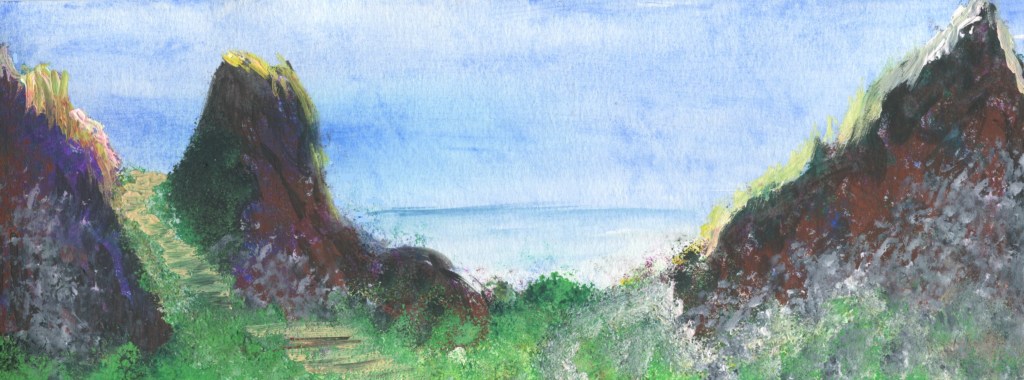
The Sister understands my need to leave the care of her brother now.

      “Tomorrow follow me across the Christ’s saddle to the monastery so you can make yourself known there.”

      “I’d like to do that.”

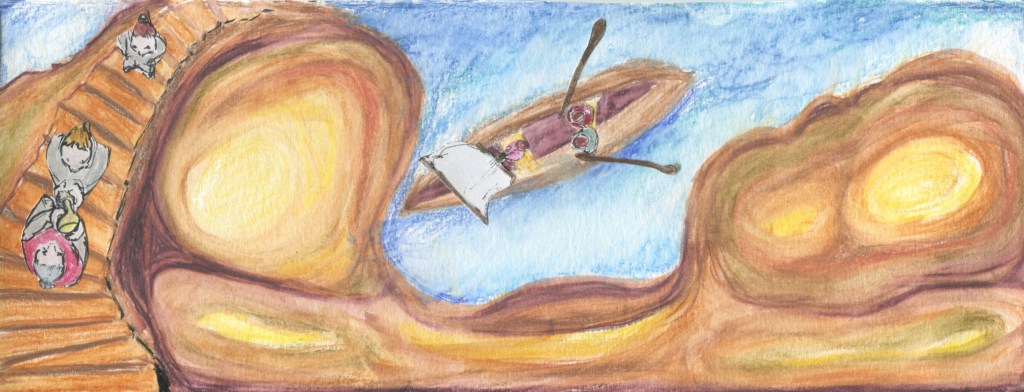
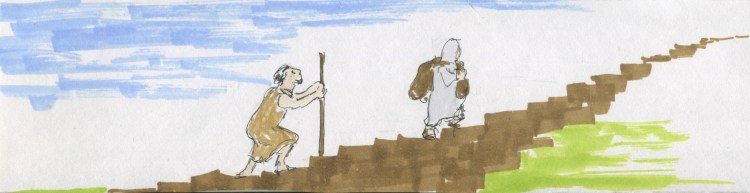
I can see the path through the green valley (known as the “Christ’s saddle” here) and a pathway nearly like steps rising to the stone works of monks.

      “So, I should look for the abbot.”

      “No. You should go first to Brother Lugh. He was the monk who came up the climb, breathless, panicked and pale, saying that a dead man had washed up on the rocks.”

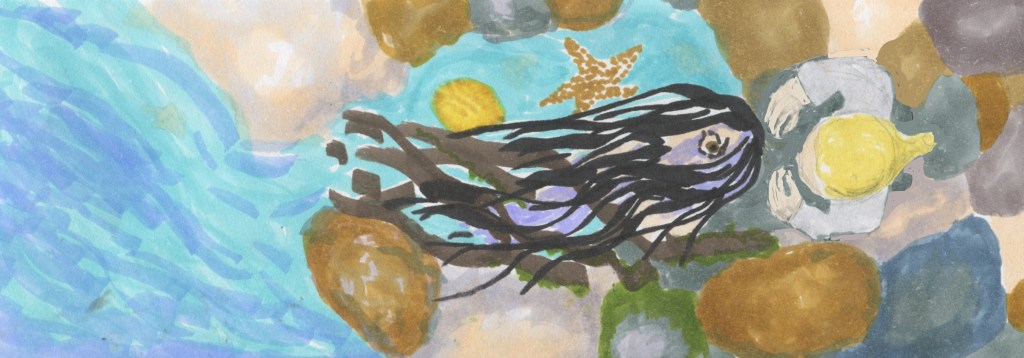
      “I must have been a grotesque find.”

      “They had just experienced the first death among them. And these monks, who only recently arrived to fill the shell of a monastery were vowing to God they would be here forever. They haven’t even been here through all the seasons around, and already one of them passed. Then, just as they were preparing for that burial, Brother Lugh reported that a dead man had washed up. Fresh on the edge of mortal fear, every tide turned with the trepidation that it might expose something more of death stalking every nightmare. They are young and mortal fears still haunt them.”

      “Then I just landed here like a piece of driftwood on an island that never had a tree. I can imagine that the sight of dead stranger would be horrifying.”

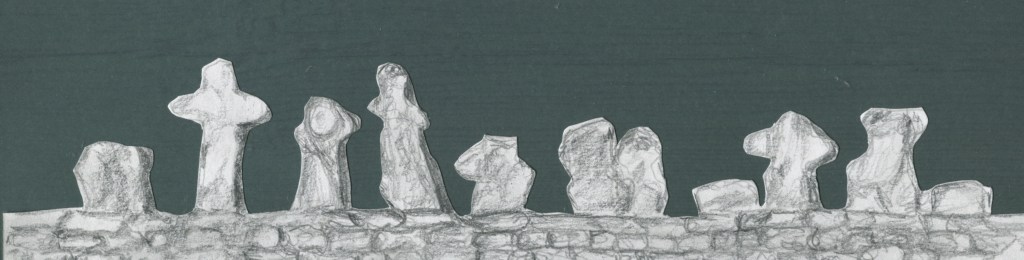
      “So, they set about preparing a second grave, but this one was beyond the monk’s cemetery where they had just prepared to bury one of their own. But making a grave in the unturned rock was daunting. Any untilled earth here is solid rock. So, they didn’t chisel a dent.”

      “So sorry to put them through that.”

      “Well, it was good there was no body to be found so they didn’t have to finish it. The abbot assumed the dead man was invented by Brother Lugh because finding death was new to them. The abbot accused Lugh of dancing with the devil in lies.”

      “I’m sorry.”

      “The abbot doesn’t easily let go of the devils he evokes so you will be a blessing of truth for Brother Lugh. You can understand why Lugh would welcome you. “

So tomorrow, when Sister Brigid delivers the goat’s milk, I will follow her across the valley and up to the monastery to the cell of Brother Lugh.

Returning now to Brother Timothy, my prayer is for strength for the long trek in this healing.

(Continues tomorrow)

#82.9 Tuesday, July 21, 2026

Historical Setting: The Great Skellig in an unknown time

Sister Brigid affirms my concern that Timothy only perceives me as a creature in his care. If I were a bird, I would be released into the sky. But as a human being, my release poses a problem. Am I seeking his friendship and expecting belonging? I’m finding all Brother Timothy chooses to offer me is his relentless care and maybe some pity for my brokenness.

      “This isn’t like the bird’s healing, where one day I just fly off.”

      His sister says, “This is something to talk with him about.”

      “How can I do that?  It can’t just be explained in pointing to some simple metaphor or guiding him in the recipe for steaming the Swiss chard.”

She shows me a sign they use with their fingers that means “sibling.”

      “You need to use this sign of grasping hands, then pointing from one to the other to say to him, I am your brother.”

      “And I also need to thank him. How do I sign ‘thank you’?”

      “I don’t know.  We never say that to one another.”

I interrupt the introspective silence she sets between us in this moment.

      “I’ve seen that the others he rescues know how to speak gratitude. The hound sits with him in the storms, the bird returns and always knows who he is. So maybe my gratitude to him isn’t a simple sign for a spoken word but a commitment.”

      “Indeed, Lazarus, but I’d guess the real communication challenge you have isn’t to thank one who doesn’t hear, but it is how you will explain your presence at the monastery. Last they saw you, you were dead.”

         “I’ll just tell them I’m Lazarus, risen again.  They’ve read the gospel. They’ll know the story.”

She laughs.

      “You probably don’t want to take that news to the abbot. In fact, I will suggest you follow me tomorrow when I deliver the goat’s milk up there, and we will go first to Brother Lugh. It was he who claimed he saw a dead man in the tidal wash, and he may be glad to know he wasn’t imagining that. The abbot assumed he had invented a lie. But maybe you should introduce yourself with your real name, then say, ‘like Lazarus.’ who returned from the dead.”

      “So, I shouldn’t say I am Lazarus?”

      “I think not.  Brother Lugh actually does have fits of fantasy and he would be one to believe you.”

      Apparently, she doesn’t believe me.  What can I say?

(Continues tomorrow)

#82.8 Thursday, July 16, 2026

Art notes The [Irish text] text as edited by Stokes 1888,  is here shown alongside the literal translation [English]  due to Todd. (Footnote)

Historical Setting: The Great Skellig in an unknown time

Sister Brigid offers the human conversation I’ve been craving.

      I ask, “How is it possible that a Brother in a community of faith, such as a monastery on a remote rock, could be excluded from the monastery as you suggest.”

      “Timothy and I are not excluded.”

      “You aren’t?”

      “No, we belong to God the same as they do, but we don’t belong with them. It happens here that bands of monks come and go. They show up for a season as though they are here forever, but then they’re gone. They come here to belong to God alone. But they always keep a boat for the return or they arrange for a boat to show up from time to time. Timothy and I don’t have a boat.” [footnote]

      “How did you get here?”

      “We were delivered here as children by the ‘holy person’ God sent to rescue us when we were discovered to be homeless orphans living by the sea.”

      “You mean, you were just abandoned all alone on this bleak rock?

      “We are never alone, of course. God is with us.”

      “Of course, I know that. I too feel God’s presence here in the silence and the sounds of this place.”

       “The holy person taught us the breastplate of St. Patrick, “Christ before me, Christ beside me, …”

         Interrupting, “I know it well.”

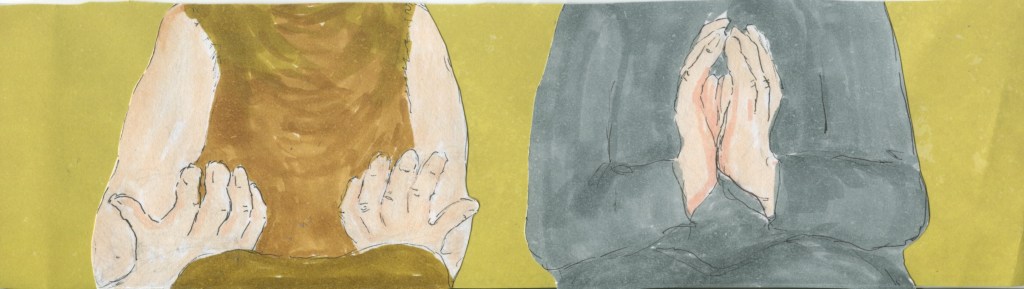
She continues speaking it with her hands. Then she folds her hands in a silence at the end and tells me more of their deliverance here.

      “We could have survived on the land over there, fine enough, but people misunderstood Timothy and cruelty is the human nature of misunderstanding. We were in danger so it was a blessing that we were delivered to a place.

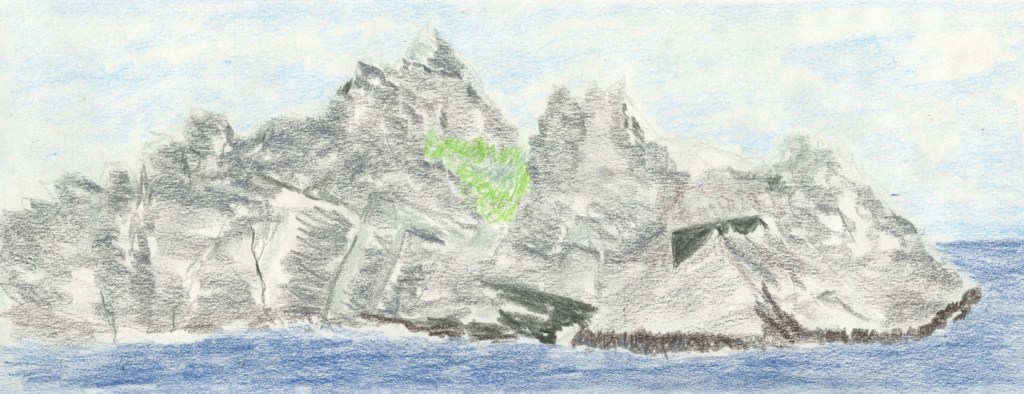
      “It has always been known that this Skellig is a holy rock where only the most God-fearing come for solitude. It is the dessert place, for the sacrificial commitment to God alone by the living martyrs.  Here, we found the birds and sea creatures and the life we had known living by the sea. But we also found the little gifts left behind by the past people, the stone stackers: hounds and goats and gardens, their little cells and a cell for worship. Some have even left their graves up there in the cemetery. When my brother knows of a death, he chips a marking stone for them. The stone-stackers left their tools for Timothy — the mallet, chisel, sledge and rod.”

Art Footnote — https://en.wikipedia.org/wiki/Saint_Patrick%27s_Breastplate

retrieved 1-17-26

Footnote The Great Skellig has long been known for the ruins of an ancient monastery. It was the launching pad for Star Wars. and the speculative source for many other fictional tales, like Sun Dancing by Geoffery Moorhouse, and recently Haven by Emma Donohogh.

(Continues Tuesday, July 21)

#82.7 Wednesday, July 15, 2026

Historical Setting: The Great Skellig in an unknown time
 

Things are different now. I’m not needy and helpless and Brother Timothy is not the caregiver. One healing changes us both, and just as the stretches of healing are painful for me, the new stretches of relationship for Brother Timothy challenge his power over me. Healing is miraculous, but also, it is a severance of care. He will have to rescue another broken bird, and I will have to find my own way here.

On this new day Sister Brigid delivers the more abundant flask of goat’s milk and now she goes on her way with her other deliveries as she does daily. I step out of the cell, and watch her cross the deep, green divide and up the stone stairway to a higher place. Now that she knows of me, here, she has filled her brother’s flask more fully, so sharing with me isn’t his personal sacrifice.

I’m hoping he sends me back this morning to return the empty flask so I can thank her with words; but the little monk goes off as he always did until yesterday and returns it himself. So today, after he comes back, when he settles into his routine of silent prayers, before he begins his daily task of chipping stones, I go back again, down the path to the Sister’s cell.

I see her pouring fresh water into the goat trough.

      “Good morning, Sister Brigid.”

      “Good morning, Laz. Did my brother send you back down? He was just here.”

      “I know. I just wanted to thank you for adding extra milk today, now that my presence isn’t a secret anymore.”

      “Not a secret now, from me anyway; I am pretty sure the others haven’t a thought he’d rescue a man among all his saved birds and critters. But if you wander up to the monastery, you may find that you, just showing up on the Skellig, will be very hard to explain.”

      “I see that Brother Timothy finds joy in the healing power as he released a bird from his care. And he probably needs to release me as well, so I need to go on my way to find myself useful.  I’m not needy anymore, but I’m not needed either. And I don’t know how to speak to Timothy so I could be a brother for him.”

She laughs.

      “Even the brothers aren’t brothers for him.”

         (Continues tomorrow)

#82.6 Tuesday, July 14, 2026

Historical Setting: The Great Skellig in an unknown time
 

Sister Brigid sends me with a sack of Swiss chard which she promises will be a treat for Brother Timothy when it is cooked properly.

      She says, “Brother Timothy has no idea how to prepare this. I’ve tried to instruct him on this method for steaming it, but he insists on boiling it down in brine like sea kelp and it just blackens into slime proving to him that sea stuff is better than garden greens. Now he will be amazed to find how good this garden thing can be.”

The climb back up around the rock from Sister Brigid’s cell is a good stretch for me — not unbearable pain, but the stretch of healing pain. Trinity is waiting at the hillcrest as a hound does when one from his own abode is returning.

I’m reminded of the Sister’s story of Saint Brendan, who was greeted on this Skellig by a hound. The wonder of the story is that the hound was expecting the Saint and his monks, as though all of Creation welcomed them home to a place where they had never been before. Whenever I hear these stories of saints, the awe is supposed to be in the oddity of miracle, but to my ears, the message of God’s love is hidden in the mundane details of the story. There is an obligation to the storyteller to include the details, even though they seem usual but that is where the signs are hidden.

Brother Timothy takes the gift of chard with a scowl, as he prepares to untie it from the cloth and drop it into his boiling pot of sea stuff. But I take it from him and re-tie it to the stick to lay across the top of the pot, dangling  in the rising steam. He keeps his stubborn scowl.

When the chard softens in the cloth and the drops from the cloth redden the water, I remove it from the steam and open the cloth. I touch the reed stick to the wilted leaves, dangling the morsal which I try first. It is excellent. So, the next bite I capture on the stick, I offer to Brother Timothy. He hesitates before he takes it, like a baby bird receiving the first worm, then I see his grinning gratitude. We share all of the chard before the stewpot of rosy stewed sea stuff is thoroughly cooked. The brother will have to admit sometimes his sister has a good idea.

(Continues tomorrow)

#82.5 Thursday, July 9, 2026

Historical Setting: The Great Skellig in an unknown time

Brother Timothy’s sister tells me of Saint Brendan here on this Great Skellig. Discussing signs and miracles and we discover a twinkle of humor in the distinction between a saintly miracle and a simple sign of God’s gracious abundance. Apparently, a miracle has furniture. Her humor is gratifying. A miracle requires a great hall with tables, and an earthly sign is just a picnic with an abundance of food.

From my viewpoint though, as one who was rescued to be a redundant mortal as a sign, I too, find it better to be a sign than a saint. I tell her my name is Eleazor. It has more clarity than “Lazarus” just now. 

She tells me how she was charged at birth to always care for her twin, Brother Timothy.

      “Then I was named Brigid after a goddess, but the old woman who kept infant orphans wanted to call me Eunice to pledge my care for Timothy, as though giving me the name of a mother would provide him with a mother. But when we were cast out no longer infants, to live by the sea, God was with us and sent a ‘holy person’ to watch over us, who always called me Sister Brigid so that’s who I am.”

      “Very well, Sister Brigid, may you know me as Lazarus.”

      “Lazarus, who rose from the dead in John’s gospel?”

      “One in the same.”

She laughs. She thinks that’s funny.

Returning to her cell she ties some hands full of chard in bundles to take to Brother Timothy.

      She asks, “Do you know how to cook chard?”

      “I’ve always prepared it with the roots or beets boiling in the pot first, then when the skins are loose, I add the chard; it softens quickly and it is all good to eat. But here you leave the roots in the garden.”

      “Set in your old ways, Eleazor who calls yourself “Lazarus” you don’t need beets to redden the stew, the chard will grow again from the root left in the ground.”

She wraps a bundle of chard in a swath of cheese cloth.

      “When the pot is boiling take a stick and hold this bundle in the rising steam.  When it softens, and the blood-red drops redden the frothy boil the chard will be sweet and soft and warm to eat, and the water will be a very fine broth as well. And in the garden chard will grow again from the beet. It is a sign.”

 (Continues Tuesday, July 14)

#82.4 Wednesday, July 8, 2026

Historical Setting: The Great Skellig in an unknown time

Gardening with the Sister, I can ask my questions about the people who come here.

      “Why is Brenden a saint and Brother Timothy simply a good man with a dog? Or does it matter?”

      “Oh, it matters. When the stories that the monks tell are of the saint, they are filled with amazing wonders and miracles, where earthly us would see only signs.”

      “Signs? Signs can be holy.”

      “Signs are everyday things, like the leaves of the Swiss chard that grow back from the root when harvested. It is a sign of God’s gifts of abundance. A holy gift isn’t used up, but comes back again and again. Like goat’s milk. That is the sign in nature, but it is no miracle or wonder. It only speaks of the miracle of God’s gracious abundance. So, it is a sign.”

      “So, when the Saint and the monks were sent to this great rock soaring from the sea…”

      “…This Skilleg, God did not simply give them a path onto the rock. First, they struggled, they circled the wrong rock, then they circled around this for three days, prayerfully, of course, then the miracle. It is told for all the generations, exactly in this way:”

‘…and they saw a great rock of stone appear above all the water, and three days they sailed about it ere they could get into the place.

         But at the last, by the purveyance of God, they found a little haven, and there went a-land everyone. And then suddenly came a fair hound, and fell down at the feet of Saint Brendan and made him good cheer in his manner.

         And then he bade his brethren, ‘Be of good cheer for our Lord hath sent to us his messenger, to lead us into some good place.

         And the hound brought them into a fair hall, where they found tables spread ready, set full of good food and drink. ‘ [Footnote]”

      She adds, “So this is a story of a saint, because the hound led them to a miraculous feast, in a hall with tables and an abundance of food.”

      “Isn’t that also how Brother Timothy makes the relentless climbs, guided by the creatures, and he also finds the most needed things — the eggs and sea plants for food, and the rain water in the clefts of rock — is this not the sign of a saint, also?”

      “No. To be a saint, requires the miracle of finding the gracious feast served in a great hall with tables.”

[Footnote] Caxton, William, Modern Spelling Version The Voyage of Saint Bredan (Published by Langley Press, Copyrght 2016, Simon Webb, noted as the author.) The introduction to this hagiography is informative, and sets this publication in its historical context 1470’s, hundreds of years after the life of the saint, but even in that later time it was not in the English words we would expect to read in our century. Author, Simon Webb, made it accessible. Caxton was producing the first ever English language printed books.

(Continues tomorrow)

#82.3 Tuesday, July 7, 2026

Historical Setting: The Great Skellig in an unknown time

I’m gardening with the sister. Here she sets the weed sprouts aside for the birds, lecturing me on the human numbness to the gracious gifts of Creation. And she takes from the garden only the leaves of the chard, letting the root stay in the soil. It’s been my tradition to pull and use the beets to redden the pot.

      I ask, “Do you not find the beets would be good to keep for your winter stores?”

      We don’t store up for days that may never come. We are gifted each day according to our need.”

      “Of course.” I recite the prayer words she’s considering, “Give us this day, our daily bread, or Swiss chard, or beets, or whatever this day may bring without worry for the next.” I can agree with her frugality; it just isn’t of the world I’ve ever known.

      She says, “It is the wisdom of Saint Brendan that is left in the place, to grow and grow again. When we have need of the roots, I will come for them, but here, from that root the leaves will grow back soon enough and they will keep on giving back to us for the whole season.”

      “So, tell me more of this Saint Brendan.”

      “It is said that he was an abbot with monks and they prepared hides, oiled to endure the sea water. Then they framed a little currach with high sides for sea tides and covered the oaken boat frame with well-oiled skins. Then they set out to release themselves onto the sea, following only the will of God. If God sent them to the little Skellig and there was no place to go ashore, they circled it three times, ‘father, son and holy ghost,’ and then by the will of God they laid eyes on the Great Skellig, which is this place.” [Footnote]

      I ask,   “So, they landed on this rugged rock, by the grace of God?”

She nods and smiles.

      She says, “Saints don’t beg for ease. Here the saint could hear God speaking to him in the voices of the birds.”

      “So, if a saint is gifted with listening to creatures, then surely Brother Timothy is a saint.”

      She stifles her laugh — being the good sister she is.

      She says, “Whatever that hound tells him isn’t for me to question. My task in life is only to tell him what people say.”

[Footnote]  Caxton, William, Modern Spelling Version The Voyage of Saint Bredan (Published by Langley Press, Copyrght 2016, Simon Webb, noted as the author.)

(Continues tomorrow)

#82.2 Thursday, July 2, 2026

Historical Setting: The Great Skellig in an unknown time
 

This Sister is the actual sister to the little monk she tells me. Her twin is Brother Timothy.

She takes the weeding prongs and a garden bag and we follow a well-trodden path that descends then turns steeply. She’s promises to tell me the tales of St. Brendan.

We slide down toward this wider green space on a ledge, rich with grasses already forming seed heads. It isn’t a long way, but it does tax my nearly healing bones and I wonder if I am even fit for this. My walking stick is of little use downward but I cling to it, because I suppose I will be able to use it for the climb back up. Here are rows of chard growing in a sunny spot between the rising rocks.

The sister kneels down on the earth at the chard rows and gestures for me to do the same. Kneeling is a good stretch for my stiff knees, and we are perfectly situated either for gardening or for prayer. Why did I assume we were kneeling for gardening? She folds her hands together, and casts her gaze skyward.

      “Oh, Holy three, let us not profane your sacred soil with human greed. Let us borrow only our merest sustenance. Amen.”

      “The earth is sacred here?” I ask.

She scratches up some fresh shoots of weeds from among the chard and sets them aside on a particular flat rock near-by. 

      “Of course, the earth is Creation, and all that it yields is gifted to us from God. It is by our human frailty that we cast away any of these gracious gifts simply because they don’t serve people. People can be so narrow to save only the things we plant ourselves as though we are better gardeners than angels or nature itself. The birds, with the wiser palate, will find a use for these weed sprouts.”

      “I see.”

      “And furthermore, this particular land is specifically sacred, because here, in this very place, it is said that Saint Brendan and his monks once trod. When this place was pure, with no rock or grass turned by human labor it was said that the Saint and his little band of monks were welcomed by the sea birds and the creatures.” [Footnote]

The sister takes her gardener’s blade and trims the leaves of chard leaving the root tops standing in the garden rows.  She collects these leaves, allowing the wounded root to stand in the soil. 

Footnote: Wikipedia offers an overview of this Saint. https://en.wikipedia.org/wiki/Brendan_the_Navigator (retrieved 2-20-26)

(Continues Tuesday, July 7)

#82.1 Wednesday, July 1, 2026

Historical Setting: The Great Skellig in an unknown time

The little monk’s sister asks me if I am a merchant or a Viking.

         “Doesn’t anyone else travel the sea?”

         “Of course, but you don’t have the glow of a saint, so I assumed you weren’t among the blessed.”

         “Indeed, I wasn’t glowing of sainthood when the brother dragged my broken body up this cliff. He told no one I was here until I found healing. Today he gave me this walking stick and he sent me here to return the flask.”

         “He probably doesn’t want the abbot involved. If my brother could have his way, he would choose to live across on the Little Skellig with no people at all. He only wants the company of God, and the creatures of the skies and sea.  So” she asks again, “what are you? Why do you travel the seas?”

         “I’m no Viking, nor am I a merchant, though I was sailing with a merchant. And maybe that was the cause that my saintly glow is dimmed.”

She laughs.

         I explain, “We were on a journey in a currach, only made for river travel, bound for Iona, when our craft was devoured by the sea in a storm. I held the empty chest and floated on the sea for a moment, but the merchant held the chest of coins and sunk down straight away.  It was only by God’s grace that I was delivered here.”

         “At sea in a currach, adrift on a journey to Iona — how like Saint Brendan you must have seemed to the angels.”

         “So, who is Saint Brendan?”

         “You don’t even know?”

         “I don’t know anything about this time or place.”

         “He isn’t of this time. Saint Brendan is a known throughout all the world — an abbot in his little currach filled with monks. They were seeking Paradise.” [Footnote]

         “And they found it?”

         “Of course.  He’s a saint.”

         “So where is Paradise?”

         “It is said to be far to the north on the easterly side of the wind.”

         “Really, I hadn’t heard of that.”

         “I am oh so busy today, with the weather so fair. So, if you expect me to tell you the truths of the whole realm of God you will have to follow me on my chores.”

         “Fair enough.”

And so, the little monk’s sister goes back inside her hovel and is back in an instant with weed picks for both of us, and a harvester’s bag.

Footnote: Brendan of Clonfert (c. AD 484 – c. 577) is one of the early Irish monastic saints and one of the Twelve Apostles of Ireland.  .https://en.wikipedia.org/wiki/Brendan_the_Navigator

(Continues tomorrow)