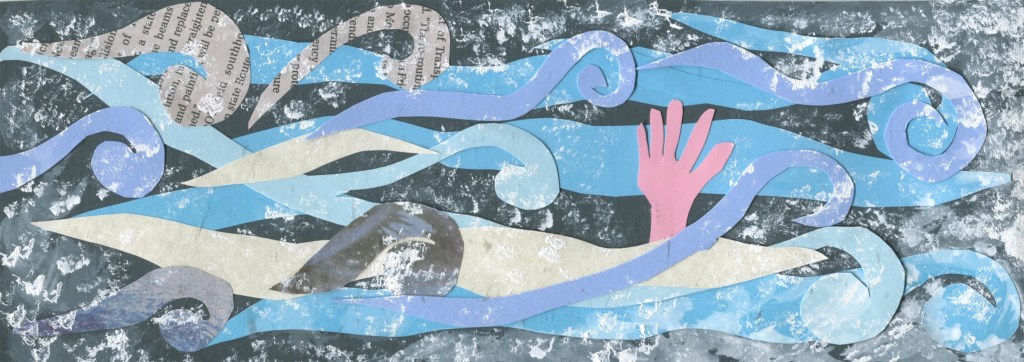
#77.1 Tuesday, February 3, 2026

Historical Setting: Monkwearmouth, 794 C.E.

It is the dark hour before dawn. We are five people waiting for the tide to turn in a shelter shed. The three who just arrived are arguing. The nuns are midwives advising the man on the needs of his brother’s family as they prepare for a new baby.

The grieving girl I’ve been keeping watch with through this night is huddled in the corner waiting for these people to leave– waiting for the silence to return pretending silence could be peace.

I’m waiting for God to answer my own silent prayer — Dear God, stay close to this young woman on her terrible journey through grief.

The three arrive in the midst of a heated argument.  The nuns insist the family must procure a fresh cow. The soon-to-be uncle raises the timbre of the argument insisting a cow is too costly, accusing the nuns of having no empathy for the poor.

         One nun says, “It is the responsibility of the family to care for their infants. It’s not simply the luck of having wealthy neighbors from whom to borrow a cow! Rich or poor, your family is responsible!”

         The other nun adds, “If we didn’t know your family to be poor we would demand that you hire a wet nurse. The cow is the poor man’s substitute!”

The man starts to speak. The nun speaks over him. 

         “All we ask is that you borrow a cow for the sake of this baby! It is the least you can do.”

The tension rises. The man rages.

         “Oh, dear Jesus, have these wealthy nuns no idea of what it is to be poor?”

At this moment, the girl huddled on the bench, flips her cowl back, stiffens her posture and shoots her demon glare right at the nuns and the uncle. She speaks boldly through gritted teeth.

         “Here is the fresh cow Jesus sends you.”

Silent. Stunned. These nuns have seen this demon’s glare before. Then they were prepared with a chain and manacles — though, of course, they prepared for a much larger demon. They recognize her now.

It is the nature of gracious God to send a holy happenstance.

When the tide turns the nuns, the man, and the holy gift of the wet nurse, cross the sandbar. I know the truth of this holy happenstance might seem a miracle at this moment. Really what happened is that God sent the baby to rescue the wet nurse. Thank you, God.

(Continues tomorrow)

#76.13 Thursday, January 29, 2026

Historical Setting: Monkwearmouth, 794 C.E.
 

It’s been nearly all night that we’ve sat here in the quiet darkness, except for the gentle sounds of a horse waiting for his master to return and our few words. I asked her to imagine a wishful story. She has an imagination and she has words that could tell fantastic stories. Were she literate, she could write her way through all the years of this grief.

It isn’t dawn yet, but we hear people talking, approaching outside. I step out and here is a man and two women crossing the meadow toward the shed, coming down from the convent of St. Peter. The young girl hears them outside and hides as best she can, not being a mouse that can fit between the boards. She is crouched at the end of the bench with her cowl pulled over her head hiding her face.

         Now they are here.

         “Hello. We’re seeking shelter here until tide ebbs so we can cross at the sandbar.”

The three of them crowd into our midst — two nuns, and a villager with them who is holding up a lantern so we can all see the young woman huddled and silent as though she is hidden. Once I saw a kit in a wood, thinking he was hiding from me, but only his eyes were hidden. The rest of him was clearly exposed, sticking out from the side of the tree that shielded his eyes.  And though her hiding is imaginary, no one acknowledges her.

         “Is something happening at Jarrow, today?” I ask them.

         “It is possible.” says the man. “My brother’s wife may need a midwife this very day.”

         “What a wonderful blessing for your family!”

         The man doesn’t answer. A nun answers for him.

         “There is a fear. This mother had a beautiful little girl a while back, but the mother is sickly and then that infant failed to thrive.  We told this family then, and we tell them now, they must borrow a fresh cow if any baby can survive at all.”

         The man argues, “These nuns think every family is rich and all the neighbors have fancy farms and cows just for the lending.”

         The nun adds, “We aren’t talking about great wealth. We only insist that you borrow a fresh cow that has recently born a calf. Even a poor family can surely take on that little responsibility.”

So, here we are audience for a continuing argument.

(Continues Tuesday, February 3, 2026)

#76.12 Weds., January 28, 2026

Historical Setting: Monkwearmouth, 794 C.E.
 

We sit here in the dark mostly in silence — the dark is cold — the silence is raw.  What can I say? There are no words of goodness or even hope. Much as I wish it, I can’t repair another’s grief.

She explains it again too easily.

         “I took him to the sea, and the baby prince was taken up by the angels. Them angels came in a crashing wave, and wrapped him up in sea foam and took him away to the place where the sea meets the heaven. But they didn’t take me — his own mother.”

She rubs the bruises on her wrists.

         “Instead, you and the demons took me away to Hell.”

         I say, “It was the king’s guards who were keeping watch over Jarrow and Monkwearmouth who pulled you from the sea. They brought you up from the water just as I was crossing over the sandbar to the church on this side of the river. I took you on to the church and to the nuns. They didn’t see you as you are. They only saw what belonged to the stories they tell — first they remembered you were a mother and they thought they saw Mary, then then they feared you were plagued by demons.”

         “They feared demons? But they’re the ones keepin’ the demons in the tower! There the ones chained me to the demons!”

         “The Reverend Mother showed me the tower and the chains with manacles sized to fetter a demon, but without a fearsome devil, a person in those chains could just slip away and run down the stairs and cross the field to the river. That’s what happened, isn’t it?”

         “I had to be stealth to hide all the demon howls.”

         “You were stealth. The Reverend Mother didn’t even know you had escaped until I asked to see you in the tower.”

         “Good for them.”

         “So now you are free from the chains. I could walk with you maybe to a new place. We could see what is on the Jarrow side.”

         “I already said that’s where I can’t go! And look at me now, all dressed up like a princess but bringing no one any of the riches. Maybe they could trade me for a better price now.” 

         “Very well, use your castle words and make up the story you wish to live into. Hone the words to say any kind of worthy ever after. We should make a new plan now.”

(Continues tomorrow)

#76.11 Tuesday, January 27, 2026

Historical Setting: Monkwearmouth, 794 C.E.

The young woman has a dress and an apron and a cowl, all the things she needs to appear presentable to other people who could meet her with either judgment or compassion. Only heaven knows her nakedness, though earth is still touched by her unshod feet.

She recognized my selfish need in trading away my cloak for her to have this clothing. She offers me no gratitude. She saw my gift for what it was, my own selfish appeasement of conscience. So, we sit here in this little harbor shelter in the dark.

There is a horse sheltered here with fresh straw while his rider might be rowing up the river a short way to spend this night in Jarrow. This shed has a purpose. The horse has purpose.

This young Rachel has her focus on the mouse in the corner working feverishly to move its nest out of view of our human eyes. Now two mice are working on this project. When the last of the babies are tucked safely between the boards of this structure and out of our sight, the young woman still stares at the emptiness.

         “I could go with you at first light in the morning, when the tide ebbs again, and we can cross the river and walk to the wood where there are people you know.”

         “You would take me to the pauper’s woods where already they traded me away? Why would I go there?”

         “I don’t know. Is that where your home is?”

         “They would expect a princess bringing treasures and food from the castle. But I didn’t take stuff when I was dismissed.”

         “The house we saw across the river was no castle it was the ealdorman’s house. This village is small and Cloothar agrees with me that a king assigns a literate villager, hardly royalty, to be the ealdorman. It was your hopes and dreams that made it a castle. And you still have the gift to make castles of your dreams. So, tell me the story. What happens next, when the hour comes, and a castle is an ordinary house and the coach is a pumpkin, and the coachmen are rats? Is there still a hidden princess in a common girl? What is the ever after for this story?”

         “There is no ever. I gave that baby prince to the heaps of waters in the sea, and I promised to always keep him safe. but I was taken from the sea.”

         “So, what happens next in the princess story?”

(Continues tomorrow)


#76.10 Thursday, January 22, 2026

Historical Setting: Monkwearmouth, 794 C.E.
 

The young girl, along with Cloothar and I, have found shelter from the cold wind in a stable shed at the harbor on the sea gate of the Tyne. Cloothar has tailored a dress for the girl — the dress I traded for my cloak. And now he is in the spirit of this gifting also, and has made this child a cowl, and he has found in his heaps of merchandise. a linen apron just right for a small sized woman.

She fingers the apron, nudging the smooth weave, the purity of clean cloth, between her thumb and finger. Her fingers are like bird’s legs, rough and spindly but purposed for clinging to a branch — a flightless fledgling, alone. Her prayer is silent.

Dressed up in her own wools and an apron, she has the outward appearance of one who can manage the normal routines of life. But of course an outward appearance doesn’t fix the depths of a person where grief is relentless. The torments and sorrows aren’t dismissed when hidden. Underneath her restyled clothing she is still naked and grieving. But at least, I suppose, she isn’t exposed to the judgement from others for how she suffers. She looks to be a person first, before any infestation of demons, or sins of self-destruction are conspicuous. At least that was my thought as I wish to fix this thing.

So, what will she do? Where can she go?

Cloothar, hurrys to return to his boat by the rising tide and before the impending dark of night. I feel the unsettled night coming on as well.

         I tell her, “When the tide is out, the sandbar becomes a shallow crossing if you wish to go back over to the woods.”

She may know that as her first home. But she keeps her head bowed studying the weave of the apron with her fingers.

         She says, “You don’t have to wait here, you know.”

         “Yes, I do have to stay. It would ache my conscience to leave you here without a place to be or people to be with.”

         “It’s not about you and your shabby little conscience. I have to figure it out for myself, or not.”

Her idea of ‘Not’ isn’t an option. My “shabby little conscience” won’t allow it. So we sit here in the dark.

(Continues Tuesday, January 27, 2026)

#76.9 Wednesday, January 21, 2026

Historical Setting: Monkwearmouth, 794 C.E.
 

The young woman wrapped in my cloak, follows me along the river bank toward the sea to the mooring harbor where I’ve noticed Cloothar’s merchant’s boat is moored.

         “Friend Cloothar!”

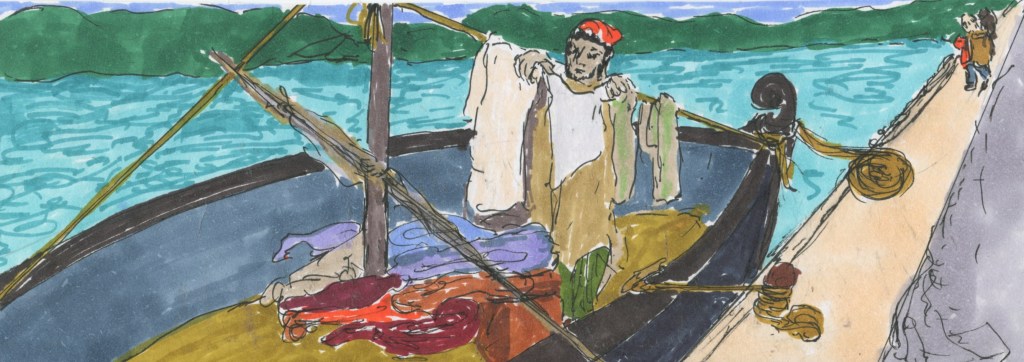
He is in his boat, folding and sorting his wares, preparing to travel up river at high tide.  He sees me and untethers from the mooring post to bring his boat closer to this bank so that I can tell him of our need.

         “Have you a woman’s tunic of wool to suit this season?”

He rummages through his heaps of goods, and emerges with a perfectly fine dress in a size much too large for this girl.

         “What price can she pay?”

         “I’ll trade the dress for my cloak which you remember, you traded me for my work and the monk’s robe.”

         “That is a very fine cloak, you realize, worth much more than this old dress.”

         “It is what I have to trade. Perhaps you will do the alterations for her.”

         “That would make it worth the trade.”

A cold January wind whips off the sea and this poor waif draws my cloak tighter around her. It is the same gust of wind that shivers me and reminds me of my sacrifice. Do I give up my cloak so easily because I think God needs to be reminded of my goodness? Maybe that was a thought that crossed my mind. But, as much as I would like to win God’s approval, like adding a star to my crown in heaven, I know in my brain God doesn’t love a person by the measure of their goodness.

God loves everyone, freely. The gift giving that shivers me, also defines humankind. It practices the God-love on earth as it is in heaven and speaks from the in-born nature of human empathy. When I give a small gift, it is amplified into all human goodness and because it says simply, “God is gracious and good, and through this gifting we know grace and goodness.”   With a few blatant and obnoxious exceptions, goodness prevails. So, now my one little shiver reminds me of all the goodness on earth and in heaven.  Life is good.

         Thank you, God.

The three of us find shelter from the cold in the harbor shed. So Cloothar fits the large woman’s tunic on this very small girl with fabric left for a cowl. Cloothar is being generous here. Generosity is contagious.

(Continues tomorrow)

#76.8 Tuesday, January 20, 2026

Historical Setting: Monkwearmouth, 794 C.E.

The young woman who was rescued from intentional drowning on Christmas, then chained in the tower as demon possessed, then escaped, and found by me on this river bank contemplating grief, is talking with me about perspective.

The tiny specs of human existence on the opposite bank of the Don are this child’s whole life. What to her is untamed forests concealing a world of paupers, was the only world she had known until she was taken by a powerful “Mister,” I think she means ealdorman, into a castle (a simple house) and there she was the victim of this little man, bearing his child, then being “trashed” or discarded, or dismissed, when the infant was a year old. Without the care of a mother, the baby died, and now grief is the largest thing in her landscape.

So now where can she go if she could survive all this? I ask her about the paupers in the woods.

         “Are the people in the woods your family?”

         “No, they are old and poor.”

         “Before you were a child with them in the woods who cared for you?”

         “They said I once had a mamma, who gave her baby to them. She is gone. Only ones left are them now, who traded with Mister — me, for the King’s letter.”

         “What names do you call them by?”

         “Gramps and Old Ma and…”

         “Do you think they miss you, now?”

         “No, no, not me. They wanted a princess from the castle. The princess was always in their stories all shared around, and then they traded me, and I was supposed to change into the princess in the castle until… (she is sobbing) I can’t go back to them and tell them I was dismissed. Mister will want the King’s letter back. And here I am not a real princess, with nothing at all, no baby prince, no riches, no crown, no nothing –only one old robe.”

She is still wrapped in my own fine cloak. My cloak is no “old robe,” it is the scholar’s cloak that I traded with Cloothar for a monk’s robe and a few days’ work.

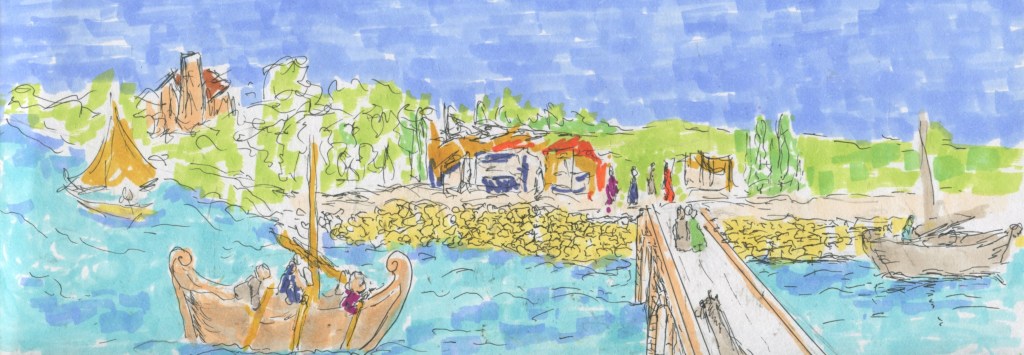
Now, when we walk along the river in the direction of the sea and come to the mooring harbor. There, are the little boats waiting for high tide to row up the river. I see Cloothar’s boat is moored here today, either a very fine coincidence, or a blessing.

(Continues tomorrow)

#76.7 Thursday, January 15, 2026

Historical Setting: Monkwearmouth, 794 C.E.
 

     The relentless intensity of grief that owns this mother’s spirit allows a breath for my mundane questions about the circumstances of her life. I am trying to understand her options.

         She says, “Everything is made of words. In a castle even the words are rich. For the castle man “stinky garbage” is “discarded” or “dismissed. But when the Mister took the baby from me, he said I was “dismissed.”

She knows lots of words for garbage and for death, and she even knows the euphemisms.

         She says, “The castle word is ‘deceased. But the baby is still the same dead.”

Grief takes this moment for humor — dark and messy — momentary, oddly displaced laughter is couched in grim. Then in this meandering silence the emptiness continues. I grope for reprieve, a change of subject.

         “Where is this castle?”

         “It’s on the other side of the river up high from the pauper’s woods.”

         “I’m staying on the other side, at the Monastery and I’ve taken walks from there in the evenings.  I’ve seen lots of woodlands, and on the hill behind to the woods is only a little village. I thought only a few houses are there.”

         “Come, I’ll show you.”

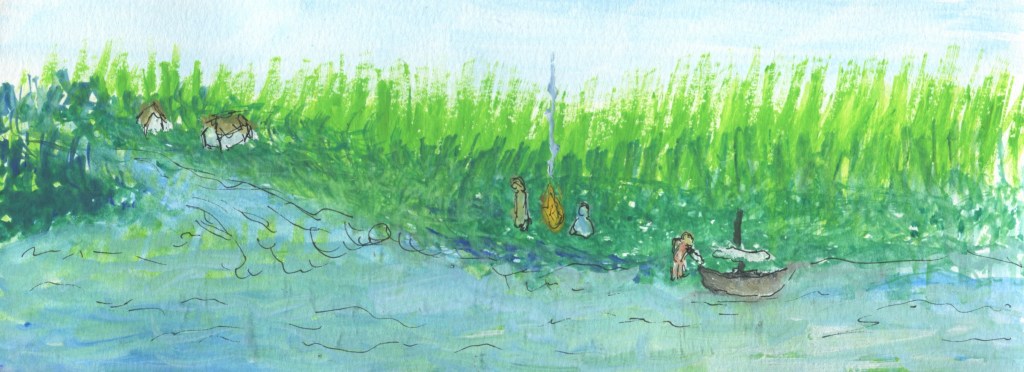
We walk along the river looking across at the same river bank I’ve often walked.  She points to a little stand of trees she calls the “paupers’ woods,” she chooses to creep along behind the sparse foliage on this side, to stay hidden from the paupers she knows, but I see no one over there. Then on the rise near the clearing is a small cluster of houses I called a village.

         “See there, overseeing the village is the castle. The Mister might see  me here.”

We are much too far away for anyone to distinguish individuals over here. Yet, this girl insists we stay hidden as though anyone over there would see her. She whispers imagining they could hear us all the way over here.

         “That is his horse, tied there by the castle, so I know he is there.”

Now I see, her word for a house with a roof is “castle.” And very likely, seeing the lay of the village, the cruel man who owns a horse and rules from the castle and speaks in inflated words is probably only the village ealdorman — the one assigned the authority to collect the fees and dominate the lives of these poor in the name of the king.

(Continues Tuesday, January 20, 2026)


#76.6 Wednesday, January 14, 2026

Historical Setting: Monkwearmouth, 794 C.E.

What to do with this grieving mother is the issue. I could take her back to the nuns if they could listen without judging. Maybe they would receive her with pity, unless their own fear of a writhing demon overrules their holy compassion. Obligations to care for strangers are always weighed against the possibility of hidden demons.  Maybe the nuns would understand her grief because they know the Matthew story of the slaughter of the innocents. Rachel could be their name for her. They know that Rachel weeps, and Mary ponders. They practice the mother’s grief each season with the Lenten sorrow standing with Mary at the cross. Maybe the nuns could understand.

But I know something of this grief also, because I have been the grieving parent, and even then, when it was my own child, I didn’t know the depths of Ana’s grief as the mother of our child.  No one knows another’s grief, we only know our own and from our own grief, sympathy is born. We never have the same grief as another.

         Dear God, you already know her, you love her, and I know you also love her child. You love the love bond of mother and child. You have given her voice to speak of it though the words she gave it were crude. Help me listen-in with what I have so carelessly named sympathy, that I may, in some little way, help carry the burden of her sorrow.

She’s shivering, even wrapped in my cloak. Her only garment is a simple dress– an undergarment the nuns gave her to hide her nakedness. I asked her if she has other things she can wear.

         “Mister had fine clothes for his son’s mother, but he sent me off in my old beggar’s rags and what was left my old cloak, he used to wrap the dead baby in. The baby wore my rags into the sea. I meant to give that child more, but all he has in his death are my old rags!

         “I wore fine clothes in Mister’s castle. And yet, he saved my rags because he knew from the first, he wouldn’t keep me. If he had only noticed me, I could have been a useful slave for him all the years of that baby’s life.

         “I would be a good servant.  I learned the fine words of the castle.”

         “What do you mean?”

         “I used to have wildwood words like “trashed” and “crud.” Now I have castle words: “dismissed” and “filth.”

(Continues tomorrow)

#76.5 Tuesday, January 13, 2026

Historical Setting: Monkwearmouth, 794 C.E.
 

The Christmas story leaves Rachel grieving for her child.

There are lots of bits of the Christmas story. When the nuns read the whole of it from the gospel of Matthew, told and told again by the followers of Jesus escaping Romans in Judah it calls for pondering, not just celebrating. The early Christians sought safer places. In the Matthew allegory the angel visits Joseph in a dream, while in Luke the angel comes to Mary. Joseph is the name of the biblical dream-keeper, so of course it was a dream. In Matthew, Mary and Joseph escape, back across the Reed Sea into Egypt with the baby, while Rome works through their puppet King, Herod, to issue infanticide on Judah.  Matthew keeps a finger on the pulse of the Hebrew bible and remembers Jeremiah 31, and allegorically names the weeping mother Rachel, after the mother of Jacob (Israel).

We know who Mary is. She is the happy ending to the Christmas story. But happy endings all depend on where the story teller takes a breath and sits back and smiles and says, “and that was the story of…” to make the story seem complete.

So, we sit here by the river, a stranger just visiting Jarrow for its library and this young woman who escaped a brutal household, then escaped the sea, then escaped the chains, forged for demons…

         Is there a place where she is safe, Dear God?

         I ask, “Where did you live before Mister took you to the castle, ?”

         “I lived in the pauper’s wood.”

         “Is your family there?”

         “They says my ma gifted me to the olders when I was a babe, then she went on her way. In the paupers’ woods people come and go but the olders are forever there. When Mister come down, he traded with them — me, for a King’s letter of permission.”

I can’t leave this child and yet she seems to have no place. She surely can’t return to this powerful man, “Mister” who traded a “King’s letter” for her, then sent her away after she birthed his baby and nursed it for a year. And it seems there is no place for her in the paupers’ wood where they traded her for a letter of permission. Permission for what I wonder. And that is all I know of this place. 

         I ask again, “Can you show me where these places are?”

(Continues tomorrow)