#79.10 Wednesday, April 22, 2026

Historical Setting: Jarrow, 794 C.E.

I’ve been listening to the talk of the old fellows who gather here in the mornings to consider the state of all things.  Some come disgruntled, regardless of the events of life. But Tam comes with a resilient, joyful spirit despite his losses. It is the simple allegory of Job.

Here in this place where people gather, the murmurs and gossip are not about Job and the trials intended to threaten his faith. Here the talk is of Tam. Here it is Tam’s friends and neighbors who envy his good life and expect his faith to be tested when he faces difficulties and grief. But, Like Job, Tam is persistent in faith. And Like Job, his neighbors don’t fully understand the source of his gratitude.

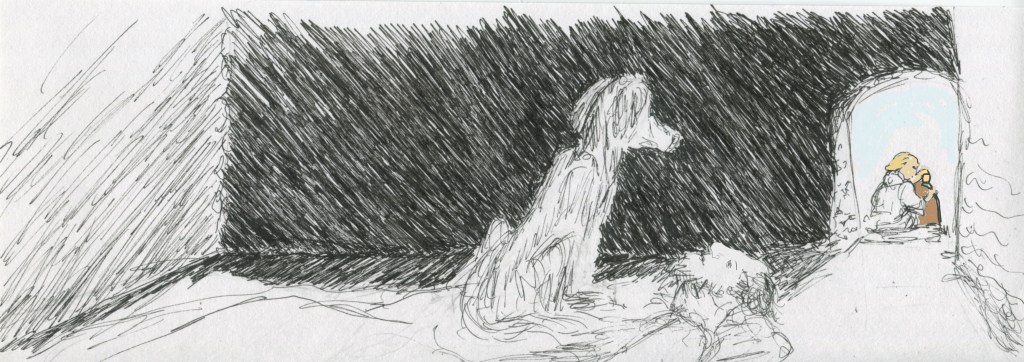
The real tragedy that visited this deposed ealdorman’s house, or call this a “castle,” was the abuse of a young pauper and then the death of her infant. Apparently, the ealdorman who served here made it his task to sit in this place and measure the wealth of the neighbors, accepting bribes in place of fair judgement, leaving him envious of achievement that seemed beyond his reach — made more conspicuous with the simple joyful spirit of Tam. Envy set the ealdorman searching, and he thought he could name his emptiness “legacy.”

It is some weeks now, when we are well into Springtime.  Ousbert returns with the ealdorman, judged innocent and now restored to his place here. Ousbert and the ealdorman will find the coffers empty, because I’m not very good at collecting tithes, and I don’t make judgments based on bribes.  I suppose I’m not a worthy ealdorman. So, it is probably a good thing all around that I won’t be doing this task any longer. The ealdorman returns to an empty, but clean house.

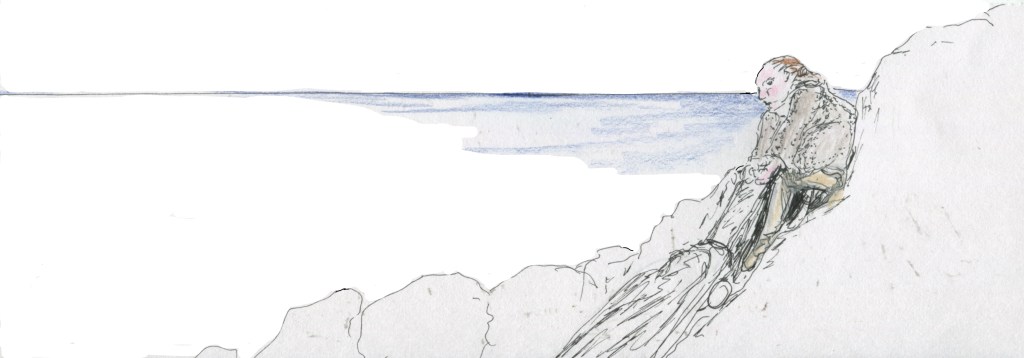
Now, I am weighing a plan to visit another monastery that is rumored to continue in the Irish rule — Iona.  One of the regular merchants visiting Jarrow is Cloothar, with his traveling market for used garments. He brought me down here from Lindisfarne in his little boat, as he often trades among monasteries. He knows of my appreciation for the Christian communities rooted in mystical Ireland, and he came here to Jarrow making a plan for that long sea journey to Celtic Iona. He is inviting me to go along with him.

While we prepare for the journey, I’m staying again in the guest quarters of St. Paul.

(Continues tomorrow)

#79.9 Tuesday, April 21, 2026

Historical Setting: Jarrow, 794 C.E.

Comparing the things in our lives with others is always a false gauge for happiness. Envy and greed are closely linked to each other. It seems all these seven dwarves of “deadly sins” are false paths to love for self and neighbor, and these things leave us spiritually hollow, not hallowed. That is because envy and greed are always reaching, never grasping. Greed is always chasing after more, never with enough to fill the hollow space, and envy also sets an unreachable, ever-shifting goal based on what someone else has. Envy and greed are moving targets — a mythical leaping stag always escaping into the woods just ahead of the arrow released.

Defining one’s own actual needs and goals is a completely different way of thinking than these motives of persistent emptiness. Jesus explained the respite from this endless chase simply as the Kingdom of Heaven. [Matthew 5:1-13] But then frailties of greed words and envy words moved this kingdom from available here and now to a far distant place in the clouds. To assure it would always be distant and unreachable the Kingdom of Heaven morphed into the folklore of an after-death reward, like Valhalla.

The variety of happiness Jesus spoke of starts simply with gratitude — noticing the goodness of what is already. It is based on abundance, not emptiness.

         “Thank you God, for…” Like the child’s prayers.

         “For mother, father, family, home, enough food…”

Pretty soon all this thankfulness widens to cows and friends and trees and birds, and on and on, until all of Creation can be named, then the asking prayer is simple.

         “Give us what we need to live today.” (our daily bread)

         “Take away the worry so that enough is complete.”

The asking prayer becomes the opposite of envy and greed. The hollow space that isn’t envy is compassion and that becomes the healing power.

So, in the mornings the old men gather on the benches, some with hollowness, loneliness, hopelessness, anger at what is not in their control — like the tithes and taxes and the people who mandate them. They come to the benches to complain. But if Tam shows up with his gratitude in-tact for his sons and daughters, for his cows, and for the grass that feeds them in the spring after a bare-bones winter that left him grieving for a calf that failed, and of course his own father passed this winter. Even in his grief he comes with a sense of joy for his neighbors and friends, who are these other men gathered here.

         Thank you, God.

(Continues tomorrow)

#79.8 Thursday, April 16, 2026

Historical Setting: Jarrow, 794 C.E.
 

He asked about the infant, and I asked the question back to the three old fellows gathered on the benches here. 

         “Why would an ealdorman keep a baby here?”

The man with no teeth answers first.

         “He thaid it were hith own thun.”

The owner of cows, Tam, still smelling of fresh milk from his morning chores has an explanation.

         “He envied those of us with children, and said he also needed a ‘legacy.’

         Toothless said, “He took one look at Tam’th richeth — cowth and five thunth and nary a tithe needed pay for them and he envied.”

         Tam said, “He’d collect the king’s tithe from me in churned butter and straw bales, but my sons are a value far better than land or riches. Children are better than all the riches of earth. They promise a future. I think he saw I was rich in legacy and not even paying the taxes of a rich man.”

         “Let me guess” I added, “without the ealdorman here now, you’ve delivered the butter to the monastery.”

         Tam answers, “The monks came for it themselves.”

         The other says, “The ealdorman’s envy ate him up. He told everyone he thuffered from luthting for legathy.

         Tam added, “He weren’t seeing the value in the wife or daughters, just the legacy of sons.”

         I ask, “Didn’t he expect a son would come with a mother?”

Toothless belts a laugh.

Maybe they know what I know. The ealdorman had no comprehension of family. The tiny infant that was conceived, not in love, and most likely not even in lust, was the object of greed. Legacy through sons wasn’t a taxable treasure, and the ealdorman took this tax loop-hole very personally when his greedy eyes fell on Tam with three cows and five sons, and apparently, he decided the inescapable emptiness of his life could be filled by legacy. He had no notion of his own need for love.

Envy miss-leads us so easily.  We see simple happiness in another and we give our envy the name of whatever it is that person has.  Tam pays the king’s due for his land, and yet the ealdorman saw Tam was happier than others. And he wanted what Tam had. Tam had a legacy. Tam had sons.  But envy is always a flawed map to happiness.

Dear God, release us from the measure of the neighbor’s stuff, that we may see beyond the treasures and find the happiness in the love itself, for neighbors and selves, and for family.

(Continues Tuesday April 21)


#79.7 Wednesday, April 15, 2026

Historical Setting: Jarrow, 794 C.E.
 

At the ealdorman’s house, Ousbert left the desk and the chair, the empty shelves and the sleeping mat which I have washed in lye soap and refilled with fresh straw. And in the first room are also some benches lining the outer wall.  I thought the benches were for people waiting to make their required payments — but then, why would they come here and sit and wait to do that?

Now I find the benches are a gathering place each morning for the town elders. It was the baker yesterday with his bread bribe. Today some old men come in and sit and talk chewing long stems of green grasses. They tell their old stories to this new ealdorman, complaining over the power structures, and they fill me in on all the history and happenings in a whole different way than Bede told it, but with the same variety of bias. Here history comes as gossip.

The real work of this ealdorman’s post is supposed to be collecting the tithe for the king, while the Church manages collecting the tithe for the Church. It is all called a tithe, from the old land divisions naming the worth of these lands in terms of “hides.” [Footnotes]

How do I, a stranger to this land know of this? It is because these benches seat the tradition of the old men of the morning gathered and telling all there is to know of this place, truth or gossip, whatever.

Ousbert told me some things: that the ealdorman receives a third of these fees for the king; and that is how he’s paid. And I can see, that since the military and the monastery are exempt, this post thrives more on bribes for justice than on the portions of payments, since this doesn’t happen to be a wealthy corner of the earth for collecting a lot in tithes — and with the king and the church each expecting a cut, paying up the taxes is no simple inconvenience for these people.

I’m still waiting to talk with Ousbert again so that I can report to him the thuggish behavior of the soldiers he posted. Now I can also understand the tension between the abbot and the posted guards there. It is why Ousbert did not ask to have a monk temporarily assigned to this ealdorman’s post.

So, the first question these old men perching here have for me is, “Whatever happened to that other fellow’s little-un?”

Footnote: https://en.wikipedia.org/wiki/Tithing — retrieved 8-17-25

(Continues tomorrow)


#79.6 Tuesday, April 14, 2026

Historical Setting: Jarrow, 794 C.E.
 

The baker came here with the sheer terror of Hell. I thought the issue was simply a matter of a miss-understanding about payment for bread. The abbot affirms the monastery doesn’t requisition their bread from local merchants.

So, who is it that shows up every week and demands an abundance of fresh loaves, then offers only a blessing?

         “Which blessing is it?” the abbot asks.

         “I don’t know one blessing from another. It is all in the — magical incantation–holy and unsuited to a simple layman’s understanding.”

         The abbot asks, “So what do these monks look like?”

         “Of course they look like monks. Monks always just look like monks, except the particular monks that order the bread don’t have shorn beards.”

         “Eureka!” The witness identifies these blessing giving, sword bearing monks as the monks with beards.

         I answer, “I will speak to Ousbert regarding the behavior of his men.”

I leave the baker with the abbot to make his confession.  I don’t find Ousbert in the monastery today. But I do find my holiday drinking partners. They aren’t disturbing the sacred halls with carols right now. In fact, they are slathering fresh bread with butter. They have a big pot of butter and their dagger tips are slimed in the oily sweetness.  The bread is common, though I know it’s source.  But the butter…the butter is nothing that is served in this place, even to the guests. And I’ve seen no monks at the churns with this rendering of butter from cream for this fine feast. 

Here is all this butter and only a few days ago I was hearing a poor man arguing with nuns over the availability of a fresh cow to be milked to feed the infant of a needy family. In the gapping chasm of miss-understanding between the rich and the poor, the nuns assumed borrowing a cow from a neighbor was a simple solution to nurture an infant, but the poor man knew of no neighbor from whom he could borrow a cow. And now, butter is wasted for the mere pleasure of soldiers.

(Continues tomorrow)


#79.5 Thursday, April 9, 2026

Historical Setting: Jarrow, 794 C.E.

         To the abbot I say, “Assigned as I am to temporarily fill the place of the ealdorman, this man has a concern that needs to be settled. He is the village baker and every week he brings bread to this place, and the monks receive it, offering him only a blessing, but no earthly payment. Yet the bread is of earth.”

The baker gave me bread as a bribe, of course, so he expects I will take his side in this dispute. But I don’t need to take his side just because I was gifted bread. This has a simply a matter of justice, regardless of the bribe. 

He presents his complaint to the abbot. I expected he will tell the abbot that he delivers bread to monks with swords at this monastery each week and that he is not paid for it. Then, I expect the abbot will know what has happened here, and will summons those so-called “monks” with swords to pay for the bread.

But the baker amends my simple plan to solve this.

         “It isn’t that I don’t need a blessing. In all your holiness you know I am a sinner. And that is why you’ve sent your monks to judge me and taunt me. Of course, the bread is my humble retribution for my sins. I know it is my required payment if I am ever to enter into heaven.  I should be glad in the opportunity to give all the bread I ever bake, freely to God as required for my sins.”

         “Have you come here to make a confession?”

         I say, “We came to discuss the marketing of bread?”

The baker is not simply awed by the holy, he is terrified. It is as though I brought him to the gates of Hell. To a layman looking at the church from the outside, the distinction may be blurred.  No wonder the abbot is confused, and my assessment of the problem is far too simple. 

I suggest we talk first, about the payment for bread, then I will leave and give the baker his privacy to confess his sins if that is what is needed.

         The abbot says, “It would be a simple issue, as Eleazor suggests, but for the fact that we raise and mill the wheat and bake all the bread we use. We neither buy nor beg bread from local merchants.”

(Continues Tuesday April 14)

#79.4 Wednesday, April 8, 2026

Historical Setting: Jarrow, 794 C.E.

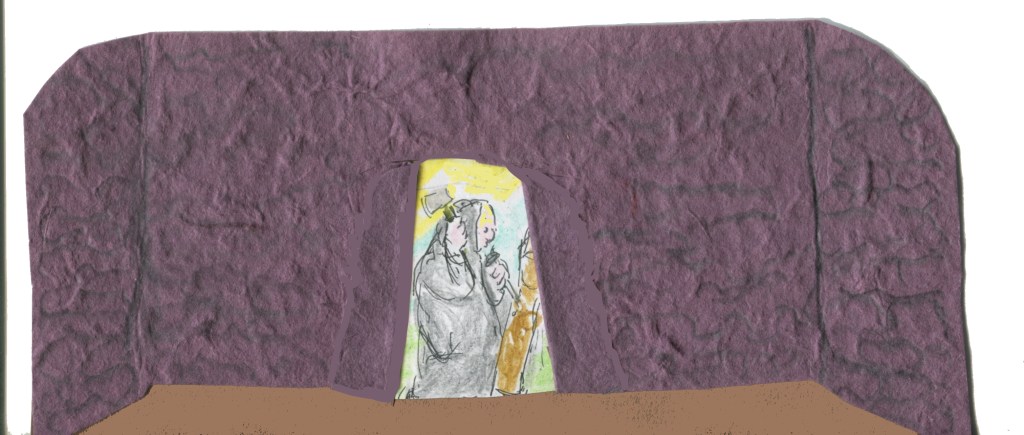
The baker and I are waiting to meet with the abbot in the monk’s chapel of St. Paul. Here the window is leaded with pieces of colored glass. The places in this room where shadows would nestle are not shadows at all, but little patches of dancing light, though the room seems shaded in a solemnity and placid, like the cool depths of a summer forest.

Here the windows don’t reveal the awesome grandeur of vast panorama of Creation, rather the sun comes as a kind of inner light — a Spiritual presence. While I find it peaceful, the baker does not.

         “He sees us, doesn’t he?” The baker says. “God is watching. He sees us when we’re sleeping, he knows when we’re awake, and he knows every sin! There is no hiding from God.”

I let the baker reminisce over Psalm 139 finding God everywhere, even in the depths of Scheol. While my own prayer of thanksgiving is silent.

         Dear God, when I feel you near, I have a sense of peace. Thank you for your nearness in times of trouble, always present with comfort and assurance. But I am in here in your sacred presence with a man who has been harrowed with the rumors of Hell. I know that some people who represent you are known to find power in punitive abuse. So called, holy men threaten retribution for innumerable sins heaped onto a poor soul with mere human guesses threatening an afterlife filled with horrific punishments, though it has never actually been witnessed by any living person. He suffers an inescapable guilt gnawing at his conscience. Maybe he is only a victim of human power-plays and rumors. May your truth-filled judgment bring forgiveness and…

         “What? Are you praying? Are you bringing the Holy wrath down on us?”

         “Has ‘holy wrath’ come down, or is it mercy that surrounds us here?”

         “Devils lurk.”

         “God listens.”

         “God knows we are all born in sin.”

         “God set the land and the sea and the sky with life, and said ‘It is good.’ God didn’t create sin.”

         “Then, by one man, Adam, sin came into the world.”

         “Adam is only everyman. Original sin came into the world on the lips and the quills and inks of early church fathers — The once pagan Augustine remembered it and wrote it to be copied over and again.”

         “The Church Fathers were Christian Saints.”

         “They were also people — wise men, maybe, but people.”

The monk who showed us to this room comes to tell us the abbot will see us now.

(Continues tomorrow)

#79.3 Tuesday, April 7, 2026

Historical Setting: Jarrow, 794 C.E.

The baker and I are waiting in a monk’s chapel near the river, with the monastery gardens all around. Just beyond the wall is the place where the grasses grow and grains are harvested. 

But here I am with this commoner, a baker, a village merchant who has a very different notion of fearing God than do I. I think of the “fear of God” as the experience of being overwhelmed by grandeur, like seeing from a mountain top — the earth and the sky and even the oceans stretch out in one view, with the details of life, the houses and even the great towers of a fortress or a church become miniaturized by the wideness of view. Recognizing God in the grandeur is what I call awe.

But then, I suppose, the smaller view of awe could be fear. And this man truly “fears” God. He puts onto God the worst notions of an earthly tyrant. And the worldly view of the ordained humankinds — the monks and priests. This does nothing to dissuade the notion of God as a human-like earthly man filling in the office as a visible representative of the invisible God. I don’t share his fear.

We are assigned this empty chapel as our waiting place. It would be a large enough size for choirs of monks and a procession of people receiving the elements of the mass, but it is not a well-lit sanctuary where a priest can be clearly seen presiding over worship.  The window in this room casts an unusual light, filtered as sunlight but transformed by the window itself. Like a holy man, who speaks for God, but is not God, this window speaks of light, but interprets the light to cause earthly amazement.

This window [Footnote]  is itself, an art piece as fine as any glazier could set, with glass sections carefully cut and sized, and set together to fill the frame with lead between the sections. A glass window allows a Roman styled basilica with its arches for light but without a view beyond the room. It makes its own view. The sunlight streams in through the tinted glass in colors. It is as though a mosaic is laid in tile but with sunlight coming from the outside dancing the light in colors that fill the room.

[Footnote] https://stephenliddell.co.uk/2018/08/22/st-pauls-monastery-in-jarrow-and-the-oldest-stained-glass-window-in-the-world/    retrieved 6-23-25

(Continues tomorrow)


#79.2 Thursday, April 2, 2026

Historical Setting: Jarrow, 794 C.E.

The baker and I set out to call upon the neighbor in baker’s complaint but apparently, this neighbor is the monastery. And the baker suffers a dreadful fear of God. Worse yet, he can’t distinguish between God and men of the cloth. He walks behind me with his head bowed.

In this temporary assignment, this is my first venture into this kind of justice. It can’t be that complicated. But the baker has an apparent warped perception of holy wrath and fears God’s judgment.

         “Haven’t you heard of the wrath of God, Eleazor?”

         “God made us, and holds no more hatred for humankind than you have hate for the bread you bake. We’ll just talk to the purchaser of supplies and get you a fair settlement. And I always thought this monastery was self-sustaining, raising and grinding their own wheat to make their own bread.”

         “I know well where I deliver the bread. It is always received into the depths of God’s own chambers so well-guarded by monks with swords.”

I know this monastery has gardens and a grain field. It would make no sense for them to call on the village baker to supply bread. But his notion of “monks with swords” hints the clue.

         I say, “I’ve been staying here and as a guest and of course God is here as in all places, but I never thought of God hidden away in guarded chambers.”

We reach the abbot’s door. If Ousbert had been on good terms with him the abbot would have assigned a monk to this temporary task as ealdorman. We are invited to wait for the abbot in the side room — the monk’s chapel.

Ousbert thinks this abbot is unreasonable because he expects soldiers to behave as monks. But that is Ousbert’s issue. Here and now, I expect this baker can’t distinguish between monks with beards and swords and actual brothers.  Mostly the baker is terrified, awestruck and intimidated by any holy authority as he fears the omnipotence of God.

         “This is not like asking justice from the king.” he says, “When a king turns fickle, he can put an innocent man in the castle dungeon for the rest of his life but the king’s prisoner could always hope for salvation. Here, there is no hope at all if God is the fickle master?”

         “God is not a fickle master. I can assure you, in all my years I’ve never known God to be a fickle master, but of course, I haven’t met the abbot.” 

(Continues Tuesday April 7)

#79.1 Wednesday, April 1, 2026

Historical Setting: Jarrow, 794 C.E.

Today I rule a cottage known by the very poor to be the “castle.” It is the assigned post of the ealdorman. Ousbert, the king-appointed captain of the guard in this region found the ealdorman who was here to be corrupt, and had him removed to await the king’s judgment. So, I’m here temporarily, filling this post of the judge and tax collector. In lieu of any written laws I plan to simply rely on the love laws Jesus taught, as I do anyway.

Yesterday the baker brought me a fresh loaf of bread just when I was hungry for bread. And today, the baker comes for his basket to tell me his side of an issue he has with his neighbor. Before I even have a chance to obtain ink and quill to make a report for the king, he’s at the door.

         “I appreciated the bread” I tell him returning his basket empty now.

         He says, “I have a wicked neighbor who demands I supply bread without payment. We’ve just come through a terrible drought and wheat is scarce. It is costly to meet this demand.”

I wonder if this bread was delivered to me yesterday, not as a bribe as I had assumed, but for me to provide the payment for it. I worry the ealdorman receives the bread regularly and actually was that negligent neighbor, so I ask.

         “Was the ealdorman the unpaying neighbor?”

         “Of course not. I gifted that bread to you so you would rule in my favor and demand that my neighbor pay for the bread.”

Good. It was just a bribe. And it hardly seems a complicated issue. May all my judgements be so simply solved. We should just visit the neighbor and I will demand fair payment.

         I say, “Although I appreciated the bread, I don’t intend to rule by bribes. I promised the king’s man I would try my best to be fair, so if your plea is righteous, I will freely judge in your favor. Now let me go along with you to your neighbor, and I will speak up for you, and demand the payment for the loaf you bring him.” 

         He says, “It isn’t one loaf now and then. I’m required to deliver two score loaves, every week.”

         “That seems like a lot for one neighbor. So why do you continue to deliver it?”

         “They have swords and they own my soul.”

(Continues tomorrow)