#53.12, Weds., Feb. 28, 2024

Historical Setting, 626 C.E. On the River near Trier

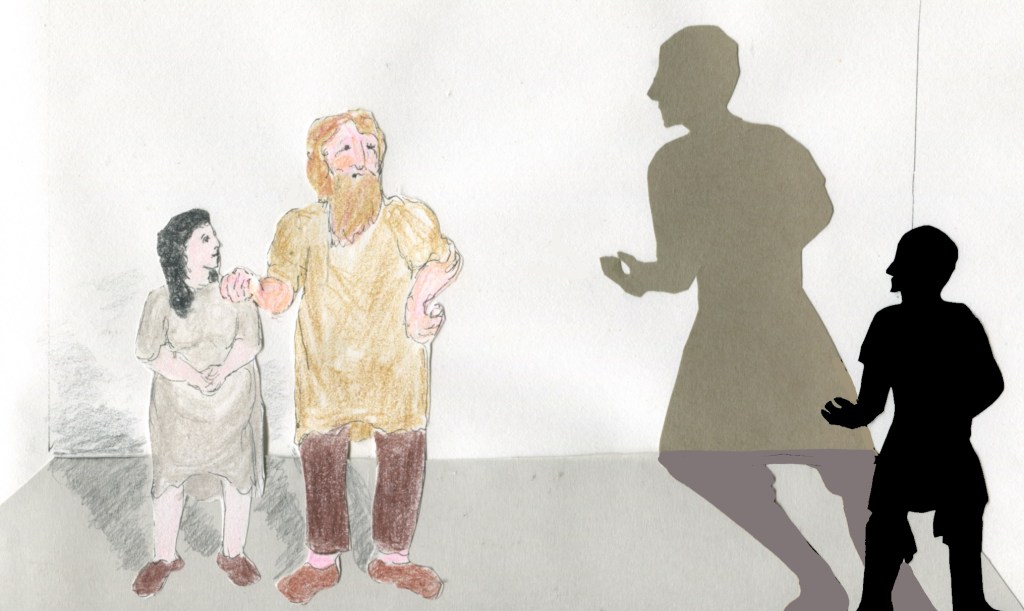
“Where is your weapon, boy?”

         I answer the captain, “I didn’t come for the fight.”

         They are pushing the boats into the water with no time for considering consequences.

         “Then you are a rower!” The one who would be a captain assigns me a task.

         I choose not to abandon my mission of peace just at this critical moment, so now I take up the oars. The rowers in the other boats are pulling hard at their oars, while this “lead boat” with the one acting as captain is lagging. He orders me to row faster. I do not. I am chatting with the others in this boat.

         “Have you ever warred against your neighbors before?” I ask.

         “They aren’t neighbors, they are Jews.”

         “We’ve never had Jews before.”

         I goad them, “It is a hard thing to risk your life for hate. It is bad enough to sacrifice for love, but to take the risk for hatred seems futile.”

         “There is no risk. They aren’t expecting us. We just go in with the torches and light the vineyards then we leave.”

         “And yet every man has a weapon…”

         “If they should hear us, we will need to frighten them off.”

         “Who are they? Are they powerful men, like yourselves? Or are they only families with children?”

         “What do you mean?”

         “The vines are small and frail. What if the people are like that?”

         “They aren’t. They are Jews.”

         All of the boats are pulled onto the shore now, except this one. The captain carries the flame for the torches, and he doesn’t wait for our prow to touch the mud, he is in the water, wading to shore, holding his own flaming torch high, and the others take their light from his.  I can only wait with the boats and watch.

         As I had supposed, these vines are small and green-stemmed with early growth.  Maybe this wall of fiery torches loosed on the land is frightening, but as far as actually burning these tiny sprouts, widely spaced, in fresh clean rows, there is nothing here that can burn. My human nature makes me want to tell them God is against burning the vineyards, and they should see this as a sign.  But I happen to know that God loves all people, and that incomprehensible holy empathy is also concerned for these who come with torches and are hurting now with the disappointment of failure.

(Continues tomorrow)

#53.11, Tues., Feb. 27, 2024

Historical Setting, 626 C.E. On the River near Trier

         It is breezes from the northeast that rustle the leaves left-over through the winter from the autumn-turning that signal a storm to come.

         “I hear you will all be crossing over the river tonight and setting fire to the vineyards of the strangers who have planted starts on the other side.”

         The old fellow doesn’t stop his work to answer me, so I must follow him for his simple affirmation, “Yup.”

         “Where can I find your captain?”

         “He will be down soon. They all will.  I just wish I was young and strong and able to go too.”

         “How many men are going?”

         “Every able-bodied man we have! They will sure be glad to have you with them but you’ll need to have a weapon. Mostly they are using pruning knives and axes.  Some have swords, but you will need to carry something.”

         “What is on the other side? A whole army of soldiers?”

         “’Don’t know. We’ve never been over there and they’ve never been over here. We just have to be prepared for the worst.”

         “So, if you don’t know them, why are you making these plans to burn them out?”

         “They are Jewish, against all that is Christian. They bring Jewish vine starts from foreign lands, to plant right there across the river from us.  It just takes one good waft of winds like we have tonight, and all of our vineyards will be tainted Jewish.”

         From this land point where the boats will launch, I can look across the river and see the expanse of vineyards — young starts of plants in wide spread rows – maybe over there they only dream of what is on this side the river. On this side are vines with generations of maturity and all this well pruned vinery must be very productive, year after year.  As for me, the only burning of vineyards I’ve ever seen has been the autumn bonfires of the heaps of prunings.  I have to wonder if this plan to burn new vineyards is even viable.  And in all my years I’ve never heard of this concern of grapes on one side of a river empowered to change the grapes on another. This sounds to me like a rumor wrought in blind prejudice, not like true vineculture.

         Here are the vintners now, coming down to the boats some alone, some walking together, all armed with heavy blades forged only to be tools for planting and harvest.

(Continues tomorrow)

#53.10, Thurs., Feb. 22, 2024

Historical Setting, 626 C.E. The Vintner’s Cottage on the Moselle

         I should know not to expect a simple little Jesus story to heal the thousands of years of xenophobia, nurtured and developed with wars and walls and obstinance, slaves for a century then abusers for next. With every whim of shifting power humans collect enemies, while God just shakes their head in dismay.

         And here I am on this mission with my only task to say to the Christian wine makers “God loves all people.” Why is this so hard?

         The vintner, master of this house, tells me if I choose to sleep in the guest loft this night it will not be a restful sleep. I’m not sure if that is a warning or a threat, but it is too late and I am too far from home to leave now.

         “Why,” I ask, “What’s happening here tonight?”

         “Not just here. It’s happening all along the river. The Christians are rising up and crossing the river to burn the vineyards of the Jews, then we will sleep very well, all through the bright new day tomorrow.”

         “Then I won’t sleep tonight either. Who’s leading this attack? I’d like to ride on up the river and talk with the leaders of this plan before it’s too late.”

         “It is already too late. When you ride north, you’ll see the boats are all lined up on the bank already for the darkest hour, then, with only the stars for light, one by one the boats will slip onto the river and when the last boat touches mud on the other side we will all light the torches at the same time and sweep into the vineyards with our shouts and flames. Then when the fields of new vines are blazing behind us, and the people come out to watch the flames, we will leave with the same stealth that delivered us to the evil side.”

         I ride north on the river path, on this unfamiliar road as the last light of the setting moon is overcome with darkness. I see how the boats are lined up all along the river in the clear spaces. It looks to be a flotilla of about ten boats all prepared to be rowed. I see one fellow here, going from boat to boat with bundles of tallow oiled rags wrapped around sticks.  Here I tether the borrowed horse loosely to go speak with him.

         Who will be leading this project?

(Continues Tuesday, February 27)

#53.9, Weds., Feb. 21, 2024

Historical Setting, 626 C.E. The Vintner’s Cottage on the Moselle

         This man recites the law precisely.  So how does his understanding of this simple message turn into something so completely different than Jesus could ever have intended?

         I argue, “I know Jesus, his followers and even the lawyer in the conversation were all Jewish so even when missing the point of the story how could this possibly be a teaching against Jews?  In fact, Jesus told a story to make this message perfectly clear.” So, I explain, “when the lawyer asked for that clarification, ‘Who is my neighbor’? He answered with a story.”

“Yes!” The vintner’s hand gestures are so grand he stands up to recite the story! “It is that story that says it all!” Now he finds his seat again, and pours us both some vinegar.  “The story goes, a man was walking down the river path.”

“Actually, he was walking down the road from Jericho.”

The vintner tastes the vinegar in his cup and pours out his cup, as he explains, “it doesn’t matter which road it was. The man was robbed and beaten and left for dead — when along came a rabbi, and he walked on the other side, and so did a lawyer, so all the Jews left him for dead.”

“Actually, everyone was Jewish, the man who was robbed, and the people listening to the story and even Jesus, who was telling the story; it’s an old Jewish story.”

“Of course, Jesus is really the Christ so he is speaking for the Christians.”

“There were no Christians then.”

“He wanted us to know, and now we know, that it is important to be able to sort out the good from the bad. So, when the Samaritan came along, who was notably the ‘good Samaritan,’ he was what they had to fill in for Christians way back then.”

“Actually, the Samaritans were the outcasts. They were the ones the people of that time and place avoided. They were the butt of jokes, the goatherds in the midst of vintners, …”

“The story would make no sense if Samaritans weren’t the good Christians of the time. The good Samaritan acted like a good neighbor to the man, and that is how the story ends.”

Oh dear Jesus, I pray silently, it is all backwards!

The vintner pours out my vinegar, and refreshes my cup with his own fine wine. “So, my friend, Laz the goatherd, the Christians are neighbors together here on this side of the river – good neighbors we are.”

(Continues tomorrow)

#53.8, Tues., Feb. 20, 2024

Historical Setting, 626 C.E. The Vintner’s Cottage on the Moselle

         Face-to-face at the table with this vintner, the old wineskin he pours from has turned to vinegar. So, I already have a clear mind for this argument. We’ve acknowledged a distinction between the edicts of earthly kings and God’s law – something no king or churchman would ever admit to.  Now, when I speak to him with the wisdom of all my years and my strength of literacy and my knowledge of gospel it will be clear to him that God’s law, not necessarily an emperor’s edict, is to love all people, Christians and Jews alike, as God loves us.

         “I know God’s law” he says to me, “It is to take the side of Christians, as does God.”

         “But that’s not the gospel message…”

         “But I’ve heard this from a very fine priest who can read, and there is an actual written gospel right there at the high altar of the basilica for the priests to read it from.”

         “It is something more than that…”

         Before I can even speak the vintner challenges, “I know this well. I listened with all my heart and mind and soul to this reading and I know exactly what is written in that gospel.”

         “Did you hear the part in Luke when Jesus is questioned by a teacher of the law?” [Luke 10:25-37]

         “Yes!  That’s what I am talking about! It clearly says we have to love the Christians and burn down the vineyards of the Jews!”

         “What? No! There is nothing like that at all in Luke! There is nothing at all about burning vineyards.”

         He says, “Maybe you weren’t listening when it was read. Or maybe you can’t understand the inuendo. You know, the Christ told simple stories for simple people, so even a goatherd could know what God’s law is.”  He goes on, “The Christ was teaching and the enemy of God stood up and asked a trick question, ‘what is the most important law?’”

         I happen to know Luke Romanized the teaching style a bit, making a normal question and answer teaching style into a confrontation, a challenge, but the message was the same. This vintner fellow did have the rightful words of the law in his memory.

         He said, “The first law is to love God with your heart and mind and soul, and the second like it, to love your neighbor as yourself.”

         “So” I ask “how can that love law be confused with instructions for burning down vineyards?”

(Continues tomorrow)

#53.7, Thurs., Feb. 15, 2024

Historical Setting, 626 C.E. The Vintner’s Cottage on the Moselle

         The vintner asks me why I’ve come to the vineyards if it is just to pick my way fighting into their controversy. I have to wonder that myself.  Was I driven here for some reason only I can fulfill? Or am I so caught up in the mission of my son that I decided to take this one on too?

         I answer the vintner, “The priest near us received a visit from some vineyard owners from this region, asking about the Christianizing of Jews with baptism.”

         “I wasn’t with them. Our vintners group sent them to that secular church with the question about baptism.”

         “Mater Doe mentioned it to me because she knows my travels have led me into other controversies over the persecution of Jews in other times and places.”

         “Well, this isn’t other times and places, this is here and now. Here it’s about vineyards and wine, not grain sacks and goats.”

         “It was just that she felt the answer she gave your representatives was incomplete and she worried she misled your group about the nature of baptism and the love of God.”

         He fills my cup with a bitter wine this time, and argues, “Since neither you nor I was in that conversation we have nothing to say about it.”

“Of course, so I need to find those who did speak with her, so that they’ve not been misled.”
         “There is no misunderstanding.  We sent them down there to find out if the king’s rule to baptize the Jews was from God or man. We know our Roman Church at Trier makes no distinction, and yet, for Christ’s sake, we needed to know.”

         “Why?”

         “Obviously, if we are preparing to drive out baptized Jews we need to know if that is the same as driving out Christians which might bring holy wrath down onto our own vineyards.  We just needed to know if we would be in danger of God’s judgement.  But if the baptism is just a church thing, and it doesn’t make them Christian in the sight of God, then our vineyards won’t be cursed. After-all, even if baptized, they aren’t really Christian.”

         “That was the concern Mater Doe feared was left unspoken. She thought they were only asking about the holy ritual and not seeking to know the truth that God loves all people.”

         “Of course. We could have asked our own priest if we wanted to hear that.”

(Continues Tuesday, February 20)

#53.6, Weds., Feb. 14, 2024

Historical Setting, 626 C.E. On the River Path near the Moselle River

         This morning I leave early on the borrowed horse. Ana doesn’t exactly send me off with her blessing.  She thinks it’s foolish for a pacifist as I am to go off to quill a fight among wine growers. But, while Brandell is going off across the full span of the earth, I’m simply visiting our neighbors with the plea that they may be welcoming to the settlers coming to the area.

         By afternoon I will be at the stopping place marked with three wine barrels, which is the home of the particular vintner who has a loft for travelers where we’ve stayed before.  It’s my intention to hear what he has to say.

         “Welcome Lazarus!  Are you traveling alone, today?”

         “Yes, but I am not on a long journey this time. I wanted to come up this way a learn a bit more about a controversy among the vintners on the Moselle.”

         “First, let’s tend to your horse, then we can give you a sip of our hospitality here, and when we have said every important thing to say and we have nothing more to talk about, then you can mention those rumors of politics.”

         “Yes, of course. I’ll try to remember good manners despite my purpose in coming.”

         As always, the vintner’s wife is chatty.

         “Your son came this way a while back.”

         “Yes, we suggested this stop to Greg and his partner Gailliard of Metz.”

         “You must be very proud of your son — such a gallant and heroic soldier.”

         “Gallant he may be, I only hope his heroics will never be tested.”

         “Even though he takes after you in outward appearance; he favors his mother with his brilliant conversation and good manners.”

         “May it be so.” And by these people’s good manners my wine goblet is renewed so now I must keep my focus on why I am here. 

         I start, “I hope you will share with me some thoughts about your neighbors to the north, the vine growers near Trier, and the concern with new neighbors coming here from the East.”

         The master of this house brings the whole wineskin to the table abruptly disrupting the normal prattle of his wife’s interrogation, just as she was moving to the topic of my “lovely wife.” 

         He takes a seat across from me, “Why do the politics of wine sales matter to someone who knows nothing of us or of the wine industry?”

(Continues tomorrow)

#53.5, Tues., Feb. 13, 2024

Historical Setting, 626 C.E. Luxeuil to borrow a horse

         This morning I am at Luxeuil which happens to be one of these monasteries built on a Roman ruin. Here my own son, Brother Gabriel, takes the messages from the leg of a bird to the abbot in this community.

         So here I find Gabe at his work in the dovecote.

         “Papa, Greg told me Brandell is leaving with them on their next journey.”

         “You’ve heard right. He has a whimsy in his heart that won’t let go of him until he has found a way to tell his perceptions of gospels to those who can’t read. Now that his songs are banned, he wants to make paintings of the stories.”

 Gabe folds his hood back, and looks right at me. “It would be a noble cause for a poet or artist if it were possible to change a person’s understanding. But I fear he isn’t being realistic. I can’t see how stories and pictures can turn any hearts.”

“Well, Gabe, maybe it’s not much different than kings and emperors believing baptism can change Jews into Christian. But I’m sure that journey will change Brandell, himself. Whether or not it will be a tool for him to change the thinking of others is yet to be seen.”

         “So, you aren’t worried about him, Papa?”

 “Of course, your mother and I are terribly worried – Brandell, setting out on such a long and dangerous venture — a young man alone with nothing but a whimsical cause. Yet considering his obedience to Spirit how can we argue?  I imagine his long-passed grandpapa is celebrating in whatever way our buried ancestors can rejoice. And of course, you know, we are proud of him.”

“So where are you going, Papa, that you need to borrow a horse?”

“I’m kind of finding myself on Brandell’s same mission.  I’ll be riding up to talk with the vintners on the Moselle.  Mater Doe alerted me to a controversy over baptism, and we are concerned the group of vintners are looking for an excuse to keep Jewish families from settling across the river from them, now that the emperor’s edict is sending so many Jewish refugees off this way.

“So,” Gabe asks, “are you taking them songs or pictures?”

Gabe has indeed learned the rye humor of a monk. “Maybe just a leavening for conversation. You know I’m a talker.”

“Stay safe, Papa, Via con Dios.”

(Continues tomorrow)

#53.4, Thurs., Feb. 8, 2024

Historical Setting, 626 C.E. The secular church near Annegray

Mater Doe, our priest, shared with me her concern with answering the question of the vintners with her explanation of baptism, it puts the Jewish settlers coming to the lands in danger as outcasts. She is realizing now, after they left, that the real concern they had wasn’t about who is allowed to be baptized, but that baptism is only an outward sign and the Jewish families that follow the requirement of baptism won’t really be changed into Christian by it.

 “I know a vintner who lives on the Moselle River,” I tell Mater Doe, “So you needn’t worry about any misunderstanding left with the arguing vintners. I will just ride up there tomorrow and find out about the source of this controversy. I agree with you, that someone needs to assure these worried Christians that God also loves their Jewish neighbors regardless of the rule made by kings against them. They need to know the Christians aren’t being replaced.”

Thinking this through on my way home I know it’s been centuries since Gaul made its enemies based on ancient Roman ideas of intolerance. But now, in these times, fear of Jews is being dredged up for convenience of the politics in the East. Maybe the intolerance already lay deep and unspoken among the grape growers or maybe it is just spreading anew. But I believe this was this same intolerance that crucified Jesus, then the Romans turned around and blamed the murder of Christ on the Jews themselves.

         That is the ugliest variety of political deception. It happens when an autocratic emperor or simply an abusive parent or spouse commits a cruelty against a person or a nation in their care, then blames this same victim as though the child or the abused tribe or people had crucified their own rabbi.

Now this ugly stain is in the vineyards of Trier. It is the unhealed wound between Christian and Jew which really is only about the severance between ancient Rome and ancient Judaism. It should be buried in the rubble of the destroyed temple and left deep in the ruins of Rome.  But the ruin and the rubble of Rome is all around us here. Why do we keep trying to make churches out of it?

First thing tomorrow I will borrow a horse from Luxeuil and ride to the vineyards on the river, hopefully, to stifle the murmurs of hate.

(Continues Tuesday, February 13)

#53.3, Weds., Feb. 7, 2024

Historical Setting, 626 C.E. The secular church near Annegray

 Mater Doe tells me of her conversation with two men who came here asking about baptism. “They asked me particularly about the power of baptism as it is demanded for Christianizing Jews.”

   “That is the concern these days?”

 She continues, “We know it’s a king’s rule and an emperor’s edict that Jews must be baptized. And of course, I’m always glad to pour out the water with blessings and speak the words of Christian baptism for anyone who asks, even if it is only to keep them safe from the political persecution. And I will put their names in the book here.”

   “Why is this a concern of the vintners on the river; are they not already Christian?” I asked.
         “I was also wondering why they asked. I simply told them I know that baptism is an ‘outward and visible sign,’ but that only God knows the Spirit in each of us. And that seemed to be all they wanted to hear. When I explained baptism only affirms the change, it doesn’t create the change, they’d heard enough and they left.  Now, it worries me that I didn’t know why that particular answer would be a resolution for them.”

   “And you have second thoughts?”

   “Oh, yes,” she explains, “Now, I realize they were looking for an excuse to distinguish between the spiritual nature of the Christian and the Jewish spirit.  I wish I had said it differently. I wish I had said people are all of one Spirit in God. God loves all people, Christian, Jew, Pagan, whatever. It may not always be the Roman Rule, but it is what I teach here. I wish I had told them that distinctions between people deciding who is beloved and who is not, is a human flaw, not a judgment by the all-loving God. Drawing these artificial human distinctions only separates us from God.”

   “Even if you had explained it to them, would they have listened?”

   “Maybe not.  I think they were just looking for an excuse to turn against the Jews.  There are Jewish settlers coming into the lands near Trier making their homes across the river from these Christian vineyards. And the more I think about it, I have to wonder why they came all this way to ask me, when they could have taken this question to the priest in Trier. He is the one doing those baptisms.”

(Continues tomorrow)