#53.5, Tues., Feb. 13, 2024

Historical Setting, 626 C.E. Luxeuil to borrow a horse

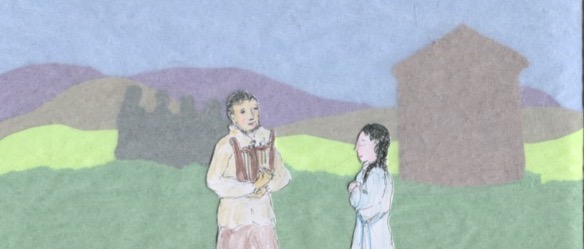
         This morning I am at Luxeuil which happens to be one of these monasteries built on a Roman ruin. Here my own son, Brother Gabriel, takes the messages from the leg of a bird to the abbot in this community.

         So here I find Gabe at his work in the dovecote.

         “Papa, Greg told me Brandell is leaving with them on their next journey.”

         “You’ve heard right. He has a whimsy in his heart that won’t let go of him until he has found a way to tell his perceptions of gospels to those who can’t read. Now that his songs are banned, he wants to make paintings of the stories.”

 Gabe folds his hood back, and looks right at me. “It would be a noble cause for a poet or artist if it were possible to change a person’s understanding. But I fear he isn’t being realistic. I can’t see how stories and pictures can turn any hearts.”

“Well, Gabe, maybe it’s not much different than kings and emperors believing baptism can change Jews into Christian. But I’m sure that journey will change Brandell, himself. Whether or not it will be a tool for him to change the thinking of others is yet to be seen.”

         “So, you aren’t worried about him, Papa?”

 “Of course, your mother and I are terribly worried – Brandell, setting out on such a long and dangerous venture — a young man alone with nothing but a whimsical cause. Yet considering his obedience to Spirit how can we argue?  I imagine his long-passed grandpapa is celebrating in whatever way our buried ancestors can rejoice. And of course, you know, we are proud of him.”

“So where are you going, Papa, that you need to borrow a horse?”

“I’m kind of finding myself on Brandell’s same mission.  I’ll be riding up to talk with the vintners on the Moselle.  Mater Doe alerted me to a controversy over baptism, and we are concerned the group of vintners are looking for an excuse to keep Jewish families from settling across the river from them, now that the emperor’s edict is sending so many Jewish refugees off this way.

“So,” Gabe asks, “are you taking them songs or pictures?”

Gabe has indeed learned the rye humor of a monk. “Maybe just a leavening for conversation. You know I’m a talker.”

“Stay safe, Papa, Via con Dios.”

(Continues tomorrow)

#53.4, Thurs., Feb. 8, 2024

Historical Setting, 626 C.E. The secular church near Annegray

Mater Doe, our priest, shared with me her concern with answering the question of the vintners with her explanation of baptism, it puts the Jewish settlers coming to the lands in danger as outcasts. She is realizing now, after they left, that the real concern they had wasn’t about who is allowed to be baptized, but that baptism is only an outward sign and the Jewish families that follow the requirement of baptism won’t really be changed into Christian by it.

 “I know a vintner who lives on the Moselle River,” I tell Mater Doe, “So you needn’t worry about any misunderstanding left with the arguing vintners. I will just ride up there tomorrow and find out about the source of this controversy. I agree with you, that someone needs to assure these worried Christians that God also loves their Jewish neighbors regardless of the rule made by kings against them. They need to know the Christians aren’t being replaced.”

Thinking this through on my way home I know it’s been centuries since Gaul made its enemies based on ancient Roman ideas of intolerance. But now, in these times, fear of Jews is being dredged up for convenience of the politics in the East. Maybe the intolerance already lay deep and unspoken among the grape growers or maybe it is just spreading anew. But I believe this was this same intolerance that crucified Jesus, then the Romans turned around and blamed the murder of Christ on the Jews themselves.

         That is the ugliest variety of political deception. It happens when an autocratic emperor or simply an abusive parent or spouse commits a cruelty against a person or a nation in their care, then blames this same victim as though the child or the abused tribe or people had crucified their own rabbi.

Now this ugly stain is in the vineyards of Trier. It is the unhealed wound between Christian and Jew which really is only about the severance between ancient Rome and ancient Judaism. It should be buried in the rubble of the destroyed temple and left deep in the ruins of Rome.  But the ruin and the rubble of Rome is all around us here. Why do we keep trying to make churches out of it?

First thing tomorrow I will borrow a horse from Luxeuil and ride to the vineyards on the river, hopefully, to stifle the murmurs of hate.

(Continues Tuesday, February 13)

#53.3, Weds., Feb. 7, 2024

Historical Setting, 626 C.E. The secular church near Annegray

 Mater Doe tells me of her conversation with two men who came here asking about baptism. “They asked me particularly about the power of baptism as it is demanded for Christianizing Jews.”

   “That is the concern these days?”

 She continues, “We know it’s a king’s rule and an emperor’s edict that Jews must be baptized. And of course, I’m always glad to pour out the water with blessings and speak the words of Christian baptism for anyone who asks, even if it is only to keep them safe from the political persecution. And I will put their names in the book here.”

   “Why is this a concern of the vintners on the river; are they not already Christian?” I asked.
         “I was also wondering why they asked. I simply told them I know that baptism is an ‘outward and visible sign,’ but that only God knows the Spirit in each of us. And that seemed to be all they wanted to hear. When I explained baptism only affirms the change, it doesn’t create the change, they’d heard enough and they left.  Now, it worries me that I didn’t know why that particular answer would be a resolution for them.”

   “And you have second thoughts?”

   “Oh, yes,” she explains, “Now, I realize they were looking for an excuse to distinguish between the spiritual nature of the Christian and the Jewish spirit.  I wish I had said it differently. I wish I had said people are all of one Spirit in God. God loves all people, Christian, Jew, Pagan, whatever. It may not always be the Roman Rule, but it is what I teach here. I wish I had told them that distinctions between people deciding who is beloved and who is not, is a human flaw, not a judgment by the all-loving God. Drawing these artificial human distinctions only separates us from God.”

   “Even if you had explained it to them, would they have listened?”

   “Maybe not.  I think they were just looking for an excuse to turn against the Jews.  There are Jewish settlers coming into the lands near Trier making their homes across the river from these Christian vineyards. And the more I think about it, I have to wonder why they came all this way to ask me, when they could have taken this question to the priest in Trier. He is the one doing those baptisms.”

(Continues tomorrow)

#53.2, Tues., Feb. 6, 2024

Historical Setting, 626 C.E. The farm in the Vosges

         Brandell prepares for his journey into the unknown of Constantinople. He will be guided by his brother and Gaillard across the mountains, then they will part ways and Brandell plans to join a merchant ship’s crew in Ravenna to earn his travel by sea to Constantinople. Lots of ships are traveling that route. I only hope he will find travel by sea to his liking.

Greg has dressed him up as a traveler with trousers and a shirt instead of a tunic. Brandell thought it was a prank at first but he’s getting accustomed to the outfit. Greg always dresses like a soldier, so he doesn’t wear this traveler’s outfit.

When Brandell reaches Constantinople, Greg has placed a little map of the city in his traveler’s bag so he will know how to find the icon artist when he arrives. Ana worries. She wants him to take a bird to send home when he is safe. But Constantinople is too distant for that so the bird they take will be released after they cross the mountains.

         When Ana was so young and bearing these children, we knew each of them by their spirit throughout that dangerous journey into life. In losing and parting we pray that we will always find each of our loved ones in the great milieu of love that is Spirit. We will miss Brandell. May he always go with God. Dear God, always remind him he is loved. Give him courage. Amen.

After the Sunday songs and prayers Mater Doe asks to speak to me alone. Ana and the others go on with the wagon. I’ll walk home. The priest is concerned about a visit she had from two men who are vintners along the river near Trier.

 “They came all the way down here looking for something that could settle an argument they have with an edict issued in Austrasia against the Jews.” She continues, “I can only wonder why that would be a concern for vintners in Burgundy. Apparently, this king of Austrasia, Dagobert, who may also be rising to power here, has continued the edict made by the Eastern emperor against the Jews.” [Footnote]

“Oh, I know what this is about. This forum of hate has floated up from the Roman depths these days, as a Church issue because Jews will be baptized to Christian by this rule. This rejection of Christianity’s Jewish root is the same concern that sent Brandell off wandering.”

[Footnote] https://en.wikipedia.org/wiki/Jewish_revolt_against_Heraclius   retrieved Oct. 1, 2023

(Continues tomorrow)

#53.1, Thurs., Feb. 1, 2024

Historical Setting, 626 C.E. The farm in the Vosges

         The little painting, the icon, that Greg and Gaillard brought as a gift to our household is captivating. People who know the story well, children who’ve never heard it, the peasantry who have heard it all bedazzled with mystery by priests and scholars, everyone, now sees it just this way. Since the pale, frail Lazarus in the image, all wrapped in linens really looks nothing like me, even at my worst, having the image in our house seems to stifle the rumors that I am that same Lazarus.  I am probably the only one seeing it who is surprised by seeing a Jesus image who looks like a man of today in Constantinople. This wardrobe of Jesus makes that common Jewish man look like a Roman ruler. And the style and detail of the burial vault is not at all what my sister provided for this, her dead brother, even though she could afford the best.

         But an image is always made for the time in which it was created. We pretend to know the look of history but it’s always invented simply from a few relics and a lot of imagination. Yet this little picture speaks perfectly of the story it tells. It shows a “sign” from Jesus.  Jesus did this thing of raising this dead man back to life to show something of the nature of earthbound humanity, a metaphor or sign or maybe say a visible window on the invisible heaven.  “On earth as it is in heaven.” It is what signs in the Gospel of John have to say.  On earth a friend of Jesus was sent back into life on earth, and in that way, the mirror to the invisible world of Spirit offers an image of resurrection. It’s a forever story and so here I am, metaphor for everyone’s Spiritual forever. If I must be a relic, let me always speak for the time we are living in now.

         Maybe Jesus hadn’t a thought about a complicated earthly forever he gave to this friend. But maybe that vague, invisible reality of Spiritual life is no less overwhelming.

         Whatever way the picture tells the story, it’s been an inspiration for our youngest son, Brandell, to learn this technique of art so that all the stories from our family lessons in bible can be told seemingly alive and in brilliant tones. Then others can see the stories through his eyes.  Now he is preparing for this journey to find a teacher.

(Continues Tuesday, February 6)

#52.14, Weds., Jan. 31, 2024

Historical Setting, 626 C.E. The farm in the Vosges

         While Brandell is completely committed to a journey somewhere he knows nothing of, using shear creative imagination to solve a problem he has no control over, he is simply answering God’s dare. He has no imagination for any of the dangers of travel. He doesn’t know the loneliness of strange places or even the pitfalls of standing against the edicts of the Church right here. He just has no idea.

         I, on the other hand, know exactly what God is calling me to do. And instead of jumping head long into it teaching the message for which I am a  mere earthly sign — that life is many times over, resurrection in spirit, in healing, in hope, in love, in renewal…

         And I haven’t been speaking of the sign my life was intended to reflect. On this metaphorical earth I am the resurrection and the life of one metaphorical human. While in heaven, the spiritual truth in the full eternal reality of the love of God, Jesus is the resurrection and the life for all spirit. On metaphor earth, the visual image shows an invisible heaven. So, I have been remiss. I’ve been quietly living a farmer’s life for these years now, while the Church gropes blindly in the darkness of ignorance, feeding the spiritually deprived a diet of edicts and platitudes and contrivances of doctrine to fit earthly politics, sending people plundering after anything but the love of God.

         So here it is in our house on the shelf for precious things, a little icon from the imagination of some stranger master artist showing a story I have been hesitant in telling. And even though I saw it when it was happening, I hardly understand now how the error persists in the retelling of the Gospel as stories that are disparaging of the Jews. It was a Roman hate, not a God hate, or a gospel hate yet it seeped into gospel words.

         Surely Brandell has no way to know anything of this. Clearly, the Roman trick of redirecting blame to the victims of crucifixion seeped into the Gospel of John. Now for all these hundreds of years the Church and the people who obey the law of the Church, just let those words say what isn’t even possibly true: “The Jews killed Jesus.” It was skewed to suit the ancient Roman politics and to accommodate Gentile Christians in an emerging sect of Christianity rising in the turmoil after the destruction of the Temple.

         For Brandell, setting the record straight is his holy mission. For me, this is personal because it is the pages of the story of my own family.

(Continues Thursday, February 1, 2023)

#52.13, Tues., Jan. 30, 2024

Historical Setting, 626 C.E. Creekside near the farm in the Vosges

         “I did pray about it, Papa. And God answered with that kind of backwards answer when God expects us to already know something. So, the second verse of my prayer was, ‘Yes, dear God, Creator of all Creation, I don’t even want to think about going off for a year or two to a foreign land that speaks a strange language just to look for that icon painter to teach me how to tell the bible stories in pictures so not speak them with poetry and dancing.’”

         So, Brandell believes God is calling him to become an “icon painter.” 

He feels his prayer was answered with a holy dare.

         He tells me, “God knows it’s all I can think about. I’ve tried not to think of it at all.  But now I really have to go to Constantinople to find the teacher of this art. I have to learn this so I can give the gospel stories to the people who are illiterate, the common people Jesus most wanted to teach, those who are hungry for stories of how God loves them like a mother, when what the Church provides for these longing hearts is hollow incantations of doctrine.”

         “Maybe Greg and Gaillard will be going back there again soon. You can go with them.”

         “They said they are gathering sponsors for a journey to escort bishops to Rome. But probably Constantinople is on the way to Rome, wouldn’t you think?”

         He has no idea of faraway places. And yet he feels such an urgency to go off somewhere and learn something new. It’s more than the words of a song, or even the rumors of a living Lazarus. He isn’t running from anything so much as he is driven to find a way to retool his skills to tell bible stories using visual images that speak without words. And he feels God is demanding this holy mission.

         Brandell explains, “When I talked with Greg about my need to go to Constantinople he said I would have to wait until they went there again, which might be months or years, or else I will have to go alone without any sponsors or purse.”

         “He told you that?”

         “Well, actually Greg said he couldn’t imagine anyone going alone on a journey like that. And so, I’m hoping they will stop off at Constantinople on their other journey, or else I’ll have to go it alone.”

(Continues tomorrow)

#52.12, Thurs., Jan. 25, 2024

Historical Setting, 626 C.E. The farm in the Vosges

         “Brandell.” I ask, “sing for me this so-called evil verse?”

         He sings shamedly, nearly under his breath.

         “My grandpapa was a Pharisee, fine,

           A God beloved, obedient Jew!

         He feasted on lamb and sipped blest wine

          And remembered the Sabbath, solemn and true.”

         This little verse hides no devils. But in these times the Church seems to be looking for any way to sever the Jewishness of Jesus from doctrine. It is non-sensical that Church authorities would banish a people simply in remembrance of ancient Roman propaganda.

         Brandell explains, “The Church authority said don’t think about using gospels for music, but when someone says don’t think of something like bible stories, I think of more bible stories for songs that only make it more complicated.  I could sing a different song, but I really don’t want to never ever do the vine dance again. 

         “And what’s worse, I’m afraid the Jesus love will just be pushed aside, especially among the common people and the illiterate poor who go to Church thirsty for the bread and wine of Christian belonging, and then are given the cross — the sign of death by imperial power — when we are the child who asks for love – and what father would give a stone when asked for bread?” [Matthew 7:9 ]

“Brandell, I hear what you’re saying.”

What can I say to him? Maybe my silence is my failure. I let my own calling to life and life again go silent. All Creation and all people are like a great pot of vegetable soup with all varieties of sweet flavors together in God’s love on earth as it is in heaven. Then picky people sort out the peas and carrots from the barley in the soup, and by the time the illiterate peasants are served it is a bland barely broth.

We are varieties of people yet all are one in God’s loving Spirit. Maybe I, as nothing more than a sign from a gospel, should be making the plea for others to see through me the sign of the ever-healing love of God, because that is how we are all gifted. Yet, here I have allowed the Church doctrine to invent a death of me in order stifle the true reading of the variety of gospels and law.  My silent prayer is Forgive me God. It seems a long silence.

         “So Papa, I know you are so quiet so not to lecture me. I know you will tell me to pray about this.”

         “Of course, Brandell. Just pray about it.”

(Continues Tues. Jan. 30)

#52.11, Weds., Jan. 24, 2024

Historical Setting, 626 C.E. The farm in the Vosges

         I can understand Brandell’s frustration with that Church authority at Luxeuil. For all these centuries the ancient Roman’s rumors of poison hate against Jews have been lingering in the shadows, seemingly harmless. Rome is long gone. But now, suddenly, one emperor, far away in the East has himself a skirmish with a tribe of Jews and he decides the Jewish warriors are obstinately undaunted even by the heaps of horrors of wars. Of course, the emperor had no imagination for Jewish fighters winning against the empire. They are a small Persian tribe and he has armies. But he strikes out at that resilience by turning around the longstanding religious tolerance. Now, in the East, Jews must be baptized Christian or die!  So, the unbaptized whom the Gentiles called, “stubborn,” maybe really meaning faithful, decided they won’t be Christianized and they are picking up their families and seeking safety in Gaul. Now that Emperor, Heraclius, calls on the kings of Gaul to make similar edicts against Jews. One Merovingian king rising in Austrasia, Dagobert, rules in solidarity with the Emperor, and he is also requiring Christian baptism of Jews. [Footnote] And when it comes to baptism, the Church is the responsible administrator. Hating Jews seems to be the Church’s political responsibility.

         The fearsome thing is the animosity that is intentionally taught against Christianity’s own Jewish root.Brandell is concerned that the authority of the Church Doctrine is not only opposed to the Christian songs but also to the ancient dance.

         “Papa, I’m definitely not allowed to mention that the vine dance is very likely what Jesus was dancing when he said, ‘I am the vine and you are the branches?’ [John 15:5] When we are dancing together, reaching, connecting one to the next and set ourselves as the vine linked as we are, surely, we are in remembrance of Jesus’ words to his friends. Bound together he told us we are in the spirit of love, ‘you are in me as I am in you,’ and in dancing we are all a part of the same vine together. But Father Albestus says that even the ancient dance should be banned if it tells a gospel story to the illiterate.”

         “Why does it matter that the stories are kept hidden from the illiterate?” I wonder.

         “He said, offering the stories without knowing Doctrine was the source of my error.”

[Footnote] As noted earlier, #52.6, Dagobert did make an edict against the Jews, and the Jewish encyclopedia article followed the notion that Dagobert’s support of Heraclius was unlikely because the communications between Frankish Gaul and Constantinople would not have supported solidarity. But Carroll and others point to on-going and extensive communications between the East and the West in the early Byzantine era.  A better reason for no connection with the edict by Heraclius is that antisemitism was already widespread anyway.

(Continues tomorrow)

#52.10, Tues., Jan. 23, 2024

Art Notes: This gouache painting is this artist’s interpretation of a detail of the relief from the Arch of Titus (in ruin) showing the Roman looting of the Temple in Jerusalem.

Historical Setting, 626 C.E. The farm in the Vosges

         Brandell asks me, “So Did Rome ever conquer the Jews?”

         “Rome is gone and Jewish people still worship one God as they always have.” That’s an easy, but incomplete answer, that seems to break open a ray of light into Brandell’s deep darkness. He nearly smiles.

         So, I throw a little more history into that darkness. “The Romans used every warring way they knew to try to subdue the Jews. They infiltrated the leadership with their own puppet king and even the appointment of the Sadducee, high priest, required Roman approval. When a popular leader arose from the people and went around teaching the old law of God’s love, it was an impossible challenge to imperial pride — to love one’s neighbor as self — so they crucified him. They sacked and burned the Temple built with stone. Before that, they massacred the Jewish people at Sepphoris. [Footnote]  When flat-out killing people and destroying the temple didn’t make Jews dissolve away into Roman, rumor and propaganda hammered away at truths to make Jews seem to be devils.

         “Even when Rome took thousands of Jewish lives and their property, they couldn’t break their deep bonds of faith and obedience to God’s law that made them a people together. The Jews could never become Rome’s war prize. Rome would have had to separate the people of the Hebrew root from God and the law that made them/us, a people together. All the conquering Rome could muster could never twist these people into Roman to worship a pantheon of imaginary gods, or even a serial monotheism of flesh and blood Caesars.

         Brandell wonders, ”What do I do with a song about a Jewish Grandpapa? Is he still beloved by God when the Church follows the king’s edict against the Jews?”

I can affirm, “It is the broken bonds of love among people that surely must break God’s heart. Brandell,” I ask, “what do you suppose is in the extravagant resilience of Judaism that so wrankled the Romans and now annoys the Church?”

         “You are going to tell me, aren’t you, Papa?”

“It was pure obstinate faithfulness that was taught us by our mothers and our prophets. It was the story of God’s love for all the followers as a whole people with God always goading us through each wilderness.”

         “So, how was it that Romans conquered all these tribes of Gaul and never conquered the Jews?” Brandell asks.

[Footnote] Carroll, James Constantine’s Sword: The Church and the Jews, A History, [Boston, New York, Houghton Mifflin C. A mariner Book, 2001.] p. 83

(Continues tomorrow)