#54.12, Thurs., March 28, 2024

Historical Setting, The cottage in the Vosges

         This is a family reunion feast day, celebrating these generations. My oddity of life and life again is simply assumed among these people as they’ve been waiting for me, where other families meet for reunions, bringing the completed stories of ancestors who are no longer present to set the stories right. Here, I am the bearer, the earthly connection with the Jewish root of Christian.

         Gabe has taken leave from Luxeuil to be with us here. He’s been filled in on details of Brandell’s discovery of my burial and rescue. We are three generations here, with a deep root into the Jewish heritage of Christian. Four at this table are here as lovers and mates to our children so any thought we are a Jewish family with a Christian frosting is probably unfounded. Now we are all simply Christian at this table.

         Galliard mentions it, in its most superficial revelation, “We never seem to serve up the traditional Christian pig, it’s always lamb or less at this table.”

         Greg adds, “No pig ever dies for Easter on this farm.”

         Haberd adds, “No pig ever dies at all on this farm.”

         Haberd’s wife adds, “No pig ever lives on this farm.”

         Gaia weighs in, “But this lamb is really delicious.”

         Layla makes an excuse for her husband’s sour grunt, “For some, lamb is an acquired taste.”

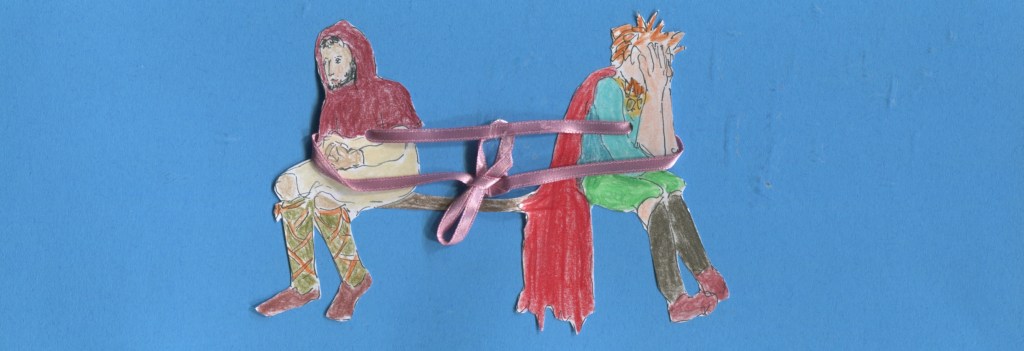
         This is Layla’s husband’s first feast at our table, and she seems to be caught between her childhood family and her husband. He seems to me, at this first meal with him, something of an oversized, blundering ruffian – an oaf.  And here he is complaining about a serving of meat. He says, “It hardly seems like Christian food.”

         I only wish I had been here for Layla when her marriage was arranged. At least I would have sat this stranger down and asked him his dreams and biases before he ever planted his seed in the womb of our own baby girl. At least I don’t have to make my objection to any noble parentage of this fellow. Though it is clearly too late for me to make any objection now at all.

         Gaia, eases the tension asking the fellow if he is a hunter or a fisherman.

         He answers pridefully, “We have fish aplenty at our house, and when the peasantry is allowed the hunt, I can provide a plump and oily boar.  Poor but plenty is our table, isn’t that right, Girl?”

(Continues Tuesday, April 2)

#54.11, Weds., March 27, 2024

Historical Setting, The farm cottage in the Vosges

         Greg has no interest in hearing a lecture on gratitude for Haberd’s keeping the farm in good order. He dismisses our chat with, “we are all glad you’re back, Papa.” Kind as it sounds, Greg does have his own elder brother edge gnawing here at the peace.

         Now Hannah’s turn to speak with me is wedged in among all the tasks of organizing the family feast. Haberd’s wife seems relieved by this reprieve from her most helpful sister-in-law while Hannah takes this bench by the fire to talk with me.

         “Hannah, I know your mother has appreciated having you with her in my absence.  When we made that little cottage by the creek, I never imagined Ana would have to be alone there.”

         “Papa, I can understand why you wouldn’t be very good at noticing other people’s mortal needs.”

         “That’s gracious of you Hannah. How have you been?”

         “Momma and I have both been busy calling on the sick, and minding the needs of people all around. We’ve been going out on our calls together now that Momma is getting older.  She tires more easily but she is still strong and able to work.”

         “And how have you been, Hannah?”

         “What do you mean?”

         “I ask you how you are, and you tell me how everyone else is. You are always very good at noticing other people’s mortal needs. But, what of your own mortal needs?”

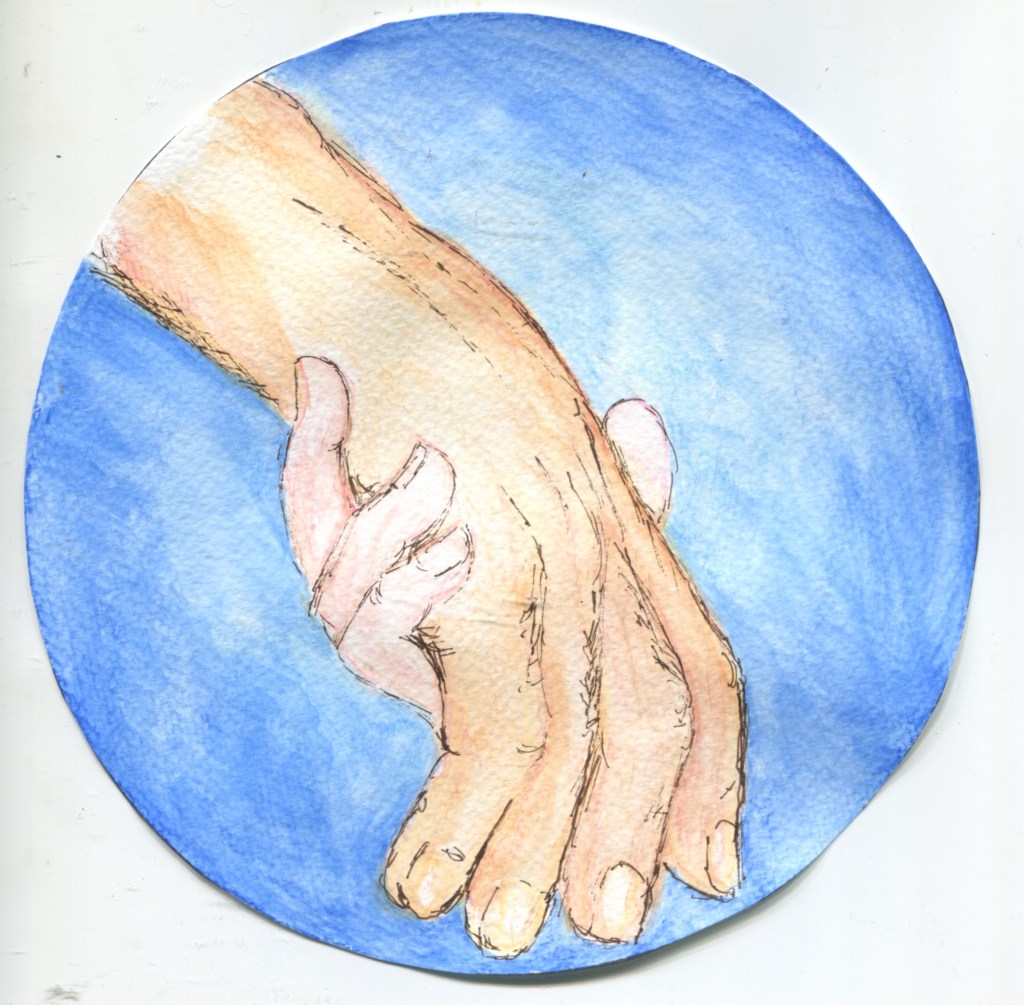
         Hannah bows her head so I don’t notice her quivering chin. And I know her need is this father’s hug to wipe away her tears. She is always the strong arms of strength for everyone else. And here she is now, in my arms sobbing. The youngest grandchildren come to watch this, and the five-year-old pats her so very tenderly.

         “What did you say to her, Papa?” Haberd accuses.

         Hannah regains her composure to answer for me, “It’s nothing Haberd, just leave me alone,” and she goes outside to be alone.

         “I just asked her how she’s been. Maybe that’s a question she isn’t accustomed to answering.”

         “Hannah is always fine. She is just Hannah.”

         Haberd makes this weary excuse for this blind habit we all may share in, taking Hannah for granted. She keeps her vulnerability hidden in all her good works. It’s not that no one thinks of Hannah, rather it is that everyone doesn’t.”

(Continues tomorrow)

#54.10, Tues., March 26, 2024

Historical Setting, 629 C.E. The cottage in the Vosges

I’m listening to my children fill in the missing years. Next, I listen to Greg who is here on the bench with Gaillard.

Greg begins, “Papa, I guess you found out the hard way about that ‘bad neighborhood’ where the Jewish refugees ended up.”

“Did Brandell tell you of the peacemaking possibility he and Gaia laid out for them?”

“He said their outsider viewpoint gave them unbiased judgment, which made it obvious the neighbors on both sides of the river had to work together or no vineyards could ever flourish.”

I add, “Try as I did, when I went there several years ago, I wasn’t able to interest anyone in peace, and they couldn’t find it for themselves.”

Gaillard observes, “It was probably one of those possibilities that was right in front of them yet the established vintners feared any success of new neighbors would only result in their own loss.”
         Greg adds, “and the refugees had their own fears and concerns.”

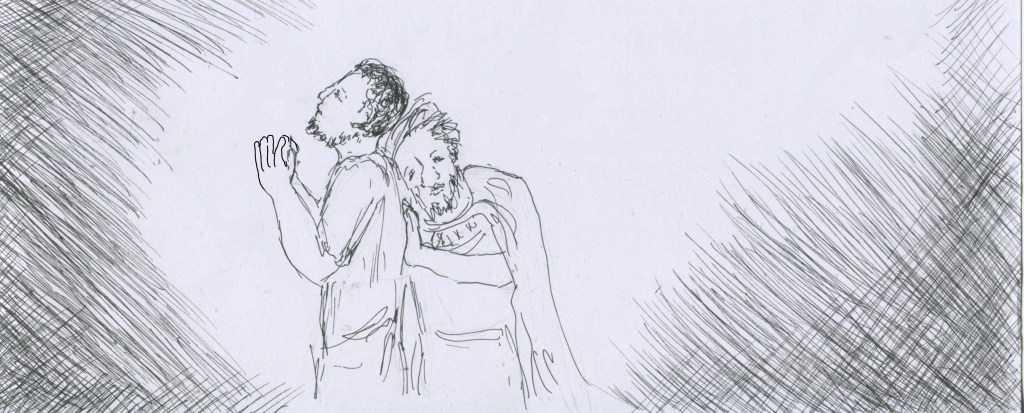
“Now,” I mean to speak to Greg of his own brother, “when a rift arises close to home it is sometimes hardest to see.”

“I feel one of those patriarchal lectures coming on, Papa. Did I ignore my responsibility to the brotherly bond with Brandell, somewhere in all this?”

“No, Brandell only spoke of his gratitude to you for starting him on his journey, guiding him through the mountains to the port in Ravenna.  But I have heard from Haberd that you have a debt of gratitude due him.”

“Haberd? What do I owe Haberd? He gets to rule the family farm, even though he is hardly the first born here.”

“Haberd and his wife and children have kept it a family farm, when so much tilled land is controlled by the few rich noblemen in these times.”

“So for this, Gaillard, nobleman of Metz, and I, are supposed to be grateful?”

“He only needs to hear you are grateful for the use of pastures for ten horses and ten mules.”

“So that’s what this is about. You know we could have brought elephants.”

“Or camels, he said you offered. He doesn’t need threats of larger beasts, or even payment for the extra straw that took a bit of ingenuity for him to maintain. He just needs a kind word of appreciation from his older brother.”

(Continues tomorrow)

#54.9, Thurs., March 21, 2024

Historical Setting, 629 C.E. Along the creek in the Vosges

         This is the season when brittle winter softens to life.  Ana and I are hearing the grandchildren tell us things they remembered of the creek last summer. One turns over a rock just now at the edge of the water and a little crayfish is found to be wintering in that place. Suddenly, exposed and vulnerable it scurries deeper into the creek. 

         Hannah comes down and reminds me it’s time to go up the hill by the fireside to listen to all the versions of events that have mattered over these missing years. One-by-one each of my children takes the bench across from my chair and we whisper in threads of story, mending our gap in time.

         Haberd and his wife are the first.  He works the farm and his wife keeps it all in order. His wife’s report is of crops and beasts and successes.  Haberd’s report is of drought and flood. His concern is the factors beyond the control of a farmer.

He tells me, “So much dampness last season the weeds grew faster than the crops and it would have led to spoilage of all our straw. But,” he explained, “The sun shelters I had to put out in the pasture a year ago when we had too much heat made useful racks for drying all that straw this year.”

         “That’s your gift, Haberd, to work one problem to solve the next. You always seem to find the creative resources.”

         “Yes, but Papa, the problem that I have now is something I wish you would mention to Greg. This farm requires an inordinate amount of dry straw because Greg comes here at any random time, such as now, bringing large numbers of beasts – horses and mules. I said that’s a lot for one farm to take on, and he just suggests I should be glad he isn’t leaving herds of camels or even elephants.  He expects me just to accept this extra burden.

         “Should I suggest Greg find another pasture for so many beasts?”

         “No, Papa. That isn’t really the problem.  We aren’t even depending on that particular pasture area anymore.  We just have the one mule, and the donkey goes with the goats in the walled in area. So really the pasture is just for these visitors — but ten horse and ten mules is a lot. I just want him to know.”

         “When I speak to him, I’ll suggest some gratitude in place of threats of camels.”

         Greg is next up.

(Continues Tues. March 26)

#54.8, Weds., March 20, 2024

Historical Setting, 629 C.E. the family farm in the Vosges

I have an agenda already for my first day at home. Everybody has something to tell me so Hannah scheduled my day as though I were a king sitting at court. I will see all my children by appointment today.

         But I find something important to me was apparently overlooked. I will need some time with the grandchildren. Gone away for a couple of years I imagine that’s the particular place in this household where the most has changed. I want to see them now, two years older. I want to know what they wonder about and what they can tell me that I might have forgotten to notice.

         Hannah allows me this time she schedules as “soon.”  Now Ana and I meet Haberd’s three children, racing, rolling, romping down the hill path to our door. They are eight, five and four now, each a unique personality, each venturing into the nature of earth with new eyes on life itself.  These are the things I want to know about. What is new and fresh as God awakens the world into life nearly into the season of spring? What was new this morning? What had we, in our old ways, let go of by just assuming it was mundane, but through children’s eyes is precious.

         I ask the oldest if she’s been to this creek in the summertime to see dragonflies here. She seems miffed and asks why I want to know about something like that. Ana tells me the children have been encouraged to prepare for my return by practicing a show of excellence in letters with recitations. But those are things I already know. Presentations are lovely, though they are simply young voices trying to get old things properly aligned.

“What happened last summer?  Did anyone see dragonflies?”

“Last summer there were lots of them – little bright blue sticks hovering over logs, snatching up gnats.” That’s the knowledgeable word from the oldest.

“I saw a red one once.” ventures the four-year-old.

“You did not! They are always blue except for the white ones with brown stripes.  They aren’t red.”

“Maybe it was just too hot and it turned red?” suggests the five-year-old.

I add my actual words of wisdom, “Red ones are very rare, but they are known to exist.”

“I told you so,” agrees the red dragonfly denier, as though she thought that all along.

(Continues tomorrow)

#54.7, Tues., March 19, 2024

Historical Setting, 629 C.E. The creek cottage in the Vosges

         In the moonlit night Hannah hears the horses at the door and she comes out to tell Brandell and Gaia to keep quiet so Ana can sleep. Then she sees me here, wrapped in Brandell’s cloak, waiting for him to help me down from the horse. Hannah really means to be her stoic self, but she is so silently and deeply happy to see me, I realize this joyful reunion is not mine alone. Hannah, being Hannah, immediately has an elaborate plan for this revelation of my return. She brings me my night shirt. And now, with my strength returning a bit too slowly Brandell walks with me into the house, and there is Ana still sleeping as though this were simply another night alone for her. I slip into the covers next to her, and Hannah and Gaia and Brandell leave the house with the same stealth they just entered.

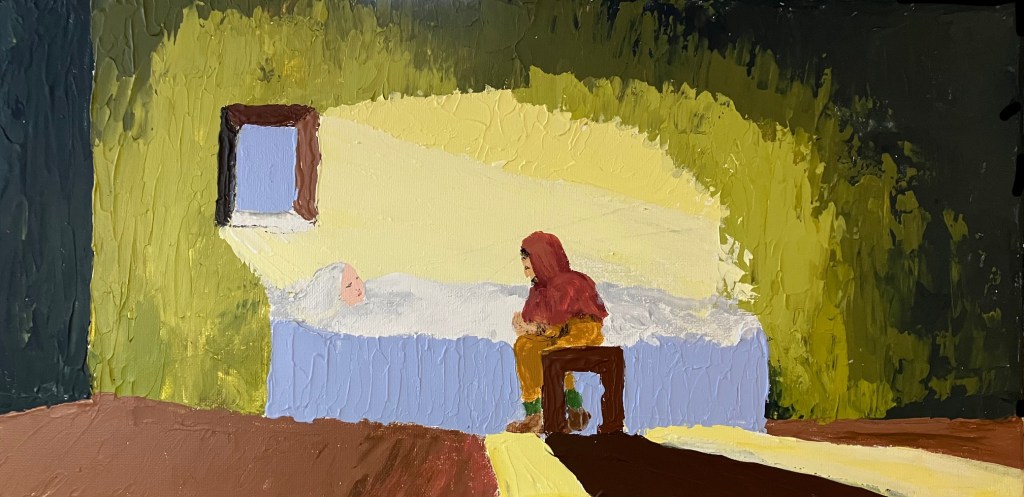
Ana is waking now with the streaming moonlight filling the room. I see she is transfigured by these years of worry and waiting, now, with silken white hair, pure white, whiter than any whiteness. All of her life’s joys and sorrows are etched into her face with age. She is still strong as always, and here, in her arms, it is I who may seem frail just now.

There is nothing to say that can’t be said in the morning. So this beautiful night is just warm and tender, fragranced familiar. Would you call that sound an owl’s song? Do owls sing? Even that is the calming for enchanted sleep.

On this new day Ana and I just sit and stare at one another in silence, maybe in awe. I see Ana is still beautiful, and I’m sure she sees however I am. We savor the changes and sameness in this quiet morning, until Hannah arrives with the complete plan for the day. So now we have a plan.

Hannah has a roster of family members who want to talk with me. Haberd has questions and his wife has necessary updates about the farm. Gabe has already sent a bird in response to say he is allowed to  come join us for this feast which Hannah has completely arranged.  And Greg and Gaillard are in the area now, again they are staying at Luxeuil, so they will be at the family table too. 

(Continues tomorrow)

#54.6, Thurs., March 14, 2024

Historical Setting, 629 C.E. near Trier

         A long sleep. Now, in the dark of this morning the vintner’s widow serves boiled oats and honey. A few minutes with a blade and a washbasin and now my hair and beard are normal length again, though Brandell clearly owns this look now.

         I have asked this chatty vintner’s widow about the peace negotiations Brandell and Gaia instigated with the wine growers on both sides of the river. She assured me, my version of pacifism continues to be foolish even though she has become more favorable to peacemaking in general. Apparently, Brandell’s way of peace is much more appealing, since he considers a plan where each side will get something from it, besides the usual benefits of peace: life continuing and good neighbors and God’s blessings – and not having everyone dead and all the land burned.

She explains it, “Since the Jews have no vineyards over there yet, and because they plan to plant them, in order to make peace here they must plant only Frankish grapes, so the wine they make won’t be foreign wine no matter how it gets blessed.” She goes on with the theology of it, “They still want to bless it Jewish even though they were baptized at Trier. Then while their vines are not yet producing, those of the Jews who know the ways of grapes and wines will help restore our vineyards on this side. That is a plan that has something for us in it. So maybe it is good plan, we’ll see.”

Brandell readies the horses, and at sunrise we start out for home. I find I‘ve hardly recovered strength enough for a long ride, but at least I have sense enough to know it will be a long ride.  Brandell helps me onto Gaia’s horse which is well accustomed to following after Brandell’s. And he puts Gaia on his own horse. Sometimes they ride two together, and sometimes he just walks both horses. It is a slow ride. We stop often wherever the brook runs pure, so the most stress of this day is the wonderful anticipation of home.

With the sunset, there is nothing from the beautiful heavens for warmth. I’m still wrapped in Brandell’s cloak, so we are all shivering. Now a bright moon rises early, and we are in our own familiar forests. We’ve turned to follow the creek we know so well. We are just continuing on regardless of the darkness until we are home.

(Continues Tuesday, March 19)

#54.5, Weds., March 13, 2024

Historical Setting, 629 C.E. near Trier

         Brandell and some others come here where I am waiting for help to pull me to my feet, useless as my feet may be. I have one arm around the shoulders of Brandell, and the other arm around a stranger. With all my wooly beard and long hair, no one is mistaking me for this tidy and powerful son of mine. These two who came to help are known to Gaia and to Brandell. The one who goes ahead of us, guiding the blind Gaia is Zachariah. We go through a tent village, then through a meadow toward the river. I have a memory now, this is the meadow that once was a newly planted vineyard that wouldn’t burn when it was torched. It became the battlefield.  I was staying with the boat staying out of the fight.

         Now I am starting to get my feet under me, as we move along, and when they slow the pace a bit, I can be more helpful, nearly taking my own weight if they would give me moment. So, we stop here, I can see the river now, ahead of us.  I can take a step and if we go slowly, I can walk with them, somewhat.  I’m glad to find a place to sit on the floor of the rowboat. Gaia is seated in the front and Brandell is at the oars. He thanks the men who helped us, and they push us off from the bank.

         On this side of the river now, we are at the vintner’s cottage marked with three barrels for hospitality, though I know the last time I was here hospitality had worn very thin with all my talk of peace making.  Has anything changed?  Gaia tells me Brandell has been helping negotiate a peace. And now that I hear one language on one side of the river, and another on the other, and knowing of Gaia as a translator, I can guess both Gaia and Brandell had a part in the peace negotiations.

         We seem to be welcome here, though the chatty vintner’s widow perceives my presence, not as a miracle by Jesus, but more as the annoying fool who once believed in peace for the sake of peace, even though no one seemed to get anything from it. 

         “So what use is this possibility for peace with your neighbors now?”

I ask her.

(Continues tomorrow)


#54.4, Tues., March 12, 2024

Historical Setting, 629 C.E. A near Trier

         Gaia, this woman, betrothed to Brandell, already knows my odd notions of peace, “Your pacifistic demands are known by everyone.” She tells me.  And it doesn’t even seem to bother her that I am laid out as a dead man in a cemetery.  

          She explains it all to me, “Brandell and I went searching for you because Brandell believed in the Lazarus myth of his papa ever healing back into life.  We learned that you had gone to see the vintner at the place with the three barrels.  And then, we learned there was a terrible battle with the established wineries that were Christians, fighting against the Jewish newcomers across the river. After that battle, only a few were left on the Christian side of the river – widows they were.  The widow of the vintner whom you had visited on the day of the battle mistook Brandell for you. And she went off on a little rant telling you how foolish you were. 

         “It seems when Haberd came asking for information about what had happened to you, she wouldn’t tell him because she didn’t want to tell your son his dead father was, what she called, a fool.

         “But then, thinking Brandell was you, but without a memory of that day, she told him everything that happened that day, even the clue he needed to find you here. She didn’t realize it was an important detail that you were born Jewish. But she said after the battle the few who were left living on the other side stripped the clothing off the bodies of the men left on the battlefield and buried only the Jewish bodies. Then, Brandell realized you would be marked with the sign, the scar of the briss. So, we realized then, we would find you here with the war-dead on the Jewish side.

         “And now today, just as Brandell expected, you are not only found, but found to be living. And that so-called foolishness of peacemaking that won for you that Christian slashing and a Jewish hammering is a peace that Brandell and I hope can rescue all these people from their own hates. We have been negotiating with winegrowers on both sides of the river. Peace is really what everyone wants. Not having peace here has cost these people everything.”

         So now I find I’m gaining back strength enough to appreciate relentless pacifism. But I wonder why would this woman ever want to be wed into such a stubborn family?

(Continues tomorrow)

#54.3, Thurs., March 7, 2024

Historical Setting, 629 C.E. near Trier

         Gaia tells me things. “Papa Lazarus! You’ll be proud of Brandell!

         “We’ve journeyed in a caravan all this way across the plains and mountains with the families of new settlers bringing their little shoots of vines kept in their tender care all the way here. They came with dreams. No one heard of the battle.”

         I can nearly speak now, “What of those vineyards and the people over there? I have enough hurts to know they are brutal antiSemites.”

         “No, Papa Lazarus, back when the battle was blundered they were only afraid of strangers.  Think of it?  All that brutality, all that killing, all that grief just because no one knew how to greet strangers. They were afraid everything they had would be taken from them, and then it was all taken from them by the war they thought would save it. The only people left were the women and children and elders on both sides of the river who had no weapons left and no tools. Now on both sides all are widows and orphans. The vines grew wild and untended, and no one was harvesting anything or making any wine.”

         Now I remember some things of this vintner’s battle.

         She goes on, “And now, Zachariah of the Jews arrived here with another band of settlers who had heard nothing at all of the battle and had no thoughts at all of the hatred of the vine growers across the river.  The refugees were told they only had to go to the Church in Trier to get their names in the book there, and then they could join with the other refugees and use this land for their own vineyards. But there was nothing here.”

         I have enough clarity of thought now to worry over that, “So now will there be more fighting?” I ask.

         Gaia explains, “The settlers arrived here only a day ago. Brandell and I had been traveling with them. We went on to Brandell’s family before we came searching for you.”

         “So, this new band of refugees are here now?”

         “Yes, Papa Lazarus, and your demands for making peace are well-known on both sides of the river. You will be very proud of Brandell.”

         “I always am.”

         “He did a particularly fine thing I can tell you all about while we wait here for the men to take you back to the boat.”

(Continues Tuesday, March 12)