#47.4, Tues., Aug. 8, 2023

Historical setting: 602 C.E. A cottage in the Vosges

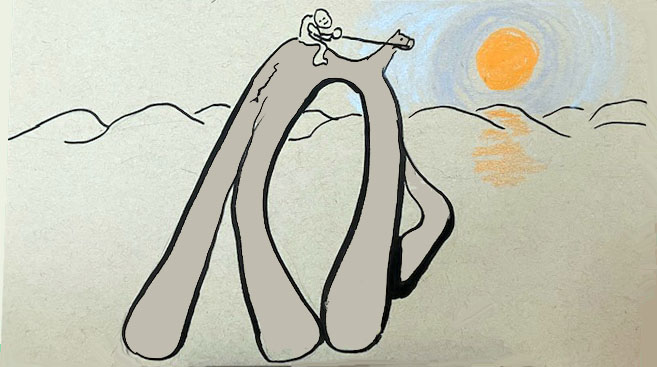
         Here, I play a simple tune on Simon’s harp.  It’s a song Simon invented to please the cuckoo nesting near this place where only flowers may grow. Brandell is delighted. For just a moment the tones of cooing cuckoo sullies the sorrows of us humankinds. It is a rustling breeze in the stillness of grief like the rings on still waters spreading out from the hole in the center.

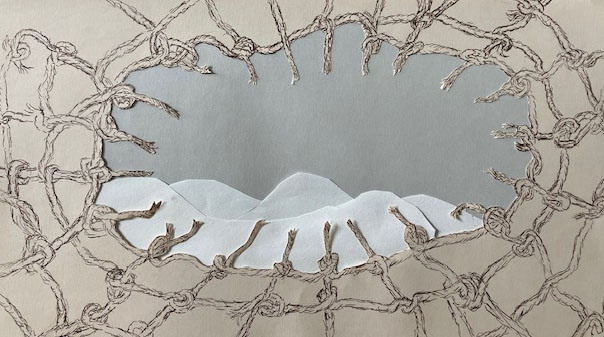
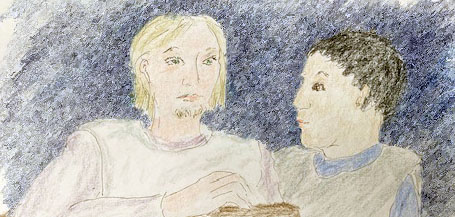
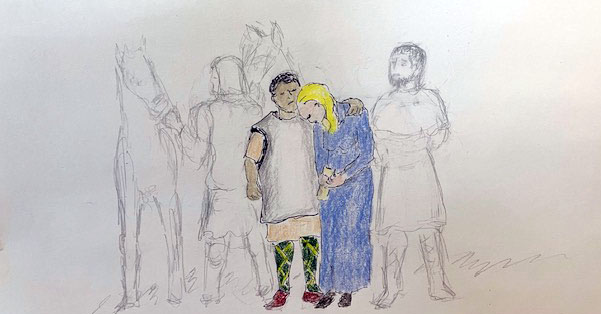
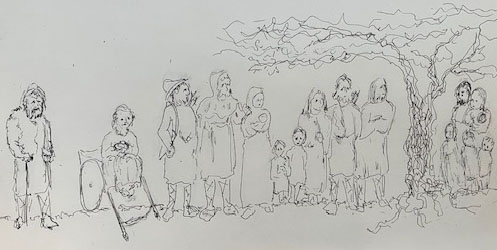
         Ana and I have these, our four youngest children with us here, and now our neighbors have come up from the forest. Charlie is leading them, towing the handcart with his grandmother. This is the old woman who so often rails and rants against strangers, now coming to Ana, reaching her bony arms around her to share a touch of understanding in the loss of a child. The old woman’s impervious wall against strangers is broken into with this window of shared grief.

         Our neighbors stay awhile. Hannah takes all of the children to the place by the door where Haberd makes up games with his heap of favorite stones. Hannah insists Haberd share his games with Charlie’s little cousins. At first Haberd resists, then the game is more interesting than keeping his own rock finds from other’s hands. Isn’t that how it is?  Each in our own ways, each in our own times and ages find this welcoming peace in making windows and doors in our walls. Children sharing a game seems so simple.

         The neighbors brought biscuits and now Ana asks me to break off her favorite leaves of mint while she prepares to make us all a tea. Charlie brings a fresh pail of water. He knows the routines of our household.

         We have a few remembrances of Simon to share, but this family also has remembrances of their own children lost. Ana shows the old grandmother the book Simon left. The old woman knows nothing of books, but recognizes Ana’s appreciation of the tattered little pages.

         Then it is a conversation about these changing times.  The land parcel where hunting is thin was granted to an aristocrat from Metz. His men are already taking down the forests to build a house, a castle really, with a walled fortress as though everyone is planning for wars. This is already happening.  There is no going back to “once upon a time, in the forest primeval.”

(Continues tomorrow)

#47.3, Thurs., Aug. 3, 2023

Historical setting: 602 C.E. A cottage in the Vosges

         Simon played this little harp we made with gut strings on a bent ash root. From these hardened leftovers of life-things Simon made music and Brandell believed Simon had magical power. Maybe a two-year-old notices the “hole in the music” when someone is missing, and Simon’s ability to move his fingers in space could fill that emptiness with the song.

         But it was Simon who named the emptiness the “hole in the music.”  He said that to tell me he missed his older brothers and me in the singing at the church. He missed my harp those days so we made this harp for him to play.

         But how can music have a hole?  Music flows like a river, and when it isn’t flowing it isn’t music. How could there ever be a hole in a river?  A fish swims up and touches the surface from beneath, and there is, for only a brief moment, a hole in the flow, but then it is gone and no one knows it was ever there.  Maybe a heavy earth object, such as a rock, could crash through the surface and make a big hole with a splash all around sending out ripples in rings in ever-wider circles.  And yet the rock only sinks to the bottom and the hole seems healed.

         So now, a heavy rock has landed in the middle of the music.  We are trying to navigate the rings of hurt moving out across the surface.

         We should walk outside on this exceptional day and find the beautiful things Simon understood so well. I take Brandell by the hand, and in my other, Simon’s harp. Ana carries Layla in her arms, and Hannah watches out for her little brother Haberd, as always. This is who our family is now.  It is Ana and I and these four tiny little children, and our thoughts of the oldest who are away. And here are two sons we remember in this quiet place we have made on our farm just for the grief part of life.

         As we are all out here in this sacred place, our neighbors, the hunters, come walking. They are bringing the elders in a handcart and all the children are here, the young men with their bows, and the old men with their stories. Charlie has brought his whole wide family to share our grief with us.

         It is good.

(Continues Tuesday, August 8)

#47.2, Weds., Aug. 2, 2023

Historical setting: 602 C.E. A cottage in the Vosges

         People like Simon would seem ordinary, or common, amid the great heroic tales that are told by the fires of soldiers gathering for wars. The ordinary aren’t mentioned. Great stories are spun around the likes of Greg or Gabe. And I can imagine little dark-haired Layla, our baby, could be the mysterious woman of legends one day.  Mystery is already her nature.

         But what is there to say about Simon, except that we love him, and we miss him now?  We miss the constancy of his listening, and his ever-intense care for details. The hens and the pigeons miss Simon. The mule and the donkey miss Simon. But what do they know of grief — the hens and pigeons, the cuckoo in the trees, a turtle on the log at the creek? Now the whole earth grieves for Simon. And as he found his lost brother Samuel we can still know his warm spirit flowing in the vastness of all love, invisible.

         Ana takes my hand as she is powerless to dam her flood of tears. We watch our children gathered here for their daily lessons. But we have no lessons for them today. Now, the lesson for me is that learning new things is a celebration of life itself, and in this time of grief, forcing that celebration seems raw.  Haberd expects Hannah to fix this sorrow by playing one of Simon’s games with him – stacking rocks – pressing funny pictures into the writing board – Hannah is of no mind to play. She has never seen her mother’s tears and she is at a loss for how to fix it.

         Layla is nearly sleeping in Ana’s arms, and Brandell waddles over to me, and I pick him up and hold him close to me and hum a chant to fill the empty place. A sad song has a place just now.  The woeful futility of Ecclesiastes shines as hope amid grief.

         “A time to break down, and a time to build up.

         A time to weep and a time to laugh;

         A time to mourn, and a time to dance.

         A time to throw away stones,

                  And a time to gather stones together…”

[Ecclesiastes 3:3:5]

         Brandell pushes away, and waddles over to get Simon’s harp down, and he brings it over to me.

(Continues tomorrow)

#47.1, Tues., Aug. 1, 2023

Historical setting: 602 C.E. A cottage in the Vosges

         All night last night, we sat at the table with a candle and the book. Ana and I took turns reading to one another through warm tugs and tears. We read the scribbles of words in Simon’s journal. [Footnote]

         The pages are the story of his secret. He couldn’t speak it to God, because he feared God would tell us that he knew our secret, so he wrote it in his book. He wrote that he knew the soul of his twin. Though he knew nothing of his name and had never heard us speak of him, Simon knew his brother. And he also knew we loved his brother.

         The intangible nature of Spirit is something that living, physical people try never to speak of, even though each of us probably has known Spirit since our infancies. When we learn language, we learn what we can talk about and what is ours alone. If we speak to others of the nature of Spirit those ears that don’t hear assume we are speaking of childish fantasies, or maybe we are pretending some kind of holy ordination only offered to saints. Personal communion with Spirit is kept silent.

         In Jesus’ time the Greeks and the Persians had ways to speak of Spirit. And Jesus led us into Spirit in every way spoken and unspoken, through metaphor as signs, through words of prayer “on earth as it is in heaven,” through touch for Thomas who needed touch, through vision walking on the water, through love, through air, through wind, all things invisible yet known to us all.

         For centuries bishop’s councils have met and met again, and even warred over it in Chalcedon, to come to some earthly concoction of Spirit conjoined with tangible being in order to fit into a world where belief is a dictum, not an experience.  But encounters with Spirit are always personal and never prescribed.

         Spirit is what nurtures the ascetic – that lone monk perceived as reclusive and alone. Maybe when we are well-fed and safely tucked in from the wind then it is easy not to know we yearn for Spirit because Spirit is invisible and we can pretend not to notice.  But Simon knew Spirit as the vast, all-encompassing love – the flowing waters where child spirit mingled and he found his brother, and where we still find both of these sons who seem lost from earth. Death is only for the living.

[Footnote] This journal is “How Still Waters Run” available as a pdf on the homepage of this blog.

(Continues tomorrow)

#46.12, Thurs., July 27, 2023

Historical setting: 602 C.E. A cottage in the Vosges

         Commoners don’t record their begottens. No one but God and the memories of old grandmothers keep this lineage. But with my oddity, having an ever and ever perspective I’ve come to know that the human record of history is only as good as the keeping of names. Precious relics are really only old stuff with the name remembered.

         Yesterday a terrible tragedy visited our farm. Yesterday there was nothing to say that wasn’t spoken through tears.

         Today, Ana and I are trying to sort through it and now we are finding blame.  Blame is everywhere. Forgiveness is yet fantasy far from today’s grief.

         Yesterday, Charlie came rushing up the hill from the creek shouting for help because Simon was in the deep water of the creek. Ana and I rushed down. I pulled what was once little Simon from the water. It was only the pale wet form of a child who once lived. If only I’d taught him to swim. And Ana was sobbing too.

         She found the little handmade papyrus book by the rock. [footnote] She held it close to her, as though it was a newborn — but it was not. She blames herself for encouraging him to take quiet time alone with this book she made for him. “If only we had insisted he never go off alone…”

         I dug a deep grave in the place where only flowers may grow – these daisies aren’t food or healing for physical sustenance. This is only for flowers. They bloom fresh in late spring and bob in the summer winds, then, the gardener, who, a few days ago was Simon doing the chore, pops the withered heads off the daisies to give them strength for fall blooming. When Simon and Samuel were born, a few October daisies bloomed wild here, where we buried the tiny Samuel.

         We never speak of Simon’s twin, Samuel. He was born too frail for life and died on his birthday.  It happens. That’s what Ana tells other mothers when she’s called to help in dangerous births. But to happen to her own infant was devastating.  She blames herself. Maybe it was guilt, along with grief that kept her hiding this sorrow. Or maybe she meant to protect the children from hurt. But she wanted the children never to know.

         Don’t children know grief? And when they see a parent grieve, they surely know a parent’s love is deep and children are valued.

(Continues Tuesday, August 1)

 [footnote] In this story, Simon’s little journal is the Novella “How Still Waters Run” by the author of this blog. As an e-book, it is a free download to readers  posted on the homepage of this blog. https://lazarus-ink.blog/

#46.11, Weds., July 26, 2023

Historical setting: 602 C.E. A cottage in the Vosges

         Late summer days on this farm bring so many changes – geese and goats added and the earth yielding a full harvest. The root crops are particularly abundant and if we store them properly, they will stretch well into winter, maybe even to spring.  The old cow was traded away, and the goat cheese is different. Ana is talking about adding sheep for the wool. Everything comes with different chores, and things that would seem changeless on a farm, come with new patterns, always.

         Our oldest sons are new places at new ages. Simon, nearing eleven-years-old, has taken on extra responsibilities.

         Hannah emulates her mother in everything and I expect one day she will be a fine practitioner of healing, even though, right now she’s something of a bossy eight-year-old. The younger children still accept her voice of authority.

         My worry for this family is that we’ve been told we are “commoners” in this new world rising. The strivings of nobility demand ever-larger castles and greater gifts to monasteries with new churches everywhere named for some sainted noble. Gifts assure the newly rising nobility have met the obligations of the fearsome and invisible God. Their expectation may simply be that they will have God on their side in the next war.

         Once this forest was the hunting ground for kings, and once the clearings and rock walls were just ruins of Roman times where now the aristocracy pass by on horses without a thought of the land, where once in this wilderness, ascetic monks wandered for solitude.

         Now, while the power of kings wanes, the lesser nobility proliferates. Human “owners” of Creation are called lords. The land stays the same as always, but somewhere in a castle drawing room or a far battlefield all these hills and rivers have been divvied into small parcels. The people who live on the lands farming and hunting for food have been sorted out and redefined. Most are common. Commoners are peasants and serfs, slaves, servants, indentured, or taxed, whatever name they may know us by and we are required to provide our wines and cheeses, meats and grains to those who say they own the land. Our farm was good this year so the amount of our tithe is very high. If next year we have less, this same high mark will again be demanded of us. I fear commonness is easily abused by people who name themselves lord.

(Continues tomorrow)

#46.10, Tues., July 25, 2023

Historical setting: 602 C.E. A cottage in the Vosges

         Gabe and I share this private conversation as we brush down the horses Greg and I borrowed and Gabe wants to discuss the issue burning through the night whispers in the novice quarters. “Fear of the Lord” whether required or optional, or interpreted through abuses of power, or skewed by translation of languages, or fraught with misunderstanding it is a humbling confusion. “Fear” as in Psalm 103, is offered with the simile of ‘compassion like a father’ but depends on the nature of the child’s earthly father to give it meaning.

         “Maybe Psalms are confusing because sometimes they are intended to speak to a whole gathering of people at worship, not purposed for the quiet spirit of a child in his homesick prayers before sleep.

         “So, the command to fear God rings through the crowds at worship to say, ‘even though the God who is God is invisible and intangible God truly is God.’ Fear is offered by the psalmist as a way of separating those who can only recognize a statue or a tangible god, from those who have been opened to recognizing the vast invisible Spirit as the power source of all Creation.”

         “So, Papa, are you trying to say that ‘Fear of God’ simply means we should recognize God’s power?”

         “Yes! Maybe.”

          Gabe continues, “And you need to have that beaten into you in case you are following a nobleman into war as a soldier, and you were thinking kings are more powerful than God?”

         “I guess that would be implied. But Gabe, to know for sure what way of God is really God, just make your private prayer that question. ‘How do you love me God? And ‘How should I fear you?’

         “When you know God’s answer the only thing confusing about it is that the psalmist tried to say it so many different ways.”

         Our time to talk is measured by the time it takes to brush the horses. I take one more moment to tell Gabe that his brother was accepted for training as a guardsman for the Bishop of Metz. I choose not to mention the terms of his brother’s indenture.

         My prayers for my sons fill my full thoughts through these six miles walking home. 

         Thank you, God. What more could a father want for his children than a place in life where prayers are still spoken? Amen.

(Continues tomorrow)

#46.9, Thurs., July 20, 2023

Historical setting: 602 C.E. A cottage in the Vosges

         The novice here on stable duty this morning is Gabe. That was probably a kindness by the brother who assigns duties to the novices. I can see Gabe is well and finding his spiritual nurture in this place. He tells me he has a better appreciation for his preparation at home growing up because others around him are finding this transition much more difficult. Gabe also tells me he misses his brother and all of us, but he adds, missing your birth family is forbidden here.

         He says, “The teacher here wants us to know one another as brothers. The reason, they say, is to give up our earthly ways for God’s sake, but really, I think these rules are made to heal our wounds of loss.  

         “I hear other boys weeping late into the night. I think they don’t find comfort in God always being with us, even here. I whispered to that poor fellow next to me and I told him not to worry because God is with us. God’s Spirit carries silent and invisible love, like a messenger dove, even for family far away. But for him, that was the worst thing to say. He thinks God is some kind angry, humanlike monster looking for excuses to punish boys for their tears. And it doesn’t help that the monks who rule here in the night tell us we should all ‘Fear God.’ because it makes us properly humble.” 

         I ask Gabe, “What does it say of the fear of God in Psalm 103?”

         Gabe knows his psalms well, and he answers,

         “As a father has compassion for his children, 

           So, the Lord has compassion for those who fear him.       

         For he knows how we were made:

                  He remembers that we are dust.”  

         “So, what do you think that psalm and all those like it are intending to say about fear of God?”

         I can see him thinking through the psalms he remembers – even including Psalm 23 that he whispers as he considers fear, “for I will fear no evil…”

         I intrude in his thought, “Fear of God comes with lots of human interpretations: punishment, dread, terror, awe, appreciation, relationship, faith.”

         “Yes, Papa, that’s why it’s so confusing. Maybe when it is my turn to copy scriptures, I will use more words of awe and less of fear.”

         “Oh, that it was so easy to just reword the human spirit.”

(Continues Tuesday, July 25)

#46.8, Weds., July 19, 2023

Historical setting: 602 C.E. On the road between Metz and Luxeuil

         It was a different kind of authority that Jesus taught in a time when Romans kept the order and Pharisees kept God’s law. Jesus opened that old Jewish vault of always knowing that God is love. He remembered the ancient stories of the father welcoming his lost son, regardless. And Jesus taught us prayer as conversation with a personal parent, sometimes to God as a mother who told us who she was, and when we forgot she let her children suffer consequences but loved us through it all anyway. Jesus reminded us of God arguing with Abraham like a papa to an obstinate son, a father begging for a strand of goodness from his children. Sometimes this parent was perceived as the maker of law and also the authority in keeping the law. [Genesis and on and on]

         I remember that first part in the ancient tale of human –

         “If you eat of the fruit of the knowledge of good and evil you will die!”

         Then they ate, but by God’s kind of justice, they didn’t die. They lived to tell the story. They lived to love one another. They lived to bear children. They lived to make bad choices and maybe even good choices. They lived to the continuance of the generations of humankind. They lived on to participate in the fullness of life. They even lived to grieve. They live. They die. They live…

         Maybe it is the design of God’s big everything kind of love that sets us each into earthly life as infants surrounded in parent love, already knowing that despite the howling pains of birth, God is love like a mother. 

         Yet, humankind seems to be on this eternal quest to let go of the grand invisible universal love and keep only earthly control making human divisions of order and chaos, of rule and disobedience, of naming noble or common, of knowing ally from enemy. It is all so Roman of us. So now Gabe follows the rule and Greg follows the orders.

         Dear God, so much bigger than my imagination, how is it you can notice me among all these stars and number every sparrow of every nest of every earth under every sun you watch over? At yet, you are here to assure me that my parent love is useful even to my wandering sons. Thank you. Amen.

         This morning I returned the borrowed horses to Luxeuil.

(Continues tomorrow)

#46.7, Tues., July 18, 2023

Historical setting: 602 C.E. Metz

         It seems as though I should be grateful that my son would be indentured to a man who, as bishop, has placed his own commitment to God above his noble need for expanding earthly power. Thank you, God.

         And maybe this chaffing at my conscience is only my own stubborn nature. Help me God. But I fear when next I lay eyes on this child, he will be tall and shining in borrowed armor, head to toe, shield on his arm, sword at his side, fully prepared to obediently slay some unknown nobleman’s guard. Or maybe his orders will be to drive a polearm through a messenger who brings unwanted news.

         My choice isn’t to change anyone else.  All I can choose in this is either to let him know that he has the unconditional love of his parents or I could hide that from him forever.  Actually, I don’t have this choice at all. A punitive withholding of love — a father sending his child off without his blessing – is a spear through the heart of the father regardless of the harm it brings the son. Really, I can only choose to let him know his father’s love is unconditional, as I also know God’s love is for all of us on earth as it is in heaven.

         So, I tell him the same as I told his brother as I am leaving.

         “Always know I love you, and I speak for your mother also, because we love you as you are, regardless of where you go and what you do.”

         But as I ride back to Luxeuil on a borrowed horse, leading the borrowed horse Greg rode, this emptiness is raw.  

         Dear God, of course I’m grateful for these beautiful sons.  Help me to know the difference between owning them and loving them. Amen.

         I consider the differences between these two who are so like one another that others can’t even distinguish between them. Yet we’ve always known their unique personalities. Gabe is at peace in solitude and when he is with others, he simply works along with them, side-by-side. But Greg is a bit more like me. What I call leadership, Ana calls controlling. Greg would soon chaff under monastic rule. He probably wouldn’t argue issues of creed and trinity, but like me, he will, no doubt, always make his own choices. Will he prefer orders to rule? I’m not sure.

(Continues tomorrow)