#46.3, Thurs., July 6, 2023

Historical setting: 602 C.E. Between Luxeuil and Metz

         So, on this new day Greg and I are starting out toward Metz with that letter from the monastery affirming the quality of this son that he may become something I would never wish for him, an armed guard for nobility. It is a child’s imagined dream that he may outgrow one day; and then where will he be? He will be indentured to these noblemen who only want warriors.

         It seems like a longer journey to Metz to go by way of Luxeuil, but by borrowing horses from the monastery stable it gives us a good excuse to summons Gabe to the visitor’s foyer. I hope to know that he is well.

         He seems to be comfortable with the rigors of this life. The daily simplicity of a monastery is not very different than our home life, except for the structure of the hours and the disgruntlement of his fellow novices.  Most of these boys come here sacrificing their privilege for the simplicity Gabe has always known. His teacher takes me aside to tell me that not only is his academic work exemplary, also commendable is his compassion for the others who are struggling more to adjust.

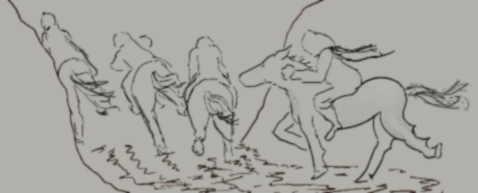
         By early afternoon we are following the old road from Luxeuil to Metz. We spend the overnight in an inn designed to accommodate travelers such as us. We sleep in a public loft, and the supper of barley stew is not expensive. Then we continue on to Metz.

         Greg isn’t as talkative as he usually is. I ask him if he is worried about fitting in with the other boys.

         He answers, “I’m glad we are coming in on horses, so they won’t know we are paupers.”

         I want to argue with the idea that we are ‘paupers,’ after all, our farm yielded plenty these last couple years. We’ve been gifting our abundance. But I know it is the commonness of us that he feels is how he will be judged; it is the simplicity of our lives, the very thing Gabe finds helpful, that will be painfully humbling for Greg when he is thrust in with the aristocracy.

         I can offer one consolation; “I think this lifestyle offers a bit more leeway than a monastic life, for taking some days away from study and duty to visit family. And Greg, please know, you will always have our love regardless of where you are and what you are doing.”

(Continues Tuesday, July 11)

#46.2, Weds., July 5, 2023

Historical setting: 602 C.E. A cottage in the Vosges

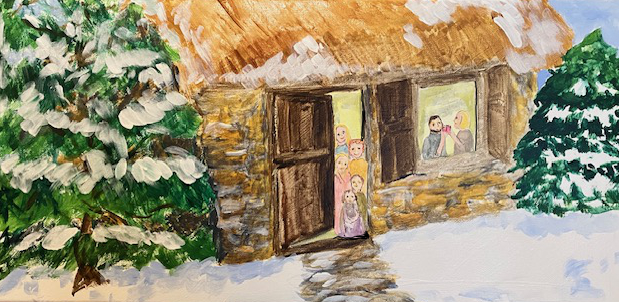
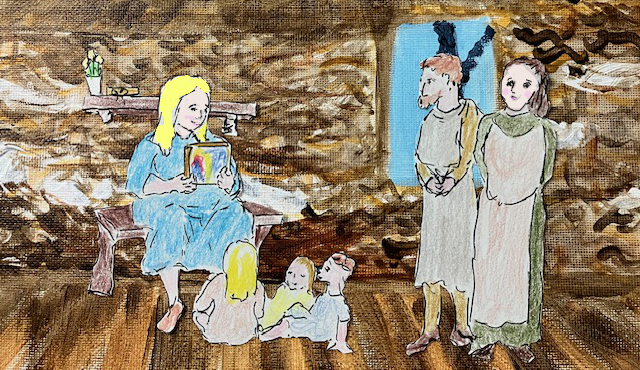
         Our family gathers at this table; but Gabe is gone from us. Everyone is celebrating the success that his good education brought. But now, I, myself, am reconsidering this unusual requirement for literacy that Ana and I have laid onto these children. We have no grand lineage — no king or baro or dux to entitle our children—so how does reading and writing serve them? We would need to draw from a family fortune to buy acceptance for our son; and, on the other hand, it’s probably good we have no earthly treasure worthy of warring over. We live by a simple peace. But in the ways of the world today that simplicity isn’t a choice, it’s a birthright, and as birthrights go ours is simplicity itself and not much earthly value. 

         Now I’m to take a letter from the monastery to the nobility of Metz and turn Greg over to learn the manners of warfare — the sword — the horses — the hierarchy. His servitude will fund an obligatory gift for Gabe to remain a novice monk at the monastery. Even my wife doesn’t understand why I don’t simply celebrate this offer. Both of my oldest sons are able to use their own fine learning, each in his own way, to follow childish dreams into worlds beyond their common birthright.  Why should I be reluctant to offer my approval for this?

         I, myself, was born into a household of privilege so many ages ago. Rejected by the Roman appointed power-mongers of the temple, then, with his dreaded skin disease, my father, a pox-scared Pharisee, went out and made a good life for our family anyway. Then he used his wealth to support an itinerate teacher of the old law ever teaching us to love God above all else and neighbor as self. Jesus, often a visitor in our home, was my source of goodness, and I might add, the gifter to me of life and life again.  All that Jesus taught and exemplified, all that he was and is for us is the opposite of slaughter and warfare and destruction for nothing more than earthly power. But here we are now, commoners, and my son wants only to learn to wield a sword.

         Dear God, I am thankful for the timeless clarity to know that love and peace are not just passing whims of these times. Help me bring my beloved family through this temptation to study war just now. Amen.

(Continues tomorrow)

#46.1, Tues., July 4, 2023

Historical setting: 602 C.E. Returning to the cottage in the Vosges

         We leave Luxeuil in the donkey cart with a Luxeuil bird in a box, so we can message Gabe and the others back there. Greg is walking a fast pace just ahead of the cart.  I have this letter with me to carry to the Bishop of Metz regarding Greg finding placement in Metz as an écuyer. It was prepared by the overseer of gifts, but this letter was surely read and sealed by the Father. Yet somehow, the seal was set askew so that the letter isn’t closed from my reading because I think the Father wanted me to know what was being said.

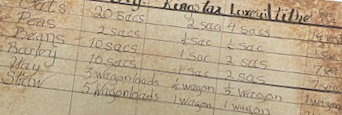
         It describes an issue of a “commoner” seeking placement for one of his twin sons at the monastery though bringing no other gift than his regular sack of grain. 

         Reading the letter, I’m reminded that our farm is on the King’s hunting grounds and is not our land but under the authority of the King of Burgundy who sanctioned the monastery. Our family obligation is to the monastery and we already gave our tithe of grain. That is noted in the letter, so at least I’m not portrayed as a hapless beggar. But we do seem to be begging, asking a place for our son. The recommendation is that Gregory, brother to the one seeking placement as a novice monk, be accepted as an apprentice to the bishop’s guard.

“Gregory’s exceptional literacy and his valor, though a commoner himself, would make his service of such value to be worthy of a gift to the community of Luxeuil and thus account for the training of the novice, Gabriel, Gregory’s brother.”

         We arrive home and I think Ana is relieved to see I only left one son behind. Greg is brimming with the wonderful news that all their literacy and learning of psalms and gospels is valued outside of our household. He was so proud in watching Gabe’s testing and he tells every detail of the encounter with the teacher who recognized Gabe’s ability, which he also knows to be his own ability.

         Simon and Hannah, Haberd and Brandell, listening here are rapt in this story of Gabe’s success. I surely don’t have to prod these children to their lessons anymore. They understand now how it serves them. All this, just as I’m wondering how such education could ever be any use at all for a family of commoners. 

(Continues tomorrow)

#45.13, Thurs., June 29, 2023

Historical setting: 602 C.E. Luxeuil

         I’m telling the Father of the brutality in Châlons and my rescue by Gabe and Greg. Ana is well-known for her gift of healing so they shouldn’t be surprised that I’m not dead, but healing. Brother Servant brings me a chair.

         The Father apologizes for sending us on this mission. He said he hadn’t realized the danger.  He offers a prayer for my healing.

         Then he asks, “So, Brother Ezra, what is it you want for your sons?  I know they are with the teacher today, and I’ve been told they are capable scholars even at their young age.”

         “They are both seeking adventures as youths will do, Holy Father. But my hope for them is they will fill their usefulness following the Jesus love even for enemies — serving God in everything they do-–finding their peace through forgiveness, not vengeance.

         “I approve of Gabe in his hope to be trained for a life as a monk, which is why we’ve come here today. But I am firmly opposed to Greg’s whims. Greg pleads for my permission that he may be trained as a soldier. In witnessing the violence he is only more resolute.”

         “Of Course.” the Father agrees.

         I continue, “I pray for them in their childhood and into maturity that they may grow ever closer to love for God, for others and for themselves. If Greg is a soldier trained with the sword how could the fullness of love ever become his driving power?”

         The Father just clears his throat, maybe stifling a grin, he looks away, then back at me. 

         “You realize Ezra, my son, you are this boy’s father; you are not God. And even God isn’t always known to sway childish ambitions.”

         He offers a long and prayerful pause then continues.

         “I recommend that you accompany your son on that short journey to Metz.  I believe some years ago you delivered a message to the bishop there.”

         “Yes, Bishop Agilulf was serving that see at that time.”

         “He is still there. He is a supporter of Luxeuil and he is a devout and thoughtful man caught up in the very conundrum you are laying before me here today. He will understand your son’s gifts and longings, and I think he will acknowledge your concern also.”

         I am dismissed to carry a letter from the overseer of gifts, when I go with Greg to Metz.

(Continues Tuesday, July 4)

#45.12, Weds., June 28, 2023

Historical setting: 602 C.E. Luxeuil

         Brother Servant calls me from something of an embarrassing conversation with the overseer of gifts while I was negotiating a place for Gabe at this monastery. I find that those monks who knew me from my association with Annegray had been grieving my death. Now they assume they’d received misinformation from Metz.

         I’m glad to see Brother Servant’s familiar face here, as he leads me to a small library room where I’m to report on the reception of the Father’s message to that Council of bishops. A scribe is present, along with Brother Servant and Father Columbanus, himself.

         Of course, the first question, before there is concern over naming the bishops who had been in attendance, is what led to the rumor of my death? I told Brother Servant and the Father the story.

         “I went before the council to deliver the message. They were seated as a circle, so I couldn’t discern which had the most status. And I think the circle was invented to serve themselves in that way as they are always fearing one another’s authority.”

         Father Columbanus smiled at that obvious explanation.

         I went on, “Baro Dithrum waited outside with the guards, and my sons were expected to remain at the stable, but they were also watching from outside. I delivered your message and it was read aloud by a scribe. Then, instead of an answer for me to bring back here, the guards were called. When Baro Dithrum saw that the orders were ‘death for this messenger,’ as though it were simply a traditional response to an unacceptable message, the baro abandoned my sons and me and apparently scurried back to Metz.

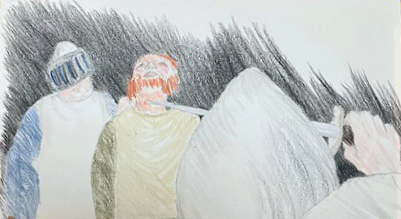
         “I was bound and blindfolded and led into a wood. I was aware my sons were following and when the guards noticed them I called out for them not of follow. They stayed out of sight of the guards but were surely watching. They saw it when I was pushed to the ground and driven through with a polearm. I would certainly be buried in the woods of Châlons to this day had my boys not found a way to return my bones to Ana.

         “As you might suppose my sons were terrified in witnessing this violence. Yet they did all they could to rescue me. I don’t want them to be burdened with my slow healing, so it is important to me that I show them my full strength now.”

 (Continues tomorrow)

#45.11, Tues., June 27, 2023

Historical setting: 602 C.E. Luxeuil

         Luxeuil is different from the small cloister of monks that peopled Annegray. Now it has overseers for things like gifts from nobility. Father Columbanus is so well-known far and wide that bishops must gather in councils to request his attendance, even when they mean to accuse him of ignoring their jurisdiction; and he is so important that his refusal to come is apparently worthy of deadly force. I know that only too well. For Father Columbanus to have time to hear the plea of a farmer begging entrance for his sons would be unusual, though I know him to be thoughtful of the needs of the poor.

         It seems to me Gabe’s interview with the teacher would surely be remarkable because, of course, it is this papa who is speaking, and I must say that Gabe is remarkable child.

         Now Sister Colleen is aware we are here because we sent word over that her donkey is at stable here, then she alerted Brother Servant that Gabe had come seeking admission as a novice.

         There is a closed balcony above the room where the academic testing is done. The balcony has a filigree window, allowing the testing of novices to be observed without notice. So, Brother Servant struts that balcony to observe the testing. When he sees it is indeed Greg and Gabe in the testing room he goes on to the overseer of the gifts to find out who is sponsoring Gabe so soon after my death had been reported.

         Father Columbanus had only, this week, received the news from the Bishop of Metz reporting the death of me when I was serving as the Father’s messenger. Apparently, the bird that carried the message of my death returned to the dovecote unnoticed by the monk who cares for the birds here. And the message was not discovered until the monthly cleaning. They were only now planning to carry the bad news on to my widow along with the Father’s prayers and condolences. So my current good health and healing are very unexpected.

         Brother Servant is startled to see me fully alive here, groveling at the feet of the overseer of the gifts. Well, at least I’m begging a favor for my son. Our meeting is interrupted because I am summonsed to meet with Brother Servant and Father Columbanus immediately. Obviously, the full story was not told to anyone here, either of the death or the healing.

(Continues tomorrow)

#45.10, Thurs., June 22, 2023

Historical setting: 602 C.E. A cottage in the Vosges

         Greg and Gabe have only been back from Metz for a day when they are ready to go off again, this time to find the places where noble families plot their children’s successes. We aren’t of the aristocracy, but Greg would like to be trained as a nobleman’s guard anyway. And Gabe has his mind set on becoming a monk at Luxeuil. I know, seeing their enthusiasm, making plans to leave home so young, is as hard for Ana as it is for me, but she isn’t arguing to stop them.  In fact, she is urging me to see them through these changes, thinking always and only of their happiness in life. I fear she doesn’t really see the consequences of what she’s saying. And I don’t want to make this an argument that divides our family.

         Ana and I make a plan that I will go with both boys to Luxeuil, and let Greg observe as I help Gabe negotiate a place as a novice monk. I do have connections there, even though I’m not a wealthy benefactor as is often needed to send a child off to a monastery. After that we can discuss Greg’s plan. I’m still not ready to yield to that.

         It’s only a half days’ walk to Luxeuil but I surely need to have my healing from the wound well behind me so my grueling misfortune doesn’t become my sons’ burden again. I’m pretty sure I can do this. But Ana decides Sister Colleen needs to see her old pet donkey, Jack, again, so we will take the donkey cart.  We also don’t want to put the whole burden of the extra work at home onto Simon and Hannah.

         So, it is agreed we will stop at our neighbors and arrange for Charlie to come over, sometimes, while we are away, to work for us here. We will carry a bird with us to let Ana know when we plan to return, but it shouldn’t take more than a couple of days.

         At Luxeuil the boys are taken to meet with the teacher and I’m sent to an overseer of gifts to the monastery.  I know it is usual to give a large gift to support the community as a gesture of gratitude for a child entering into preparation to become a monk. I will soon learn if that is required of me.

 (Continues Tuesday, June 27)

#45.9, Weds., June 21, 2023

Historical setting: 602 C.E. A cottage in the Vosges

         Greg argues against my hard rule for pacifism. He says, “When plotting bishops order their guards to murder an innocent man just because he brings them a message — then they are evil.”

         “’When’ you say? So evil is not a person but the temporal action of a person?  Yet, you would retaliate and kill the person? In fact you are talking about using a weapon against a whole council of bishops.  And if that righteous sword were successful then all the bishops’ guards would be obligated to retaliate.  And pretty soon the battle is not for righteousness, but for retaliation. That’s how wars are made. No one is wiser for it, or more beloved by God because of it. No one is just. And no one wins.”

         “It’s just not that simple Papa. If the bishops are not actually the epitome of evil, as was the Roman Empire that crucified Jesus, then when the guards of righteousness bring out their swords against evil, they might see it as God answering the prayers. And then the evil side will know the will of God and will withdraw their guards.”

         “So, you think it is the prayers of the unjust that cause evil to relent?”

         Greg argues, “I’m saying it just isn’t so simple as ‘swords and poles wound and words and prayers heal’.”

         “Yet you expect both sides to find God’s righteousness through prayer? Greg, isn’t that the exact scenario you just what-if-ed to me?  When two sides are at war, and both pray for God’s righteousness to make the hurt and death seem worthy, then which prayers does God answer?  The fact I know is that God loves all of the Creation, including humankind. It’s on the first page of the Torah, the Bible, and imprinted on life itself and the whole universe. As sure as Creation is good, God is, and God is love.”

         “Then how does God make one army win over another?”

         I answer, “It isn’t God; it’s only superstitious kings and bishops who claim that God causes the winning and chooses the loosers.”

         “Papa, I still intend to learn the tricks of the sword, even if I never use it for war.”

         “You will not do that with my blessing.”

         Greg retreats, maybe respectful of my blessing. But Gabe isn’t gloating. He seems to be making an attempt to appear neutral as he has his own need to argue with me over starting his future right now at Luxeuil.

(Continues tomorrow)

#45.8, Tues., June 20, 2023

Historical setting: 602 C.E. A cottage in the Vosges

         Greg and Gabe returned from Metz more excited than ever about the possibilities of taking their accomplishments and making themselves into some twist of aristocracy. They’ve decided riding horses is more to their liking than managing the farm mule, and a polished sword dangles from the waist with more prestige than a hunter’s bow over the shoulder.

         I know when boys are teens their heroic imaginings always seem pointed with sharp objects. They see problems solved with swords and poles not words and prayers. And that narrow imagination for future quests lands right in their lives at this most sensitive life-stage when irrational violence appears to be winning. They observed the bishops’ guards driving me through with a polearm simply to make a statement about the message sent by the abbot. Words would have sufficed. Wars are waged by crazy despots, then brutalized by the very young who are drafted to carry the weapons. The pacifism of Jesus is one place where I always stand firm.

         When I was their age, my own best friend forever was the very pacifist who, while barely beyond his youth, died on the cross denying to his followers any plan for a sword of retaliation, then the very lyric of his dying was forgiveness.  Who are we to say pacifism is impractical in this time when winning seems the ultimate goodness in everything? Pacifism has always been out-of-step with the times — in all times. It didn’t just become out of date just now in the 7th century.

         I’m relentless. “Swords wound. Words and prayers heal.”

         I hear no impulsive, “But Papa…  ” 

         Instead, here is a thoughtful silence. I watch their faces as bright minds formulate response.

         Then Greg answers, “There is nothing that can stop the sword of the evil bishops’ guards, but the swords of the guards of righteousness.”

         “That would be a good answer, but flawed, in that evil and righteousness are inconsistent and not a universally shared measure,” I argue on, “So how do you, as a mere humans know the righteous from the evil?”

         Greg answers, “Of course I know what is good and what is evil, and I will always take the righteous side. I know righteousness is always the side I’m on.”

         I ask, “When it is a council of bishops? When it is holy men devoted to righteous teaching, are these the evil or the good?”

 (Continues tomorrow)

#45.7, Thurs., June 15, 2023

Historical setting: 602 C.E. A cottage in the Vosges

         I’m tempted to lecture little Simon on the assurance that God is with him even though silent. I would tell him that, but he isn’t asking me to send him God. And really, for any of us, it is only God who can answer the longing.

         The best I could say is, “I love you Simon, please know your Papa loves you.” I can only trust that God will speak for God’s self as I have always known to be the nature of God, though it is so rarely a voice that rattles the house and speaks in the familiar language. This thirst-quenching Word comes more often as a wordless knowing from the depths of soul. Is that what little Simon is listening for?

         I wake to hear Greg and Gabe are home and Ana is greeting them with “Shhh, your Papa is sleeping.”

         What a shabby welcome home that is!  These days I’m much better than when they left.  So, I get myself up to give them a proper welcome. Ana is preparing a homecoming meal. And I can be the one to bring the water from the well. It’s been a while since I’ve been any help at all for this family. 

         Simon meets me at the well, and he draws up the water. He carries the heavy pail to the door and sets it just outside so that I can heft it into the house, as though it was all done by my strength alone. Ana gives me a scolding look.  In all his quiet observation little Simon knows that I need not let his brothers see how slow is my healing.

         It’s wonderful to have this family altogether at the table for this meal.

         To bless the food, I offer thanks to God for an itemized listing of gracious gifts – beans enough for porridge — water, pure and fresh — safe journeys for Greg and Gabe — and I think I accidentally spoke aloud my hope they stay home now until they are fully grown. Whatever it was I said, Ana kicked my shin under the table to tell me to hone my words less selfishly. She has already heard them bubbling with a new kind of enthusiasm — hopes and dreams and possibilities. She whispers to me I should listen to their plans before I speak.

(Continues Tuesday, June 20)