Post #34.5, Weds., July 13, 2022

Historical setting: 589 C.E. from Metz to Trier

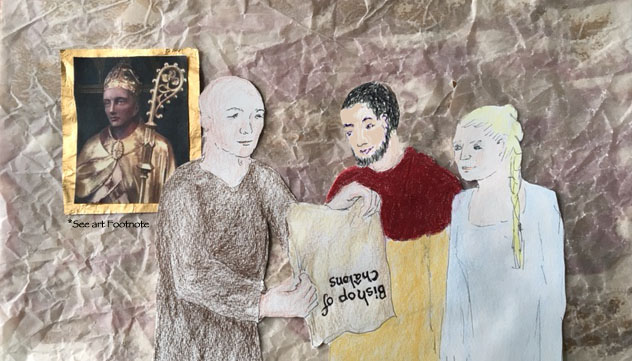
         The bishop queries. “So let me understand. You are a mere messenger for the foreign abbot and your wife is a woman of higher stature than yourself — a literate woman of medicine.”

         “That seems to be so, Father.”

         “I know well how you suffer my son. May God be with you.”

         It seems the abbess, Dode, listened to Ana’s request for information with her particular concern for childbirth procedures. Ana learns they have no ancient Greek or Roman books here, and they know nothing of the studies from Alexandria; though the care they give the sick follows deep ruts of Roman order. So if a woman in labor doesn’t proceed as prescribed — if she deviates from the usual order — she will find no help here. And the rule is that a baby may only be taken with surgery from a mother who has died. That practice is clear and simple. It is as Eve had done in the time of Thole’s birth. It allows for a baby to be rescued to life, but there is no thought given to saving the mother. Ana is looking for an alternative.

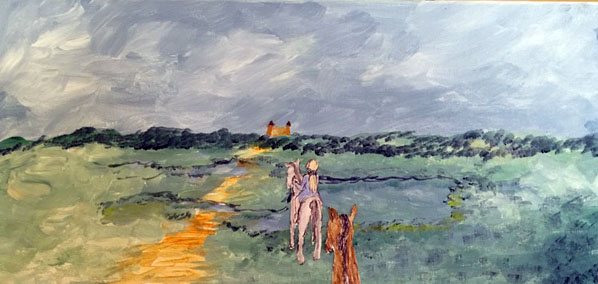
         This afternoon we continue our journey following the river according to the map given us by the iron merchant. We reach the stopping place marked by nightfall but we are the last of the travelers to arrive. In this place the guests sleep in a loft over a stable and tonight it is shared with a band of men. So here my wife must play a silent monk tucked in under the eaves at the end of this sleeping loft. The other guests probably know she is not a tiny, silent monk, but I am her guardian sleeping next to her to be a solid wall between her and the other men who are filling this haymow with their snorts and snores.

         In the morning we ride along the river to the village of Trier. This is also a bishop’s see, so the scrolled letter for this man finds its place in the largest most central building in the village.

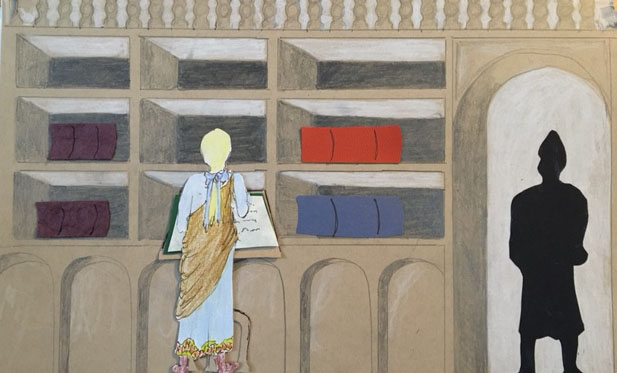
         It is a bit of a surprise to find that this is the place that houses the libraries of Austrasia so the ancient writings that we didn’t find in Metz might be stored here.  We’ve decided to spend an extra day as guests of this parish in order for Ana to peruse the books.

 (Continues tomorrow)

Post #34.4, Tuesday, July 12, 2022

Historical setting: 589 C.E. Metz

         Sweet fragrance of vineyards hums a placid summer’s gloss over any purpose for this journey. As we leave the vintner’s wife tells us we are seeking a dark old Roman basilica with baths. It will be dreary and damp, seeping with the laments chanted by women.

         In Metz our expectation is fulfilled. [Footnote]   The leftovers of Romans, then Graoully and other snakes still cast shadows on the stern gray walls here. And this city owns both king and bishop of Austrasia. We are out of the reach now of Father Columbanus’s friend, King Guntram.  And so royal boundaries may be one reason for the politics of complaint in the messages the father answers. Here in a far corner of this basilica we find the Bishop of this see who keeps his own political stature. Ana is given audience with the abbess, the wife of the bishop, whom it is well-known, is of a more noble lineage than even the bishop. Awe abounds.

         In times such as this religious communities are numerous and rich yet seemingly bleak and dreary with collections of nuns and monks and relics speaking for them of appropriate suffering. Here Christians are sent to find Jesus among the poor and the sick and the imprisoned so the aristocracy clothes themselves in poverty and suffering to encourage laity of Christian duty when the poor make their tithes.

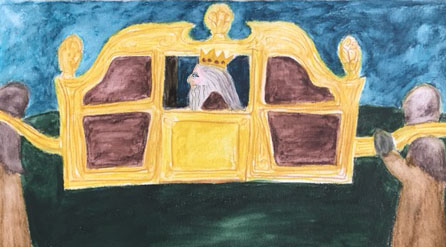
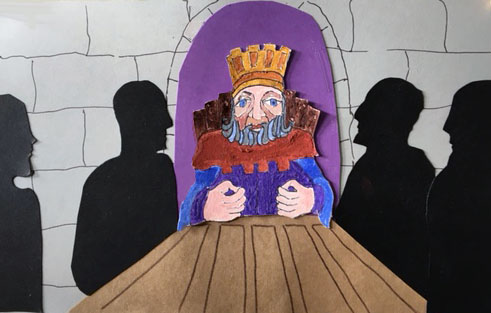
         I deliver the scroll to Bishop Agilulf, himself, who is seated on a carved throne in a small room. Proper protocols in place, I genuflect for his cross, not for his person. I’ve not broken the seal on these scrolls I carry, so I haven’t read the letter Columbanus sends with me. The bishop reads it and speaks to its content.

         “So this ruffian from a far distant island, barely Christianized, considers that he has now come into a ‘wilderness’ for his spiritual withdrawal. Yet he thinks the disruption he brings with his haphazard tonsure and random, uncensored calendar of Christian ritual should be excused in the name of Christ. And you have come here with this message for me, and you have also brought us a ruffian woman you expect us to tame?”

         “No, your holiness. The woman who is with me is my wife, and she herself is a literate scholar in the medical arts. She is seeking a library with the writings of the ancients so that she may better her learning and her skills. Have you such a library?”

Footnote:  https://www.spottinghistory.com/view/5314/basilica-of-saint-pierre-aux-nonnains/ retrieved 1-18-22.

(Continues tomorrow)

Post #34.3, Thursday, July 7, 2022

Historical setting: 589 C.E. An inn by the River Moselle

         Ana has learned she was born only a day’s ride from here.

         “Ana, don’t you want to go there and see what you remember? The church that gave you to the pagans might have written your baptism in their book.  We could go and see.”

         The vintner’s wife encourages the venture. “It is only a day away. Surely you want to see your family.”

         “No, no. My family is my husband now. I was given over to the church, and the priest gave me to a tribe of pagans before my teacher took me in and that was the only way I came to have any family at all.”

         Later when we are alone I ask her again,  “Do you want to find your mother?”

         “No Laz, they are not people who love me. My mother named me for a rock miners sought. Maybe my father was a miner? I think they really just wanted a hard cold treasure from the earth when they named me Anatase.  And now people know me as Ana, and it reminds me of Hannah, the mother of a priest, Samuel. That story was that the dream of having her child had to wait. Yet Hannah’s prayers were answered. [I Samuel 2:1-10] No, Laz, Let’s just go on our way as we’ve been directed.”

         The chatty wife of the vintner greets us with the morning.

         “So, a new day, a new path, will you follow the River Moselle to Metz, or wander a bit east toward this dear woman’s roots?”

         Ana answers, “We have a message to take to the bishop in Metz, so we’ll just go on as we’ve planned.  Do you know of that place, Metz?”

         “Of course. It isn’t far. I can tell you there is an old Roman basilica. I think it was once a Roman bath. It has little high windows and the aisles under the arches along the sides.  I have to say, it is a very dreary place for the nuns.”

         “So there is a convent there?” Ana asks with a note of hope that she will find the knowledge of women.

         “It’s a few nuns, and they practice medicine I believe. Their abbess is the wife of the Bishop Agilulf, [Footnote:] and both the bishop and the nun are born of aristocracy. They are quite proud.” With this she flicks her fat peasant fingers to frill her words with a dab of classest disdain.

Footnote: Blogger’s note—Most often, comparing sources reveals a variety of spellings for one name, but here is one name for two men of nearly the same decade and geographical area, Agilulf Bishop of Metz, and Agilulf a Thuringian King, whom Jonas, hagiographer of Columbanus called King of Nuestra.

(Continues Tuesday, July 12)

Post #34.2, Wednesday, July 6, 2022

Historical setting: 589 C.E. Beginning a journey in the Vosgas Mts.

         Ana and I were delivered two fine horses from the count’s stable. Then Thole and Daniel leave as promptly as they arrived.

         Father Columbanus has his letters ready in response to the complaining bishops and he’s also given us a messenger’s purse. The iron merchant gave us a map with lots notes to guide us.

         We are sent on one mission by the father, to deliver his letters. But our purpose is also for Ana to learn whatever may be needed to save the life of Tilp. Tilp is tiny and frail so childbirth, which is always a danger could be tragic for her and those who love her.

         Immediately we set out toward Metz a significant bishop’s see in the kingdom of Austrasia. The map uses the Moselle River as a starting place nearly at our doorstep. When the valley rises to a level place, we are told, we will see vineyards on the west bank of the river and we should watch along there for a cottage that serves travelers. It has three barrels, one rolled onto two at the horse gate to mark the welcome to this place where the food is good, the bed is soft and wine is plentiful.

         We do find this and it is a wooden house made of shaven boards mounted onto sturdy beams cut straight out of the forest. It is a simple but gracious home with a single guest room that is shared with any travelers coming along.  On this night the guests are just Ana and me. The vintner’s wife is brimming with chatter. She must be lonely here, but Ana enjoys her company. Ana seems in awe of the darkened walls, smoky stains, all aged as an empty wine barrel.

         The smell of the wood walls and the fire, the huge cut stones that make the hearth, a little round bubble of glass for a window — Ana says it reminds her of the village where she was born.

         “You remember where you were born?” I ask her.

         “I remember the smells, and a few other things. There must have been a river named Oos near there.”

         “Of course!” The vintner’s wife knows, “You are from Baden Baden. That’s only a day’s ride to the east! Is that where your family is?”

(Continues tomorrow)

Post #34.1 Tuesday, July 5, 2022

Historical setting: 589 C.E. Near Annegray in the Vosges Mts.

Ana and I have a journey before us and we’ve barely finished preparing. A bird arrives with the message that Thole is waiting at the monastery with our horses. So on this fine summer’s day we take up our traveler’s bags and our bird in the box and we walk to the monastery. On our way we meet Brother Servant, with another bird in a box and his bag as he plans to tend the gardens while we are away. He mentioned it again, two men with horses are waiting for us.

Two men? It’s both Thole and Daniel and it’s good to see Daniel again. The last time I saw him was at the count’s “victory feast” and his mother was touting him as a dragon slayer. I think it was to assure him a smidge of fame so that he could marry into aristocracy – a fine move for a commoner, though dragon slayers seem in abundance in these times.

The journey that was mapped for us starts with Metz, a city with the legendary St. Clement the first bishop who slew the dragon Graoully, [Footnote] and chased the snakes from the Roman amphitheater that was already in ruin when the Christians arrived. But in our own time we have Daniel as the rumored dragon slayer.

“Daniel! So good to see you again.”

His gaze is riveted on Ana. He seems bedazzled to see her again, older now and looking so well. The stories of her struggles no doubt, have been rumored all around.

Daniel knows, “They call you Ana now, I hear.”

“Ana, I am, and wife to this man I still call Lazarus, but everyone here calls him Ezra.”

  I add, “When last I heard, Daniel, you also had marriage in mind or at least your mother was fixing up the necessary gossip to make that so.”

“Yes, indeed. I have a wife and soon we will fill the Count’s castle with little children again. Bert’s and Celeste’s children are grown up already.”

“Tell me how they are, and what they are doing now.” Ana asks,

“I’ve thought of my old friends so often, especially when I was so alone. And look here! You’ve brought that blue speckled mare, Teardrop, I always used to ride her at the Count’s stable.”

“I think she thinks she’s your horse, Anatase. Everyone missed you and worried for you, even Teardrop.”

[Footnote] https://en.wikipedia.org/wiki/Clement_of_Metz, retrieved 2-9-22.

(Continues tomorrow)

Post #33.14, Thurs., June 30, 2022

Historical setting: 589 C.E. Ana’s cottage in the Vosges Mts.

         The Lenten pilgrims reported to their bishops that Father Columbanus, while true to the creed, allows, and in fact, supports some contrary practices. The complaints seem not about spiritual practices, but more about external details. The Irish tonsure, shaven clean across the top of the head from ear to ear, with no specific rule about the hair in the back of the shaven line. This appears to those with Roman orders, meaningless, and in fact “paganish”. The Roman Catholic tonsure is a circle akin to a crown of thorns. Meanwhile, the Kings of the Merovingians who rule now have their own dictates for hairstyle. The Roman tonsure is allowed, but the Celtic tonsure must be trimmed short in back because only kings are allowed to have long hair. In this land King Guntram is one among those royal Merovingian brothers called “long-haired kings.” They are of the superstition that their uncut locks allow them a supernatural power that only a king may have. So length of hair matters.

         Furthermore those of Roman order howl at these Celtic monks that Easter is celebrated on the wrong day. This issue has truly riled the rule of the all-powerful bishops.

         Since the power of the bishops is scattered among many, there is no one bishop to whom Father Columbanus answers. So for a lesser abbot from a foreign land it would be unheard of to call a council of bishops. And like the kings, each bishop is powerful in his own see. So each message of complaint must be answered individually.

         Father Coumbanus himself confides to me, “A messenger on horseback is needed.”

         The father has a gift for eloquent rebuttal so I’m sure his responses will be gracious and will offer ways forward in Christian peace. I would be glad to deliver such news. But I also suppose they wouldn’t see Father Columbanus as a threat if he weren’t so popular. Father Columbanus gives us a messenger’s purse for our needs as we travel.

         And I will need directions to these cities. Since the father himself has never traveled throughout the lands he has asked the iron merchant for help in drawing a map for us. This itinerate merchant has lots of helpful information about roads and travel seasons and locations for inns and hospitality for two people on horseback.

         Dear God, thank you for calling both Ana and I to purpose. May we always consider our first calling to serve Holy Love in all that we do. Amen.

(Continues Tuesday, July 5, 2022)

Post #33.13, Weds., June 29, 2022

Historical setting: 589 C.E. Ana’s cottage in the Vosges Mts.

         Thole is grateful for Ana’s promise. Before Tilp and Thole’s baby is due Ana wants to search out the resources from the ancient times when medicine was a science and things she needs to know now had been written down. We make a plan to visit to the nuns of the Holy Cross Abbey in Poitiers. As well-endowed and famous as that place is they will surely have ancient books of medicine. And maybe she will be able to observe the latest that is known among women of medicine dealing with a possible difficult birth.

         Thole will arrange for us to use horses so Ana and I can travel more efficiently to the places where she can learn what is needed. And he suggests a path for our journey back to the Loire through more Christian places. I’m definitely pleased that I won’t have to encounter those hunters again; neither of us wants to leave here the ways we came.

         Thole goes on as we sort out the necessary preparations and make a completely new plan for the summer season now here.  I’ll be finished with the roof in a day or two, but now more than ever I see the need for some kind of stable or shelter for beasts. Also we need to speak to Brother Servant to arrange for our gardens and the crop of grain to be harvested and used while we are away.

         With all these new plans we’re making this cottage can become useful to the monastery as a place for travelers to spend a night, as we put aside our own hopes.

         When the servant monk hears of our plan to travel to other monasteries on horseback he tells us of a particular need of Father Columbanus.

         “The iron merchant is at Annegray today and he has delivered to Father Columbanus messages from bishops in cities all around us. It seems the pilgrims visiting from distant monasteries are complaining about our community. It seems it is not enough we are all Christians together, with the same God, the same Creed, the same Trinity and the Psalms. They want to see the same hair cut. A messenger on horseback is needed now take letters of response to these complaints the father has been receiving.”

         Brother Servant says I need to go and meet with the father and hear more of his need for a messenger. So now I may also have a purpose for our journey.

 (Continues tomorrow)

Post #33.12, Tues., June 28, 2022

Historical setting: 589 C.E. Ana’s cottage in the Vosges Mts.

         The anticipation that fills this house just now is the complete terror of hope. No one ever speaks aloud of hope being terror, but we all know. Hopes and joys and promises always appear as blessings, but hopes are hidden fear.  Awful possibility haunts as a shadow behind every dangerous journey. It lurks in the darkness of the minds of sailors and travelers preparing for voyages packing a travel bag with a flute in case there is dancing on deck, but also with the leaves of hyssop to ward off the odors of death. And like any journey, birth into life is wrought with fear. Hope and fear are always close traveling companions.

         Dear God, give us the fearless wisdom to nurture hope.

         Thole stayed the night. Ana lay awake all night considering what to tell Thole, whispering to me her thoughts and plans.

         “Perhaps a monastery with women in medicine would have books about dangerous births or at least the midwives there could share advice with me. Do you know of a convent such as this, Laz?”

         “I do know of just such a place, but it’s such a long way to Poitiers from here. I’ll go with you Ana, but how could we leave here now, with our own gardens planted and all our own hopes and dreams just starting?”

         “You pray about it, Laz. God will surely offer you the clarity of purpose: is it more important to watch the oats and beans grow, or to care for one who is in need?”

         “Of course, Ana.  I should know I can’t be husband to God’s own angel without my first thought being to care for others also.”

         “You can put off the work of this place, Laz. Thole will bring horses so we can travel those distances quickly, and I will see all the monasteries that have the knowledge of these things tucked away with secrets. I can search the writings of the Romans and Greeks who knew medicine so well. Then we can find the knowledgeable women so that when Tilp’s baby comes, I will know better than anyone but God what can be done to save both mother and child. Just think of that wonder. I have time to learn it well! God answers our hopes and prayers that I may truly be of value in the work to let generations continue.”

         Dear God, Thank you. I see you are all about saving the ever after. Amen.

 (Continues tomorrow)

Post #33.11, Thursday, June 23, 2022

Historical setting: 589 C.E. Ana’s cottage in the Vosges Mts.

         Thole led the horse, as we made the heavy trudge up the hill on foot. And Ana is delighted to see another familiar person from her childhood on the Loire.  She hung the water pot on the hearth and spread the biscuit dough rising to make two into three.

         “Thole came looking for you to ask your advice on finding someone to help with the birth of the baby he and his wife are planning for.”

         “Actually,” Thole corrects, “We are in need of a midwife to stay with her through the months. I mean, it would be too long a journey for you to go just when needed. So you would be welcome to stay in our village.”

         We have barely a cottage here, with only a half a roof, and not even enough hay for his horse. In among the ruin of this place was a stone cut for a watering trough, so we can water a visiting horse, but we have no stable and barely any oats now in this season between the planting and the harvest. I leave them to talk offering to tend to the horse. All I can do is loosen his lead and tie him out where there is pasture grass for this night’s visit.

         When I return to the house Ana is sitting on the hearthstone, and Thole on the frame of the guest bed and they are talking softly and seriously over a pot of tea.

         “Laz, Thole has told me of many great strengths and also of the brokenness of his wife, Tilp. I’ve never witnessed such a birth as this might be, but I have heard of it before. In the ancient times Julius Caesar, the Roman Emperor, was birthed by cutting the mother.”

         “No, no. You can’t do anything that would hurt Tilp.” Thole interrupts.

          Ana goes on, “I don’t know if it is something that could be used to save both the mother and child. My teacher said only to do this if the mother had died, and then it could possibly save the baby.  I believe you, yourself, Thole, was one she saved in this way.”

         “No.” Thole protests, “we don’t want the baby without Tilp. I know what that was for my father to endure.”

          Ana offers, “I’ve heard it said that Caesar’s mother didn’t die. I just have to learn more about it. If I could find the ancient Roman writings I could prepare myself with a better understanding.” [footnote]

[footnote] https://en.wikipedia.org/wiki/Caesarean_section Let me take a moment to warn readers and followers– this blog is most definitely an unreliable source for modern medical information even when Wikipedia is noted.

 (Continues Tuesday, June 28, 2022)

Post #33.10, Weds., June 22, 2022

Historical setting: 589 C.E. At the monastery at Annegray

         Thole came here because hunters brought rumors that a healer once owed to the pagans is here.

         “So” I ask, “what is this urgent need the pagans have to find Anatase?”

         “You’ve seen her then?”

         “Why are you looking for her now? You, yourself, paid the debt.”

         “You know, Ezra, Tilp, my wife, is tiny and frail but she is sweet and beloved.”

         “I know. I was at your marriage ritual last winter.”

         “We are planning that she will birth our child sometime in winter around the time of my own birth when my mother died. And you know that was because my father couldn’t find anyone to attend the birth. He found Auntie Eve but it was too late. She could only save me.”

         “So you are afraid for the birth now, is that right, Thole?”

         “Yes, of course, everyone is afraid. There’s been no baby born to our tribe in a whole generation, ever since Tilp was born. And that was a difficult birth. And they had help then. We have no midwife among us, and there are terrible dangers of having no one with the knowledge. Anatase had the very best training ever. Even as a child, blind Eve took her to be the eyes for so many births. So, Ezra, have you any idea what has become of Anatase?”

         “I do know, Thole. She isn’t here at Annegray. And she escaped the pirates who kidnapped her. Then when they saw she was one bent on escape and they couldn’t sell her they raped her and beat her.”

         “Where is she, Ezra?”

         “She’s married now. She belongs with a husband and not to Largin’s Pagan tribe any longer. She is old enough to choose her family.”

         “Well, let me find her husband then and beg him to let her come.”

         “Her husband doesn’t own her. She has her own mind as you would know. You knew her. So finding her husband is pointless… as you can see clearly as you are speaking to him just now.”

         “Ezra, are you saying you married Anatase?”

         “It was just a blessing by the father here, and she calls herself Ana now. Come along with me to our cottage.  I’m sure Ana will be surprised to see you as I was also.”

(Continues tomorrow)