Post #25.3, Thursday, October 7, 2021

Historical setting: 588 C.E. Ligugè

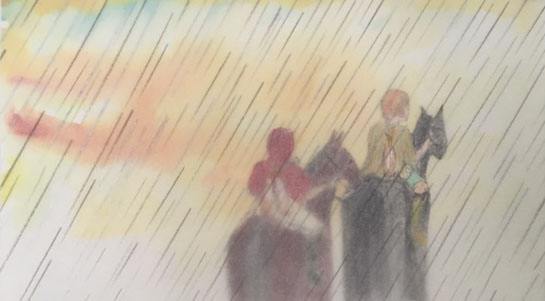
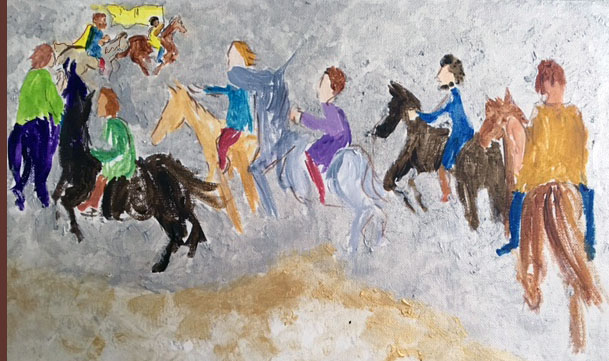
         Ezra is bringing me up-to-date on all the news from the vineyards.

         He goes on, “Eve adores that gift Anatase gave her that you helped in lettering when you first came here. Eve keeps her ‘precious pages’ next to the door and rubs her hands over the herbs often to ‘see’ through touch and smell what you and the apprentice wanted her to enjoy always. In the spring and fall seasons Eve and the young woman now, replace the dried leaves with the soft, fresh herbs so they never loose the fragrances and textures.”

          “Daniel was at the cooper near the forest and found that the druid priest was asking about Anatase because their village is in need of her now. But Daniel simply said she hasn’t completed her apprenticeship yet. It seemed to suffice.”

         I comment, “Eve and Anatase surely must need one another, now, more than ever in these times of transition. I’m glad to know the child wasn’t returned to that tribe as Eve had feared.”

         “Child? She is nearly a woman now; she seems older and wiser than any ancient magi. A lot has changed. Maybe, if this place is too dull for you just come back up our way.”

         “I’ve been thinking when the garden is under for the winter I may just spend the season up there. It’s good to hear about it.”

         I help Ezra harness the mules as he is on his way.

         Dear God, thank you for this good news of my family. Amen. He could have sent someone else with the wine, and saved himself this journey. He must have known I was thinking of them.

         Fewer of us are here and the elders who remain were once, like Brother August, lone aesthetics following visions of youth. Now this particular Christian community is aging and dwindling but here value and purpose aren’t measured by earthly tallies of numbers and wealth. The ancient tradition of spiritual peace gives these monks a kind of freedom from standards of worldly success which seem ever-creeping into the well-funded monasteries in these times. This distinction shows up in little ways like tipping one’s head to the most learned bishop or powerful pope, or scoring the most donors or greatest number of monks and nuns, or announcing the most miracles bestowed onto pilgrims. But here I still find that mystical peace free from the strivings and winnings.        

(Continues Tuesday, October 12, 2021)

Post #25.2, Weds., October 6, 2021

Historical setting: 587 C.E. Ligugè

         Ezra still comes, though with our numbers thinning we have less need for wine.  I’m so glad to see him and hear the news he brings of family. I learn now that the vineyard land is also in transition. My concern in hearing of the death of King Chilperic was that Celeste’s husband, Bertigan, wouldn’t be allowed to keep his new land and title since he was a commoner appointed count by the late king.   

         Ezra explains, “King Chlothar the Young, is keeping better peace in his rule through his regent (strangely that would be Clothar’s great-grandmother, Brunhilda). With more negotiations and less warring he is leaving the kingdom of Neustra much as it was under his father, the late brother of the dead King Chilperic. So Bertigan remains a count, with Daniel his scribe.”

         I’m glad Daniel is literate, even though he isn’t a churchman. It seems a valued rarity in these times to be a literate commoner.

         Ezra continues, “Now Count Bertigan and Daniel have set more of our original land to cultivation and they are bringing others to do the work of tending the fields and vineyards. People who would be needy with no land to till are now working these lands splitting the harvests with the portions to Daniel and the Count. So even without the daily routines of farming this family has plenty in these years of good harvest. Celeste and the grandchildren moved into the grand new estate house, Bertigan Hall,” and Ezra adds, “Colleta and I find our place there also.”

         He tells me Celeste is a fine lady now, a countess, and he bragged on his grandchildren who are my family too of course though I don’t know them well.

         I say, “So there you are, the elder in a count’s castle and yet you drive the mules and deliver wine barrels to the monks.”

         Ezra enjoys the irony. “Wine is always an excuse to see family.”

         I ask Ezra what of Eve and Anatase.

         “Eve and her apprentice still keep the work of healing with potions and remedies. Eve’s cottage and garden are as always, but Bert and Celeste’s cottage and our old cottage are houses for the families of the tenants. With the lands divvied as they are into smaller parcels worked by tenants there are still lots of folks around so Eve isn’t alone.

         ”That’s good.”

         “Oh and I took them that gift you helped the child make for Eve…”

 (Continues tomorrow)

Post #25.1, Tuesday, October 5, 2021

Historical setting: 587 C.E. Ligugè

(A note to followers who receive this blog by e-mail and may lose track of the storyline:  A recap to end one month and start another is always current on the home page of the blog.)

         More than three years passed by us while I’ve been working in the inks of Ligugè. The commissions for our work continue to dwindle and our elder abbot has not accepted the available tasks of lettering copies of legal documents for secular dealings, as the politics of the aristocracy flail and shred in the shifting winds of royal whims. I know we need the work and the kings and counts need the help but the abbot holds to our sacred purpose despite the earthly tug toward what are called realistic values. 

         The nearby convent of the monastery of the Holy Cross has been tossed into a worse turbulence these days with the death of their abbess, Queen Ratigund on August 13. The appointment of a new abbess, Agnes, has inflamed the embers of disgruntlement already smoldering among the sister’s.  The sisters of the Abby, like Ratigund herself, are daughters of nobility and these nuns have long chided the strict Rule for Virgins. But now they are in flat-out rebellion over the appointment of an abbess of lesser rank. [Footnote] Rumor has it they are no longer confined to virginity by the walls of the Abby. Some are giving themselves away to marriage, or worse. But I suppose the advantage of an earthly, autocratic power-structure such as the bishops maintain will save this establishment in the end.

         I find my peace here at Ligugè where the bishop doesn’t interfere in our most intimate prayers with the Creator God, and this abbot affirms our version of obedience driven not by rule or threat but by love and respect.

         With less work to do in the inks I’ve been assigned to help in the gardens. Maybe it’s because I need the spiritual participation with things that grow, or perhaps it’s simply that I am one of the few of us with the youthful flexing of knees required to genuflect for every weed in need of pulling.

         As I watch the Creator’s patterns of continuation of life despite the shortness of seasons I see that changes from our clustered order of monks might become more as Jesus commanded, a mission of sending out, like a spreading of seeds on the wind. Whether or not we are a church of countable numbers or just a few wanderers, I know God will always provide a worthy pattern for Christians. To everything a season — for seeds flying — for seeds buried.

[Footnote] One source that attributes the nun’s rebellion to the noble ranking of the nuns is Patrick J. Geary’s Before France & Germany: the creation & transformation of the Merovingian world.(New York: Oxford University Press,1988.) p. 147.

(Continues tomorrow)

Post #24.14, Thursday, Sept. 30, 2021

Historical setting: 584 C.E. Ligugè

         Copying a manuscript is a different practice than reading it, so to read the scriptures I do that in its own time.  Here’s this page John Chapter 9. I know this. I’ve seen it happen when I was following Jesus. We came upon a man blind from birth and Jesus spit on soil then placed mud on the man’s eyes and told him to go to a healing lake and wash it off. The man received sight. In John this is a sign, not a miracle. So what does the sign point to? I wonder anew each time I read it and the mystery only increases.

         The disciples’ questions, as usual, are base. In this story they asked who sinned to make this fellow blind from birth, was it the unborn infant or the parents? Jesus answers that it isn’t about sin; it’s about the light.  So there you have it; its not about sin so seeing another’s blindness, or pain, or woes doesn’t speak of God’s judgment but of light. So if that means God doesn’t reveal holy judgment by letting us see someone punished  maybe King Chilperic’s assassination wasn’t a display of holy justice.

         But the gospel story’s concern over judgment goes on and on. This tale is full of characters making wrong conclusions about God and sin, light and blindness. Everyone is looking for sin. No one is looking for light. Neighbors wonder who the man is  — is he the same person if he isn’t blind? Pharisees wonder about Jesus healing on the Sabbath. Maybe Jesus is the sinner? But we all (at least the ones speaking) know God doesn’t listen to sinners so the sinner can’t be Jesus because God listened to Jesus and the man was healed.  The Sadducees call for the man’s parents to tell if he was faking blindness all along. The parents defer to their now adult and sighted son.

         All these people just couldn’t let go of that idea of sin even though Jesus said in the very beginning it isn’t about that. It’s about light.

         Then Jesus makes everything perfectly clear when he explains, “I came into this world for judgment so that those who do not see may see and those who do see may become blind…If you were blind, you would not have sin. But now that you say, ‘We see,’ your sin remains.” [John 9:41 NRSV]

         Okay that explains everything … maybe.

 (Continues Tuesday, October 5)

Post #24.13, Weds, Sept. 29, 2021

Historical setting: 584 C.E. Ligugè

         The eulogy offered to King Chilperic I by Gregory of Tours is grim.

         Gregory of Tours said of the King, “… in laying waste and burning districts he had no feeling of anguish .. but rather joy; like Nero before him, when he recited tragedies as the palace burned. He often punished men unjustly to get their wealth. … He was a glutton and his god was his belly.” Gregory called Chilperic’s writings “feeble little verses” and said, “he put short syllables for long, and long syllables for short.” Gregory adds, “he hated the interests of the poor… was constantly blaspheming… He called one [bishop] a lightweight, that one arrogant, another was a spendthrift, and this one a lecher…” The Bishop of Tours was ceaseless in his lambast of the King. [Footnote]

         Gregory’s words for this dead king were not spoken at his burial. Bishop Mallulf of Senlis performed the burial rites and Chilperic was interred in Paris, not Tours.

         The talk among the Brothers of Ligugè is mostly affirming the perspective that God is righteous, but also, that God judges the wicked with a kind of punitive vengeance I once believed was only something the most ancient mythology of Hebrew or Pagan religions could accept. I thought the teachings of Jesus and surely the more recent Jewish writings had amended these old and human-centric views of a vengeful God.

         The God who is God known to us through the eons is the God who sent out the prophet Jonah. Jonah was sent to the worst of the worst sinners ever — to Ninivah of Babylon, in order to warn them and tell them to repent. Jonah, being human and all, believed this loving God who is God would hear the message and simply forgive the sinful nation with no worse retribution than Jonah himself suffered in being vomited by a fish. And that is what God did; he forgave Ninivah. There are lots of old Hebrew myths and stories of God who didn’t seem to punish adequately. [Jonah]

         Why does it always surprise me that news spreads so quickly in these silent halls? Whatever it means, even our worship prayers are thanking God for this prevalence of righteous “justice” observed now in the death of a King. Personally, I wonder what will become of my granddaughter’s family enriched with the plunder when Chilperic ruled.

         I’ve returned to my workstation.

         Today the text I am assigned to copy is John 9, considering the question of blame in the case of the man born blind.

[Footnote] Murray, A.C., editor and translator, Gregory of Tours: The Merovingians Broadview Press, Ontario, 2000. page 145.

(Continues tomorrow)

Post #24.12, Tuesday, Sept. 28, 2021

Historical setting: 584 C.E. Ligugè

         This morning I follow the stable master to his workplace after morning prayers and before our work begins. I want to assure him I have prayerfully considered my attitude and he was right. My father would surely be dismayed at my insolence. I won’t try to untangle the confusion he nurtures over any of the versions of eternal fatherhood this may invoke. Eternal anything is confusing and mortally unverifiable.

         A messenger arrives in a flurry on a tired horse. As the soldier’s saddle is changed to a fresh mount, the messenger announces the news he is spreading of King Chilperic: “The King is dead!”

         “How? What happened?”

          “He was assassinated returning from a hunting trip.”

         “Who did this?”

         “It’s unknown.”

         “So it was by God’s own hand,” the stable master surmises.

         The messenger answers with detail. “As is usual when our hefty king dismounts his horse he had one hand on his retainer’s shoulder when the king was stabbed under his arm, then in his stomach. He died quickly in a great flow of blood at the hand of an unknown assailant.” [Footnote]

            The stable master assumes, “So surely, if the assailant was unknown, yet standing at the intimate distance of dagger, it must have been…”

         “The message from the Bishop of Tours is that he deserved it.”

         Whatever we thought of the king the news left a huge lump of quiet in our midst. When words returned to our circle the questions were of justice. Was this God’s justice? Who was the assassin? Was it a servant sent by a hated brother or another queen? Was it an angel of the Lord who did this? In these times, in this land hatred is administered in extravagant acts of torture. Stories abound of one who was tortured, then allowed to heal so that he may endure the full pain of his torture onto death. Complicated acts of violence to remove evil from the earth may include lashings, or burdening with chains, or having animals – horses or camels — drawing and quartering a man or woman. Was the king’s quick and easy demise simply a blessing by a servant? It’s well known that God has already punished this king with plague – bringing death to two of his sons and sickness to his household even to himself. Then he did acknowledge that it was God’s punishment for the heavy taxes he had placed on the poor farmers who paid it with vats of wine. After that he lifted much of the burden on the poor then, and God was apparently appeased.

[Footnote]The account of Chilperic’s death, and much of what is known of the history of these times in France was written by Gregory of Tours in his ”History of the Franks” This account is paraphrased from Gregory’s Book VI, number 46. [Murray, A.C., editor and translator, Gregory of Tours: The Merovingians Broadview Press, Ontario, 2000.]

(Continues tomorrow)

Post #24.11, Thursday, Sept. 23, 2021

Historical setting: 584 C.E. Ligugè

         So the rumor is that the tree fell due to my disrespect for the holiness of an image representing the Holy Spirit swath of Trinity. I guess I should repent before any more trees faint away in the forest.

         Dear God, please help me to be more respectful of others particularly these of this community whom I say I love as my brothers even though they are so completely ignorant of your grace. Let me not practice disdain for their pagan ways of human judgment, and their ridiculous assumption that any god punishes, even, in our times of better knowledge of the grace of the God who is truly God …Dear God, Maybe I should think through my prayer a bit more before I pray it.

         My thought, here I am looking to blame the stable master for his primitive ignorance while at the same time I’m using my own prayer to ask for God to help me be respectful of others. But these brothers of mine seem to assume God would spew punishments for anothers disrespectful attitude of the Trinity. Are they completely ignorant of God’s relentless love? God who is the very nature of love is gracious, always giving freely according to our need, in fact way beyond our need, and not giving to us as reward for human good behavior. So why would that same power of love throw oak branches at a monk’s cell because his drawing of a dove didn’t meet the human standard of Trinity? And before I can pray that to God, I can see that the Holy answer is in the twist of my own words where I think I am asking God’s forgiveness for my insensitivity when really I am trying to blame another for being so ignorant. Let me give better words to my prayer.

         Dear God, thank you for setting all of us in the constancy of your love. Help me always to practice that pattern, repeating it ever, even in the midst of all of our human flaws and error. May I forgive others, as you forgive me. Amen.

         At first it seemed ironic that my dead so-called ‘father’ would be embarrassed by my insolence. But, as I think of it, my actual father, a Pharisee named Simon, would most definitely be embarrassed by my insolence though he surely would have no use for a three-part God especially with one part being my earthly, childhood friend Jesus.

(Continues Tuesday, September 28)

Post #24.10, Weds., Sept. 22, 2021

Historical setting: 584 C.E. Ligugè

         I’m grateful that the chatty stable master delivers dry straw for my mat and he stays with his ax to help me finish tidying the debris of twigs and sticks.  Now after the others have gone he is still helping me weave back my damaged roof. Even in this time for silence this fellow is never short of conversation.

         “So do you suppose God sent this disaster on your cell to punish your obstinacy?”

         “What do you mean?”

         “Even in the stable I heard what you did with that wisp of horse hair you gathered for your brush. You painted a tumbling and fumbling, rancorous dove of the Holy Spirit, falling splat onto the head of Jesus our Savior.”

         “Is that what you heard?”

         “That’s what you did my brother. Your father would be very disappointed with you. And you know, Brother August knew your father before his untimely death. You probably don’t even remember your father.”

         “My father?”

         “Lazarus, your namesake. Brother August said he was a very good man. He was a dear friend of our departed Brother Nic as well. I’ll bet your father would be shocked and embarrassed to know of your youthful insolence. And now, because of your little whimsy of jest we all had to suffer through that storm God sent down on us. Even the horses turned restless at the shudders and roars of that storm.”

         I don’t believe these things are punishments by God. I try to answer with scripture, so that my so-called ‘youthful insolence’ won’t be further revealed. “It was said by Jesus himself that the rain falls on the just and the unjust. [Matthew 5:45b] But I apologize if it is thought by the others that my sins wetted all of us with this rain.”

         He argues, “In community as we are here, when one suffers we all suffer.  Of course God’s judgment fell harder upon you with the crashing of the tree. That’s how we could all know it was your sins that brought on the holy retribution. It was all on account of your disrespect for the Holy Spirit that the heavens hurled spears of lightning, and bolts of thunder. Even though it’s been said that God lets the rains fall on the just and the unjust, the punitive bolts are only for the sinners.”

         I thank the brother for his help with my roof. Good night.

(Continues tomorrow)

Post #24.9, Tuesday, Sept. 21, 2021

Historical setting: 584 C.E. Ligugè

         “The light shines in the darkness and the darkness did not overcome it.” [John 1:5] It was the metaphor of message in the letters we inked.

         It happens every day, and sometimes after a thunderstorm. A glorious refreshing lightness overcomes darkness. The great human lust for dualities is satisfied, though application of judgment, the good and the bad of it can only be inferred. Darkness itself isn’t always what evil is. It hides the prey and narrows the confusion of sight. It allows for sleep and dreaming in dreams and visions and for some, imaginings. Whatever we bring to the darkness or hide from in darkness it is our most intimate selves. It is a cozy quilt of nestling families of fox and critters of all varieties of furs and feathers. Neither the darkness nor the light is substantive. Both are illusions of sight.

         Thank you God, for darkness and the light.

         But here in the waning light of what was today I see the storm that left last hour cleansed the earth fragranced it with sweet mist. At its height it bolted through the oak near my cell and left a huge tree where once I had pieced together a weave of branches and leaves to be my roof.

         Communities of monks, such as Ligugè, first here with St. Martin, is a random collection of lone ascetics only slightly sheltered from the wilderness; here as community there is also the power of neighbor. The fallen oak becomes a purpose to rally help from every able-bodied monk. So the massive limb with all its sticks and branches and the full weight of leaves is an easy lift for ten monks. My cell wall, a circle of clay bricks, is just slightly damaged, but the covering of brush for the roof will need to be replaced.  The fallen limb wrapped in a vine that escaped from an unkempt vineyard becomes the new material for this repair. I use the untangled vine as rope to bind my roof into a tighter woof and weft than it had before.

         The storm and the broken tree plundered our usual sacred silence, and gave opportunity for the chatty stable master to stay and help long after the others have gone to back to finish vespers. And here he is face-to-face with me, filling late hours with decrees of his own order of justice.

(Continues tomorrow)

Post #24.8, Thursday, Sept. 16, 2021

Historical setting: 584 C.E. Ligugè

         This time I paint the dove from the back. Triangular, yes, but its head is forward with legs extended for the landing on the head of Jesus.  Maybe it’s a more awkward position than a nestled dove but it is true to nature and yet a triangular wingspread is discernible. I’ve achieved compromise.

         Today it’s the master of the scribes who comes by my bench.  “Scrape it clean Brother Lazarus. Brother August will finish this. You do well with the pen, we thought you would be able with the brush also. But for now, we need you more for copying exactly.”  So I’ve been demoted, sent back to scribe.

         St. Jerome’s translation is really quite similar to my own since he chose to work from the ancient Hebrew, so I appreciate the cadence. Of course, John was always in Greek, at least since the Jewish stories of Jesus were morphed into Gospel by the new emergence called “Christian.” And the master of the scribes doesn’t seem to notice my own little edits with an all-cap lettering style for the places where Roman up-dates once changed “Sadducees” to “The Jews.” No one who is a capable reader seems to slow down and ponder a lettering style, so it goes unnoticed among scholars. But those student readers who pick through the letters one-by-one might notice. My hope is that readers who come with fresh eyes and will see that “THE JEWS” are different from “the Jews” who were all of us, and it was only “THE JEWS” who were making the politics of hate into Roman prejudice against our own people. Shouldn’t it mean something that Jesus was Jewish? In these times Jesus isn’t even known as a man; he is of some other “substance.” My indelible hope is that this gospel won’t be fodder for prejudice. Wishful thinking perhaps, but still…

         Dear God may it be so that this gospel does not become a forever tool for human hatred. So be it.

         The days are shorter now and with the afternoon thunder storm rising we are very nearly working in the dark. Some are moving our benches at angles to windows to capture whatever light overcomes the dark. Some light lamps. The shadows are danced onto walls with only the slightest light — lamps with lightning flashes nearly constant.

         The rain pours down, drenching, cleansing, quenching a thirsty earth. A sweet fragrance of earth anoints us.        

(Continues Tuesday, September 21)