Post #25.9, Thurs., October 21, 2021

Historical setting: 588 C.E. leaving Ligugè

         We leave after morning matins. The rising golden sun, the alleluias of our lauds, even the early songs of the birds rising from the trees for their autumn pilgrimage – it all seems out of place in my own grieving. 

         Riding at an easy gait the young man Thole is a length ahead of me.

         Dear God, thank you for the crispy dawning. Please stay close. Let tragedy not be impetus for vengeance, but in your way, rescue us  to love. Help me through my hurt and rage. Amen.

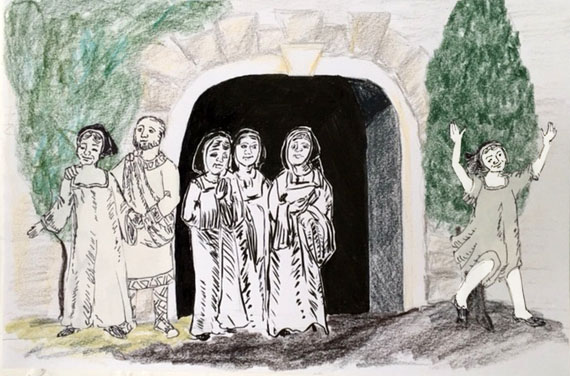
         Eve is wrapped in a linen sheet. A grave was dug in that same place next to Eve’s and Ezra’s mother where Nic once laid my bones. I draw back the cloth from her face. My chin quivers. She is ashen and as always scarred with pox and hollows of hurts. The slash of a sword on her neck is the single blow of death I see. My tears drop onto her face as I kiss her forehead and pull the linen to cover her forever and after. Ezra’s hand is on my shoulder as he too weeps. She is laid in the grave, and the pages I scribed that Anatase enhanced with herbs are laid onto her. I add as many handfuls of rosemary as I can gather after the Christian practice.

         There are no pagan gifts given here to take her to their other world. She will have to die a Christian as she was born. Dear God, please take Eve’s spirit into the ever flowing river of your love — stay close. And thank you for the gift of her. Amen.

         Everyone has a grief in this. The strongest men of us, Thole, Ezra and Daniel, and I too weep silently.  Colleta brings the loud wailing of Christian muddle of sin and guilt. And here is Thole’s father, Jesse, cousin to Colleta, wracked with the passions of his second love lost. Thole said his father never stopped pleading with Eve for marriage, and she never relented in proclaiming against it. Now he is shouting his woes into a loud and raging rally for vengeance.  Count Bertigan and Celeste are standing further back with their children, good mannered, watching. And there are others here as well. Maybe they are the new tenants on this land, or people who have come to Eve for healing, or maybe so many are here simply drawn by the rumors of a violent death.

         Some mourners scatter to their homes. I stay here to wander the ashes with my plea to God for closeness.

(Continues Tuesday, October 26, 2021)

Post #25.8, Weds., October 20, 2021

Historical setting: 588 C.E. Ligugè

         I’ve just met this man who has come as a messenger bringing the sorrows we share. We both love Eve in our own ways. I’ve learned now that Eve was violently slashed by invaders outside her burning house. She was clutching her precious parchments on which Anatase had placed herbs for ‘reading’ in her blindness. Thole tells me the child was stolen, probably to be a young wife for some brutal heathen.

         I do know of this man Thole. All those years ago even before there was Nic, I was staying in the haymow of Eve’s cottage when I heard the farmer, Jesse, pounding at the door begging Eve to come help his wife in the midst of a difficult birth. (Blog posts #3.13 & #4.1) So it was an icy Christmas Eve when this man was born, and also when his mother died. The Christian mid-wives and even the whole family of his father, Jesse, on that night were celebrating the birth of Jesus at the Cathedral of the Saint. He could find no Christian to help with the birth so he walked all the way to Eve to summons a healer he thought was pagan. I heard him at her door, but I didn’t realize what was happening until near morning when I found Eve returning alone in the icy storm nearly frozen to death. This man Thole was born in a bed of sorrow that night, and now here we are strangers to one another, both grieving for a woman who was called by Christian’s  “pagan.”  But the chant she taught to fill that night with shouts and pleas was the Jesus prayer. She told me his father, who claimed the creed, didn’t even know the words to the Jesus prayer. She had to teach it to him so the cold silence of the death before the birth would be hallowed.

         I think at his birth this boy was named “Troll” by his father, to honor the pagan who came when no Christian would come. Now he is called “Thole” and I also know that as a small child he was Eve’s helper before she had Anatase.

         He remembers her. He says, “I could easily see why my father was so taken with her. My papa always wanted to marry her, I wish he had; then she really would have been my mother.  But she would never hear of it.”

         “I know.”        

         I show Thole to the guestroom. We will leave at first light.

(Continues tomorrow)

Post #25.7, Tuesday, October 19, 2021

Historical setting: 588 C.E. Ligugè

         The abbot tells me the messenger will stay the night, and in the morning I can go back to the vineyards with him. May we not be too late for Eve’s burial. The abbot said this fellow wanted to visit the grave of Old Nic so I can find him there.

         Brother August comes with me to the graveyard.

         Yes, I see this messenger is here. He is a slender young man with a shock of orange hair. Standing here in the breezy autumn twilight he is like a slender candle with a flickering flame. To bring me this news, and to know of Brother Nic he must know something of my family but I’ve never seen him before.

         “You are the messenger who has come for me?” (He nods with a curiously raised brow.) “And I’m Lazarus.”

         “Brother Lazarus? I was expecting someone older.”

         August intrudes, “This Lazarus is the son of Nic’s friend Lazarus.”

         The stranger speaks for himself, “I’m Thole, a friend of your family. Auntie Eve was like a mother to me.”

         Brother August is questioning. “How is it that you don’t know one another?”

         “It was a matter of timing, I suppose. I do know of this man Thole, he is the son of Jesse, Ezra’s wife’s cousin. Thank you for coming for me. I hope we won’t be too late for Eve’s burial. Maybe we should leave immediately rather than wait until morning.”

         “We won’t be late; they’re waiting for us. They knew we would have to rest the horses before we could return tomorrow morning. And travel by night would be inadvisable.”

          August goes on to vespers and Thole mentions, “Apparently, here they don’t know of your, shall I say, ‘gift’?”

         “Gift? You may call it that. It is simply more of a unique circumstance.”

         “I was a very young child staying with your daughter Eve, when Nic first came with your bones all wrapped and I watched him build a sepulcher as he waited for your rising. That was very interesting for me, as a young child.”

         “I imagine. Did Nic offer any worthy explanation?”

         “Not to my liking.  Of course I missed lots of what he meant for me to hear. He wanted to teach me to read and to know the Christian things. But Auntie Eve wasn’t a demanding enough tutor so I never minded my lessons.

(Continues tomorrow)

Post #25.6, Thurs., October 14, 2021

Historical setting: 588 C.E. The courtyard of Ligugè

         The abbot comes to me, grim faced with my old tunic and cowl across his arms, and on top of my once familiar clothing is a sword.

         “Brother Lazarus, a messenger has arrived from the vineyards on the Loire. They are calling all of the young men of your family to war.”

         “Why, what do you mean?”

         The abbot is blunt, “The messenger brought you a horse and a sword because you are called to battle against the heathen of the forest.”

         “I don’t understand. What is this about?”

         “A known pagan healer was murdered and her house was burned. And for some reason, maybe you can make some sense of, your Christian family has taken it upon themselves to avenge this horror.”

         I can’t speak, I can’t even catch my breath. I sit down next to the uncut stone. The abbot can see my pain and he lays the sword and clothing aside. Brother August reaches his hand onto my shoulder – it is strength. Dear God, are you near?

         The abbot answers in gentler voice, “I know you are not one to go warring; we can turn the messenger away for the sake of your Christian duty here.”

         “No. Eve is my family. Her house was my house. Is there news of the child?”

         “So you mean you know of these pagans and heathens? I’m sorry to bring you this sad news then.”

         My prayer is aloud so the abbot will know my heart, “Dear God, you know the prayers of this daughter Eve – she knows you well. You’ve heard her healing chants in Christian prayers. Through all her own pain she lets her empathy and love for others only increase. I’ve heard her whispering to you, ‘Dear Mother Creator God who is, let us be on earth as it is in your own heart of love, forever, and after Amen.’ Stay close to Eve, Dear God, stay close. 

         “Abbot, Father, what can I do now?  I’m a Christian, like Jesus and I can’t carry a sword or do harm to any so-called enemy. My duty is to love.”

         “Brother Lazarus, my son, some of the things Jesus taught are not relevant to our real lives. Maybe you can’t let this heathen enemy go unpunished. Your own family seems to own this battle.”

         “Did the messenger say anything of the child?”

         “The messenger is staying this night. You can ask him.”

(Continues Tuesday, October 19, 2021)

Post #25.5, Weds., October 13, 2021

Historical setting: 588 C.E. The courtyard of Ligugè

         But this is the day Brother August was delivered a great quarried stone of marble. Ligugè has a new commission. With Brother August’s eye and artist’s hand we are consigned a task to create a greater work of sculpture for a wealthy man’s garden than his neighbor’s Queen of Heaven statue. The huge stone comes on a flat bed with several axles, so that when the work is completed the wheels that brought the stone here can be put back, and mules can tow it to the place of its sponsorship.

         Brother August will chisel to mark a pattern of spaces to be hammered away by others monks helping in this work.  When the chisels are nearly deep enough to find the hidden mother and child Brother August will lay the next pattern; the artist always watching and choosing each lump of marble to be hammered off until the form is perfect and ready for polish. This statue will have symmetry and this time Mary will dress up like a queen. It was what the sponsor requested.

         “So how is it all so simple, Brother August?  You’ve always said your art is your prayer – as psalm calling for response your hands answer. Is your own creative work still the dialogue with the Creator herself?”

         Brother August answers, “Creative artwork follows the law of abundance as does prayer. The more you use it the more it is.”

         I know, “I know that law of creative abundance too, the more one creates the more ideas come. The more you love the more you love. So by that logical razor the earthly metaphor for the spiritual nature of love becomes lots of children. One seed becomes many in the next season; that’s the law of abundance.

         “But what does the law say of war? Doesn’t a small battle also yield a wider war?” I argue this dark side of abundance with Brother August. “And what of fears and hates? Do these destructive things also increase with use?”

         The artist answers, “There is only a guise of increase in these evils but that isn’t abundance. Soon the increase quills and we see it for what it is. War upon war ends in annihilation, not abundance. Just follow a thing to its fullness. And fear which often appears as hate, doesn’t increase with use, it self-destructs when seen in the full light of day.”

         We are interrupted by a frenzy of fast horses – one messenger with two horses.

 (Continues tomorrow)

Post #25.4, Tuesday, October 12, 2021

Historical setting: 588 C.E. Courtyard of Ligugè

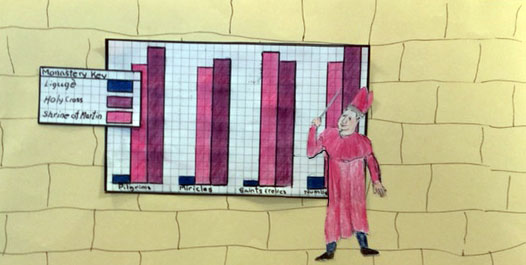
         I fear our peaceful joy of Creative Spirit eternal in beauty and life may not be perceived as enough to satisfy unquenched longings for earthly wins. Earth and heaven seem further apart. When creeds and mouthed prayers twist and unravel with the sound of a Christian earthly achievement as “thank you God for our numbers and power” something tangible may be seen, but also, something mystical is lost. 

         Now as Ligugè dwindles in numbers and earthly importance we too, are unsure if we celebrating a lasting spiritual legacy or grieving an earthly loss. Ligugè really doesn’t have much shine on earth. Yet I do know God is still present with us. Thank you God. We still have songs and prayers and responses to calls. We simply have none of the earthly “mosts” of today’s monasteries.

         Brother August’s artistry has attracted a sponsor. A marble stone was quarried, and is being brought to us by a team of mules.

         I’m glad we haven’t taken to making our own wine so that I can see my son once in a while even though fewer guests drink less wine. So it is longer between visits from Ezra. And I know Ezra too, is a rich patriarch now.

         These are times for remaking the metaphor for the Jesus kind of joyful peace, “the kingdom of heaven.” Jesus always answered questions of an eternal heaven in the present tense. He said, “I am with you always.” And whenever I find I am in his midst and warmth even in these times he never says “if you achieve enough goodness to earn your way to heaven I will be with you only in some far off distant day to come.” He is with me now, still speaking.

         In our Jewish ways we shouted out psalms of lament and expected God to be a power present with us. Now the blessings from earthly priests seem shy in calling God directly into the hungers and hurts of earth. The priests say “one day there will be golden streets and castles in heaven for those who suffer on earth.”  But isn’t that place with many rooms, prepared for us by Jesus right here in our midst like the prayer caves for the desert aesthetic? [John 14:1-7] Or is the long wander always somewhere other than in life. Is it like the horizon, always within view but never present?

         Here, I would ask the artist.

(Continues tomorrow)        

Post #25.3, Thursday, October 7, 2021

Historical setting: 588 C.E. Ligugè

         Ezra is bringing me up-to-date on all the news from the vineyards.

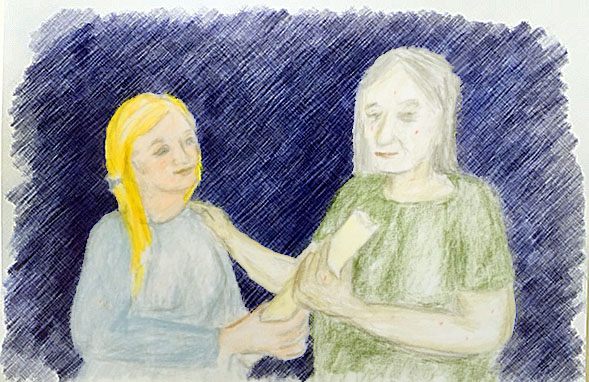
         He goes on, “Eve adores that gift Anatase gave her that you helped in lettering when you first came here. Eve keeps her ‘precious pages’ next to the door and rubs her hands over the herbs often to ‘see’ through touch and smell what you and the apprentice wanted her to enjoy always. In the spring and fall seasons Eve and the young woman now, replace the dried leaves with the soft, fresh herbs so they never loose the fragrances and textures.”

          “Daniel was at the cooper near the forest and found that the druid priest was asking about Anatase because their village is in need of her now. But Daniel simply said she hasn’t completed her apprenticeship yet. It seemed to suffice.”

         I comment, “Eve and Anatase surely must need one another, now, more than ever in these times of transition. I’m glad to know the child wasn’t returned to that tribe as Eve had feared.”

         “Child? She is nearly a woman now; she seems older and wiser than any ancient magi. A lot has changed. Maybe, if this place is too dull for you just come back up our way.”

         “I’ve been thinking when the garden is under for the winter I may just spend the season up there. It’s good to hear about it.”

         I help Ezra harness the mules as he is on his way.

         Dear God, thank you for this good news of my family. Amen. He could have sent someone else with the wine, and saved himself this journey. He must have known I was thinking of them.

         Fewer of us are here and the elders who remain were once, like Brother August, lone aesthetics following visions of youth. Now this particular Christian community is aging and dwindling but here value and purpose aren’t measured by earthly tallies of numbers and wealth. The ancient tradition of spiritual peace gives these monks a kind of freedom from standards of worldly success which seem ever-creeping into the well-funded monasteries in these times. This distinction shows up in little ways like tipping one’s head to the most learned bishop or powerful pope, or scoring the most donors or greatest number of monks and nuns, or announcing the most miracles bestowed onto pilgrims. But here I still find that mystical peace free from the strivings and winnings.        

(Continues Tuesday, October 12, 2021)

Post #25.2, Weds., October 6, 2021

Historical setting: 587 C.E. Ligugè

         Ezra still comes, though with our numbers thinning we have less need for wine.  I’m so glad to see him and hear the news he brings of family. I learn now that the vineyard land is also in transition. My concern in hearing of the death of King Chilperic was that Celeste’s husband, Bertigan, wouldn’t be allowed to keep his new land and title since he was a commoner appointed count by the late king.   

         Ezra explains, “King Chlothar the Young, is keeping better peace in his rule through his regent (strangely that would be Clothar’s great-grandmother, Brunhilda). With more negotiations and less warring he is leaving the kingdom of Neustra much as it was under his father, the late brother of the dead King Chilperic. So Bertigan remains a count, with Daniel his scribe.”

         I’m glad Daniel is literate, even though he isn’t a churchman. It seems a valued rarity in these times to be a literate commoner.

         Ezra continues, “Now Count Bertigan and Daniel have set more of our original land to cultivation and they are bringing others to do the work of tending the fields and vineyards. People who would be needy with no land to till are now working these lands splitting the harvests with the portions to Daniel and the Count. So even without the daily routines of farming this family has plenty in these years of good harvest. Celeste and the grandchildren moved into the grand new estate house, Bertigan Hall,” and Ezra adds, “Colleta and I find our place there also.”

         He tells me Celeste is a fine lady now, a countess, and he bragged on his grandchildren who are my family too of course though I don’t know them well.

         I say, “So there you are, the elder in a count’s castle and yet you drive the mules and deliver wine barrels to the monks.”

         Ezra enjoys the irony. “Wine is always an excuse to see family.”

         I ask Ezra what of Eve and Anatase.

         “Eve and her apprentice still keep the work of healing with potions and remedies. Eve’s cottage and garden are as always, but Bert and Celeste’s cottage and our old cottage are houses for the families of the tenants. With the lands divvied as they are into smaller parcels worked by tenants there are still lots of folks around so Eve isn’t alone.

         ”That’s good.”

         “Oh and I took them that gift you helped the child make for Eve…”

 (Continues tomorrow)

Post #25.1, Tuesday, October 5, 2021

Historical setting: 587 C.E. Ligugè

(A note to followers who receive this blog by e-mail and may lose track of the storyline:  A recap to end one month and start another is always current on the home page of the blog.)

         More than three years passed by us while I’ve been working in the inks of Ligugè. The commissions for our work continue to dwindle and our elder abbot has not accepted the available tasks of lettering copies of legal documents for secular dealings, as the politics of the aristocracy flail and shred in the shifting winds of royal whims. I know we need the work and the kings and counts need the help but the abbot holds to our sacred purpose despite the earthly tug toward what are called realistic values. 

         The nearby convent of the monastery of the Holy Cross has been tossed into a worse turbulence these days with the death of their abbess, Queen Ratigund on August 13. The appointment of a new abbess, Agnes, has inflamed the embers of disgruntlement already smoldering among the sister’s.  The sisters of the Abby, like Ratigund herself, are daughters of nobility and these nuns have long chided the strict Rule for Virgins. But now they are in flat-out rebellion over the appointment of an abbess of lesser rank. [Footnote] Rumor has it they are no longer confined to virginity by the walls of the Abby. Some are giving themselves away to marriage, or worse. But I suppose the advantage of an earthly, autocratic power-structure such as the bishops maintain will save this establishment in the end.

         I find my peace here at Ligugè where the bishop doesn’t interfere in our most intimate prayers with the Creator God, and this abbot affirms our version of obedience driven not by rule or threat but by love and respect.

         With less work to do in the inks I’ve been assigned to help in the gardens. Maybe it’s because I need the spiritual participation with things that grow, or perhaps it’s simply that I am one of the few of us with the youthful flexing of knees required to genuflect for every weed in need of pulling.

         As I watch the Creator’s patterns of continuation of life despite the shortness of seasons I see that changes from our clustered order of monks might become more as Jesus commanded, a mission of sending out, like a spreading of seeds on the wind. Whether or not we are a church of countable numbers or just a few wanderers, I know God will always provide a worthy pattern for Christians. To everything a season — for seeds flying — for seeds buried.

[Footnote] One source that attributes the nun’s rebellion to the noble ranking of the nuns is Patrick J. Geary’s Before France & Germany: the creation & transformation of the Merovingian world.(New York: Oxford University Press,1988.) p. 147.

(Continues tomorrow)

Post #24.14, Thursday, Sept. 30, 2021

Historical setting: 584 C.E. Ligugè

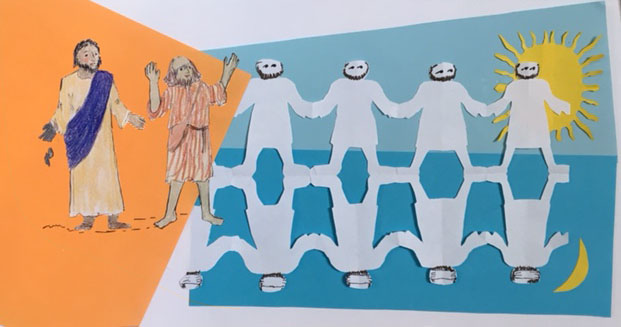
         Copying a manuscript is a different practice than reading it, so to read the scriptures I do that in its own time.  Here’s this page John Chapter 9. I know this. I’ve seen it happen when I was following Jesus. We came upon a man blind from birth and Jesus spit on soil then placed mud on the man’s eyes and told him to go to a healing lake and wash it off. The man received sight. In John this is a sign, not a miracle. So what does the sign point to? I wonder anew each time I read it and the mystery only increases.

         The disciples’ questions, as usual, are base. In this story they asked who sinned to make this fellow blind from birth, was it the unborn infant or the parents? Jesus answers that it isn’t about sin; it’s about the light.  So there you have it; its not about sin so seeing another’s blindness, or pain, or woes doesn’t speak of God’s judgment but of light. So if that means God doesn’t reveal holy judgment by letting us see someone punished  maybe King Chilperic’s assassination wasn’t a display of holy justice.

         But the gospel story’s concern over judgment goes on and on. This tale is full of characters making wrong conclusions about God and sin, light and blindness. Everyone is looking for sin. No one is looking for light. Neighbors wonder who the man is  — is he the same person if he isn’t blind? Pharisees wonder about Jesus healing on the Sabbath. Maybe Jesus is the sinner? But we all (at least the ones speaking) know God doesn’t listen to sinners so the sinner can’t be Jesus because God listened to Jesus and the man was healed.  The Sadducees call for the man’s parents to tell if he was faking blindness all along. The parents defer to their now adult and sighted son.

         All these people just couldn’t let go of that idea of sin even though Jesus said in the very beginning it isn’t about that. It’s about light.

         Then Jesus makes everything perfectly clear when he explains, “I came into this world for judgment so that those who do not see may see and those who do see may become blind…If you were blind, you would not have sin. But now that you say, ‘We see,’ your sin remains.” [John 9:41 NRSV]

         Okay that explains everything … maybe.

 (Continues Tuesday, October 5)