Post #19.6, Wednesday, April 14, 2021

Historical setting: Inside a daub and wattle sepulcher — 584 C.E.

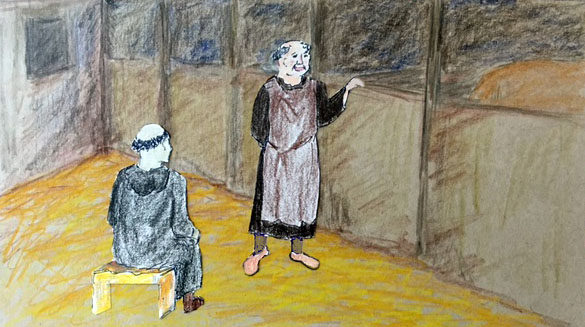
         “He looks to be a living man, dear Teacher. Shall we unwrap more of him?”

         “I don’t know what we should do. Maybe he would like to sip water.  Go, Anatase, and fetch a cup of cold water for him.”

         There is a scurry of leaving but Eve is still here.  I focus my eyes on her face. I see she has lost her sight.  I wonder if she knew of this blindness when I last saw her as a young woman only pretending to know reading and reluctant to marry.  But here she is a healer and now a teacher. How I wish I had strength to reach out my hand and touch her and I would tell her she is beloved. It’s her hand now that gropes for mine.

         “Papa, maybe you can hear me? Your hand is warm as living after all these years. You told us of your gift of life and life again, strange gift that it is. We only marveled in the wonder of it never thinking of the long waits through deaths and all the griefs you know in lifetimes of losses.

         “The God-things you taught me in childhood are my secret now, Papa.  People these times choose their quests for healings between the miracles of the Christian saints or the ancient pagan science. I know you would say God loves us all; it isn’t one or the other. But this world only knows choices, not fullness.  Since I’m not a saint so if I choose to be a healer I must be of the pagan variety and I have to keep my God prayers hidden. But I do pray to God and I very often thank God for staying close. I’ve prayed for my strength and life to last into this day, knowing nothing about how your waking would be except that it would come. And now I see by your frailty your healing will need to go on a bit longer before you are the full strong man we’ve waited to see walk from this tomb all aglow.”

         “Aglow” she says? Does Eve notice I’m smiling? Have I any smile at all to give? She doesn’t even seem to notice the clasp of my hand around hers. I’m sure I will one day move again but I don’t expect to be “glowing” ever.  I hear the child coming back.

         Eve offers, “Papa, would you like a sip of water?”

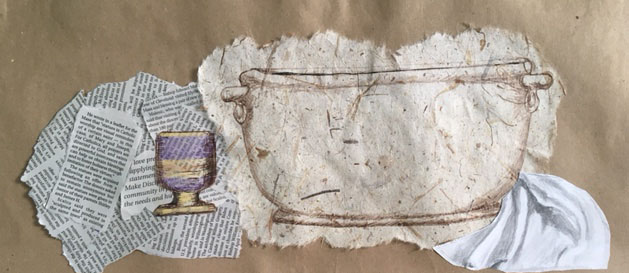
         The child tips the cup. “It is a cool sip of water.” She says. I can’t swallow. My chin and beard have a cool, fresh drenching.

(Continues tomorrow)

Post #19.5, Tuesday, April 13, 2021

Historical setting: Inside a daub and wattle sepulcher — 584 C.E.

         At this waking I hear the voice of the child.

         “I see the wheel is over the opening again. But don’t worry, Teacher, I can roll it back easily. I always roll it off when I come here to practice my flute.”

         I hear them rustling. I feel someone very near.

         “Here, Teacher, you can touch the edge of the opening then crawl in through this space. Now Ma’am, if you reach out your hand you will touch the broken man. Don’t be afraid. He’s very gentle.”

         Gentle? She says I’m gentle? I can’t even move. But I feel the touch. The firm hand of a healer touches my head.

         My daughter Eve’s clear voice is as always, the deep whisper of calm, “It seems he’s wrapped in linens is he not, Anatase?”

         “Yes Ma’am he is all wrapped in ribbons and ribbons of linens. Only his hand is unwrapped and that doesn’t seem as broken as they say he is.”

         “The monk must have wrapped him like this when he made the sepulcher. We should unwrap the linens.  Oh, dear little Anatase. I hope it isn’t a frightful sight for you.”

         “How does that concern you Ma’am? I am a student of healing and I am your eyes, so do you think I would be fearful of seeing a death now? If I haven’t had to turn my eyes away from new birth then why would I not be able to see the face of death? And anyway, do you not feel his gentle living spirit with us now? Maybe he’s not in death at all just now.”

         “I do feel my father’s spirit near us. But that’s not unusual for one who grieves as I would have grieved had my father died forever dead. But Anatase, the deaths of this man are not usual deaths. And I‘ve never removed linens like this before. Even I don’t know what to expect.”

         The child explains, “The hand that has been unwrapped seems like a hand of living person. Here, reach your hand to touch it.”

         “Oh, yes, this hand has flesh and warmth and life. Let’s take the wrappings off his head.”

         My eyes see a blur of bright lights, sun pouring through the spaces in the rotted away daub on the wattle of this tomb, and here are two human faces a blur. It is Eve, sparkling and silver-haired now, and a child with long yellow braids.

        “Please, Anatase, what do you see of his face?”

        “He has a black beard and sparkling dark eyes. I think his eyes are like yours Ma’am. But I think his are eyes that see, because he was casting his gaze all around and now he is looking right at you and now at me.”


 (Continues tomorrow)

Post #19.4, Thursday, April 8, 2021

Historical setting: Inside a daub and wattle sepulcher — 584 C.E.

         This is my son Ezra; now he is crouching in this small place next to me. I feel his spirit with me. Maybe he is lifting a candle. I feel the warmth of a pale light. He touches my hand with his own hand.

         “Papa, can you hear?” Yes! This is Ezra, he calls me “Papa” so surely the woman I heard was my granddaughter Celeste, a grown woman now.

         Ezra speaks to me,  “Have you a mind and a soul and a life after all these years of waiting in death?”

         I can’t answer.

         “Let me loose the rags that wrap your hand so I will know if your life warmth has returned.”

         My fingers are freed.

         “I’ll send Daniel for the monk who is waiting for you, Papa.”

         Ezra has never been much for talk so it is a shear blessing that he speaks to me now, though, I suppose he doesn’t expect that I can hear him. And I do have feeling and touch in my hand. He touches my hand with his. His hand feels dry and gnarled with age and hard work. Now he’s gone, and I’m alone again.

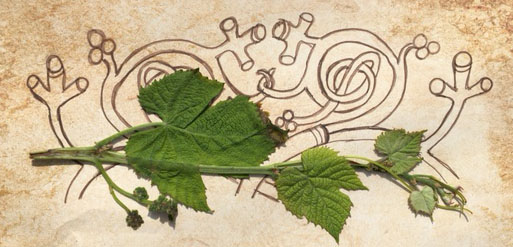
         I think of the day we went out to prune his grapevines and I was ready to burn all the old wood particularly the dry and gnarly vines seeming to be spent. Had he not stopped me it would’ve been a terrible destruction. These old stumps he told me, are the root that feed the new vines, not to be mistaken for the useless debris of last year’s harvest that we do mean to burn.

         Dear God, thank you for sending me a son who values keeping the ancient root around, anyway. Amen.

         If I could speak or move or even imagine that I had a being I would answer him, but he hears nothing from me, and now he is gone.

         Who is the monk who is waiting for me? It would be someone who would know my secret of life and life again. Only my family who is here knows of this, and of course my elder patron, retired soldier. My hope is that it could be Nic, maybe now a monk as he had hoped he could be. And surely he must be very old in this new time, a generation now passed.

 (Continues Tuesday, April 13)

#19.3, Wednesday, April 7, 2021

Historical setting: Inside a daub and wattle sepulcher — 584 C.E.

         “Anatase, Anatase, you naughty child! You know you are not to go near that place! We’ve been looking for you everywhere. You have to tell your teacher when you leave the house. She was so worried when you weren’t in your bed.”

         Now the voices of woman and child are gone.

         Do I know the voice of this woman? When I hear the particular bend of the words I picture my son’s first daughter Celeste. But I believe Celeste is a child. She is the older of Ezra’s children and she is the bossy one of course. Possibly it happened that this voice of woman is Celeste and the years have passed by me in this death.

         And what of the wheel with its crosses, and the great stones shouting out for the Christ of us?  What of the unfinished wall rising for church? And how would there be a tomb made of wattle and daub? And where is the “here” that I am in this tomb that surrounds me?

         “Its alright Papa!”

         I hear that voice again, of a woman, Celeste shouting just outside this wall.  “I found her Papa, and I sent her back to her chores.”

         And a man answers, “Where was she?”

         This is surely the voice of Ezra my son.

         Celeste answers, “She was here in the graveyard, Papa. She was inside Gran’papa’s sepulcher.”

         “Why? What was she doing in there?”

          “She said she was playing her flute for the broken man.”

         “Why?”

         “She said he likes to hear it.”

         “Why does she think he can hear?”

         “Papa, are you going to send that naughty little Anatase back to her own people now?”

         “You know I can’t do that.”

         “Well, at least give her a good scolding?  And you know what Mama and I think you should do with her.”

(Continues tomorrow)

Post #19.2, Tuesday, April 6, 2021

Historical setting: Inside a cell of wattle and daub.
This earth has passed two decades since the crashing of the wheel.

         At this waking — darkness. Dear God, are you near? I know nothing of the sun or the season or the year or the place or even what kind of burial this is. There is no weight of earth.

         In a brief moment passing I hear a child’s breath across the openings in the clays of a flute.

         It is the music of breath over clay

          as was the first mention of human life –  first human

         Lifting musician’s fingers from openings

                  Breath of Spirit escaping through passages

         Release into music – a child’s tune.

It is five notes to make a sound or a song or strangely a dirge, over again and over, a low and breathy measure of sound, faster the tune to step or now dance, then a note lands wrong and the child stops to sigh and try again to find a better note, then song. Then silence, The child is gone but left the song in my head.

                  Clay of the pipe, daub of the wasp.

         Spring breath in breeze through the reed of the wattle

                  But no beams of morning seep into this tomb

         Music comes as breath of the Spirit, to life

                  A dark dirge it is into this pounding and breathing of life.

         Dear God are you near, or am I alone?

         I long to see the beams of a day. I thirst to hear the music again, then into sleep.

         If it weren’t for the dark it would be a new wakening. This early hour is the deepest dark holding its breath for new light – beams through the spaces, now blur of lightness through ribbons over my eyes.

         Near me the rustling, a sniffle, a breath, the melt of the frost from the wools that wrap around a child in the early morning freeze.

         Then here is this music again.

         And today I would take a breath to sing along…

         I have no voice … I can’t move even a finger or a thought of a toe to make it a dance. I am the silence, I am the still, but then I know there is life to this song.

         Thank you dear God for music and life,

          For wonders of darkness and longing for light.

         Thank you dear God, for hearing my silence.

         Music broken, even the silence without it shattered.

         “Anatase are you in there?”

(Continues tomorrow)

Post #19.1, Thursday, April 1, 2021

Historical setting: A Building site in Bordeaux — 564 C.E.

         Now on this new morning August’s father and he are seated on the stone, and Shollo and Kairn are looking into the brightly risen sun to see what is on top of the wall. Maybe they pretend they have never seen a winch on a wall before. August nudges his father to take notice and he asks his father to be the one who orders brothers to use the better tools. Maybe the brothers know who put the winches there, but it needs to be the father who issues the order to make use of them.

         It is the full light of day and the workers have gathered at their places.  I am in the wheel waiting the arrival of the other treadman. The ground crew has the steering ropes in hand; Shollo and Kairn are minding the crank handles guiding the ropes high on the wall stretching from the crane arm through the pullys and onto these newly placed tools. The mortar is spread; the stone is still on the ground but firmly grasped in the claw.

         August’s brothers say nothing of these new devices. I’m sure they know who placed them here but since they had no bad words to say of it they said nothing. The gratitude is unspoken but August knows.

         Now the other treadman has arrived and we start the trudge in the wheel, ever climbing to the next rung, but never climbing higher, always the same place near the ground, yet the harder we climb, the faster the wheel, and the higher the stone creaking from every taut rope hold. Step-by-step the stone rises on the beam nearly as high as the top pulleys until it is hovering next to the wall for this highest layer, perfectly positioned, guided by the ropes on the winches when the whole arm beam gives way, cracking into two parts one falling quickly toward my team mate who has immediately fled. I have no way to flee. The high end of the beam is now tumbling with the stone in slow time is plunging straight down, onto…

(Continues Tuesday, April 6)

Post #18.14, Wednesday, March 31, 2021

Historical setting: Sixth Century Bordeaux

         With sun high this site is finally ready for work.  In the middle of it all is the crane-master who is spewing orders and counting the ropes for the day’s work. He gladly hires me to walk the tread-wheel. But now August is at his heels barking instructions for using the newly placed pullys and winches.

         When the family came here with the wheel they also brought the iron pieces, the lifting claw and the ancient pulleys of oak and iron. August’s father was supposed to be the crane-master here. But he was stricken with an illness of age and not able to oversee the work. He was given a voice in hiring this new crane-master. So this little fellow is like a hollow copy of August, missing only the soul and the mind and a deep and hidden love for these brothers.

         Shollo and Kairn are assigned the task of working the top of the wall because their father requested that; and now August is given orders by the annoyed, current crane-master to sit with the father and remain quiet. The brothers on top of the wall are cheering on the reprimand.  I take my place on the treads inside the crane-wheel, while we await the other tread-man. Walking the treads doesn’t require construction skills so much as strength, so I would suppose at the end of the day when we receive our coins this treadman will receive the least. Maybe that is why the other treadman doesn’t mind keeping us all waiting here.

         Now, seeing this crane from the inside, clearly it is a beautiful piece of carpentry finished even on the inside, as though it were to be a part of the building itself. It surely came from a different time and place.  Any wheel is significant. It is a form that Romans and even some of the pagan tribes in these lands consider a sacred symbol of the turning of the seasons. So how is such an obvious pagan artifact also the essential tool used in building a place for Christian worship? Here four prongs of Pagan symbol are also the apses and aisles of the basilica itself. It is of course, also the sign of the cross. The Christians have used the wheel and they, or we, as I am one too, reconsidered it to become a Christian symbol. [footnote] And of course I’m one who sees the four prongs as the Roman torture tool on which my friend and teacher was crucified.

[footnote] Storl, Wolf D. The Untold History of Healing is a comprehensive patchwork of ancient remedies, religions, herbs, symbol, incantations…the use of the circle surrounding the cross as a pre-Christian symbol is explored on Page 54.

(Continues Thursday, April 1)

Post #18.13, Tuesday, March 30, 2021

Historical setting: Sixth Century Bordeaux

         The brothers were right. No one shows up at this worksite at first light except Shollo and Kairn and their father. Today, August is here too. I watch from this place at the crane as the brothers recognize August now in monk’s garb. 

         Shollo speaks first, “August, or should I call you ‘Brother’ August! Father told us you are here and hidden in the dark wools of a churchman.”

         August flips his hood back to reveal his face, clenched jaw revealing hurt more than identity. “Don’t worry Shollo, I won’t pester your work with my righteous ways. I’ll be going on to Ligugé as soon as Brother Joel is able to travel.”

          The large hand of Shollo clutches the shoulder of August in a condescending gesture maybe intended as a greeting.

         Kairn speaks for both brothers, “We’ve all missed you here August. Anna’s death left a terrible emptiness, especially when you were gone also. I think, in a way, we all needed to see you again.”

         Shollo adds, “That’s probably so. It was needed.”

         August answers, “I just wanted to see our father once more. I hadn’t heard about Anna or I would have come sooner.”

         The father orders, “So now it’s time for the three of you to make amends.”

         “Very well,” Shollo begins, “August is the oldest. He should apologize first. Tell us how you wish you hadn’t always spoken to us with distain as though you were looking down on us from your little short man’s vantage point.”

         August answers, “Shollo, it seems you have already spoken first and spoken for me. So yes, I wish I had been a more thoughtful brother and never mentioned your sloppy work. In my thoughtfulness. I would have just allowed the simple consequence of shoddy preparation and a great stone might have crushed you. Because of my good plan you are still alive to speak for yourself. So tell me now of your gratitude for my thoughtfulness.”

         Shollo answers, “Do you mean as a, ‘thoughtful God-man Brother’, or thoughtful real brother?”

         Old ropes and knots binding ancient wrath are long endured in tangles. The well-placed winches may save lives, so perhaps that extra earth-time can nurture this dearth into love.

         Dear God, I can see this family has a long unwinding ahead of them. Is that why the journey between Egypt and Canaan required all those forty years, for all the healings of the hates? …

(Continues tomorrow)

Post #18.12, Thursday, March 25, 2021

Historical setting: Sixth Century Bordeaux        

         It seems the wheel itself is the fine workmanship of a knowledgeable carpenter. Anyone can see that. August witnessed its construction as a child watching and learning amid the building project in the north where their family had been located. Their father and mother and the two younger sons, along with August’s twin, Anna, came to this place, bringing with them this very wheel which August knows so well. They brought it in sections and reconstructed it on this site. So August is in deep dismay at its shoddy miss-use here. The anchors and the arm are of newer, less dense wood and it is not as solid as the woods used in the wheel itself wrought from the deep northern forests of the sacred trees of the druids now gone by the Christian ax.

         August has discovered the heaps of extra ropes and pullies that were brought along with the crane wheel left as refuse in a heap behind the outbuildings here. He says he has a plan that doesn’t call for any more negotiation.

         August says he only worries that his parents will grieve were his brothers to suffer the consequences of this inadequate structure. But I think he also fears for the safety of his brothers, as tomorrow they will start on the highest tier of stone and the weaknesses of the crane will surely be tried. He talks in detail about the hazard of the stone swinging too high for the strength of the crane arm, and with the lifted stone out of control it’s huge weight will be out of reach for his brothers on top of the wall, waiting their to snag it into place, and maneuver it into the bed of mortar. When they try to navigate it into place, it will fall, and pull them with it, off the wall.

         It is a clandestine task this night for which August has asked the help of Nic and I.  August wants to mount two winches on top of the wall to aid in guiding the great stones. With three of us using ladders and strength we are able to secure the pulleys and winches to give better tools to those working up-top. It could be that little mounted cranks and ropes may only offend the brawny sensibilities of the brothers. And offending Shollo and Kairn is what August seems to do so well even though his intention may be saving their lives.

(Continues Tuesday, March 30)

Post #18.11, Wednesday, March 24, 2021

Historical setting: Sixth Century Bordeaux

         I didn’t notice when August left his family’s house. When I return to the hearthside of the guesthouse he is already here crouching by the fireside, smothered in his wools, not speaking to anyone but perhaps to God.  At least I know he didn’t encounter his brothers. I dish some broth for him and a dish for me and I sit on the hearthstone to ask.

         “Did you have a chance to see your parents?”

         August looks at me in near tears, “They are so much older now. My father knew more of me than I knew of him and my mother thought I was my twin sister returned from the dead. My sister Anna died while I was gone.”

         “Your mother thought you were your sister even though you’re tonsured as a monk?”

         “Yes, she thought that is how angels are shorn; so she was only more certain I was my sister returned from heaven on this night.

         “My father still has his sharp mind, though he angers more easily; and my mother is still sweet and kind but she doesn’t know why. I’ve missed so much. And Kairn plans to move out. He will take a wife soon. He plans to live in a city house already built and he will pay a landlord for its use. My father fears Kairn will always be a poor man in debt to the rich. As though a monk like me isn’t always in poverty.

         “What of the paying work on the basilica? Is Kairn going to continue building?”

         “That is all any of us know to do. Of course he will build, and when it is done,… how many years will that be? 

         “The treadwheel is the same one they brought down here from the last build they were working when I was still helping at that site.  So my father blames me for the scanty rigging they have here. He says if I were here it would all be fine.  As it is now, he watches everyday and won’t let Shollo or Kairn go near the crane because of the danger that it might not carry the weight onto the wall as it is.”

         “I think he isn’t blaming you, so much as missing you.”

         “He was angry.”

         I suggest, “Maybe they just need another man to walk the treadwheel. The lift will be easier and safer with more of us working.”

         “More of us?”

         “I didn’t mean you.” I tell August.  “I meant, I already offered. I’ll meet the new crane-master in the morning.”

(Continues tomorrow)