Post #17.12, Thursday, February 25, 2021

Historical setting: 564 C.E. The Gaul Side of the Pyrenees

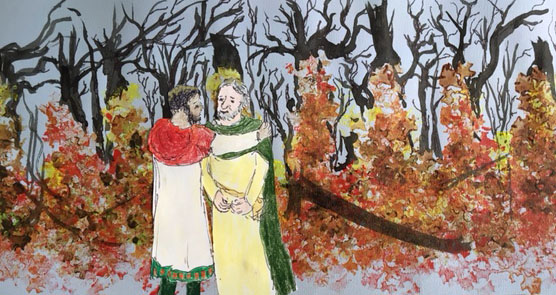
         I’m anxious to let Nic know of my recent clarity of memory. It’s all come back to me now, not as grief but as hope. I have a breathing reality in knowing where I will find my children and grandchildren.  I suggest Nic and I ride on into Bordeaux and look for an inn where we can safely take Brother Joel and wait out the healing into spring. The ride will give us time for me to talk with Nic.

         So we are riding north. The horses’ easy gait makes a brief jaunt of this, but it is time enough to tell Nic of the revelation of memory.

         “There was a reminder when I asked in Bordeaux and I was told there was no surgeon. There was a known healer who owned an ancient book of remedies. Then it came to me — an ancient book of remedies. It was held in the hand of my daughter, Eve. She was pretending it was filled with Pagan stories, really from her own imagination intended to entertain my grandchildren, Daniel and Celeste, and the baby Margey who was asleep in Eve’s arms. They are my son Ezra’s children. Eve was caring for them while Ezra and his wife, Colleta, were away in Tours.

         “Now all the webs of forgotten life are unwound and strung together as my true memories of this family. They live on the River Liger, or in these times called Loire.”

         Nic interrupts. “That’s where we found you, beaten and left for dead. Do you mean that road was so near your home?”

         “My wife, Susanna is buried on the hill near that bend in the river, and my son has the vineyard there.”

         “There is a known healer right near that place. We would have taken you to her instead of to Nantes, but we were hurried along by the rotting condition of our ship, and by the fact that we thought you a Christian because you wore a monk’s tonsure and she is known to be Pagan.”

         “Maybe she is Pagan. It’s how she’s thought of. My son and his family are Christian. Eve and Ezra were orphaned in the first wave of the Justinian plague delivered to us in 543 by the Roman soldiers who traveled on the river.”

         “Yes.” Nic adds his comprehension, “I joined the Roman Navy to fill the gap left by that first round of the plague. What else do you remember of that?”

(Continues Tuesday, March 2, 2021)

Post #17.11, Wednesday, February 24, 2021

Historical setting: 564 C.E. The Gaul Side of the Pyrenees

         August is telling of his becoming a hermit monk. “I wandered alone until I found a quarry for my stonework and I made my cave near that place, so my prayers could be my artwork.  Yet, even now I think often of my father and wonder if he is searching for me.”

         Brother Joel again, reaches to touch the hand of Brother August. “So here it is on earth, the same as it is in heaven. You don’t know if the longing you have for family is your own yearning for them, or if it is your father’s; just as you wondered if your solitude was for you, or for God’s sake. All this wonder about whose need it is you are answering is found in listening to the Spirit. When we are one in the Spirit the question of ‘whose obligation do I answer?’ is moot. Like the creek flowing out of its banks these structures of duty that separate us from the flow of God’s love are washed aside, and all that we have is the love of God, and we were taught to pray ‘as it is in heaven, it is on earth.’”

         August’s hidden hope is exposed. “I think of Joseph in Egypt, how by dreams and wonders he came from the pit to become a governor distributing grain in famine. I imagine myself like that, giving nurture to my brothers in their suffering a spiritual famine. If only they would realize they are starving I could offer them the Good News of Christ.”

         I feel like the rub of the brothers’ distain is August’s imposition of virtue. I offer my opinion, “In the Joseph story he didn’t force the grain sacks on the brothers. They had to feel their own hunger then they came begging.”

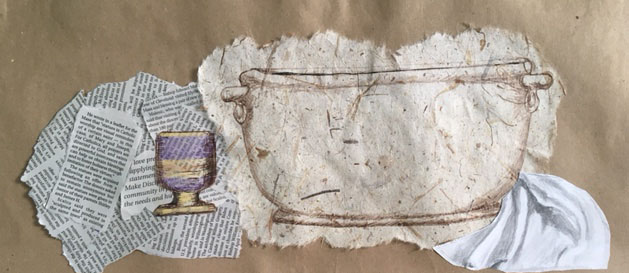
         Nic amends,  “Imposing a valuable cup, yes, but Joseph didn’t force the grain on them.”

          “I hear what you are saying.” August answers, “My family is surely not begging for a spiritual rescue.”

         And my own Jewish inheritance of the Joseph story doesn’t even end in such sweet resolution. I hear it as the scroll that explains how the Israelites got themselves into slavery in Egypt in the first place.

         I speak my so-called wisdom. “The story is as it is. The meaning of it depends on where one chooses to end it. Is it an amazing synchronicity, or the root of brotherly enslavement?”

(Continued tomorrow)

Post #17.10, Tuesday, February 23, 2021

Historical setting: 564 C.E. The Gaul Side of the Pyrenees

         So, Nic asks August, recalling the story of Joseph, “It was like your brothers plotted to take you from your father, strip you of your fine coat with long sleeves then leave you in a wilderness pit?” [Genesis 37:20-24]

         August answers, “Yes, I lived that story. But they didn’t take me to the pit; I found the wilderness cave with the help of God. I thought of the cave as that mystical pit for dreaming, the place where Joseph was discarded, stripped of his fine garment and left for dead as I am dead to them now. But making my choices, I left to go my own way just before the project was started in Bordeaux when we were repairing the rubble of a burn near Tours. I added some carvings in sandstone, flourishes and flowers for the lentil shelf over the doorway so when the bishop with his priests came to assess the construction they hardly noticed the huge stones perfectly set in place to be the walls. They stood in the doorway marveling at the carvings.

         “When they left, my brothers heaped their jealous rage onto all Christians. They jeered at the mystery of ethereal Spirit, sourcing psalms and prayers and taking these “vulnerable” Christians into “imaginary” worlds claiming an invisible God, instead of caring for the more tangible and useful things of earth like the solid walls. They called the worship of God a dream gone array leading ignorant followers into the cult of the pit.

         “But all of us, my parents and my brothers alike had spent our lives building these great halls for Christian worship. How could they do that work and never even see the purpose of it?  I was angry, maybe for my own hurt, but I thought it was for the sake of God. I believed my own rage was holy anger seeking justice for God, so I left my human family for the solitude of a cave. I confess often, wondering if my reason for seeking tranquility was for my benefit or was truly for God’s sake.”

         Brother Joel reaches his hand out to Brother August and whispers. “You are God’s child, would you not be honoring God by seeking your own peace? The sins that devour us are the ones that separate us from God, not the ones that bring us closer.”

         “Thank you Brother Joel.” Brother August surely finds comfort in the simple wisdom of this elder.

         “So what brought you down here from Tours?”

(Continues tomorrow)

Post #17.9, Thursday, February 18, 2021

Historical setting: 564 C.E. The Gaul Side of the Pyrenees

         So the decision is made. We make camp between yonder and nowhere for whatever time Brother Joel needs.

         Severing a foot is an agonizing cure but Brother Joel has accepted it as boldly as could anyone. And it’s clear Nic has a skill with the blade that it is tempered with empathy. Thank you God. He is, as he told us, one who has the soul of a monk and only the appearance of a soldier.

         August asks me about the worksite at Bordeaux and I realize he sent me to that place in particular because it matters to him. He asked who was the worker I talked to.

         “I have no idea. I was simply asking for information about a surgeon.”

         “What did the worker look like? Was he dark or fair?”

         Now I look at August’s face and I see the face of that same worker and I understand.

         “August, he did look to me that he could be your brother.”

         “Yes, I thought that might be. My family is working there. He probably tipped up a brow to scowl at your interruption.”

          August’s own tipped brow is grin-worthy. “It was your brother. Are you hoping to see your family soon?”

         “Not at all. I think it would only be my father who would wait for me, and by now he must imagine I’ve completely left my old life, as I suppose I have. My brothers and my sister Anna probably fill my place in my mother’s thoughts. I imagine she is still sitting there amid all the dust of a worksite, grinding the grain for the meal, pretending she has a home in some odd and temporary thatched hovel. We were always living our lives butted up against a construction project and she was always dealing with any kind of shelter they built for sleeping always pretending she had a home.

         “Do you miss them?”

         “No, anyway, they won’t recognize me now. Last I saw them we were rebuilding a burnt out sanctuary. Since I’m not endowed with great muscular prowess I used my wit to position the crane and ropes for lifting the stones with less heft. My father required my brothers to learn from me. But they didn’t receive my instruction graciously. They saw me as a threat to their only gift — brut strength.”

         It’s easy for me to see the brothers’ point of view as I also sometimes notice August has a rub of righteousness.

(Continues next Tuesday)

Post #17.8, Wednesday, February 17, 2021

Historical setting:  6th Century Bordeaux

         The city of Bordeaux is barely rising from the ruin of the old Roman civitas of Burdigala. It’s been battered in wars again and again ever since the Romans saw the strategic location and protected it with a wall; but in these times it’s just another example of the lost Roman glory. The larger the city with its ancient grandeur the larger is the ruin of it. And Bordeaux is a magnificent ruin indeed. Here the amphitheater for thousands is a hollow chasm grieving for the long passed whoops of crowd. 

         August mentioned the reconstruction of a basilica so I follow the flattened roadway cleared by the dragging of large stones. Some builders are working among the stone heaps still formless on the brink of new creation.

         August mentioned the Frankish Christians are considering Bordeaux to become an important see, maybe for an archbishop. And this construction is founded in that hope. I inquire of a surgeon but this worker only knows of one who can read who has an old book of remedies. That won’t due. We need a surgeon’s experience. Now it’s clear to me Nic will have to use his blade. I return immediately so they can stop jostling Brother Joel over the rough path with vacant hope.

         My ride back echoes thoughts of one who is a physician because he “has an old book of remedies.” But the image in this thought is not of a nameless healer reading from Galen’s book; but now I recall a particular physician I knew well– a foggy image who now rests in my thoughts as a beautiful memory. This woman I seem to have known once is not the wife of my grief, but she is our daughter. When last I saw her she was a young woman trained in healing by a pagan hag who raised her after the plague made her an orphan. She is marked with the pox that took her pagan teacher’s life. In my thought of her she is reading from the medical book the old hag left for her. If it weren’t a hurry to return I would just saunter in these wonderful memories now returned.

         At a gallop I meet back with the oxcart still moving slowly northward toward the place where the creek meets the river. I have the news that the city is just as August said but they have no surgeon with any better recommendation than Nic’s own blade.

(Continues tomorrow)

Post #17.7, Tuesday, February 16, 2021

Historical setting: 564 C.E. The Gaul Side of the Pyrenees

         We are trying to decide if we should take Brother Joel on a day long ride in an ox cart to find a city with a surgeon, or if Nic should just apply his blade and skill and take this man’s agonizing dead foot from him right here and now.

         Brother Joel answers,  “I am willing to try both things you’ve offered. Your kindness has let me know I‘m ready to leave this solitude here for a time of physical healing.  So let me try to manage the ride to Bordeaux and if I cannot endure the journey, I will beg the cut of your blade, Brother Nic.”

         So we set out on a day’s journey to Bordeaux now with August and the ox first and Nic walking, leading The Rose behind the ox cart in order to keep a watchful eye on Brother Joel who is lying next to the cool stone of the statue of the mother in the cart.

         I’m left to be the scout, escouter, for our direction ahead so I gather instructions from August to follow this creek then turn west at a larger river and follow that river into the city.

         Umber seems grateful for a faster pace so our ride alone has a welcome freedom though my heart and my prayers are with the others. There is always that tug between solitude and belonging with people and it isn’t just for the ascetic monks living as hermits in wilderness places. I seem trapped in the paradox of longing for the tranquility of isolation then when I’m alone, I yearn for the company of others.

         I’ve only followed the larger river a few miles to the west when I come upon an ancient Roman bridge spanning this widening meander in this otherwise empty place in sight of an ancient city wall. This crumbling bridge has endured centuries of wars no doubt. Surely any booming civitas has shrunken away from this edge of city wall as the roaring numbers of urban humans has been shrinking over the years with each war or round of plague.

         I take the dare and test the strength of the bridge, first on foot, then on horseback.  I’m sure this bridge can maintain the weight of the ox cart in case I would find no other bridge to take us across to Bordeaux.  And now I see there isn’t another bridge so this is where we will cross.

(Continues tomorrow)

Post #17.6, Thursday, February 11, 2021

Historical setting: 564 C.E. The Gaul Side of the Pyrenees

         On this new morning even the most magnificent beams of dawn can’t pale the long darkness we’ve spent. The elder monk lay the whole night in the place August prepared for him in the bed of the cart, driven, as he has been, back from death into life by raging fever. August sat with him, Nic and I prayed quietly with whispers yet our prayers were heard easily because God’s Holy Spirit hovers close by, and now the elder monk has set his face this morning toward the continuation of his tangible, physical life. The elder desert father has more clarity than fever this morning.

         Thank you God.        

         He tells us he is called “Brother Joel.” We can see that if he would choose to continue on his humble walk with God he will surely have only one physical foot to walk upon. He tells us what we feared we would need to tell him, that he may loose his foot along this way.

         August knows of an ancient Roman city on the path before us. “It was once a Roman city and now the Franks are rebuilding it and calling it Bordeaux. The Frankish kingdom is asking the church to name a bishop so that it may become the whole archdiocese of the Frankish kingdom.”

         I know something of this land. “I doubt a Frankish archdiocese could ever find root in an earthly city like Bordeaux when the great power of the dead Saint’s relic are ever beckoning Christians to Tours.”

          “I’m just saying,” August explains, “Surely in a city we will find a proper surgeon who can see to the needs of Brother Joel. We could be there before nightfall. I know this path we are on and that city is very near.”

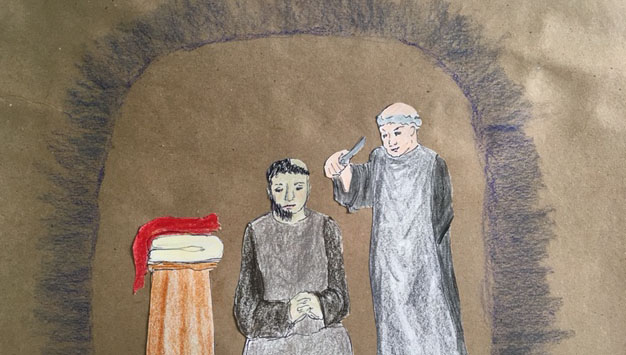
         Nic draws his dagger. “If a day’s jostle in the bed of an oxcart  doesn’t kill him, surely a stranger’s blade would. I have a soldier’s training and years of observance of these things; and Brother Lazarus has proven himself an adequate craftsman at making a crutch from a stick of wood. If we did this here and now, he can heal in his own familiar cave. We will stay with him until he is able to fetch water for himself.”

         So I ask the subject of this debate, “What do you say, Brother Joel?”

         “I think with your kindness and the grace of God I shall have it both ways.”

         (Come again Tuesday, February 16)

Post #17.5, Wednesday, February 10, 2021

Historical setting: 6th Century Gaul

         The monk we have found in his cave near death whispers to us of “thin places.” What does this mean? Explanations of thin places are only spoken through whispers as poetry.

         One preaches of the thin places she noticed in a story of Elijah. She said, “Sometime you might hear the mystics talk about the thin places. Thin places are where the boundary between the spiritual realm and the physical realm is so thin it practically disintegrates. Thin places … [are] the marshy edge that runs along the shoreline between the beach and the sea. … In the thin places, earth spills into heaven, and heaven spills into earth. In our own lives, the thin places make us tremble with their beauty. But watch out! These are the very regions that harbor the precariousness between, between life and death, so there’s nothing safe about them. It’s no wonder they make us tremble!” [footnote]

         Nic lays this withered ancient man over his outstretched arms like a precious child found sleeping in a place where people are to busy for quiet, and he brings him down the hillside to a soft fleece laid into the narrow space left in the oxcart right against the stone mother and her child. Nic looks across the cart, passed the monk and the stone mother and her child toward the stone carver and he asks August if he has ever known of thin places.

         “That’s what I was seeking when I left the cities with all their constructions of churches made of thick stones of earth. I left my family and people to find the edge between earth and spirit. It was something I thought was always somewhere I wasn’t. So I went away into the clay cave seeking solitude.” August asks for his own answer. “Is a cave what you would think was this thin place the old monk mentioned?”

         Nic is thoughtful in his answer too.  “So it is something you would look for somewhere else from where you are?”

         “Yes, I would say when I was looking for it, yes. It always wasn’t where I was. Until, it was all there was. So I made tools of iron and the hardest rock and went back to my craft of chipping away at earth stone until it was spirit, too. As an artist, a sculptor, I don’t know if the art is holding on to the tangible, or letting go of the rock that hides the Spirit.”

         The old monk spoke again. “It is the wonder between.”

(Continues tomorrow)

[footnote] The preacher? Rev. Mariah Marlin-Warfield from a sermon delivered to the “Church of Peace U.C.C.” on November 1, 2020. This blogger is celebrating the beautiful, trembling, thin place of that preacher’s birth on this date in 1980. Thank you, Dear God, for all this time I have to see Mariah grow from infant to woman.

Post #17.4, Tuesday, February 9, 2021

Historical setting: 564 C.E. The Gaul Side of the Pyrenees

         August investigates the deeper of the caves in the steep bank of the river. He takes a lit lamp and the alms the villager gave. Now Nic and I have been waiting here, and August emerges with only an empty earthen water jar.

         “Brother Lazarus” August reports, “Those shoes you made are too small. The monk’s feet are already darkened from the freeze though all the rest of him is the pale of death. His body is sparse and thin but still the shoes would not cover his feet and he needs warm shoes. At first sight I was sure his soul had long fled the bones so I covered what was left of him in the wool. I thought I was wrapping his body for a burial, but then he stirred and then he shivered. He was sleeping nearly breathlessly as in a deep trance of prayer. So when he awoke I offered him a sip of water from a cup I found nearly empty. He was grateful, and said his feet could no longer take him down to the creek and he asked that we fill his jar before we travel on.”

         August adds that he thinks we need to bring him out of the cave and take him on with us to the monastery where he can get proper care for his damaged feet.

         “Is that what he is asking?” I wonder. “He might be one who seeks spiritual perfection in abandoning the physical world, so placing him in a oxcart for a long journey to find physical healing would only intrude on his spiritual journey even if it takes him beyond this earthly life.”

         “What are you saying Laz?” Nic argues, “that we leave him here to die alone simply because he can’t walk to the creek for water?”

         “We need to ask him.” August offers that pragmatism and goes back into the cave with Nic following close behind and now I choose to follow also.

         While we are deciding his need the monk has pulled himself closer to the front of the cave, so when we find him again he is hiding his eyes from the glare of sunlight beaming into the entrance. Having heard our conversation he is ready with his answer. Now I can see I was quite wrong to suggest he would choose to abandon his bones to nurture spirit alone. He spoke of the thin places but not of death or even of a heaven without earth.

(Continued tomorrow)

Post #17.3, Thursday, February 4, 2021

Historical setting: 564 C.E. The Gaul Side of the Pyrenees

         We’ve walked all day in search of a particular cave said to be dug into the bank near this creek. Nic scouted out the river bank  ahead of us and said he did locate some caves a few miles ahead but they seem uninhabited. At least we know we have a way to go yet. So we choose to pitch our tarp and make the night fire now rather than go on. There is still a bit of daylight and a ruby sunset with a promise of a good day tomorrow.

         The promise is kept by the old adage of red sky at night. It is indeed a beautiful morning to continue our journey to Ligugé, and more immediately our search for a monk in need of the alms the villager has provided.

         It is still morning when we reach the abandoned caves Nic told us were here. Here we stop to investigate for signs of a monk. There is a pale silence about this clay bank. Three caves are dug into the hillside. One of the caves has rubble and rocks pushed across the entrance, a common way a cave is sealed at the discovery of a monk who has passed away. We approach the second cave with reverence and trepidation. It’s a shallow dig, containing nothing, probably the source of the rubble in the first cave.

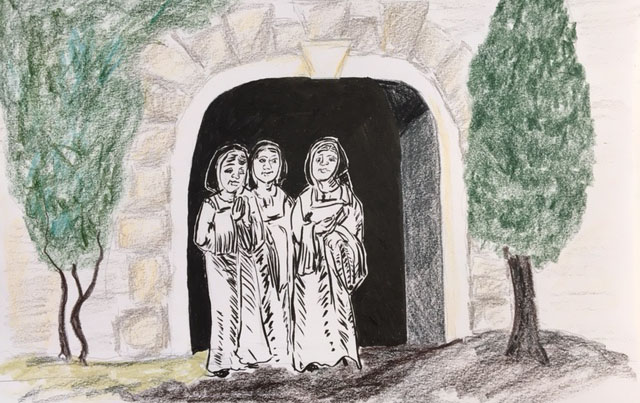
         The third cave is deeper, and investigation of it requires someone to enter with a lamp. August wants to go in alone in case a monk is present and deep in prayer. Brother August goes down the hillside to fetch the alms and flame in the lamp from the embers we carry. Nic and I wait outside. The cave sends out only the fragrance of damp deep earth. There is no smell of death here, and the life smells are only our own, so we guess Brother August surely won’t find a needy monk here or would he find anyone here at all. Even our prayers are silent as we wait. Then whispers echo from the gaping dark hole – sounds in the voice of eunuch or angel or August.

         Brother August emerges from the darkness alone without even the beam from the flame.

(Continues Tuesday, February 9)