Post #17.2, Wednesday, February 3, 2021

Historical setting: 564 C.E. Village on the Gaul Side of the Pyrenees

         Last night we slept in comfort in the loft of the stable. We learn we are now in Gaul.

         I was telling Nic and Brother August of the priest’s message to the villagers who thought the statue was Lot’s wife turned to a pillar of salt in the desert. August enjoyed the twist of story; Nic wonders if we should turn the statue to face front. But it survived mountains and flood why change it? And besides, the villagers needed the Father’s message of Christian duty to care for outcast rather than judge them. If the villagers assumed the stone woman was dauntlessly holy, like the Virgin mother of Christ no one would have mentioned it. It would seem sanctified and out of touch requiring a holy and silent distance.

         This morning one of those who saw our procession and heard the sermon returns with gifts for the “needy desert father walking with the ox.” Along with a small sack of grain the kindly woman brings a cut of black wool said to be a better size than the larger hooded garb the monk is wearing.

         As the villager leaves Brother August complains, “Why is it people are always trying to dress me up in clothes that don’t suit me?”

         I know he is also bemoaning the required shoes. But I’m still glad we are demanding shoes on this icy journey. 

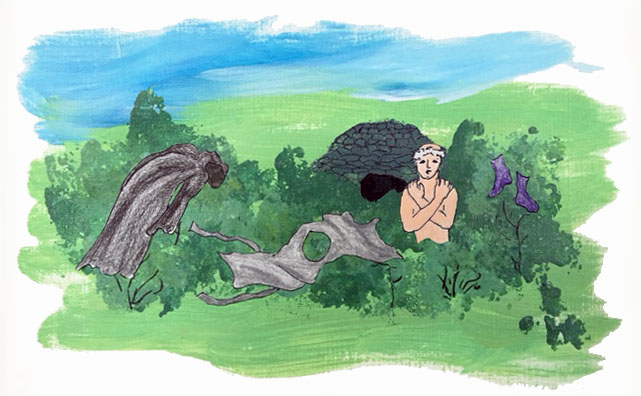
         The priest suggests we take these gifts on with us, and that we look for a particular ascetic, Brother Joel, who is known to live in a cave along the river where we will be traveling. He said a monk came this way recently and mentioned that this desert father in that cave is aged and frail and he may be in need of a warm wool and a supply of food soon. So maybe these gifts have the synchronicity of miracle that was intended by the villager who brought them.

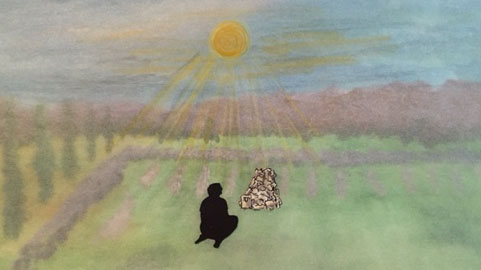
         After our morning prayers and the feast to break the night’s fast we set out on our journey to find that particular cave. Following the river, moving only at an ox’s pace we are not likely to pass by a cave without taking notice but Nic rides ahead to scout it out anyway. By this time when he returns the sun is already sending tall shadows, anticipating dark. He brings news that there are some caves dug into a hillside, but they don’t appear to be occupied.

(Continued tomorrow)

Post #17.1, Tuesday, February 2, 2021

Historical setting: 564 C.E. A Small Village in Southeastern Gaul

         Stopping at a small village church, the stone woman in the oxcart captures the imaginations of villagers who are now demanding the priest retell the Genesis story they’ve heard before – the one where Lot’s wife turned back while running from the mayhem. Maybe it is that we placed the statue in the cart with the mother facing backwards, or maybe it’s just that people like to hear stories of smashing, flaming, punitive, holy justice instead of a promise of a simple mother’s love.

         The priest begins his sermon likening the Genesis dialogue with God and Abraham to the Matthew visitation of an angel to Joseph. How is it a worthy comparison?

         He explains, “Like that Genesis story this begins when God comes, as God does come as an angel or a dream to speak of love beyond justice. In the Matthew story God sends Gabriel in a dream to the carpenter, descendant of that Genesis man Abraham.”

         “No. Tell us the other story! The one where the mob begs to rape the angels!”

         “Tell the story where Lot offers the raging men his own daughters!”

         “Tell us again, how God’s judgment came down on Sodom and Gomorrah as molten rock and ashes crashing down from heaven!”

         “Tell us how Lot’s family ran away but Lot’s wife looked backwards to her old life burning behind her and she was turned to a pillar of salt.”

         The priest answers, “This story begins where God speaks to the earthly father with possibility for reconciliation for those whom the human measure would judge as evil. The human voice of judgment calls for Joseph to break his betrothal to Mary, because she is already pregnant. But God’s question is the same one God asked of Abraham. ‘Who is worthy of rescue’? We remember in this that God loves even the outcast.” The villagers know they have heard a sermon.

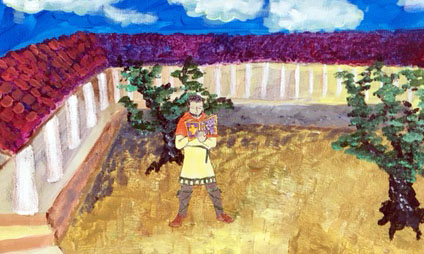
         Besides the small size of the oratory space inside the church, the other unusual feature of this place was the very large and accommodating stable welcoming travelers more than it is a display holy artifacts as in a wealthy city’s basilica.

         Nic and August missed this sermon because they were in the stable behind the church putting the animals in for the night. But I was listening.

(Continues tomorrow)

Post #16.12, Thursday, January 28, 2021

Historical setting: 564 C.E. A Small Village in Southeastern Gaul

         The villagers argue:

         “This is no statue, Father!”

         “A statue is an image of an emperor or a hero!”

         “A statue is like a pagan god trapped in the stillness of stone!”

         “Of course we have seen statues, and this is not a statue!

         “This is a common woman!” 

         “See for yourself! This is Lot’s wife, solid salt, always looking backwards.”

         And that is the spirit of the mob now gathering around the carved stone on the cart near the front of the church.

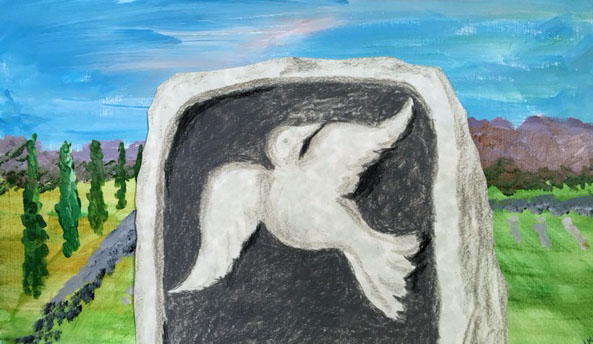
         The father preaches, “Really, my friends, this is not that woman from the story in Genesis! This is a Christian statue cut into solid earthen rock by the humble hands of a desert father! It was made as a prayerful act. But never was it a real woman; it was always stone and now it is art!

         “Listen, now, dear sheep of this parish! You know well Christians don’t worship statues of emperors or idols of pagan gods. We don’t worship tangible gods! Christian art is creative works by human hands though sometimes driven by the intangible and invisible God through inspiration.” The priest’s complexity of sermon seems to pass by their ears, favoring what their eyes see. 

         He continues, “This art is like the songs sung by ancient shepherds that inspire all of us in wars and peace to give us courage and lead us to thanksgivings before the true Creator of earth and heaven. We sing songs and share in poetry with our human voices, our fears, our humor, our imagination, always reflecting our human being as image of Creator. So why wouldn’t an artist share the Creative Spirit with the work of his hands carving stone?”

         One of the mob shouts, “Songs are never of salt or stone, they are like whispers of wind that fade away!”

          “Please, all I am saying is that stone images do not replace the Creator. They inspire us to notice the invisible. And so this image of a poor mother caring for her child inspires our human knowledge that like children we are beloved by God.”

         The crowd still calls for the other story, “So tell us the true story of the woman driven from her home by the angry God. We want to hear of the justice where the fire and ash reigned down from heaven and destroyed the wicked city.”

         “Always you want to hear of the ruin.”

(Continues Tuesday February 2)

Post #16.11, Wednesday, January 27, 2021

Historical setting: 6th Century A Small Village in Southeastern Gaul

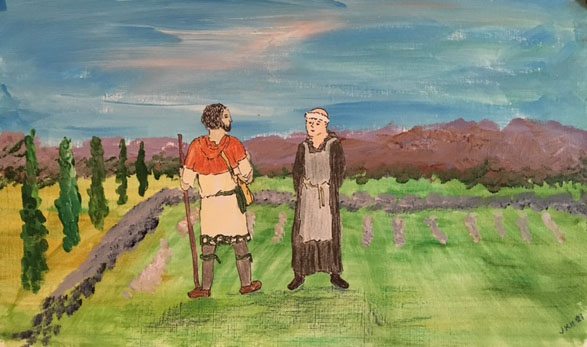
         We’ve stopped in this small village to for the night’s. The priest recognizes August even with the hood that covers his face. Their warm greeting includes the introduction of us fellow travelers. Then the priest takes a long ponder in awe at the stone woman and her baby in the oxcart ignoring the curious on-lookers of villagers who gather.

         “So this is what you do for so many months in the mountain cave?” The priest asks.

         “It is what my hands are doing while my heart and my voice are in prayer.” August answers.

         This church building is barely a stone heap topped with thatch, hardly more than a dessert cave. It has two rooms, one for worship and prayer if the community at worship is no more than four, and the other is the priest’s sleeping quarters. He has no fire center inside so in the back is a wide opening with a covering tarp as a tent would be, and the fire circle is outside.

         I’m tending the fire while Nic and August take our beasts to the large stable prepared for guests and their animals. I can hear the voices of villagers who are now a larger group in front of the church discussing the stone statue.

         Apparently, the people were rallied by rumor that this is not a carving, but the actual woman turned to salt in the desert. I can overhear a mottled piecing of the Genesis 19 story after Abraham and God negotiated the rescue of Lot and his family from the destruction of Sodom and Gomorrah. In recalling the story the villagers have hobbled together their account of the likely sins that wrought this horrific judgment on the towns, but I hear no mention of the part where Lot offers the unruly mob his own daughters in place of his visitors. Its odd the things people remember most. Surely the Genesis story was history told by the ones who lived to tell it without mention of their own sins. So was Lot’s goodness the reason why the wrath of this punitive, judgmental God left Lot’s family living? Were they really more righteous than those who died? When I hear these old stories of the God of vengeance people love to imagine, making the world more just by distributing disasters, mostly they point out some non-descript virtue of the survivors who live to tell.

          The priest shouts above the ruckus. “This is not a woman turned to salt! Has no one seen a statue before?”

(Continues tomorrow)

Post #16.10, Tuesday, January 26, 2021

Historical setting: Pyrenees Mountains, 6th Century C.E.

         Nic is arguing with August over August’s commitment to walk this winter journey barefooted.

         Nic tries another plea. “Possibly you believe that God will see your suffering as a way in which you are superior to your fellow travelers. But because your own frosting toes are not hidden from us it becomes our suffering too by way of our empathy. So you have no virtue in denying us our kindness born in empathy. You must wear shoes on this journey.”

         I try to ease the demand. “You may remove the ermine tails if you wish not to make a display of wealth.” And so he tears the tails from the shoes as he defiantly puts the leathers onto his feet like a two-year-old, disappointed with an authoritative parent overriding his “no”.

         I’m sure he sees our demands as patronizing. It’s a sensitive issue.

         “At least you look to have a man’s feet now.” Nic adds this last word as August stares down at the furs now separating his human flesh from the beloved cold breast of earth – cold earth that would undoubtedly devour his toes in frostbite.

         The winter is hardening as we set our faces again toward the north. The monk and the oxcart with the stone mother of Jesus are in front, and me and my brown horse at the rear. Nic and The Rose stretch to varieties of trots and cantors back and forth often going far ahead of us.

         It is early afternoon when Nic brings news of a small cluster of farms ahead. Here we are finding August already knows this path. He tells us just beyond the farms is a small community that holds a town fair in the summertime. They have a church and the priest of that parish is known to keep traveling monks informed of the well-being of Christian ascetics in this region. So we choose to pass by the farms and go on to the small root of a village.

         The dark of the winter’s afternoon draws us closer together on the road as we come into the village apparently appearing as something of a parade. Villagers come out of their houses to watch us pass by. August is mostly interested in hearing news of others of the lone ascetic monks and is going straight to the church ignoring the attention of the villagers toward the woman in his cart.

(Continues tomorrow)

Post #16.9, Thursday, January 21, 2021

Historical setting: Pyrenees Mountains, 6th Century C.E.

         This icy freeze was late in coming this year, but the flood that washed out the creek we followed sent the three of us wet and shivering, waiting for our wools to dry and giving us time to scrape the leathers and mend the fabrics. The various small furs we have gathered along the way are cleaned and patched together to give extra warmth to our clothing. I stitched a pair of shoes for August with ermine tails for trims. But of course I suppose such luxury is an offense to August’s holy commitment to poverty and personal suffering.

         I can understand fasting as a spiritual practice. I do practice the fast at times when I feel sated in earth’s abundance and numbing to the spiritual. It’s a natural suffering that when done prayerfully encourages empathy for the poor and enriches my prayers of gratitude even for small portions. But when it becomes a display of unction in order that I may stand apart as superior to the community of Christians sacrifice separates me from true prayers to God and honest love of neighbor. I was blessed to see Jesus’ example of this, personally. [Luke 5:16 for example] And I know there is only a slender thread between true spiritual practice and an outward display of righteousness. Yet this narrow edge is always visible to God even when it is hard for human eyes to see. And surely, no human can be a worthy judge of the motives of another’s spiritual practice. So who am I to say that God doesn’t love the bare feet of August walking in the winter snows? Perhaps the freezing of the feet is a true sacrifice and it’s possible it brings August into the divine presence in a way Nic or I could never know. While I am cobbling together an analytical acceptance of the bare feet, Nic just issues an order.

         “August, you are not alone with God in your cave just now. You are part of a journey of the three of us so you are in community with others who are also bound by the love commandment. Lazarus has stitched for you some warm shoes. You must wear them.”

         “My bare feet are not for you to judge. It is something between me and my God.”

         Nic argues, “My God is the same God you are calling your God and that God calls us to care for the suffering of others.”

(Continues Tuesday January 26)

Post #16.8, Wednesday, January 20, 2021

Historical setting: Pyrenees Mountains, 6th Century C.E.

         This campsite we made in the haste of rising water will serve us well for a few days while the wools dry and the small furs we have gathered can be soaked in herbs and scraped and pounded clean for use or trade. A newly formed spread of the creek into small ponds is now filled with some large fish trapped in the flood so we feast on fish.

         Nic offers August his suggestions for remaking the robe. It’s obvious August feels misunderstood. August takes a pause before responding to Nic and leans in towards the campfire poking at the flame with a twig.

         “If it’s suitable for a man, it’s suitable for me,” August says. 

         Nic misses the point completely and offers a naïve soldier’s thoughts on remaking the robe into a garment he explains as “more suitable for a woman.”  He lays out the fabric on the ground with a cinctured waist and strangely bold pockets for some imaginary gigantic breasts between the arms as only a chaste soldier could imagine a woman. 

         My loud laugh at Nic’s idea of woman is clearly inappropriate as neither Nic, nor August thought a strangely breasted monk’s robe was funny. My guffaw, and August’s silence and clenched jaw lead Nic to offer his defense.

          “But you’re a woman!” Nic is clearly confused.

         August answers with empathy for Nic having encountered this kind of ignorance before and maybe even with less accepting company. “Only my body is of a woman. I’ve been living a man’s life since I was a child and have always been more comfortable this way. Tailoring my robe into a woman’s garment would make others see me as how I am physically defined, not who I am as a person and how I see myself. Aside from the complications of living a monastic life as a woman, people would treat me much differently if they perceived me as such. That is not what I want. Regardless of my body, my soul is a man’s, and I give grace to God each day when I affirm that.” [footnote]

         Nic offers his pensive awareness. “I surely know what it is to have the soul of a monk clad in the armor of a soldier. I just never thought of the soul of a man, a stone carver, a monk with the physical person of a woman. But clearly it is so, Brother August.”

[footnote] Thank you Vic Heitzman, for writing August’s words into this conversation.

 (Continues tomorrow)

Post #16.7, Tuesday, January 19, 2021

Historical setting: Pyrenees Mountains, 6th Century C.E.

         This morning the creek is slowed, the flood withdrawing, but we will have to wait a little longer to scour the tangles left after the washout before we can search for August’s wools.

         Waiting here by the fire August tells of his life.

         He was set free to be who he is by a fearless and loving family who would surely need to receive news if he were washed away in a flood. The monk tells us of a childhood, always at one building site or another as his father was an itinerate craftsman — a carpenter who helped set up the crane for lifting huge stones. In these times, the stones being laid are the walls of churches and monasteries.

         August says he has a twin sister, nothing like him. But he was the first born accepted as a son into his family of mostly. As firstborn, August believed his father was particularly proud of him. He went with his father to the work sites and watched the various craftsmen at their tasks. He tells us as a youth he observed creative human hands working with stone and wood. And at the same time, these work places were the holy places where the voices of the monks echoed the psalms and prayers of ancient worship. As he explains it, his childhood was “fully blessed with the magnificent mingle of earth-stuff and Spirit.” This creative bond – earth and Spirit  — became his longing in life. And so he became an artist in stone as he committed his life to holy purpose.

         The receding creek waters reveal a great unraveling of land debris and water’s dregs twisted together in muddy dams now re-shaping the diminished flow of the creek. We walk creek-side, downstream in search of the robe. Nic has his sword drawn and is using it to turn over debris bundles in the murk. He retrieves the carcass of a marmot to rescue the fur; then he sets free a rat still tangled in debris. August goes ahead of us and reports a glimpse of the robe attached to a tendriled root stuck mid-stream. Wading into the creek Nic is able to retrieve slathers of waterlogged wool. It appears August will be borrowing my cloak for a few more days. Meanwhile I’m warding off the shivers with the fleeces we pack along. Maybe marmots have warm fur also. We’ll learn of that soon.

 (Continues tomorrow)

Post #16.6, Thursday, January 14, 2021

Historical setting: Pyrenees Mountains, 6th Century C.E.

         Add a deluge of rain to our tendril of a creek and now it foams and roars. It is well out of the banks, and surely it is a very deep river even as the storm lets up.  We decide to set our camp on higher ground in case the water rises further; then we can go in search of Augusta’s monk’s robe whenever it happens that the water recedes back into its banks. We make our night fire, even though it is early yet. We have a pot of porridge for our meal. Now that she is known to be a woman, Augusta joins us for this.

         I mention that I have known of women ascetics before, often hiding gender and identity in men’s clothing in order to escape a brutal father or a wrong marriage. I ask Augusta if she is in fear of being hunted by her family. We really need to know if there is danger now that Nic and I know her secret.

         And she says she also knows of some of the desert ammas who dress in men’s clothing to hide their identities in order to start life anew.  She said her own spiritual guide was a woman who wanted to live in the caves of Tours in order to be near the Shrine of the Saint, but her father found her and returned her to her family near Chartres. Eventually she escaped and once again returned to Tours. [Footnote]

         Augusta explains she isn’t one who must run away from her family. It’s more like she is walking toward the life she is called to. And she asks us to call her “August.” So we will. August says he dresses in a man’s robe because that is what he believes is his holy calling. Of course all three of us can easily imagine the inconvenience of visiting Antton’s quarry as a woman who cuts stone. His banter would be relentless. But August wants us to know who he is. And now that we can accept August, with a woman’s voice, our vesper psalms have three parts. Our music certainly pleases heaven this night.

(Continues Tuesday January 19)

[Footnote] The Forgotten Desert Mothers, Sayings, Lives, and Stories of Early Christian Women by Laura Swan, Paulist Press, New York/Mahwah. N.J. Copyright © 2001 Saint Placid Priory is a collection of  histories of women from whom this fictional character was drawn.

Post #16.5, Wednesday, January 13, 2021

Historical setting: Pyrenees Mountains, 6th Century C.E.

         Caught in the current, the little monk, with all his strength is able to stop himself from the pull of raging river by grabbing onto a low tree branch rooted to the opposite bank. The ribbons he was wrapped in flow loose and twist and coil on with the fury. But the pale naked human form is clinging to the tree limb with quivering strength. I leave my cloak and horse and discover the icy water with the relentless power of current. The little monk has courage and fortitude enough to trust me and let go of the limb allowing me to take him with an arm around his neck to keep his head up, and together we float downstream as I can only make slow progress with swimming for the two of us in the raging water to reach the bank. Umber wanders near to where we land with my cloak still lain across his back.

         I wrap the shivering monk in my rain soaked wool but now I have seen the naked breasts that the ribbons were meant to bind. And now, I hear her prayer aloud, thanking God with the clear and strong voice of a woman. “Thank you God, that the ox is in the care of a good man. And now, Dear God, may my rescue back to life be of service to you alone. Amen.”

         August, or I guess I should call her Augusta, still has strength enough to sit astride my horse as I walk them back upstream to Nic and the oxcart. Nic is rinsing thick mud from the knees and belly of the grateful ox. I see our rope of hemp is tied to one horn of the soldier’s saddle on The Rose, and Augusta and I both can see that Nic is indeed a very good man and he does have knowledge of oxen. Nic and The Rose were able to free the ox from the deep mud and offer it the comfort and assurance Augusta entrusted to Nic in her prayer aloud of thanksgiving.

         The little monk pulls the hood of my cloak over her head to hide her face from Nic, but Nic has already had a glimpse.

         Nic greets the shivering wools with his amazement. “So that is why we never see your tonsured head!  You are so young yet and you haven’t even a hair of a beard!  I see now this August, our desert ‘father’ is but a child!”

         I am the one to say it, “Our desert ‘father’ is a desert mother, an amma.”

(Continues tomorrow)