Post #22.5, Tuesday, July 13, 2021

Historical setting: 584 C.E.

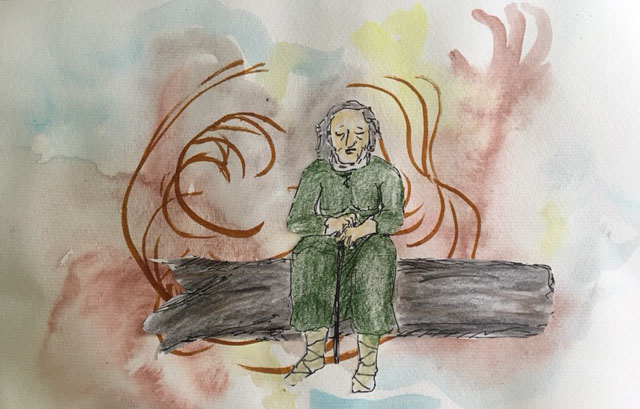
         “Maybe we have done enough reading for the day, Anatase. Do you wish to take a rest from this? I could just borrow these pages if you would let me, and read them ahead myself. And I promise to save any that are interesting for you to read aloud.”

         “No. I can keep on, now that I know The Rose he was talking about was his horse. When first I read it I thought he was trying to practice giving orders to the flowers, bossing them around, expecting they would obey his slightest whim. Knowing it was his horse makes a lot of difference.

         “He wrote, ‘I’ve always thought there were two reasons for obedience, one was my soldier duty to the officer, and the other was something I do simply because God is God and my love for God makes me delighted to follow. Holy obedience is like the difference between following a military officer and training The Rose. Everyone said to teach obedience to The Rose I needed to teach him rank and show him I was the boss. But what actually worked was when I said to The Rose, ‘I am Nic, and you are The Rose and we belong to one another each in our own way.’ So that is also how I am obedient to God.

         “’The Rule of St. Benedict says, ‘As soon as the superior gives an order, they carry it out as promptly as if the order came from God, either because of the holy service they have promised to perform, or because they are afraid of hell, or for the sake of the glory of eternal life.’” [Footnote 1]

         “’It seems to me,’ the Old Monk writes, ‘obedience driven by threat or gift is not actually obedience at all. It is simply a fear or a lust greater than the respect for the master giving the order.’

         “’And the emphasis on humility is even a more disagreeable pretend of virtue. Clearly the paradox is that one who claims ‘to reach the highest peak of humility’ would not actually be humble. There are twelve steps and not one of them is of the true humility of discovering one’s own small place in the awesome love of God that speaks of the goodness of all of Creation, even the goodness of me.”

[Footnote 1] White, Carolinne, Translator,The Rule of Benedict, London: Penguin Books, 2008. page 19.

[Footnote 2] Ibid. pages 22-26.         

(Continues tomorrow)

Post #22.4, Thursday, July 8, 2021

Historical setting: 584 C.E. Eve’s garden bench

         The pages Nic left for Anatase to read aloud describe this world I’ve awakened into. Nic must have known I soon would be seeking a place in a monastery scribing the gospels. He knew me well, and he understood my calling to keep my friend Jesus always in sight of us who are of earth. So of course I will be heading back into the inks. He tells me that all around us are these powerful bishops, overseers like shepherds for an earth of mindless sheep. Here we walk the crumbling roads of an empire gone, following the flickering torches of imperialism into the deeper darkness.

         Here these shepherds no longer trust the patterns of nature or the direction of stars and phases of moon. Things of Creation that once served as psalm for all varieties of worship are sorted from Christian and declared Pagan. Yet Christian holds tight to the magic and manipulations always looking for omen but rarely for metaphor. And like the Pagan Romans the daily journey of the sun is even numbered by hours. Now the routine of each day for a monk is set down in a rule of old paganism. It is the abbot who decides the waking and the sleeping, the times for prayers and the times for song. And it is the voice of a distant bishop that declares a silence despite the chirping cricket under the door.

         I know Nic gave Anatase and I these pages affirming the Roman yen for order so that an ever-curious little girl may learn of the ways used now for educating young boys so often in the hallowed halls of a monastery. The Rule of Benedict seems mostly to be a method for managing aristocratic youth who have been sent from their homes to learn the vows of poverty, humility and obedience. But as we explore this, it seems outward practice may supersede spiritual poverty and humility along with obedience to God alone. With The Rule, a human authority, the bishop or abbot as fine as he may be, becomes the one to whom obedience is given. God seems only an assumption.

         Anatase has looked ahead and says these upcoming pages are truly “dull.” Yet I’m curious to hear Nic’s voice in this to know if it matters to Nic if the orders come from a bishop or the Creator of the Universe and ever present Spirit of love with us always? Does Nic agree that all this detailed instruction is simply intrusion in individual personal prayer?

(Continues Tuesday, July 13)

Post #22.3, Wednesday, July 7, 2021

Historical setting: 584 C.E.  Eve’s garden bench

         Anatase chooses to continue picking through the hard words on “Page 5, The Rule

          “‘First off,’ he writes,  ‘The Rule tells of four kinds of monks and only the one who lives to obey the earthly offices of the church, the coenobites are the good ones.’”

         “I see what you mean about the hard words in this. You’re doing well with your reading.”

         “I shall continue. ‘Then there are anchorites, hermits who ‘lost their fervor for monastic life’ and now must ‘fight the devil on their own.’ [footnote 1] Upon hearing this Brother August decided this surely was written by one who had never actually ventured into the wilderness where the angels still linger. And upon hearing this Brother Joel’s deep longing for thin places and the nearness of God sent him grieving to return to the wilderness. Even an old and lame fellow would rather meet God without the hurdles of these human judgments as good a man as Joel is.’”

         Anatase interrupts Nic’s explanation, “Doesn’t God love all kinds of monks?”

         “I would have thought so but maybe that’s only my view as a Jesus-following heretic. I tend to think God made us and we are God’s people, even us heretics. So surely God loves the monks.”

         “Oh.” She resolves, “Then the old monk goes on to tell about the other two kinds of monks. Do you want to hear that part too?”

         “Sure.”

         Anatase reads on, stumbling into more strange verbiage, probably intended to put the fear of God’s bishops into young boys who were given over to the church. “He writes, ‘Then we have those untested sarabites, ‘most detestable’ who wander from the sheepfold to gather in groups of two or three or even one alone ‘calling every whim holy’ and everything they don’t want to do ‘unlawful.’ [footnote 2]”  

         Anatase adds, “The old monk says that is who he and you were. Do you think that’s so?”

         “I suppose that is why Nic included it here, unless the fourth variety is even worse. You know, Anatase, Nic was very humble – and honest to God — even if an honest look was a hurt for himself.”

         Anatase already knows what else he says, “But there is an even worse kind of monk. He writes, ‘Then there are those gyrovagues [footnote 3] the worst of the worst, wandering around from one monastery to the next…’ “

         “Well, that wouldn’t be Nic; but that would be me.”

[footnote 1] White, Carolinne, Translator,The Rule of Benedict, London: Penguin Books, 2008. Page 11

[footnote 2] Ibid.

[footnote 3] Ibid.

(Continues Tomorrow)

Post #22.2, Tuesday, July 6, 2021

Historical setting: 584 C.E. Eve’s house on the River Loire

         This new morning we finish the chores and now find our place on the garden bench for the reading lesson. Anatase read ahead again and warns me of the dreariness of monastery stories. And again, I beg to know what has happened with my friends in my missing years.

         “Very well” Anatase agrees, if you must know, Page 5 is  ‘The Rule’ Nic writes, ‘So, brother Laz, when you come back into a community of brothers you will learn the bishop of Rome seems smitten by St. Benedict of Narsia who wrote The Rule. Here at Ligugè we borrowed a copy to pass among ourselves to consider. We immediately sent it on to the convent of Poitiers.’

         “’I tell you this that you may be warned. Life may soon change for all of us who choose to live in Christian community. The Rule was probably meant for a monastery that takes in the young boys of nobility and trains them to be humble and responsible. Mostly it structures prayers and psalms to guide daily life, but it’s narrower and more specific than was our practice as fellow travelers with the spiritual Christ. Having served in the Roman military it’s not the structure and the order that disturbs me. All the order and uniformity of detail is fine with me. Details, like ‘Sunday Lauds should begin with Psalm 67, chanted straight through without the antiphon. [footnote] [blogger’s note] I surely don’t fear the structure as Brothers August and Joel do. That is all fine.’

         “But I feel I must warn you. My concern for you and your life to come lies in the human bent on judgments and punishments. Brothers August and Joel and I, as well, would never have found a place here at Ligugè if they were following this rule. In this it seems God is only briefly mentioned as a far off purpose, but the judgements and punishments are always of earth or hell. It is the bishop or simply a chosen abbot who determines goodness and badness in everything. Our abbot would judge us fairly, but he is old. This whole plan speaks more about the sins and the battle with evil than it cares for the love of God. Maybe we’re missing something but that’s how we are reading it.’”

         “I have to say Anatase, you are doing so well with all these hard words.”

         “I’ve been practicing ahead. But the next part has the strangest words of all. They are things I never hear said in real life.”

[footnote] White, Carolinne, Translator, The Rule of Benedict, (Penguin Books, London: 2008) p. 32

[blogger’s note] For the sake of open mindedness it should be said, the fictional characters in this blog do not reflect a modern Catholic appreciation for “The Rule” which can be found in other sources such as: Joan D. Chittister, Wisdom Distilled from the Daily: Living the Rule of St. Benedict Today (HarperSanFrancisco: 1991)

 (Continues tomorrow)

Post #22.1, Thursday, July 1, 2021

Historical setting: 584 C.E., Eve’s cottage on the Loire

         Eve and Anatase are telling me about a visit from soldiers. When Nic heard this he laughed and asked to keep the walnut shell.

         “Did you give it to him?”

         “Of course. Was it something special?”

 “Yes, it could remind Nic of a story I told him about a relic. I’m glad you gave it to him.”

         Eve asks, “Why did he think it was a relic?”

         “Apparently my fellow student at the inks of Tours is now the bishop as he predicted. He was George, or Georgius Florentius back then. He bragged that one day he would be a famous bishop, named “Gregory of Tours.” He said it with a kind of backwards genuflect, starting at his belly and turning his hand upward as a gesture of his own empowerment. He was assigned to teach me not to be a heretic, and I was supposed to teach him proper grammar. He was too stubborn to change his writing style and I was too stubborn to give up the notion that Jesus was a human person.  We had to show our work to the bishop. So for my part, I claimed a patron saint who was a fourth century Jewish Christian martyred before all the wrinkles of creed were even ironed smooth.  I made the relic of the true whiskers of St. Lazarus. But the lesson didn’t take. I still have my heresy. I still believe Jesus was human and that dead saints aren’t magical — either the pagan or Christian saints.  I mean, if Jesus taught us relics were important we would have saved a lot more old and smelly stuff back in the day when Jesus walked and taught.”  [Footnote 1]

         “Nevertheless, Nic thought your relic was a precious reminder.”

         “A reminder to smile maybe. I hope he didn’t try to explain it. And I wonder if my fellow student George ever finished his book about the History of the Franks. I read the first draft of the first chapter and it was just packed with fantastic powers and supposed heavenly acts of saints. In that story the first king of all the Franks, Clovis, was spawned from a beast and took on baptism as a Christian as good luck charm to help in winning wars. There were bible stories right in the mix but there wasn’t a word of the Jesus teachings of love for one’s enemies.” [Footnote 2]

 (Continues Tuesday, July 6, 2021)

[Footnote 1] “Roman law attached great importance of the sacrosanctity of a corpse” in the article “Dead or alive? The holy man as a healer in East and West in the late sixth century” by Joan M. Peterson, Journal of Medieval History, Vol.9, Issue 2, 1983 tracks to root of the miracle-empowered relic back to Roman paganism. In this article the example is described by Gregory of Tours, regarding the relics of St. Martin, and Western cults of saints.  https://www.tandfonline.com/doi/abs/10.1016/0304-4181(83)90003-9 retrieved 4-11-2021

[Footnote 2]Brehaut, Ernest (trans.) A History of the Franks, by Gregory of Tours (reprint First Rate publishers)


Post #21.14, Wednesday, June 30, 2021

Historical setting: 584 C.E. The house of Eve

         Anatase has interrupted the reading to tell me of a frightful time they had here last autumn when Gregory, whom she says is now the  Bishop of Tours, sent his soldiers here.

         “Why did the bishop’s guardsmen come here?”

         “They said they were looking for you.”

         “For me? Why? Are you sure they were looking for me?”

         “They asked my teacher for the man ‘Lazarus.’ But she wouldn’t say where you were. She sent me to get Ma’am Colleta because she didn’t think you would want soldiers rummaging your sepulcher.”

         “She was right about that.”        

         “She wanted Colleta to answer their questions or send them away.”        

          “Why were they looking for me?”

         “Ma’am Colleta said they probably were looking to arrest heretics and pagans.  So when we got back here Ma’am Colleta told them a lie to make them go away.  She said we are all good Christians here. She told them she knows the creed by heart so they needn’t worry over rumors of pagans and heretics living on this land. And she started to say the creed, but they said that was not necessary. My teacher told Ma’am Colleta not to worry, it was alright now.”

         This is all very concerning for me so I call Eve into this conversation to make sure I’m hearing exactly what happened then.

         “What is this Anatase is telling me about the Bishop’s soldiers coming here?”

         Eve explains, “They were looking for you to return something they were calling a ‘relic.’”

         “My relic?” She doesn’t see my grin.

         “They said the booty from a band of thieves had been recovered and it was mostly holy relics taken from the Shrine of the Saint. But among the things these thieves had in their hoard were a few personal items robbed on the roadway. They had with them things like torn and bloodied clothing and what they were calling a relic. They said they  were seeking the rightful owner.

         “I was sure this had nothing to do with you until they laid out your old tunic and caplet, which Colleta immediately recognized as what you were wearing all those years ago when you left here.  She stopped me from touching it, because she said it was filthy and bloodied.

         “But how could you have had any kind of saintly relic?”

         “Didn’t Nic tell you?”

         “He just laughed and said he wanted to know if he could keep the old walnut shell that was with the clothing.”

(Continues tomorrow, Thursday, July 1, 2021)

Post #21.13, Tuesday, June 29, 2021

Historical setting: 584 C.E. The house of Eve

         Anatase warns me that the page about monastery life is not all that interesting. She’s read ahead. But since I asked she’s conceded to read Nic’s Page 4 about the acceptance of Nic and my other two friends into Ligugè.

         “He said they had no problem getting accepted at Ligugè. He wrote, ‘We didn’t even have to wait outside, begging for entry and reciting the Psalms for three days in the sleet and snow. That’s what some monasteries are requiring to test for kept promises in these new times.’

         “He goes on and on, ‘There are all sorts of new rules monasteries are using maybe because monasteries are popular places for the nobility to send their extra children. Some of the churchmen of Rome are expecting every monastery to follow one Rule and some only want holy orders to go to unmarried men or women who have not the slightest comprehension of families and children. And no telling what will become of all the holy eunuchs like August. More rules tend to look like more power. But really friend Laz, you know the pope in Rome now, Pelagius, who is himself an Ostrogoth in a tight spot. He needs more power any way he can get it.  With no strength in Empire he’s the only one in Rome warring against the hoards of Arian heretics. He asked the Emperor of the east to send soldiers to Rome. But when turned down, he called in the Franks. They came and took a bribe from the enemy and didn’t have a single battle against the Lombards. [Footnote] Peace has a high price and apparently the Franks will trade for it in goods. So armies still taunt Rome and at this writing the pope still looks for power by tightening down on his monasteries.’”

         Anatase stops reading in order to share a topic more interesting to her. “Have you ever seen soldiers?”

         “Yes, at times I’ve known them to be quite common.”

          “Did you know the guardsmen for the Bishop Gregory of Tours came right here to this house last year in the season of harvest? They had horses, and swords and shields!”

         “You mean the Bishop of Tours is Gregory now?”

         “Yes! And he sent his guardsmen right here to this very house! I saw them myself! They came right inside where my teacher was making bread! The horses were outside snorting steam from their nostrils, and the men were clattering and clanking in those iron suits.”

[Footnote] https://en.wikipedia.org/wiki/Pope_Pelagius_II, retrieved 5-7-2021.

(Continues tomorrow)

Post #21.12, Thursday, June 24, 2021

Historical setting: 584 C.E. The house of Eve, pagan healer

         I was explaining to Anatase why Nic would ever want to join a monastery. She doesn’t seem particularly impressed with the life-long dream of an old soldier. She offers the easy assessment by a logical eight-year-old.  “We all know what happened now, don’t we? They let him turn into a monk anyway.”

         “Yes, of course, but I want to hear what happened at Ligugè.”

         Anatase resolves, “Okay, I will read that part aloud. But if it isn’t interesting, don’t say I didn’t warn you. The Old Monk writes, ‘On my way here with the cart and your re… [peach pit] and the stone work of art, I stopped at the monastery at Ligugè.  The abbot was very pleased to have a donation of art, such as it was. And I told him of our circumstances on a journey with Brother August and Brother Joel.  I was hoping to use my wealth and the art piece to make an opening for us to have a useful place among the brothers of Ligugé. I feared my gift may not be worthy after I had a look around there. It seems this monastery, like the place I first begged a station was set here by the Saint himself all those many years ago even before he was made the Bishop of Tours. But I suppose you knew all that. In fact I’ll bet you were once good friends with St. Martin of Tours.’ Is that true?” Anatase asks.

         “No. I was living in the east at the time of Martin. The first time I was at Ligugé was much more recent. But I saw that it still had a kind of openness that some of the communities of brothers no longer nurture. So when Nic and I added the two desert monks to our numbers our chance of acceptance seemed less to me.’

         “Why?” she asks. “I would think they would want more monks at a monastery.”        
         “You would think so. But Brothers August and Joel were given their blessings and orders by different bishops and I was afraid there would be a rivalry among the abbots. If they would be turned away I wanted to be there to speak for them. I was at Ligugè about two years before the time we would have been arriving so the abbot might have remembered me and would listen to my recommendation.”

 (Continues Tuesday June 29, 2021)

Post #21.11, Wednesday, June 23, 2021

Historical setting: 584 C.E. The house of Eve, pagan healer

         “So you were going to read Nic’s pages about the monastery.” I remind Anatase as we begin the reading lesson.

         She begins, “He writes, ‘Page 4, Ligugé.  So Laz, you may be wondering what became of our plan for us to work in the inks at a monastery.’”

         “Yes, Anatase, this is exactly what I want to know.”

         “Why would the old monk want to live in a monastery?”

         Need I explain to a child the longing that drove Nic’s life? Let me try.  “He told me when we first met (Blog post#8.5), as he was already retiring from the Roman Navy, he always wished to become a monk; in fact he never even really wanted join the ranks of the Roman military in the first place.”

         “’The Old Monk’ as you call my friend Nic was in some ways like you, born on the barbarian fringes of Christianity. His tribe was not pagan, but of a Christian Arian Heresy probably like the Christians of your own village who didn’t follow the Nicene Creed. You call those who believe the creed ‘Roman Christians,’ like Colleta and Celeste.

         “When he was a child the not Roman Christian priest of his village taught him to read and write and taught him the stories and the psalms in scriptures that are used by all Christians. So Nic and the priest and even his mother always expected he would be a monk one day; but then the changes of the wins and losses in tribal wars gave the power and the voice of rule to the Roman Christians of the Creed, the Franks. But monasteries rising from the Roman root had little use for an Arian son of a soldier like Nic. He was turned away at the monastery at Tours. At the time he thought they were only interested in taking on wealthy Frankish noblemen. And maybe that was true, but for whatever reason, Nic was turned away.

         “Just before Nic was born his father, a soldier, was killed fighting tribal wars for the side of old Rome. So Nic’s inheritance was not a noble title with wealth, but an iron shirt, a helmet, a sword and a Roman shield. When his thoughts of becoming a monk were set aside he put on his father’s armor and joined the Roman Navy. He was always hoping one day he could find a way to follow what he believed was God’s calling.”

(Continues tomorrow)

Post #21.10, Tuesday, June 22, 2021

Historical setting: 584 C.E. The livestock market near Tours

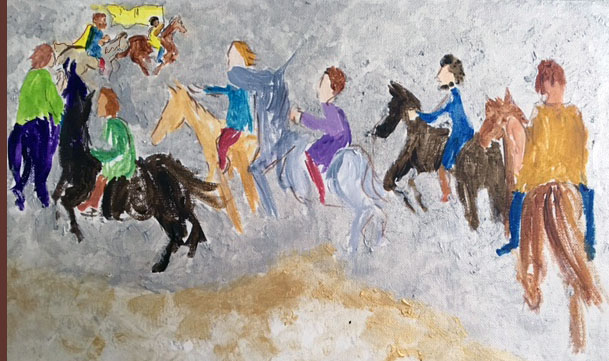
         Daniel offers to stay with the wagon and the mules. Count Bertigan and I wander into the stable area as a huge stallion with a tiny little count hanging onto him with his life-grip bursts through the gate, and romps and rollicks throughout the trial circle in the center of the corral, while first the clinging man is hanging from the neck and then the withers, and then he falls to the ground with his injuries being those of a warless hoofing. The trampled man is gathered to his feet, and he chooses not to buy a horse on this particular day. It was a good lesson for Count Bertigan to observe or he surely would have selected that very stallion.

         My recommendation is that the count should not purchase an unbroken stallion, or even plan to raise horses until he has some experience with horses. He takes my advice. So the count has chosen two fine geldings already accustomed to riders along with a mare and her foal. The trade is made for the two barrels of wine Daniel has in the wagon.

         Barrels of wine are the welcome commodity for trade in these times and places. King Chilperic was known to have levied a large tax on this land to be paid by the peasantry in barrels of wine. When Bertigan is off making his deal, Daniel tells me of the King’s error in levying that tax. The Bishop saw it as sinful and greedy. Then the king needed so many counts to collect it, and for each he had to give a parcel of his lands which explains too many counts.And it also makes the product of Ezra’s vineyard greater value for trade.

         On the return I ride one of the geldings leading the mare with the colt following. Bert courageously takes on the other horse said to be ready for riding and furthermore, he heeds my instruction such as it is. I have a slight hope for this impulsive fellow who is able to put his pride aside for the sake of learning something new. It was a slow walk home. No one wanted to urge the count to ride faster than his ease. Only the mules, now with the lighter load, were frustrated by the pace.

         We didn’t reach Eve’s garden until it was nearly dark and her child assistant was already sleeping.  I’ll have to hear about Ligugè in the morning after the chores.

(Continues tomorrow)