Post #21.11, Wednesday, June 23, 2021

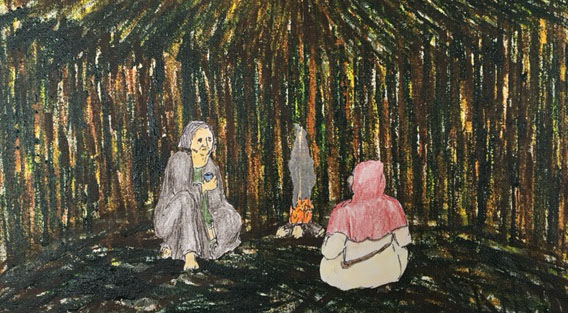
Historical setting: 584 C.E. The house of Eve, pagan healer

         “So you were going to read Nic’s pages about the monastery.” I remind Anatase as we begin the reading lesson.

         She begins, “He writes, ‘Page 4, Ligugé.  So Laz, you may be wondering what became of our plan for us to work in the inks at a monastery.’”

         “Yes, Anatase, this is exactly what I want to know.”

         “Why would the old monk want to live in a monastery?”

         Need I explain to a child the longing that drove Nic’s life? Let me try.  “He told me when we first met (Blog post#8.5), as he was already retiring from the Roman Navy, he always wished to become a monk; in fact he never even really wanted join the ranks of the Roman military in the first place.”

         “’The Old Monk’ as you call my friend Nic was in some ways like you, born on the barbarian fringes of Christianity. His tribe was not pagan, but of a Christian Arian Heresy probably like the Christians of your own village who didn’t follow the Nicene Creed. You call those who believe the creed ‘Roman Christians,’ like Colleta and Celeste.

         “When he was a child the not Roman Christian priest of his village taught him to read and write and taught him the stories and the psalms in scriptures that are used by all Christians. So Nic and the priest and even his mother always expected he would be a monk one day; but then the changes of the wins and losses in tribal wars gave the power and the voice of rule to the Roman Christians of the Creed, the Franks. But monasteries rising from the Roman root had little use for an Arian son of a soldier like Nic. He was turned away at the monastery at Tours. At the time he thought they were only interested in taking on wealthy Frankish noblemen. And maybe that was true, but for whatever reason, Nic was turned away.

         “Just before Nic was born his father, a soldier, was killed fighting tribal wars for the side of old Rome. So Nic’s inheritance was not a noble title with wealth, but an iron shirt, a helmet, a sword and a Roman shield. When his thoughts of becoming a monk were set aside he put on his father’s armor and joined the Roman Navy. He was always hoping one day he could find a way to follow what he believed was God’s calling.”

(Continues tomorrow)

Post #21.10, Tuesday, June 22, 2021

Historical setting: 584 C.E. The livestock market near Tours

         Daniel offers to stay with the wagon and the mules. Count Bertigan and I wander into the stable area as a huge stallion with a tiny little count hanging onto him with his life-grip bursts through the gate, and romps and rollicks throughout the trial circle in the center of the corral, while first the clinging man is hanging from the neck and then the withers, and then he falls to the ground with his injuries being those of a warless hoofing. The trampled man is gathered to his feet, and he chooses not to buy a horse on this particular day. It was a good lesson for Count Bertigan to observe or he surely would have selected that very stallion.

         My recommendation is that the count should not purchase an unbroken stallion, or even plan to raise horses until he has some experience with horses. He takes my advice. So the count has chosen two fine geldings already accustomed to riders along with a mare and her foal. The trade is made for the two barrels of wine Daniel has in the wagon.

         Barrels of wine are the welcome commodity for trade in these times and places. King Chilperic was known to have levied a large tax on this land to be paid by the peasantry in barrels of wine. When Bertigan is off making his deal, Daniel tells me of the King’s error in levying that tax. The Bishop saw it as sinful and greedy. Then the king needed so many counts to collect it, and for each he had to give a parcel of his lands which explains too many counts.And it also makes the product of Ezra’s vineyard greater value for trade.

         On the return I ride one of the geldings leading the mare with the colt following. Bert courageously takes on the other horse said to be ready for riding and furthermore, he heeds my instruction such as it is. I have a slight hope for this impulsive fellow who is able to put his pride aside for the sake of learning something new. It was a slow walk home. No one wanted to urge the count to ride faster than his ease. Only the mules, now with the lighter load, were frustrated by the pace.

         We didn’t reach Eve’s garden until it was nearly dark and her child assistant was already sleeping.  I’ll have to hear about Ligugè in the morning after the chores.

(Continues tomorrow)

Post #21.9, Thursday, June 17, 2021

Historical setting: 584 C.E. On the Road to Tours

         At least my grandson-in-law sees the futility of brother’s fighting one another. May he one day grow wise in peace.  But then he chatters on about futility of family wars. There isn’t really virtue in his logic.

         He explains a pragmatic flaw in warring against one’s brothers. “Yes, family wars are very bad for my king because his magical power for winning in battle is in his long hair. But his brothers also possess the same charm, so in family wars where all of the long-haired kings have the same magical power the magic becomes nullified one by another. So King Chilperic has called for every count and landowner to gather horses and to arm themselves to defend him, our king.”

         “So you need these horses for battle?”

         “Yes, of course for that.” Clearly my steady gaze hides nothing and he notices my disapproval.

         He adds a possible appeasement. “But of course I’ve heard horses are good for many things: strong as mules, fast as the wind. They can be helpful in farm work and also for delivering messages.”

         So now I find a more comfortable place on the wagon seat next to Daniel. Our journey continues in silence.

         It’s all about the game I suppose. So here we are adding those ubiquitous game pieces on the board imaged as the heads of the warhorses. I see these grandsons getting themselves into a game with a more confusing strategy now, leaping in corners and slaying pawns without enough foresight to save themselves from being cornered by mere pawns.  Personally, I’ll just follow the bishops in the straight and narrow, most trustworthy diagonals. I’ve been around long enough to know this game never ends with a win. The conclusion always comes in that last moment just before the king is dead – check-mate.

         We find this market has an abundant selection of horses. Also several of these lesser, but newly landed counts are here on this same mission — to prepare themselves for a war to support the king who gave them their land.  I can quickly see that Daniel and Count Bertigan are not horsemen.  So apparently, I am here to select some fine warhorses and maybe take these two men from their imagined self-images of heroes on horseback, into the realities of sitting astride a living, breathing, fur-covered beast.

         Dear God where is your peace?

(Continues Tuesday, June 22, 2021)

Post #21.8, Wednesday, June 16, 2021

Historical setting: 584 C.E. The Road to Tours

         “There are only three kings now.” Bertigan informs me.        

         As we are taking the wagon to the livestock market outside of Tours, Count Bertigan, now married to my granddaughter, is filling me in on the not-secret-enough lives of the Kings and Queens of the Merovingian Dynasty. Brother August’s little issues with sibling rivalry are dwarfed by this chess game of brothers in battle. This youthful aggressor Bertigan surely sees himself as the landowner, the Rook in the game. He sees with his imagination that if everything stays unmoved the rook will be in line to switch places with the King in the surprise move that ends the game. But he dare not lose site of the all-powerful queens on the board. He yammers on.

         “With only the three kings that fourth kingdom, the Soissons with Paris was divided among them. If the others had just stayed out of it, King Chilperic could have had it all and we would have a united kingdom of the Franks once again.

         “It happens Queen Brunhilda had a sister, so our king married the princess, Galswintha. Marrying a princess meant she would bring a dowry with her and King Chilperic would rule a greater land. [Footnote] That’s how these things work out. But it was a sad thing that the dowery didn’t go to the husband, our great King Chilperic. After the strangulation of this queen as she slept in her bed one night, her dowry passed to her sister, Brunhilda. And what’s worse, Brunhilda blamed Ferdegund, our king’s most beloved mistress for the assassination. But how could a mere woman kill another with her bare hands or even with a twisted bed-sheet? And how would such an assassin get into the royal bedchamber in the first place? It was a devious rumor. But with that kind of accusation afoot how can these three royal brothers ever be at peace with one another?”

          My assessment, “It all sounds brutal and driven by greed.”

         “So now King Chilperic tenses for battle to get his just due away from the greed of Guntrum and of course, Sigebert’s wicked Brunhilda. Sigebert went to his death some years ago, and Brunhilda has taken on the regency of their child-king. Guntrum is guardian of them all.”

         “So I guess as a count you have to take the side of Chilperic even in his wars with his own family.”

         “The side of my king, who has given me land and made me a count? Yes, of course. But let it be known wars within family are destined to be futile.”

[Footnote] Geary, J.G. “Before France & Germany…”

(Continues tomorrow)

Post #21.7, Tuesday, June 15, 2021

Historical setting: 584 C.E. The Road to Tours

         I climb into the bed of Daniel’s wagon with several barrels of wine and this fellow Bert. Daniel flicks the rein and the mules move this load forward. My many questions swirl. Why horses on this simple farm? And why am I needed for this venture? Who is this fellow Bert who married my granddaughter while I was sleeping and now has all these children with her?

         “So you are Bert?”

         “Count Bertigan.”

         “You’re a Count?”

         “I’m endowed that title by King Chilperic himself. I collect the king’s portion for him, and for that I have been given a land for my grand house and along with my wife’s sector of the vineyard lands I am a newly wealthy man.”

         So now I learn that even though Ezra and Colleta and Eve are still very much a living part of this family, Ezra has already divided their inheritance. Apparently my first thoughts of this fellow were accurate: he is inconsiderate of children, driven, impatient and possibly even greedy. But of course any greed I notice would only for the betterment of my own great-grandchildren. I should be pleased to know my family is part of the landed aristocracy now.

         “Why are we acquiring horses?” I ask.

         “I need horses. Daniel is my secretary, and he said you have knowledge of horses.”

         I do know, “Of course. I was once in Hispania where horses aren’t just used for war, they are common. Hispania is under the rule of the Arian Visigoths these days.”

         “I know that.” And Bert does know his politics. “Their princesses became our Frankish Queens but of course they converted to the true creed when they arrived.” [Footnote]

         Another curious new thing I learn.

         Bert’s thick brown locks are shorn even with his beard as is the fashion and the law these days. He talks on and on while his eyes wander everywhere around at the sky and the earth as though I’m nothing of importance in this conversation. I persevere in my attentive stare anyway.

         He yammers on. “My king’s brother married Princess Brunhilda. But King Chilperic is never to be outdone, and even though he had his wives and children already it was a clever move on his part to marry a princess. Do you mean you knew nothing of this?”

         I add, “I was only returning from Hispania when I endured an accident that has taken my memory. When last I knew of the Kings of the Franks, Clotiare had only recently died and these Frankish lands were being partitioned among his four sons.”

[Footnote] For a modern English telling of the history of the Franks by Gregory of Tours, ref. Geary, Patrick J. “Before France & Germany: The creation & transformation of the Merovingian world.” New York: Oxford University Press, 1988. Pages 120 and 121.

 (Continues tomorrow)

Post #21.6, Thursday, June 10, 2021

Historical setting: 584 C.E. The garden of Eve

         Anatase is more excited to read about babies and tell me about my children and great-grandchildren than answer my concerns about what happened to my friends who were Christian brothers on their way to Ligugè. She asked me if I know the children who were the babies of my granddaughter, Celeste.

         “No, I haven’t met Celeste’s new family yet.”

         “Well that first baby is Martha now! She is already ten years old. And now they have a child named Loren too, and another, little Marian!  Marian is nearly as old as I am now. Marian and I had mint tea and biscuits with berries together when I was away just now on my errand. Aren’t you so amazed by how these things turn out?”

         “Yes, I am. Thank you God for all these bright days. And always stay close and guide us through the sorrows. Amen.” She stares at me while I pray aloud.

         “Ma’am’s Colleta and Celeste are Roman Christians you know. They don’t know God up close like the old monk did, and like you do now. I mean, they don’t just talk to God whenever about any old thing.  They prepare for prayers with bowing and hand gestures, and only choose the most holy moments and places for prayers.”

         “Yes, but its prayers to God all the same. God listens to the prayers of the Roman Christians, the creed believers, and even some of us heretics. I think the Roman Christians just take a longer meander to get to the same place.”

         Interrupted from the reading lesson, Daniel and a stranger whom I learn is the father of these great-grandchildren I haven’t yet met, are standing here with something so important to say that it can’t wait for this reading lesson to end. Rude intrusion seems the nature of important men in the midst of children.

         “This is Bertigan, Celeste’s husband.”

         “So you are the father of these children Anatase is reading about.”

         Daniel continues, “We need you to come with us to help us trade for some horses.”

          “Of course.” I ask for their patience, “We’ll be done reading soon.”

         I see they are already waiting with the wagon right here.        

          “So, Anatase, I still want to know what the monk said about the monastery. We can read that part when I get back.”

(Continues Tuesday, June 15)

Post #21.5, Wednesday, June 9, 2021

Historical setting: 584 C.E. The house of Eve, pagan healer

         “The old monk does write about the monastery.” Anatase complains, “He has way too many words about that. I already read that ahead and I know those old monks were just there forever working in the inks. Believe me, that isn’t very interesting. But there is a good part coming right up next. It’s ‘Page 3. All the babies now.’ I read that he goes to the graves of the babies; baby Margey died before I was here, then Celeste had a baby that died because I still wasn’t here yet and Celeste and Ma’am Colleta, back in those times didn’t come and get my teacher. They thought she couldn’t help when she can’t see, and so they didn’t even tell her when the baby was coming. Then they didn’t know to wake the baby to life when it was born. That baby didn’t cry.”

         “That’s very sad.” I hope to ease the hurt by my acknowledgement with that way-too short little empathetic word ”sad”.

         Anatase smiles at my failed try. “Sad, it was, yes I know it was sad, but you know how the old monk is, I mean was. Listen to what he wrote for me to read about the sadness. He said when faced with sorrow we should plan for what he called, ‘the bright day.’ He writes, ‘Sometimes only God knows when there will be that bright day; and sometimes God’s time is measured by the walking speed of an ox.’ The old monk talked like that a lot you know.”

         “I know. So is the story on this page about the sadness, or about the bright day?”

         “I told you, I read ahead, and this was a bright day story after-all.”        

         Thank you God for the bright days.

         She asks, “Shall I read how the story isn’t really just a sad story?”

         “Please do.”

         “Still on page 3, he writes, ‘And so, it happened that in a God’s time Celeste had another baby and this time Eve …’ he means my teacher who is also your daughter, ‘…”

         “Of course.”

         “He writes, ‘Eve was called to help, and even though she couldn’t see the birth with her eyes, she guided Colleta to help every step of the way. And when the baby was born Eve took the baby on her knee, and set it into life crying with the glorious loud shouts of an infant.’ Do you know who that baby is now?”

(Continues Tomorrow)

Post #21.4, Tuesday, June 8, 2021

Historical setting: 584 C.E. Eve’s Garden

         We’re walking in Eve’s garden and I am asking Eve about the sorrows of my missing years with this family.  Eve tells me she knew of her blindness for many years, even while she had her sight. As a healer she knows it follows the small pox and she bears the scars of the pox. I argued with her in the times past, blaming her for not maintaining her reading skills as an adult.

         “I’m so sorry Eve, that I didn’t understand your worry then. But you gave me such a lame excuse; you said you needed to fit in with the ways of the times when women don’t read. I thought that was a strange argument from you. You always seem so unbent by popular opinion and as wise as the ancient women, some who were scholars in their own times.”

         “I forgive you Papa. I don’t need to forgive God for my blindness though. We’ve come to terms with this. The hurt was in the fear of not seeing. And with the helper that I have now my dependence on a child has also brought me into a circle of love I never expected to know; the blindness itself opened me to many new paths of learning that the likes of you, who see with your bright eyes will never know. There is one hurt but many days with the blessings of healing.”

         Perspective becomes excuse.

         We have come the full circle on this path. I’ve found my daughter Eve is older and silvered and clinging to a tattered bit of wisdom now. Thank you God for this beautiful child with all of her gifts to help and heal. Stay close in our needs.

         Anatase has returned from her errand and is already waiting on the garden bench with the pages and she is reading ahead; maybe she is even reading the sad pages I meant to save her from seeing.

         “Anatase, I would like to skip around through the pages because I may need to hear some particular things from Old Nic. I’m hoping someone will be taking a cart down to Poitiers so that I might ride along to go and see where Nic is buried. Today I want you to read to me about the monastery called Ligugé. Did he write any pages about Brother August and Brother Joel?”

(Continues tomorrow)

Post #21.3, Thursday, June 3, 2021

Historical setting: 584 C.E. The garden path of Eve

         Eve is still feeling she’s to blame in the death of Little Margey because she couldn’t save her. We are talking about forgiveness. “Do you know God loves you?”

         “Of course Papa. And this pagan healer doesn’t need to hear your God words over this. It was God who came and took her away!”

         “So you have to forgive God, and then forgive yourself. That’s a lot of forgiving you have to do before you can know you are forgiven too.”

          “I don’t need a sermon, Papa. Your friend the old monk came up here when Ezra and Daniel were yet stacking the stones over little Margey and the old monk already said prayers and brought God into this. I didn’t go down there because I didn’t want to get God and God’s man involved in my own hurt. But then the old monk brought Colleta up here to tell me it wasn’t my fault. And I did sort of fear that Colleta blamed me, so it was good to hear her tell the old monk and also me that it wasn’t my fault.”

         “So her parents don’t blame you, but do you still blame yourself?”

         “The Jesus prayer only says ‘forgive us as we forgive others,’ It doesn’t say, ‘forgive us as we forgive ourselves and God too.’”

         “Yes, but if you can blame God then don’t you suppose you will need to forgive God also?”

         Eve takes a long pause, but the garden path has not circled back to the house yet. She gropes another topic though not a better one.

         “So what other sorrows do you wish to ask of me?” She asks with her coldest commanding voice.

         “I wanted to know of your blindness. When I was here last, did you know you were losing your sight?”

         “Why does that matter Papa; are you seeking my forgiveness for your insensitivity then?”

         “I guess I am. I argued that you needed to learn reading, yet you probably remembered how to read and also you knew that would be lost with your sight. So when I blamed you for letting loose of your childhood learning did you already know you were going blind?”

         “Blindness is something I’ve known of even before I saw the shadows myself. People who have the scars of the pox as do I may have avoided the dark of death, but the dark of life is always before us.”        

(Continues Tuesday, June 8)

Post #21.2, Wednesday, June 2, 2021

Historical setting: 584 C.E. The walking path in Eve’s garden

         Eve asks, “Were there other things you thought a child shouldn’t read?”

         “I want to know what happened to little Margey, and I should hear of your blindness from you.”

         Eve answers, “Margey is buried down near Ezra and Colleta’s cottage near the newer spread of vineyards. She died when she as a small child. I couldn’t save her.  It was a terrible grief for all of us.

         “In those days I was able to see with only a few shadows taunting my vision. So it was fine that Ezra and Colleta and the children all went in the wagon to the village near Tours to celebrate the Resurrection of Jesus with Colleta’s family. I was doing the chores for both houses expecting them to be gone a week when they returned after just two days with all of them sick, poisoned by the feast all spread out for sharing on a sunny board. All but little Margey took the remedies I gave them, and when the poisons were passed, they took a potion for strength and that set them right in only another day, but we could get no medicine or eve water into the tiny child. She was already cold and fading. Papa, I could do nothing to save her!”

         “It was good you saved the others. You can’t blame yourself.”

         “I was swaddling her, rocking her, begging God to let us keep her tender little life but God said no, and she slipped away to heaven.  Papa, I don’t just let people die! People who are nothing to me come and are rescued, but she was my own family.”

         “Eve, my precious child, all these blames and hurts of our own helplessness are …”

         “Don’t preach, Papa. I already know I’m supposed to use hurts to empower some kind of new lesson for my own betterment, but it seems such a needless loss. And I don’t want your excuses for a cruel God. And without the empty excuses I have nothing. I want to find a punishment in it, but if I can’t even name my sin how can I fix it?

         “Colleta says she has lots of sins. She is such a good Christian, even just by being born she had sin so God forgives her. But I can’t even find what to say when I ask God’s forgiveness in this.”

 (Continues tomorrow)