Post #23.4, Tuesday, August 10, 2021

Historical setting: 584 C.E. Ligugè

         As a guest at Ligugè I’m assigned to visitor’s quarters in a small room in the villa while the monks are outside the walls in caves and hovels. In my last life here as a monk my cell was made of a few stones but mostly of sticks and branches and I feel it was much too easy to burn down.

         Since the abbot saw Brother August and I talking together, he assigned him to be my mentor for chores and for learning the Rule of Ligugè. And this week we are tasked with serving the meals. Preparing to break the fast is a good way to start life in a new place.

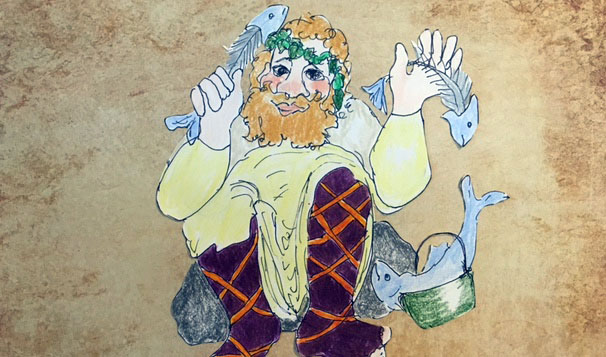
         I come into this day in deepest darkness with the echoes of the chants of night haunting these matins and I am at the cooking hearth and ready to begin. Brother August hasn’t yet arrived so I just go ahead and lay the cutlery on the boards and put some wood on the fire, but I don’t know what else to do to prepare. I see bread is rising here. I need to find Brother August to learn the plan he has in mind for this. I know his cell was near the graveyard because he was at his cell when he saw me there yesterday. The early light is already in the east, so maybe I should just go tap on his door to wake him.

         Of course Brother August assumes I’m my own son and that keeps our past journey a secret. And here I find Brother August is taking in his washed clothing left to dry last night spread out on a bush. I’m a bit surprised to see him unclothed because he no longer has the breasts of a woman but his chest is marked with a surgeon’s blade. He sees me and quickly covers himself with his scapular as though a man’s bare chest were a secret.

         “Excuse me,” I offer, “I didn’t mean to surprise you; I just didn’t know when we needed to start the meal preparation. I really didn’t mean to impose.”

         August answers, “And I didn’t mean to hide myself so abruptly. It’s just that I have a scar I choose not to explain.”

         “Of course. I also have scars I don’t wish to explain.”

         So it’s agreed. I won’t mention the wounds still healing so that everyone can just go on pretending it was my father who was crushed to death in Bordeaux.

(Continues tomorrow)

Post #23.3, Thursday, August 5, 2021

Historical setting: 584 C.E. Ligugè

         The abbot is allowing me to stay here and work in the scriptorium to copy from Eve’s book as long as I follow the rule of this abbey. Having been here before I know the daily patterns they keep. But the abbot doesn’t remember me.        

         He argues, “No, you know nothing of the Rule of Ligugè. We don’t use The Rule of Benedict here. We follow older patterns for prayer. You must observe and learn, then obey.”

         Here they follow the old way in which the monk’s live in individual cells and private prayer is respected. But also, in the emerging patterns of communal life there are times when all of the monks and visitors gather for meals and worship. As a community we each take our turns to share in the earthly chores of preparing meals and tidying and scouring and working in the gardens.

         Our songs are psalms sung in the tradition of call and response, and our prayers are long and heartfelt – some from repetitions in unison, some in silence, some spoken anew both in times together as community and also alone in our cells.

         The rigors of communal order are not as firm as would need to be in a place where teens are also being trained and when the guidance of community as family is needed. Here the rule has naturally sprung from needs of community. It surely wasn’t laid down upon the gathered with the purpose to put some earthly person in charge and empowered to control the others. It’s said this place was established by St. Martin himself respectful of the ascetic hermit life as a church together not an earthly kingdom. May there continue to be this distinction I value.

         Brother August surmised that Benedict never understood the value of hermitage when he made his rule. So I sought out available reading from the books here as I await my task assignment. I learn that Saint Benedict was himself among the desert fathers of an earlier time. [Footnote] Knowing that of him gives me a better appreciation for The Rule. He must have known personally of the temptations of the lone ascetics for wandering from purpose. It must have been from his own self-knowledge he made his criticism; then he surely was overwhelmed as a bishop seeing all of the chaos of transforming a bevy of young boys into monks. So this Rule suited a need.

Footnote– St. Benedict spent three years as a hermit living in a cave. https://en.wikipedia.org/wiki/Benedict_of_Nursia retrieved, 6-2-21.

(Continued Tuesday August 10, 2021)

Post #23.2, Wednesday, August 4, 2021

Historical setting: 584 C.E. Ligugè

         Brother August and I are here where the old, earthly bones of the monks are buried. This sculptor’s image of a soaring bird incised on the stone marks this heap of earth for Brother Joel in the most fitting way. “As it is on earth it is in Heaven,” was a favorite phrase of Brother Joel’s.

         “I will let the abbot know you are our guest with us today.” August leaves me here in this bone garden considering the immortal natures of us all.

         Dear God, thank you for these brushes with life we are granted between our earthly births and deaths. Amen.

         The abbot here is an ancient man. He seems more kindly now, and doesn’t remember me at all. But he is the same one who, so many years ago, sent me fleeing into the dark of night because my son came for me with the cart and donkey that were known to collect the dead of plague. He feared that all my coming and going as a messenger had given me the plague and now this gravedigger had come to take me. So the last time I saw this abbot he was raging with the fear of death, chasing me off and burning down my cell behind me.

         “So glad to meet you Father. Brother Nic was a dear friend of our family, and I have come to visit his grave. But I have another matter I ask you to consider. Nic was teaching a child to read and write with a particular ancient book of herbs and remedies we’ve had in our family. That child was hoping to have some descriptions from this book copied onto a trimmed end of parchment.”

         “Oh, that isn’t done here. Scribes are rare in these times, and our commitment here is to the gospel.”

         “Have you inks and edges of parchment? I myself, am an able scribe and I will do the work of it.”

         He has to consider this long and hard before he can answer.

         “Brother Nic came and made his poverty here. He endowed us well, and perhaps his lessons for this child will one day yield another  worthy scribe; so I shall allow you to stay with us as long as you are obedient to the rule of this abbey.”

         “I am familiar with the rule.”

         “Here we do not adhere to The Rule of St. Benedict.” So you may only think you know.”

(Continues Tomorrow)

Post #23.1, Tuesday, August 3, 2021

Historical setting: 584 C.E. Ligugè

         Brother Joel is with us in soaring spirit, though maybe never really walked on earth at all. He is surely still present with Brother August and I in his ancient strand of wisdom.

         I affirm, “Yes, a suit of armor called ‘pride’ would impede love for others, and if it is forged from our personal fears and self-loathing it can obscure love for self. Jesus’ command to love makes love of self the pre-requisite to love of neighbor.”

         August wonders at Brother Joel’s nuance.  “But isn’t ‘love of self’ exactly what pride is?”

         “What did Joel say? Did you ask him?”

         “When Brother Joel pointed out that my iron suit of protection may be the flaw that separates me from love for my siblings I felt the pain of truth pierce that armor. First I wanted to argue then to hold back my tears from Brother Joel who knew my heart too well. Then he said, ‘God knows you and loves you right through your armor. God made you, and you are God’s.’ So my tears flowed freely and my armor of pride rusted away.        

         “Brother Joel stripped me naked of pride right while we were still in Bordeaux awaiting Nic’s return with the cart. At first I felt vulnerable, but then my prayers echoed around in the hollow with the answer in the old man’s voice and God’s love for me became adequate love to carry me through the moment between loosing my pride and allowing the kind of humility that lets me love of others. It’s nothing like the humility that others might see on me outwardly. An external, observable, pretend display of humility is all that is asked in The Rule. But stripping the safety of outward pride is raw. I thank God for the wisdom of Brother Joel, and that I was granted time to remove the war-irons before we left Bordeaux. I made amends with my brothers then.”

         Dear God, thank you for letting me find Brother August anew, repentant as he is, without that rub that has even kept me from seeing him in the way you see him. Amen.

         So here I find my own pride shields me from August’s assumption that I am my own son, and he thinks it was Nic who taught me to read. Why does this bother me? Am I the sort that believes a son is lower than a father? Or don’t I trust Nic to be my teacher?

(Continues Tomorrow)

Post #22.13, Thursday, July 29, 2021

Historical setting: 584 C.E. Ligugè

         Brother August explains, “Brother Joel gave so much guidance to take me through a sin which to others might have been considered personal pride. I’d so easily learned the spiritual moments of true prayer as art in carving stone. But Brother Joel noticed my tethers of pride were to be found, not in the sales, but in the presentation I made of my art to others whom I wished to have in my circle of love.”

         “And pride is sin?” I ask, inviting a nuance I’ve considered for centuries.

         “Of course. Everyone knows it is sin. Paul said so. And Rule #57 of Benedict saw the pride in the pricing of the art because throughout The Rule the measure is always based on how something is observed by the earthly witness who would be the abbot or the bishop. So a monetary price on something in a symbolic way defines worth, but The Rule doesn’t really address the bond between Creator God and creative artist. And placing a value in coin was nothing about my issue with pride.”

         I affirm, “I’ve read enough of The Rule to notice it has so much more to say about the opinions, judgments and punishments of earthly observers than it has to say about the ever-present love of God. So I would assume the rule would speak only in observable symbols of pride, such as wealth, rather than a deep in the heart kind of pride or humility.”

         August affirms, “Yes, I wanted to use my art to gain the appreciation by others, though not in the form of money. In fact, my need for this affirmation from others was beyond even my human-to-God prayer. It was something that stroked and tantalized my sense of pride, as much as any kind of lust could do. And Brother Joel pointed out, the problem with nurturing personal pride isn’t the money part or the lusty part; it is, he said, that my pride fitted over me like a coat of armor, shinning my whole form into something others notice, but also keeping me from actually connecting with others in the way of God’s love. Brother Joel noticed it was my pride that separated me from my earthly brothers. I so much wanted them to be amazed by my art, not because I believed myself superior in a prideful way, but because my strong armor of pride was protecting me from humiliation by them. Pride and humility are both the sides of the same coin.”

(Continues Tuesday, August 3)

Post #22.12, Wednesday, July 28, 2021

Historical setting: 584 C.E. Ligugè        

         Changing the subject, I just asked Brother August if The Rule made allowances for an artist who cuts stone.

         He answers, “At Ligugè we don’t concern ourselves with The Rule yet the abbot here has been generous in allowing me to continue my prayers with a hammer and chisel in hand.” 

         “That’s good.  I can imagine there would be no room for an artist in all that order and routine of The Rule.”

         “Oddly enough, Benedict’s Rule Number 57 [Footnote] would allow for a craftsman to do such work. But The Rule of Benedict isn’t about the works of art, so much as the sin of pride an artist may have. And indeed, pride was my own burden of sin. But The Rule doesn’t address ‘pride’ as something that would intrude into my love for brother with the striving and envy I had been practicing. Rather Benedict’s measure of sinful pride by a craftsman comes in the selling of the art. Apparently, for Benedict, value is only measured outwardly, according to the monetary worth of something. So the artist is not to receive money for the work or The Rule assumes that may lead to pride. In the instance of selling one of my works which Nic purchased from a dealer to bring as a gift to this place, I received nothing for the work but I benefited from the opportunity for a long walk here with Nic and your father. So by The Rule I showed no sin of pride because I received no money.

         “Ligugè has been a good home for me all these years, and for Nic also; We added Brother Joel to our numbers but lost your father along the way. Brother Joel was truly a spiritual guide for me in considering my actual sin of pride. Thankfully Joel lived a very long life and his bones are only recently in this graveyard.”

         Brother August shows me a marker he made for Brother Joel. On this, Brother August has carved a bird in flight — soaring. It is a perfect image of this elder monk, since Brother Joel’s spirit was always gliding and soaring as a bird. But chiseled into a weighty earthen stone I can also recognize Brother Joel’s awkward paradox of earth and spirit.  

         “So what did Brother Joel have to say of pride?”

[Footnote 1] White, Carolinne, Translator,The Rule of Benedict, London: Penguin Books, 2008. page 84.

 (Continues Tomorrow)

Post #22.11, Tuesday, July 27, 2021

Historical setting: 584 C.E. Ligugè

         Here I am at the monastery visiting the place where Nic is buried. Brother August came over when he saw me here. Now Brother August remembers me from twenty years ago but even though he has heard about it, he doesn’t believe the story of my very odd gift of ever healing, even from death to life in a never-ending sameness of age. So Brother August assumes I must be someone else.

         “Really, you look just like Nic’s friend, Lazarus.”

         “So I have been told. And I’m named Lazarus.”

         So he assumes I must be my own son. It could be a bit creepy for me to try to make a correction of that, since I suppose the shock of seeing my bloodied dead bones is seared forever onto the minds of the on-lookers of the Bordeaux tragedy.

         “I’m Brother August. I journeyed with Old Nic and your father, so many years ago. I had no idea Lazarus had a child. Your father’s death was such a tragedy for all of us who knew him.  I know Brother Nic visited your family’s vineyard often whenever he could. So you’ve probably known Nic since childhood.”

         “I knew Old Nic well.”

          Brother August yammers on in eulogy, “I know Old Nic loved children. He probably taught you to read, didn’t he? He was always taking lessons along for the children of your family.”

         It’s hard for me to be silent in this wrong assumption Brother August is making especially when he assumes it was Nic who taught me to read. I catch myself weaving into all my generations a deep vein of personal pride. I learned to read and write ages ago in order to become a man in a Hebrew speaking family and in a Greek reading world. For this moment a monastery is a good place to practice silence.

         I answer, “I know of his reading lessons. He was a dear friend. And I know that you are the artist who prepared this stone marker.”

         “Nic told you everything didn’t he.”

         “Only up to a point. He mentioned monasteries are now minding The Rule of Benedict.”

         “Well, here at Ligugè we are aware, but this is a very old community so we already have our patterns. We borrowed a copy then sent it on.”

         “That’s good, because what I have heard of the Rule from Brother Nic, it would probably allow no place for an artist.”

         “I guess you didn’t hear everything then.”

(Continues tomorrow)

Post #22.10, Thursday, July 22, 2021

Historical setting: 584 C.E. Ligugè

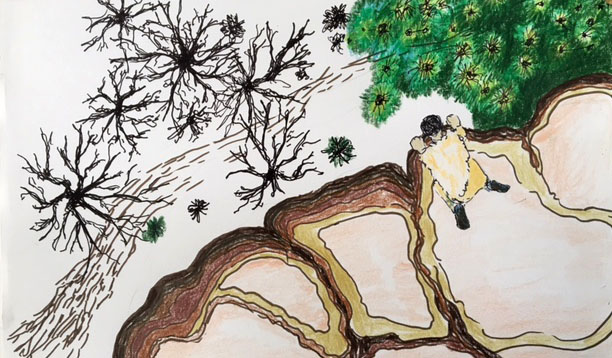
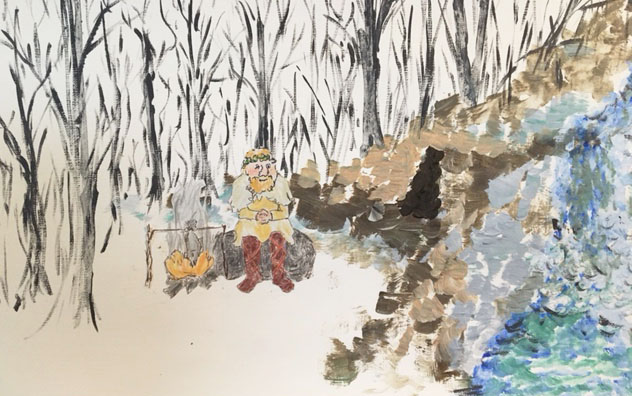
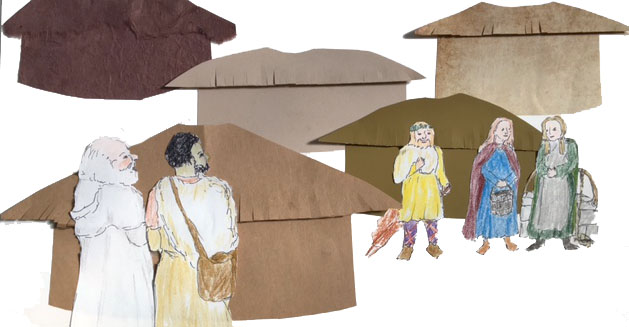
         As night creeps over I see ahead of me the hulking peak of an old villa roof.  I’m coming upon the monastery that was a Roman villa centuries ago. In a time long ago St. Martin repurposed this rich gift of a grand Roman edifice for use as a spiritual refuge for monks coming in from the wilderness to be in community. I know this place as it is now with a sunny atrium for the scribes and an oratorio for worship and dining. The cells for the monks are dug into the clay beyond the walls or built of thatch and rock scattered around the back areas of this land.

         If I knock on the door tonight I will only intrude on the silence after the vespers. So tonight I’ll sleep in hayloft of the stable. Tomorrow I’ll meet the abbot and beg a guest room or a cell. I might not mention I once had a cell of thatch that was burned up by the abbot who feared I brought plague to this place. All these years later I’ll only confuse people I’ve known in a long ago time with my incessant look of youth. My circumstance requires me to pretend I know nothing of the past. Always, it seems, history is most comfortably spoken from the present so the out of style and unpopular truths it keeps can be edited out.

         Sun rising now, silvering the morning mist and I walk through the open place of the wall of stacked stone surrounding the graveyard for monks. Here is the newly made grave with some stones already gathered. I’m sure this is the burial place of my friend. Already there is a marker — a partly carved sandstone with an artist’s bas relief showing an ox head. Yes! I know this artist was one of us who knew of Nic’s love for such simple beasts. I already know the one who placed this blessing here for those of us who knew Nic well.

         Dear God, thank you for nurturing this hope I have of meeting Brother August once again and for this celebration of Nic’s gentle nature.

         “Hello Mister. Did you know Old Nic?”

         I turn around and there is Brother August with a snowy tonsure like a great halo of heaven crowning his brow.

         He continues, “Oh, excuse my surprise, but you look just like the brother’s old friend Lazarus.”

 (Continues Tuesday, July 27, 2021)

Post #22.9, Wednesday, July 21, 2021

Historical setting: 584 C.E. the road to Ligugè

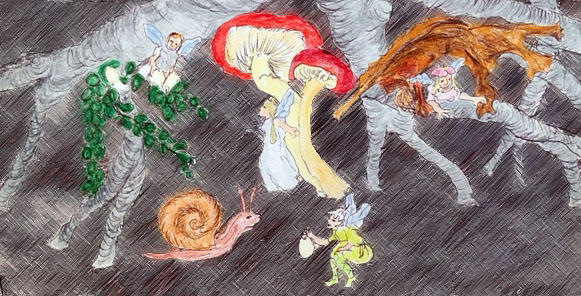
         I’ve walked this road to Ligugè before. But all these years later so much has changed from human neglect. When inattention defines our spaces the buildings don’t just sit still and empty. There come first the little creatures, the insects, mosses and mushrooms, then the grasses come with spiders and mice, then birds. Squirrels make their homes in rafters, and the roof beams become saturated with rain-dampened thatch sagging and caving until only a few stones and a flat place once a foundation are left to mark a house.

         I imagine the God’s-eye view of this isn’t really of sorrow and loss. Maybe where we see decay God sees all things new. Where once there was a house filled with the chatter of people now a whole new nature sways in the creeping of unkempt vines.  How many times do we assume our ways are the same as God’s ways, with all our branches trimmed back neatly into tidy straight edges? Yet God forgives our shorns and trims and blesses us with life in all these eternal lands anyway.

         Along this road a small group of guardsmen pass by on horseback with a banner identifying their belonging. I can step aside for them because the simplicity of walking gives me that humble choice. I had a horse in a prideful time. And Christians have another story of walking humbly that speaks of crossing social mores for the sake of love of neighbor.  [Acts 8:26-39] There is a story of an Ethiopian Eunice riding in a chariot while reading from a scroll named for a Hebrew prophet. The basic love of God is not complicated theology. In all the Holy teachings there is a simple repetition — the rudiments of ancient Hebrew law. Love God above all else, and your neighbor as yourself. [Leviticus 19:18] Here is this wealthy person of rank from wise Africa, whom we pale Christians of the north hold in awe. Dark is the shade of early wise men and saints, the early Church Fathers and Augustine, … Story goes, while walking on the road Philip steps aside for this very important Eunich. Yet the aristocrat humbled himself for the sake of a broader wisdom and he invited Philip onto the chariot to explain the scroll. In this telling of it, Philip baptizes this Ethiopian Eunich. It’s a story of looking beyond the tribal prides and social prejudices, putting aside isolating barriers of “othering” and stretching ourselves into the broader unbounded nature of love for all people and creatures.

 (Continues Tomorrow)

Post #22.8, Tuesday, July 20, 2021

Historical setting: 584 C.E. Leaving the vineyard

         I’m preparing to leave at dawn to walk to Ligugè. My bag is a bit weighty. But Anatase has something more. It’s a secret. She has the book of remedies with flower stems marking pages and she asks a favor.  Could I copy these pages onto a parchment end so she can attach dried herbs onto the written descriptions. She wants her teacher to receive a gift that has smell and touch so Eve will know what the words say. 

         “That’s a very thoughtful gift, Anatase. I will take great care of the book. But what if it’s needed before I return?”

         “It won’t be needed forever while I‘m here. I worried that it would be lost so as soon as I could read I learned it all by memory just in case.”

         “Of course you did. Why would I wonder?”

         The rumor of my leaving has spread, and now Celeste and her children are coming with river rocks, marked by each great-grandchild in charcoal for me to remember them by. I can promise I will remember, but I choose not to add rocks to my pack. So we stack them into a cairn for all of our remembering as Jacob stacked stones for the Mizpah with Laban. [Genesis 31:51]

         My strength is nearly complete so I needn’t borrow a horse or wait to ride a cart. And with a pale haze of summer morning ousting dark this promises to be a fine day for a journey. Thank you God. 

         Yesterday set my mind on this as we were reading about humility. Nic’s humor applied to the paradox of being proud of humility came to me with all the demands of grief. I have so many memories of Nic I need to share with others who knew him. The story I was telling Anatase yesterday, which tradition calls “The Good Samaritan,” recognizes the human penchant for taking pride in hatred. Pride in hate is prejudice. People, who are fearful of being cast out of their tribe create exclusions of others in order to form a bond of hatred. The Roman military bonded over hatred of Jews. But of course, this tribal pride is antithetical to the Jesus message of love of neighbor. So it was that by Nic’s most humble nature he forfeited his fellowship with the Roman anti-Semitism simply to befriend me, a stranger who was born a Jew.

 (Continues tomorrow)