Post #15.4, Tuesday, December 8, 2020

Historical setting: 6th Century C.E. Somewhere in the Pyrenees

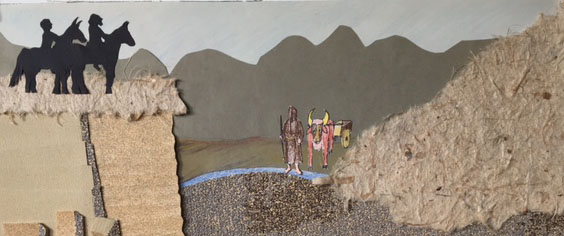
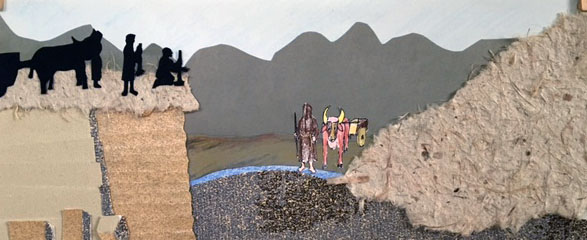
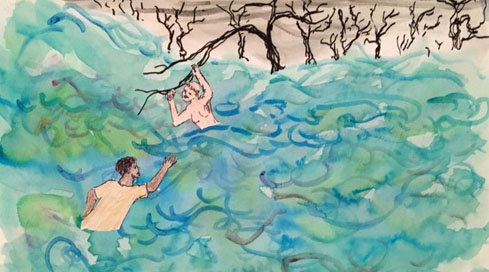
         The flat place we find for this night is barren of trees or bushes, but higher than the river should the river be raging with a new storm before morning. It’s on the leeward side of the valley in the shadow, but also protected from the wind. We set the horses to graze in the grasses by the river and go in search of fuel for our fire. I scour back to the south for wood and brush I noticed when we passed along the way, and Nic goes north.

         I loosen a winter-dry tangle of gnarly wood from its root and prepare it for a long drag back to our camp. This will blaze long into the night, with warmth for our sleep and a signal to night prowlers that this camp is guarded.  But no sooner am I within sight of our tarp than I see there a cooking fire, already blazing with a rabbit on a spit.  How could Nic have hunted and skinned a rabbit, found kindling and started the fire all in the time it took me to capture one dead bush?

         “How are you so industrious my friend?” I call to him.  “I have only a twist of fuel, and yet here you have set before us a whole feast.”

         “Better yet, Brother Lazarus, I have two furs for trade. We should say a mighty blessing with our thanksgivings to God for food and warmth and days to come.”

         “Amen. But how did you…”

         “I have a sword my friend. Take a look. This skin of the winter weasel is a perfect unblemished fur for trade and the rabbit – a few tears in the neck of its fur — but its still a fine thing for trade.”

         “How did you hunt both a rabbit and an ermine in that short time?”

         “I should just let you marvel over my gift. Let’s add that wood to this flame so that we can eat sooner.”

         So we break up my find of wood, and now the fire is blazing so high  we have to raise the spit so our rabbit won’t be ash before it is meat.

(Continues tomorrow)

Post #15.3, Thursday, December 3, 2020

Historical setting: 6th Century C.E. Somewhere in the Pyrenees

         Nic knows my silent prayers are anxious prayers. He assures us both that all the shepherds and all the sheep have only happiness before them by the grace of God. And he mentions also, that our donkey will be in the care of the big white dog and the donkey will serve even these neighbors trotting the wares to market for all the rest of his donkey days. It is happy endings all around. But we both also know the adage of the sour grapes.

         We ask this neighbor for his knowledge of the trail before us. Will our mountain crossing soon bring us to Gaul? Are there villages or farms ahead of us? What is the best route for our winter travel?

         The farmer’s mate and his eldest daughter come near with an abundance of garden roots in a bag for carrying — a gift for our journey. We’re grateful. Nic takes out coins to pay them but the father says they have no use for Roman coins; they only trade in goods. So even amid Nic’s riches we must receive this as a gift.

         “Thank you.”

         “You’re welcome to share in our plenty. But until you reach the Frankish Roman villages of Gaul you will have to trade in goods, not coin. Furs are valued in this season so should you happen upon a fox with a worthy pelt to be traded take it with your blade carefully, not to damage the fur.

         “Now the highest of the mountains are behind you with the cliffs and high edges.”

         We hear that to be good news. With horses we’ve had to seek longer winding paths around such obstacles.

         The farmer continues, “But these seemingly more gentle slopes are also high hills and they will seem to stretch forever to the north, deep into Gaul. This time of the year some of the shepherds with flocks that graze the high pastures in the summer are already at their houses in the valleys and lower reaches so I would suggest if you’re looking for the traveled route where people are, follow the middle or lower paths. The weather may even favor a journey following the river beds.”

         “Thank you, friend. This is helpful.”

         The horses seem ready to move on now, out of the sheep pastures and on to grasses that are not so sheep-gnawed and more for a horse’s liking. Now as we continue on our way our only day’s destination is a leeward flat place for our tarp and fleeces. But of course, all sorts of hopes and mysteries still may be wintering ahead.

(Continues Tuesday, December 8)

Post #15.2, Wednesday, December 2, 2020

Historical setting: 6th Century C.E. Somewhere in the Pyrenees

         This elder farmer speculates, “I suppose that boy is always in danger of hurt. His own father bittered and turned. That father turned a pain in his tooth to rage, then over and again douses his rage in sweet honey nectar only to wake and rage again.”

         “You seem to know him well.”

         “We were friends, then we were neighbors, now we are strangers living near one another. The boy, Boda, is nearly the same in age as my eldest, Gret. When the boy’s mother was living with them up there our children were always together. We fathers talked of betrothing them – Boda and Gret. But then Boda’s father turned to fits of rage. The wife’s father came and took her away, but the boy was left with that angry man and no mother to make it a worthy nest of it. Sometimes we creep into their pantry cache and refill the bag of gruel so the boy could find food where his father only kept mead. And sometimes Gret says she looks to the hill that divides us and catches a glimpse of Boda watching from behind the rocks. A hill never makes a good hiding place. We fear for the boy, but when we go calling the father accuses me of using the betrothal as a ploy to steal away his flocks. So Boda and Gret are barred from seeing one another.”

         “Well, we’ve come with news of the father.” Nic begins. And so we tell this man what we know of the father’s death and the son’s angry grief and desperate loneliness.

         “What will Boda do now, all alone up there?” This farmer, father to daughters and owner of goats seems to be a wellspring of hurt-binding, healing compassion.

         Thank you God, for stringing us humankinds together like beads on a jeweled chain, naming the next near one – a stranger first, then a neighbor then an essential friend. Amen. We are always in some state of belonging to one another.

          Now Nic and I don’t need to return to the shepherd to quill our consciences. We are assured now and can continue our journey without abandoning another’s need. But we know rivers of rage when dried in one season return to follow the same beds in another.

         Dear God, please intrude in these cycles of rage, so that Boda and Gret and all these people and sheep and goats and even me and Nic too may choose to see that fear and its senseless anger really have no power. Thank you for shining ever on us the surprises of creative grace. Amen.

(Continues tomorrow)

Post #15.1, Tuesday, December 1, 2020

Historical setting: 6th Century C.E. Somewhere in the Pyrenees

         We’re not hiding on this hill even though the shepherd told us it was a good hill for hiding. We are clearly in view from below — two men on horseback. We must be a strange sight for these two shepherds looking up at us, no doubt these are two of the daughters of this neighbor. Nic waves a peaceful greeting to break their gawking stares. One of the girls runs back toward the house either to summons help or hospitality. The other girl, a long slender stalk of a young woman, is just starring up at us offering no gesture of greeting or any sign at all. On our horses with careful steps, we ride down the hill toward her.

         “Greetings.” Nic says.        

         “My sister has gone for our parents.”

         “No need to fear us we are just passing by here. But it would be helpful for us to speak to your mother or your father regarding your neighbor.”

         “Boda?” She questions. The shepherd has a name.  We wait a few minutes in awkward silence until the younger shepherd returns with her father.

         “They said they’re travelers passing by, but that they have word of Boda, Father.”

         “So you have seen our neighbors?”

         “Indeed, we have news.”  The father sends the girls back to their task and we follow him, leading our horses. He takes us outside the gate from the pasture so that he alone may be the one to hear whatever news we bring. Now we are in sight of the house and we can see it is a busy farmyard. And yes there are several more daughters here and goats too. The wind brings a whiff of wood smoke from their hearth and the scent of freshly turned goat cheese ripening, souring to flavor. And even the distant silhouette of the woman of the house affirms every rumor we’ve heard of this neighbor. The abundance of daughters continues even into the days ahead.

         “So what news have you heard from our neighbor?”

         “There is a shepherd up there with eighty-seven sheep and a big white dog.” And Nic adds, “And now that young man rides on our donkey because his ankle was recently injured and he can’t walk very well.”

         (Continued Tomorrow)

Post #14.12, Thursday, November 26, 2020

Historical setting: Along the ridges of the Pyrenees, 6th Century

         Nic and I finally make a plan not to make any plan until we see if this neighbor has compassion for this shepherd. Maybe our consciences will bind us here to care for him; or we might find we can continue our journey knowing that the shepherd and all his sheep will be looked after by a caring neighbor. Surely we can’t avoid winter anymore. It is coming now with every breath of wind colder than the last. The black tinge of the hoarey frosts marks the lost growing season, now turned to the bleak and timeless season for waiting.

         We leave the donkey and a few supplies that the shepherd will need here in the upper pasture shelter and we pack our remaining supplies and fleeces behind us on our horses as we head north. The young shepherd barely acknowledges our departure. He doesn’t even ask where we are going or even if we will return.

         “Nic, did your old tribal priest tell you of the ancient Hebrew adage that ‘the father has eaten sour grapes, and the son’s teeth are set on edge’?”

         “I’ve heard that. For all that poor fellow’s fighting words he must have been incapable of standing up to his father’s senseless beatings. No wonder he wanted the leathers from my saddle bindings to make himself a whip.”

         “That’s the same thought I had. He wept with his longing for the beatings he will miss.  In all his grief and sorrow he yearns for thrashings because, he said, he would know his father ‘noticed him.’

         “I imagine only the love of God can loosen this bondage of hurt and lead him beyond the cycle it is.”

         “How will he ever notice God’s love? He hasn’t even a notion of a parent’s love.”

         Dear God, Are there any simple miracles of love waiting to be scattered down on earth from heaven?  Please let the snows of grace fall on this grieving shepherd and his sheep. Amen.

         This hilltop I was told is within sight of the neighbors, and here we find the longest view. Directly below us is a small pasture area, with a flock of about twenty sheep being tended by two who are surely these neighbor’s daughters.  Not much further to the north is that spiral of hearth-smoke rising from behind a knoll, undoubtedly the home-fires of these neighbors.

(Beyond that… continues Tuesday, December 1)

Post #14.11, Wednesday, Nov. 25, 2020

Historical setting: Along the ridges of the Pyrenees, 6th Century

“From that hilltop” the young shepherd explains,  “You can see the smoke where the hearth-fire burns for the house of the neighbors.

There are some good hiding places on that hill so you can watch the daughters a long time and no one will see you.”

         “I’m pretty sure we don’t need to hide from them. In fact Nic and I may actually want to speak to them. Do the daughters have parents, or who should we find to talk with?”

         “Why would you do that?  Are you going to tell them about my hiding places on the hill?”

         “Is that important for them to know?”

         “It’s my secret! If my father found out he would thrash me good. You know, my father has leather strips like the braids the soldier’s horse wears. Even when he is so sick my father can still thrash me.”

         “But now he is dead and his body is buried; don’t you suppose your father is with the angels in heaven? And from what I’ve heard there’s not a lot of thrashing going on there. Now it’s up to you to decide these things for yourself.”

         I’ve returned the shepherd to his sheep so Nic and I together offer him the simple logic of right choices.

         I was saying,  “If you think something you choose to do deserves a good thrashing, then you just know not to do it.  But if you are thinking of doing something that makes things good and better, like finding good grasses for your flocks, or sharing your shelter with visitors then the choices you make, even without your father’s judgments and punishments are probably good choices.”

         Nic adds,  “You don’t need thrashing anymore to know what to do and what not to do.  You are the man now, and can decide things for yourself.”

         He argues. “Yea, so you say. But sometimes I just need a good whipping so I can know my father notices me.” And here is another verse of the young man’s loud and wailing cries of grief. Is he grieving for the whippings he will be missing?

         He interrupts his own weeping and gnashing to recall details of the neighbors, “They have both a man and a woman that are a papa and moma there.  My father said if that papa didn’t keep that woman he wouldn’t have gotten so overrun with daughters.”

         “Yes, I would suppose there is some truth in that.”

(Continues tomorrow)

Post #14.10, Tuesday, November 24, 2020

Historical setting: Along the ridges of the Pyrenees, 6th Century

We are somewhere in mountains on the edge of winter and we find ourselves face-to-face with a grieving young shepherd. It was my thought that there must be a community of shepherds or farmers in this area or how could this farm sell its mutton and wool?  The young shepherd’s idea for finding help seems to be, as he said, “capturing slaves.” If he is thinking of shackling these two of us he will surely find we make worse slaves than we do volunteer shepherds.  We have horses and supplies. We could just leave as we are already planning to do before winter takes a firm hold; but it seems so heartless to leave him here alone and so needy.

         “So I was wondering,” I ask the youth, “are there others who keep flocks in this area? And where is it you go to trade your wool?”

         “I am not allowed to go there.” He answers.

         “Where?”

         “Over the hills to the neighbors.”

         “You have neighbors?”

         “Yes, but my father said their flock is few, and that neighbor has only daughters so I am not allowed to go there.”

         “Oh, I see. How might we find this neighbor?”

         “I know where they are, but I can’t go.”

         “Maybe if you tell me the direction Nic and I can ride over and see what the situation is there while you are taking the next watch of the sheep.”

         “The soldier said not to walk on my sore foot.”

         “You have a crutch now, and I’ll just walk you back on the donkey whenever you are ready to go.”

         After a brief lesson on using a crutch the shepherd mounts the donkey and I take the lead line, and we trudge back to the pasture.  The sleepy white dog follows a few yards behind us.

         The shepherd offers lots of chatter about the neighbors, especially considering that has been a forbidden world to him.

          “My father said they not only have daughters, but they also have goats. I tried to go see that too, but from the hill where I hide to watch them I only see the sheep and the daughters. They must keep the goats hidden.”

         “No doubt. From what I’ve heard, goats don’t flock well.”

         As we climbed the ridge onto the path to the pasture, the young shepherd points to a hilltop behind us to the north. “From that hill you can see the neighbor’s pasture and sheep.”

 (Continues tomorrow)

Post #14.9, Thurs., November 19, 2020

Historical setting: Along the ridges of the Pyrenees, 6th Century

         “So what will we do now?”

         The father is buried. The sheep have no shepherd. The shepherd is grieving. The dog and the donkey are consoling. The winter is creeping down on us all from the north. We need to use these days for travel while we can.

         Nic speaks it aloud, “Dear God, what should we do now?”

         “You know Nic, God doesn’t always answer in the season of our need.”

         “I know, Brother Laz, so we will need to make a human choice. Since you are so good at grief you should go to the house where the shepherd is.”

         “’Good at grief?’ No one is good at grief. But I will take a turn to walk over the ridge to the house and even if I can do nothing to comfort the shepherd at least I can bring back the dog to help us guard the sheep tonight.”

         “So you think we will stay another night?” Nic calls as I am leaving.

          “I counted eighty-seven sheep last night, Nic, just so you’ll know; in case you decide to count them again.”

         I walk toward the smoke rising on this crispy autumn morning considering every possibility my imagination can muster except the one that says Nic and I can winter in a sheep’s pasture with no one but an angry, grieving shepherd to bring us our daily gruel. The choices seem either we leave the shepherd alone and needy or we spend the winter in a pasture lean-to.

         The house was easy to find, not just by the smoke but by the worn footpath. And it’s surely been a long night of wailing here. Even the donkey and the dog are, or were, asleep out here near the door. At the sound of my step the dog is barking furiously and the shepherd has come to the door of the little house.

         “I came down to offer my sympathy and see how you are doing.”

         “So the soldier told you I need a Christian?”

         “No, I just came while Nic is taking a turn watching the sheep. We aren’t sure if they need to be watched every minute or if you leave them up there sometimes on their own. We’ve not had much experience shepherding.”

         “Yea, I was thinking you two aren’t much use, but now I’m so alone.” Tears of grief well in his voice. “So I will need to capture some slaves to help me.”

         “Surely you need help, but …”

(Continues Tuesday, November 24)

Post #14.8, Weds., November 18, 2020

Historical setting: Along the ridges of the Pyrenees, 6th Century

         The winter of last night posed a mere warning that the season is turning. All day a southern breeze breeches the ridge from the valley. It would have been a good day to continue our journey.

         Alone, I was able to move the sheep into the night pasture where the horses graze. I’ve spent this day inspecting each sheep and gathering a sack of dung to make a watch fire for this night. I wonder if I’ve been forgotten here, if my patron has found a more needy man to care for? Surely someone will remember these sheep — I imagine.

         This new morning I’m still at the tasks feeding and watering the horses, and setting the sheep to pasture when here is Nic, walking alone on the ridge. I shout. He turns toward me, not speaking until he is near.

         “The shepherd has no more raging; he just cries loud and long and inconsolably. The dog and the donkey are more comfort for him than I.”

         “What happened?” I asked. “Where did you go?”

         “Look beyond those hilltops.  Do you see the smoke rising?”

         “It looks like someone has a home and hearth over there.”

         “Yes. When we first came the shepherd was dealing with his worst fear, that the smoke of his family home was no longer rising where he could see it above the hills. Two days before, he left his father in a fit of rage, and admits he was running away when he injured his foot so couldn’t walk back to make amends. He watched for the smoke to be the sign that everything was all right. But he saw no smoke. We showed up amid his worry and even in the cold storm there was still no smoke. His fear was that his father’s powerless raging was, in truth, his last gasp of life.

         And it was just as the shepherd feared. When we arrived at the house his father was dead, probably a few days before, maybe even as the shepherd was running away. I buried the shepherd’s father in the best grave I could cut into the mountain, but it was a shallow grave, so the shepherd and the donkey gathered stones. All that while, and all night long and maybe even now, the shepherd wails his goodbyes to his only family. I am so little comfort for him so I came back up here.”

(Continues Tomorrow)

Post #14.7, Tuesday, November 17, 2020

Historical setting: Along the ridges of the Pyrenees, 6th Century C.E.

One mystery of courage is that it wears many faces rarely as we expect — the human moment between panic and training when the proper response comes forth and a crisis is averted. But doesn’t courage also come in the stoic intensity of a donkey’s stubbornness or the fury of the dog barking away an intruder?

         While Nic ran back up to rescue the donkey from a beating, the big white dog awakened from his daily snooze and now has hurried over to side with his fellow critter. From where I stand amid the sheep I see Nic carries the shepherd’s crutch and he is leading the donkey while the shepherd rides on it and the big white dog follows close.  As they are walking away the shepherd shouts back instructions to move the sheep to the night pasture at sunset.

         “Where’re you g…” My question went unheard and now I’m alone with this many sheep. I know I should know the number of them. Are they one hundred? And should one be missing would I leave them all to search for the one, or is that only a parable describing the Holy?

         Dear God, Thank you for taking notice of each critter of us. When it’s you who counts us do you count sheep and donkeys and horses as the same worth as people?  Yes, of course, I would suppose so. I mean we’re all part of the fullness of life, though I would suppose the prayers of the donkey have easier answers than my own, or maybe not. Thank you, Dear God, for listening to my complicated human wonders and to my woes as well. Amen.

         A large bird circles above and now there are more dark birds. How do they know this shepherd who I am has no gift for this work? It could be there is a needy lamb in this flock and the birds see a frailty I’m overlooking. I try to walk through the flock taking a careful look at each grazing lamb. They do each have their differences, but I see no injury or impairment that would interest an ominous seeker of carrion. By the time I look again at the sky, after counting and inspecting the sun is a bit further across the blue altitude of day and the birds are circling another place across the hills. It could be, they were just flying over.  But now I know there are eighty-seven sheep.

(Continues tomorrow)