Post #12.1, Tuesday, September 1, 2020

Historical setting: 563 C.E., Galleacia

         At this waking our minds, our hopes, our plans for a new day are fully in-tact; but every bone and joint has only one position without hurt and that is the one position remembered from the long trots and strides of yesterday’s many hours of riding. I hear Nic’s mindless groans, the knocks of changing an old oarsman into a rider. I pretend my own groaning is silent. The horses are ready. Do they have no memory of the long day yesterday carrying these two of us weighty men? The Rose remembers his best behavior and accepts the saddle with all its ties. Umber makes no opinion known at all. He is indeed a well-tempered gelding.

         Today we follow the river toward the west, though I know the villa I nearly recall in this land is far to the east. Today The Rose and Nic find an easier and faster gait, and Umber follows, so we are making better time journeying toward the bishop’s see of Bracara Augusta.

         I’m glad to find the few people we are encountering today at these watering places speaking the Suebi tongue, and some even use the Roman vernacular. I had a hidden worry that the Visagoths had taken over Iberia while I was away – however long that may have been.  My forgotten absence is a sore topic Nic and I try to avoid.

         The sun is low in the West when we finally we lay eyes on the city, so now we are seeking an inn with a meal served and a stable to accommodate our patient beasts.  Here again, our Roman language is acceptable, yet the spoken tongue is more as I had expected – a derivation of the Suebi.

         The inn with the adequate stable edges the valley of the civitas. The old basilica of the see is the centerpiece of the city that spreads below us.  It is the most obvious building in the valley amid the houses and markets. We plan to go to that basilica in the morning. Tonight we will rest.

(Continues tomorrow)
Post #11.12, Thursday, August 27, 2020

Historical setting: 563 C.E., somewhere near in Galleacia

A slow start this morning then a pace unhurried. We are still a distance from the turn to follow the river to Bracara. Nic asks someone at this watering place where travelers may spend a night. Again, it seems everyone is speaking the language of the Visigoth’s and not the Suebi.

         I have secret doubts as to when I remember, but Nic is starting to question my memory of who and what.

          “You say it was the Suebi Bishop who summonsed you to Gallacia?  So, when we arrive in Bracara we will seek the see of the bishop and he will be your old friend who will fill in all the missing information – dates, places, people – all of that?”

         “That’s my intention, although if the bishop I met when I was last here is not the bishop now, they will surely have the record of my summons. Whoever is there can offer direction to the villa where I went. And they may still have that copy of the Gospel of John I brought. I remember in bits and glimpses. The don was an old Suebi soldier. He was awarded the Roman villa as a spoil of the war. And every one of his children had that yellow hair. His family all wore their long braids twisted and knotted in Suebi fashion. It’s very distinctive.

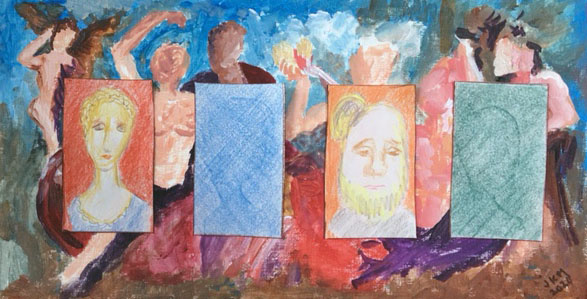
         “When we find that villa, Nic, I’ll show you something very odd that speaks of the times. Roman frescos originally filled the walls of the large atrium. The Roman artwork depicted a heavenly orgy of mythical gods and goddesses. But in the Suebi hands the garish painting was simply ignored and overhung with family portraits.

         “Piecing my glimpses of memory, I think my wife was the eldest daughter, Susannah. Her portrait is there. She was the one who recognized the tragedy in the cult and who took her concerns to the bishop who then summonsed me.”

         “So you remember her summons but not your life together?”

         “That’s strange isn’t it, which details stay in the mind. Maybe the heresy still lingers with me denying my own earthly reality. But really I don’t think a mystical moment could poison a memory of a wife.”

         “So that rumored promise of a purely mystical after-glow is what we are seeking?” Nic is kidding. I hope.

           “Really Nic, I’m only hoping that earthly villa will be familiar.”

         This night we have not yet reached the turn at the river.

         (Arriving in Bracara Augusta, September 1)

Post #11.11, Wednesday, August 26, 2020

Historical setting: Remembering a time, maybe 452 C.E.?

The heat of the day is upon us so we find a cool flowing creek to water the horses.

         Nic asks why they needed the Gospel of John brought all these years after the cult leader was executed. He does say, “all these years after” as though my other visit here was recent. But I’m starting to wonder if I’ve simply forgotten a vast swath of years.

         “In 384 only the instigator and a few of his henchmen were gone. The theology lingered. Cults popped up here and there. The newly appointed Suebi Bishop at the see of Bracara called for the Gospel to settle once and for all the loose ends of this heresy.”

         “When would you say that was?” Nic asks, goading me for remembering a date.

         “Somewhere near mid-century, I think.” Clearly a failing answer in not naming a century.

         “You don’t know, do you Laz. Your mind is still scrambled. So if you don’t even know when, how is it possible you could know how? How could the Gospel of John ever be considered a talisman against heresy? If starvation and execution didn’t exterminate it how could a gospel do it? In fact, compared to the other gospels, from what I know, I would think John would be the cult book supporting Gnosticism.”

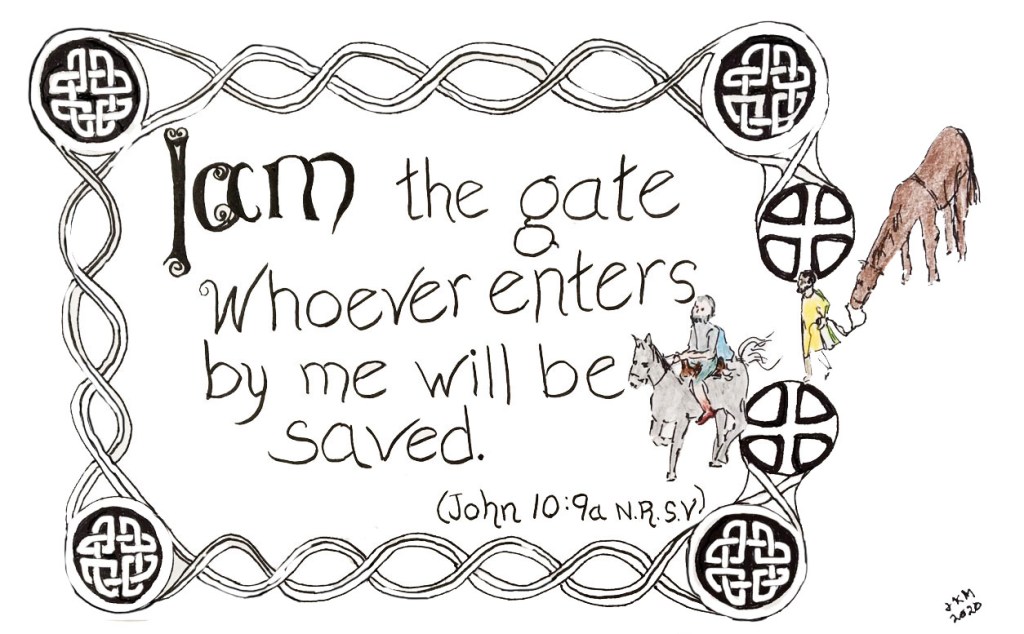
         “Oh, Brother Nic. Just the opposite. It only seems to use the language of the heresy because it was finally edited and given that Roman gloss in a time and place when mysticism was spreading and metaphor sounded earthly. The gospel co-mingles the tangible with the spiritual, using symbols of light and life as a bridge between the physical and spiritual worlds not as a rejection of the earthly things. So it isn’t Gnostic but sounds similar. And what seems a cultish narrowing to our ears, where we still know of pagans and Zoroastrians and Jews, when John (July Chapter 10) says that we must enter God’s Kingdom through Christ alone, that was actually heard in that time of Roman fixes as a statement of widening the entrance, not a Gnostic exclusion; it was expounding the universal (catholic) acceptance into Christianity.”

          Nic argues “Calling Christianity ‘universal’ is really only said in the most narrow sense. It seems confusing.”

         “Paradoxical.”

         “Maybe I just had to be there as you say. Or maybe your scrambled mind just won’t let go of the nonsense. Which is it Lazarus? Which is it?”

(Continues Tomorrow)

Post #11.10, Tuesday, August 25, 2020

Historical setting: A Dark Age On the Road in Iberia

“So, Brother Lazarus, you haven’t yet explained how the ‘Gospel of John’ cures the Iberian heresy. If the sin is dualism, or judging everything either good or bad, a Gospel hardly seems a cure.”

         “The worry over that heresy started when a cult was observed. A young aristocrat, Priscillian [Footnote 1] gathered followers based on divisiveness and exclusion. I think it was around the year 380 when Priscillian was actively writing and gathering the original cult following. That was, of course, way before I was called here.”

         I won’t mention that having a scrambled mind I’m still not really sure when it was that I was called on. Was it in the 5th century, or the 6th? I’ll continue my explanation as though my mind is clear.

         “This dangerous cult leader was looking for personal power. At first he had his own churches but the bishops closed them so the followers met in private villas which is what continued long after he was gone.

         “The version of Gnosticism he was teaching was already deemed to be heresy. With all things of earth evil, even taking food and water was considered sin. So the deadly side of this full-on devotion led to starvation of the body.  And worse yet, the withering of one’s body was viewed as a virtue by followers.

         “In 380 twelve bishops had a Synod in Zaragoza to deal with this. Priscillian didn’t go, but he sent them a tract defending his theology. Of course his argument couldn’t hold up to orthodox theological scrutiny, since he was basing his argument on a heretical Gnostic, apocryphal text. But strangely, the Synod, possibly intimidated by his intellectual prowess, or simply confused by the theology chose to deal only with the political issues. They forbad things like calling oneself, ‘doctor’; making clerics into monks and requiring women to be forty years old before the title of “virgin” was given. [Footnote 2] When he was excommunicated, Priscillian, being a self-invested power fiend, simply doubled-down and took the title of Bishop — Bishop of Avila. [Footnote 3]

         Both sides of the controversy sought affirmation from church leaders of the time: St. Ambrose, St. Martin of Tours, and even a pope.  Then, in 384 it all morphed political and Priscillian was tried for magic in a secular court and was executed.

         Nic asks, “So why are they still bothered all these centuries later and why did they send for the gospel?”

(Continues tomorrow)

[Footnote 1] Priscillian (died c.385) was a wealthy nobleman of Roman Hispania who promoted a strict form of Christian asceticism. Certain practices of his followers (such as meeting at country villas instead of attending church) were denounced at the Council of Zaragoza in 380. https://en.wikipedia.org/wiki/Priscillian  Retrieved 5-16-2019.

[Footnote 2] In or about 380 a council of Spanish and Aquitanian bishops adopted at Saragossa eight canons bearing more or less directly on the prevalent heresy of Priscillianism. https://theodora.com/encyclopedia/s/councils_of_saragossa.html Retrieved 9-26-2019

[Footnote 3] He became bishop of Ávila in 380. https://en.wikipedia.org/wiki/Priscillian  Retrieved 5-16-2019.

Post #11.9, Thursday, August 20, 2020

Historical setting: 563 C.E. On the Road in Galeacia

“If it wasn’t sex and it wasn’t disobedience what was it that went wrong in the garden that eventually led to the deadly heresy that took the full ‘Gospel of John’ to dispel?” Nic asks, nudging more holy yammer.

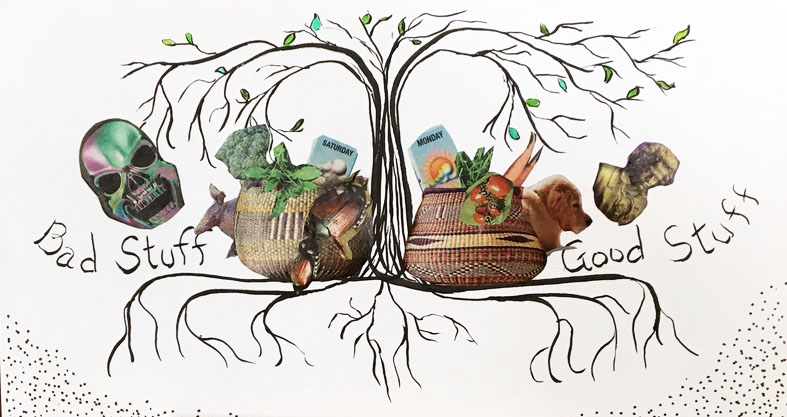
         And I fall right in. “Well, that forbidden knowledge of good and evil made the assignment Adam originally had of naming everything, seem irrelevant. The story goes they started separating everything into two heaps of judgment without even a nod to God’s eternal last words of Creation: ‘It is good.’ And maybe all the rest of the bible is simply God clarifying, ‘It is good; I love you and I forgive you all dear creatures of earth’.

         “But by accepting this stolen judgment, this original sin – the duality of the knowledge of good and evil – this perception becomes the essence of ‘falling from grace.’ It’s not an accidental trip and stumble; it’s a complete, full gallop into the pit in the opposite direction of God’s free gifts. No wonder the blessing of growing a garden seems like punishing work, or the amazing moment of birth is remembered for the pain. No wonder snakes crawl and Eden has sand dunes.”

         “Yes, Laz, but if we’re empowered to choose between good and evil, and the world is, in God’s view, ‘good’ why do people keep yearning for the evil?”

         “How would I know? Maybe it’s the human passion for rivalry that looks to set one above another. The creature lust of dominance comes easily in the ability to declare badness and to know which child in the play yard is chosen for the bad name and the shunning. It’s all just a godless power play.

         “Just a thought Nic, you might give The Rose a nudge, and let him know to pick up the pace a bit.  We can walk to Bracara faster than this ride will take us.”

         “He’s keeping me on his back so nicely, I don’t want to be critical of his gait.”

         “Here’s what to do. Press your knees tight against the saddle so you will stay on and he won’t have to balance you there, then just nudge him with your heel to let him know it’s alright to try a trot.”

         Nic grabs onto the saddle horns as the horse lurches forward. At first the trot seems like frenzy but we all quickly settle into a rhythm with both horses trotting and both of us still astride.

         Dear God, even though I’m human, I still notice it is good. Thank you. Amen.

(Continues Tuesday, August 25)

Post #11.8, Wednesday, August 19, 2020

Historical setting: 563 C.E., Iberia

         We are preparing our horses for the day’s ride. The Great Rose has already tossed his saddle once and now Nic, the least horse experienced of the three of us has taken on the project. Nic proceeds first to be sure I am holding the rein close to the bit. Then he puts his leather shirt back on and struts it in front of The Rose. With the scent of leather on himself he picks up the saddle so the horse may see it as he prepares to lay it on the horse’s back. The boy cautiously steps back. Apparently The Rose has no objection to the saddle now, so the boy comes up and fastens the straps with a braid of leather both front and back. Even a rearing horse can’t loose the saddle. We all hope for no more rearing horse. Nic may be a horse owner but he’s hardly a rider. As for Umber and me I use only a rein and a girth strap, so Nic doesn’t have to pay for another saddle. I haul myself unto Umber.

         Nic’s plan is to mount by standing on the gate rail, explaining that Calvary soldiers are taught to vault into the saddle. But he acknowledges he has had no training in that – yet.

         We start down the road like two heroes bound for adventure. I think it’s The Rose who’s setting the pace.  It’s a slow walk, probably good for balancing an upright human, stiffly perched on a strange new saddle. Nic knows I’m ready to jump in and offer a riding lesson so he provokes a talking point on another subject.

         “So tell me about that forbidden fruit in the Garden, Lazarus.”

         “Yea, last night it bored you right into snoring.”

         “I forgot what you said the sin was. You said it isn’t disobedience after-all but what is it? Oh, never mind, I think I know. Original Sin is sex, is it not?”

         “Nic, if I’d said that you’d have laid awake all night with your mind wandering. You know that notion of Original Sin is one of those inventions that comes with reading epistles with a punitive eye. It has no grounding in God’s love. I mean what kind of world would we live in if sex were a sin?”

         “A very chaste one, I would suppose, wouldn’t you think that Lazarus?”

         “A very bleak one, with either all sinners, or no children.”

         “Given the choice, I guess I’d prefer a world full of both sinners and children.”

(Come again tomorrow)

Post #11.7, Tuesday, August 18, 2020

Historical setting: 563 C.E., a stable in La Coruña

The stable boy arrives with the rising sun this morning and shows us things about feeding these horses.  The gray is a bit picky about the proper distribution of oats and my horse just takes whatever is in the trough. Umber trusts me to get it right. The Rose is questioning. Nic understands the boy’s barbarian gothic so it is Nic who receives the instruction, as it should be.

         As Nic puts on his leather to keep the iron shirt from his skin the boy has a new thought. He brings out a leather saddle and sells it to Nic for some coins. It’s well padded for the horse’s back and has a seat for a man on the topside, with four horns posted – two in front of the rider and two in back to steady any Roman soldier who might be using a weapon. Nic is very pleased that The Rose will have some leather protecting him from the iron shirt as well.

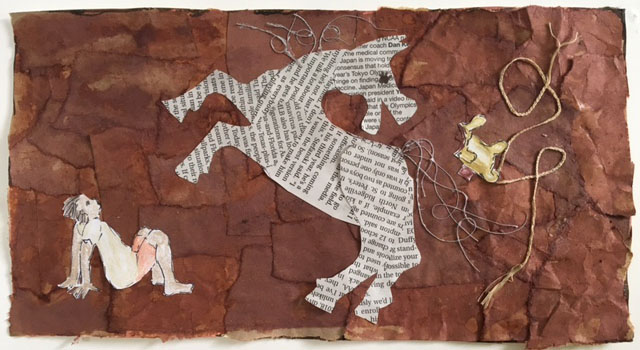
         The boy throws the saddle onto the back of The Rose but immediately the horse rears tossing the child aside as the saddle slides off down his back. I take hold of the horse’s rein near the bit and he accepts my calming pats as Nic gathers the child to his feet. But The Rose is not without empathy.  He takes notice of the boy, and also of Nic’s gentle nature toward the child. Then Nic turns his attention back to the horse.

         I suggest Nic show him who is in charge. My thought and The Rose’s instinct would be that the horse will receive a brutal reprimand. So Nic’s tone is scolding as he picks up the saddle though I’m not sure if his cursing is toward The Rose or for me. I just assume Nic will toss the saddle back onto the horse and let the mighty Rose know a horse has no say in this.  But that is neither the way of Nic, nor the way of The Rose.

         Nic lays the saddle in the straw where the horse can see it and investigate this strange new thing. Now Nic removes his chain shirt, revealing his own leather gambeson, then he removes this leather padding he wears and lays it in the straw next to the saddle. The Rose takes notice.

         What is this strange dialogue between man and horse? Do neither of them know of the traditions of master and beast?

(Come again tomorrow)

Post #11.6, Thursday, August 13, 2020

Historical setting: 563 C.E., on a beach in La Coruña

         We walk the horses back to curry them and bed them down for the night.  We’re told that Nic’s horse is named “The Rose” because the dapple looks like dew on rose petals, and mine is “Umber” because it is brown.

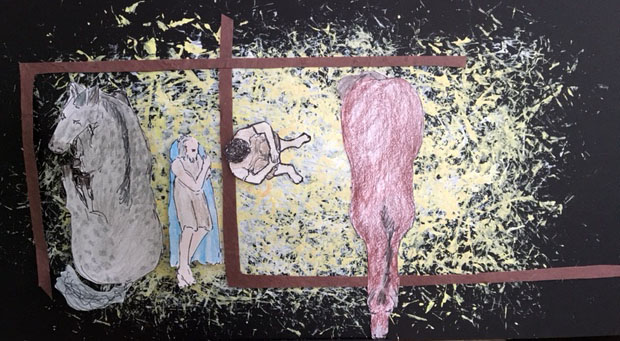
         Nic is as excited as a child with a new horse of his own. He really doesn’t want to leave the stable so here we are spreading our cloaks in the straw. Now the horses must think humans have strange murmurs into the night.

         Nic starts the chatter, “So what is the heresy that threatens the lands of Iberia and called you here to rescue them by delivering the Gospel of John?”

           “Don’t worry Nic. I was just yammering on. Goodnight.”

         “How can I sleep when you started talking about a deadly heresy and you don’t give me a clue how to stay safe from it? What is the mortal hazard of mysticism?”

          “It’s not mysticism that makes the Gnosticism of the Manichean heresies like Priscillianism dangerous; it’s the problem of denying the goodness of Creation.  Beyond believing in the spiritual nature of God they were taught that the whole Creation is not Holy. They spread a lie that the things of earth are not the work of God, but are of an evil power. This heresy longs for the Spirit yet denies the sacred nature of earth and sky and trees and all the creatures of the earth, ignoring all the signs of beauty that draw me and you into our thanksgivings so easily.”

         Again the wisdom is in Nic’s simple logic. “If the Gnostic is attuned to the Holy Spirit would she not hear the Creator God speaking ‘it is good’ at the end of each day of Creation in Genesis?”

         “This particular cult didn’t even acknowledge Genesis as a part of the bible. They simply denied the goodness.” [Footnote]

         “Whatever would draw someone to that?”

         “You know, Nic, there are two Creation stories in Genesis. The second one has Eve and Adam eating from the tree of Knowledge of Good and Evil.”

         “I know. They erred by disobeying and eating forbidden fruit.”

         “But Nic, what if the error were not so much the disobedience but was in the fruit itself? What if things went wrong when humankind started making judgments based on this stolen gnosis of good and evil which they took from God when they stole the fruit?”

         Nic is already snoring.  “Goodnight Nic.”

(Continues Tuesday, August 18)

[Footnote]

These doctrines [Priscillianism] could be harmonized with the teaching of Scripture only by a complex system of exegesis, rejecting conventional interpretations and relying on personal inspiration. The Priscillians respected most of the Old Testament but rejected the Creation story. They believed that several of the apocryphal Scriptures were genuine and inspired. Because the Priscillians believe that matter and nature were evil, they became ascetics and fasted on Sundays and Christmas Day. https://en.wikipedia.org/wiki/Priscillianism#Writings_and_rediscovery 

Retrieved September 20, 2019.

Post #11.5, Wednesday, August 12, 2020

Historical setting: 563 C.E., maybe, a beach in La Coruña

Just now there is a rhythm of hoofs, galloping, pounding as though it were coming up from under the sand! There in the distance on the edge of the water are four horses at full gallop. Nic and I step back as they go right by us. Two of the horses have riders and the other two are led but seem to be fighting lead-lines made for tamer footings and a slower pace. They slow to trot after they pass, then turn back to this place. A young woman slides off the dapple gelding in the lead and her great and glowing smile assures us that with the appropriate exchange of coins we, too, may gallop this seashore.

         I suggest we walk the horses a bit to cool them as we talk this over. The boy who rode away on the sag-backed mare slides down from one of the bays, and it is clear we were not delivered the gentle ox Nic requested. The boy hands the lead of one of the horses to Nic, and he doesn’t seem the least bit skittish – neither Nic nor the horse seems skittish. But the huge dapple-gray senses Nic’s apprehensions and arches his neck and rolls his eyes, stepping sideways to get a good look at this man who is so kind and yet awkward in his horsey greetings. The young woman tightens her hold on the gray’s lead, and he pulls back clearly disproving of her defiant hold. She offers me the choice of another fine bay or this feisty gray for our cooling down walk around. I choose the gray. Maybe I’m just strutting my feathers for the girl – it’s an instinct or a bad habit. But I went straight for the challenge.

         It’s a beautiful horse, and Nic is very aware of this and believes that I’m choosing this one for the purchase. But Nic is the one who is buying the horses. It’s his money. He should have the finest of the two horses we choose; so for safety sake I suggest we stick with two of the brown ones. He invites me, then, to pick the brown one I want and I choose one of a good spirit, but a bit less stately than the more elder and gentle bay Nic is walking. I thought Nic would make the safest choice and take the most gentle bay for himself; but the deal made, we had the brown horse I chose for me, and the feisty dapple gray for him.

(Continues Tomorrow)

Post #11.4, Tuesday, August 11, 2020

Historical setting: 563 C.E., maybe, a beach in La Coruña

We‘ve found a stick to mark the sandy beach with a timeline of history while we are waiting here at La Coruña to look at horses. 

         “Laz, obviously a single timeline fails us. You’ve added all these branches for so many philosophies. But what if history comes at us not aligned like an army of ants moving evenly in a single direction, but more like waves of sea? What if events and understandings rise and sink in importance like swells on the ocean? One appears essential, then another even greater rises in another place, only to sink back into the churning current; or maybe it all dissolves into the great smooth calm.”

         “Yes, that does seem the more likely pattern. I’ll just scratch out our useless timeline with all these specific years.” 

          “Well, I thought it might help us clarify your strange memory problem. But now Laz, I’m more curious about this budding heresy starting when all varieties of mysticisms were rising to the surface one on the next like waves on the sea.” He interrupts my breath to answer. “Wait don’t tell me, Laz; let me guess. This heresy of mysticism started when people began noticing the invisible nature of Spirit so the old idea of believing only in tangible things and things seen becomes the anathema. I mean, what would be more heretical than not noticing the invisible nature of God? I guessed right, didn’t I Brother Lazarus? Once people learned to be mystical, denying the invisible became everyone else’s heresy!”

          “Oh that you were right, my friend.” Dear God, thank you for the company of this strange old soldier of simple perspective. Amen. “But if believing only in the material nature could be considered heresy everyone would be a heretic at some time in every life.  We all so easily believe that the only reality is visible and tangible. It’s a normal human perception.”

         Nic’s imagination keeps turning. “It would be so fine if you and I were the bishops declaring the heresies. Then all Creation, even Jesus would be the physical sign for the spiritual reality. And anyone who doesn’t think the Heavens and the Earth and all Creation and every creature living is actually Holy Spirit is anathema!”        

         “Sure Nic. Write your ideas in the sands that change; just don’t carve it in stone, or write a creed of it because all life ever grows new. Ideas come and go, and flatten and rise like dunes in the desert.”

         “… or waves on the sea.”

(Continues tomorrow)