Historical setting: Maybe 6th century, off the coast of Galleacia
Maybe Nic has the same worry. What if we land here in La Coruña and I still have no memory of place or time. And all I know is I’m looking for a wife with yellow hair who might be waiting for me somewhere.
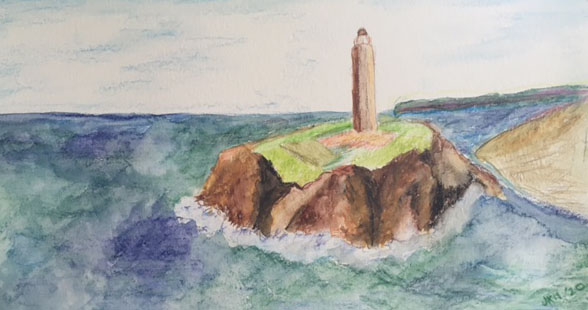
Watching the coastline, preparing for the landing I ponder this worry and harbor this fear. Relieved now, I know I’ve seen this Roman lighthouse before. I know I have a memory at least of this. Maybe I’m only missing the year. What if I’ve lost my sense of century? Nic has no idea of this possibility of vagueness. He’s testing me to see if my mind is still scrambled and he asks me if I know what day it is.
“It is August 4.” He accepts the easy answer. But I still wonder which August 4?
My worry goes unspoken. All he is asking me is to recite a numbered day and month named after a Caesar. He has no thought that it’s always been human imagination that numbers the sun’s risings and settings and measures them into distributions of sevens to make weeks. Weeks are an odd commodity of mysterious completeness — odd because weeks are contrived by ten-fingered, ten-toed humankinds, with no sevens at all in our digits to guide the count. Seven is the Godly number of completion – the perfect. You can’t count to seven on fingers, toes or even on a cube with six sides of dots for tossing, so we expect our numbering of days into weeks must be mystical, beyond human ability to understand. We place our Sabbath aside for God on the uncountable rest from work. I guess once it was noticed that the moon patterns were chaotic and the cycles of life sporadic, counting weeks into months is best kept mysteriously unpredictable on charts drawn up by ancient emperors who declare the “is” of knowledge without even a fact.
Now Nic tests me on the current of time. We both hope I have clarity. Yet I know if I can answer his quiz it will only be because I’ve been paying attention to recent things, and still I’ve noticed time has gone by me in the rotting of the boats, the wearing of the roads. Is the emperor still Justinian, who is newly failed at restoring Rome?
We are both hoping I have some idea of where to go and what to do when we land.
Nic asks, “So which version of God assigned me to be a patron to a scrambled minded Jew? I wonder. Am I stuck with you because God teaches us by using fierce and horrific punishments for all my innocent years of listening to a heretic priest, or are you supposed to be some kind of gift of a loving God?”
“What do you think Nic?”
Again, he answers only with his intense stare. In his mind he still searches my tattered head for horns, and what we both see of the other now are the scars. Healing as we both are, our scars will always speak of our vulnerabilities but maybe it won’t always be a loss that is measured in absent horns or traded helmet.
Now he answers with his words, “I know what I wish it were, but if we are wrong, this hot, calm sea is only the gateway to Hell.”
Nic already knows it. I don’t need to speak it in words. The old priest planted it deep in his heart. If I were to say it, it would only be so we both know it was spoken.
“Nic, we both know it already don’t we?”
“You know, Brother Lazarus, it is so much easier to jump in the soldier line and be the best of the best in the win, or die. But the Jesus unto life rules are so hard: love God, love the stranger, love the neighbor, love yourself, love your enemy … Its nearly impossible, and at the same time it’s also annoyingly insignificant in the eyes of other humankinds. There’s not even a plume of glory to hold onto, just that one ravely strand of love, the frayed thread, the remnant that is connecting me to … to what, Lazarus? To a needy Jew?”
“Yea, that and the whole universe and all the people in it, and to God and to the love of God… I would suppose, though I myself have only seen a few hundred years of healing and the love.”
The rising west wind filled the sails and brings relief from the infernal stillness but it riles the sea. We cut sharp and fast through the wave crests here with relentless rises and falls pitching our craft long and hard, until even the most seasoned of sailors are heaving and retching over the sides.
“No one lands in Hispania with a full belly.” Yes, I do have memory of coming this way before.
Historical setting: 563 CE, on the Bay of Contabria (Biscay)
Nic asks me, “Did you ever hear the poem about God, like the good shepherd who leads us beside the still waters and restores thirsty souls?”
“Yes, of course! That’s a Psalm! And you know that also?”
“Yes, Brother Lazarus, I learned it as a child. There is a very strange verse in that poem that makes no sense unless you are in the middle of a war, and also, if you happen to be loosing that war. It goes, ‘A table is set before me in the presence of my enemies’. I was thinking it is about the wolves and the lambs eating grass together.”
Dear God thank you. Amen. I’m so glad he has found us a tiny piece of common ground, “Nic, I too know that poem! But how is it that you learned it in your childhood, amid so much illiterate encouragement to forget the ancient epic and even the metaphor?”
“Lazarus, it was the elder priest of our tribe who taught me so many things.
“In the war where our tribe lost to the Franks my father was killed, but also our chieftain was killed so the rule of the tribe fell to our Christian priest. I was the infant son of the last war hero – you know, the one last hope for our tribe — the remnant. For all the years of my childhood which were the rest of years of the life of that old priest, I was taught to read and to practice with the inks. He taught me things he recalled of the bible, though our tribe owned no book except for the pages he himself remembered and then wrote down. When that old man passed away our tribe was assigned a right and proper orthodox priest who promptly discarded ‘heresy’ and the ‘scribbles of our heathen priest.’ And I was told all those things I had once learned as bible stories of the Old Testament were only there to foretell of the Christ; they were not to be taken as worthy teachings in their own right. But I couldn’t forget some things.”
Thank you God, for holding tight to our thread, for giving us a remnant of your truth. Amen.
I don’t want to taunt Nic with my centuries of observations. It could only speak to him of my scrambled mind. But I too have seen divergent Christianities colliding in these Roman lands.
Historical setting: 563 CE, on the Bay of Contabria (Biscay)
After a gaping silence after explaining who I really am and that I actually saw the execution of Jesus, Nic offers his thoughts.
“If you wanted me to believe all that stuff about the bible story you could have said it better. You could have said ‘some who were there saw,’ not ‘I saw.’ You have such a scrambled mind that is obvious when you say you were actually there and you knew Jesus.”
It’s hot and still. All clothing, even Nic’s iron shirt and leather gambeson yield under the sweltering calm of summer’s east wind, and are tidily packed away. The calming breeze strokes backwards across the westerly driven swells of the open sea. The crew, the captain, all are bared to our births by the calm — me, browning umber under the sun, and Nic pinking to redness. We are the full variety of shades of human.
Unlike the ancient times when birth-shades marked our tribes and tribes marked war-won rankings among humankinds, these hundreds of years after Jesus are becoming a holy swirl of tribe-less tan. The stark blackness of St. Maurice that once spoke of a people of great intellect, trade and wealth from the deep coast of Africa seems in these times, a blend into Alexandria’s tans, particularly when wed with the pallid Goths of northern lands. I would venture to guess in another century there will be no distinguishing of races.[Note from the future: He was wrong.] We will all be one people, as God sees us. But here I am, the olive Jew set against the pale Goth. What is there to say to find our oneness?
Nic is trying to listen to my feeble attempt to use reason to change his deep experience. He hears me argue scripture, I John 4:18 and then he hears my desperate prayer. I speak aloud: “Dear God, please release us from old fears and patterns of hate that our bond may be as brothers shared in your love. Amen.”
Yea, that prayer fell on his ears like a thud of blah. God, Nic and I all know we need this thing to work. But there is no reasoning to make imagined horns and armor void of human life simply vanish. Neither of us can say that these old hates don’t matter so the best we can do is curb our own rages.
Nic means to do that. He offers the common ground of his personal childhood experience with the teachings.
Historical setting: 563 CE, on the Bay of Contabria (Biscay)
“Please hear me out Nic. The Sadducees were once the sect of the priests of the Temple. Caiaphas was the High Priest that year. Caiaphas was a Sadducee.”
“They were The Jews.”
“Yes, Nic, that’s what the Roman’s called the Sadducees: ‘The Jews.’ But then, while the Temple was standing we were all Jews — me and my sisters, Jesus and the disciples, the Pharisees, the Herodians, the Scribes, the Levites, even Nicodemus – all Jews.
The Romans sacked and burned the Temple in 70 AD. Jews and Jewish Christians alike were dispersed in groups, many leaving Jerusalem, seeking refuge from the Roman persecutions and wars. Everything changed for Jews and Christian Jews after the Temple was gone.
John’s gospel was edited after 70 AD after the Temple was gone and the Sadducees were gone with it. There were still Pharisees but no more Sadducees. My younger sister and some others of us who remembered all those forty years since Jesus’ rising from death were retelling our own experiences with Jesus. My little sister Mary thought calling them Sadducees would seem out of date and maybe even too Jewish when we Jewish Christians, Ebionites, were already being called heretics among other Christians. So in telling the story it was soon after edited with a Roman gloss. The Sadducees were changed to the Roman catch phrase, ‘The Jews’ and all the other references to the Jewish community were left the way they were originally and always were told in John. [Footnote] So the gospel says, ‘The Jews killed Jesus.’ But there are two different things. One was ‘The Jews’ who were really the Sadducees who did send Jesus on to be sentenced by Pilate, and the other was everybody else — all of us in the Jewish community.
I know my little sister and others of our group really wanted the blame for the execution on the betrayers of our own tribe – the High Priest and all those of that traitor sect of Sadducees. But I myself heard the declaration of the death sentence from the Roman lips of Pilate. And I saw the Roman soldiers pound the nails into his hands. Our anger at the High Priest’s sect is long forgotten now. But in these times the Romans are calling themselves Christian and little-by-little shaping the pacifism and the lessons of reconciliation taught by Jesus into nothing but more wars. And apparently the Romans have made the ancestry of Jesus into the horned effigy of an enemy. No Jews, not even the Sadducees ever had horns.”
(Continued tomorrow)
[Footnote]Time and again for two millennia Christians have used the Gospel of John to excuse and even condone anti-Semitism with horrific results. It is apparently a propaganda gloss leftover from an early century in Christianity when other Gentile propaganda also promoted anti-Semitism and washed Roman hands of the killing of Jesus. But the scrutiny of methodology of scholarly study can only assume it is a gloss and has yet to decode the ancient original documents of John to prove it.
So, this blogger seeks out the obvious answer using only the lesser resources of scholarship — all available in English: the concordance listing bible words in alphabetical order, and a basic Dictionary of the Bible, defining terms. (Here is used the Interpreters Dictionary of the Bible Vol. R-Z published 1962 by Abingdon Press referring to an article on “Sadducees” by A.C. Sundberg pages 160-163.)
First find — Sadducees in the concordance listing Sadducees aplenty in Matthew, Mark and Luke but none in John. Why is that?
Sundberg offers a documented perspective of Sadducees using an array of sources, including the accounts of ancient Jewish historian Josephus. Briefly, the Sadducees were the sect of Jews in the period of the Second Temple from whom the High Priest was appointed. They oversaw the function of the Temple. The Temple was destroyed by the Romans in 70 A.D. and that ended the Sadducees. That is one reason they are missing from the Fourth Gospel that was compiled into a single work after the destruction of the Temple.
In the Gospel of John are eighteen references to “the Jews” used to describe the community of Jewish people as a group of worshippers, followers and basically the community of Jesus and the people that the story in this gospel was about. Ref. John 2:13, 3:01, 4:09, 4:22, 5:01, 6:04,11:36, 11:45, 11:54, 11:55, 12:09, (Here the Chief Priests and the Pharisees were separated out.) 18:20, 19:03, 19:19, 19:20, 19:21 (two times in this verse), 19:03, 19:40. “Jew” singular is also used to describe individuals in this Gospel, even including Jesus and particular members of his following.
But in John (and not in the synoptic gospels) there is another usage for the words “The Jews” and this is to replace “the Sadducees” as a party in power who oversaw the priestly order of the temple.
“The Jews” contextually meaning the temple authorities who would have been the Sadducees at the time are ref: John 1:19, 2:18, 2:20, 5:15, 5:16, 5:18, 6:41, 6:52, 7:01, 7:11, 7:13, 7:15, 7:35, 8:22, 8:31, 8:48, 8:52, 8:57, 9:18, 9:22, (twice in this verse) 10:19, 10:24, 10:31, 10:33, 11:08, (Throughout Chapter 11, the story of the raising of Lazarus “the Jews seem to be the community who gather with Martha and Mary. When there is a reference to Pharisees and other Temple authorities in 11:47 it is Pharisees and Chief Priests (which would be the Sadducees by a name other than “the Jews.”) 13:33, 18:12 (officers of the Jews), 18:14, 18:39, 19:07, 19:12, 19:14, 19:31, 19:38, 20:19.
The obvious “find and replace edit” using “The Jews” to replace “Sadducees” has the hallmarks of some of this gospel’s contemporary apocryphal writings, which clearly exonerate Romans as Jesus killers, and implicate “The Jews” as Christianity is becoming less Jewish and also struggling with the universality of God’s love.
Historical setting: 563 CE, on the Bay of Contabria
I need to tell Nic my whole secret of who I am, that I was actually a witness to the killing of Jesus. He needs to understand. I’m sure if I explain it all, he will loose his irrational fear of me.
“So Nic, just hear me out.” His stare is intense. His teeth are clinched.
“My scrambled mind is not the problem here. Yes, the confusion I am left with has allowed me glimpses of a family waiting for me somewhere, but I don’t know where. I have a beautiful wife with yellow hair and I think I have children. But all the things I think I can’t remember are recent things, just before I was attacked. So I’m deeply thankful for this quest we are on to find my home again. Thank you Nic. And I also thank God for you.
“But Nic, you need to know it’s only my most recent circumstances I’ve seem to forgotten. I know what I have to say now is something odd of me, but I need to tell you this so you will understand why I know some things.
“You see, Nic, the Jesus of the Gospels was actually my childhood friend. I am the same Lazarus in the story in John 11. The circumstance of healing back to life from death continues for me, after each death, so I am the same person. The memory I have is lost from this same century, but I have not forgotten the first centuries of the Christian era. I remember long ago well.”
Nic breaks his glare, “Should I pity you for this nonsense, or should I just hate you for it?”
“If I have to choose, you look better pitying than hating. In my strange way, however you would like me to say it, I was witness to the execution of Jesus. I didn’t attend his trial before the Sadducees. Do you know of the Sadducees?
“Your mind is scrambled. How would I know what you’re talking about.”
Historical setting: 563 CE, on the Bay of Contabria (Biscay)
Nic and I are exploring our deep hurts and differences. This ship is too small for a war, and with these calming easterlies we could be face-to-face for a very long journey.
I’ve asked Nic to explain why he thinks Jews have horns. And to my surprise, his answer is as reasonable as my opinion that Roman armor is vacant of any God beloved human person.
Nic explains, “Buff and I were trained together in broadsword. We were both equal in our skills — the best of the class. In fact, the Roman officer training us wanted to put us in a more elite unit with spears, but I chose to stay at the oars on the Saxony Shore because I had no longing for faraway lands at that time. Buff went and fought the Persians and the Jews, then he came back to Gaul at the oars. He knows of all those strange peoples of enemy lands.
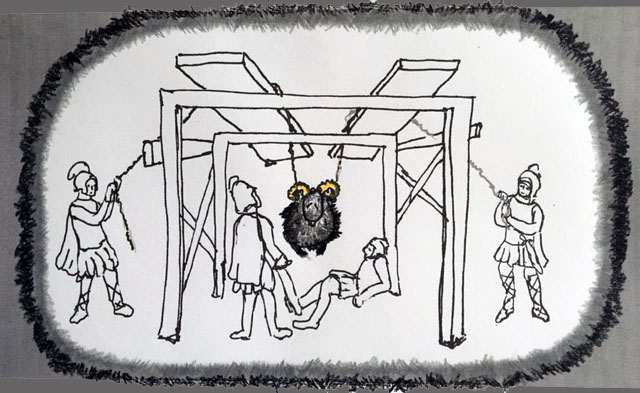
“In broadsword training we used an effigy. It was called ‘The Jew.’ It was a black-haired goatskin stuffed with sand and chains, hanging from scaffolding by cables that could be used to draw it up and down to fling it away from our swords; then it would swing back and wallop us with its full weight. It always seemed to be attacking us, even in our worst nightmares. Our hatred filled our waking hours with plans to do harm. It was the relentless great black goat, ‘The Jew,’ hurling himself at us, slamming us to the ground. Again and again we came at it with our swords shouting our war cries against The Jews. We were the best, Buff and I, the best. Surely it would take The Jew even now, to make me trade off my armor for fancy clothes and passage to Hispania. It would take The Jew to turn me against my brother at arms. I expect your horns were ravaged and lost in the attack, isn’t that right Lazarus? It was your horns that were stolen from you, but deep down you are still The Jew.”
My only defense, “Jesus was a Jew.”
Nic answers, “The Jews killed Jesus.”
“No, Nic, the Roman soldiers killed Jesus. I saw it.”
“Your mind is scrambled, Lazarus. It is written in the gospel, ‘The Jews Killed Jesus.’”
Dear God, thank you for my clarity of mind. Now heal our broken hearts. Amen.
Historical setting: 563 CE, on the Bay of Contabria (Biscay)
Nic is still burning over my failure to assure everyone I’m not a Jew. If that is what is needed to make peace, it isn’t peace. But he brings all his hurt and pain begging me. Regardless of what his friends think he still wants to hear me say it aloud, that I am not a Jew. And maybe it’s true that I am not a Jew; I’m a Christian now. Maybe it’s true the Jews would have no use for me in these changing times when Christians no longer honor their inheritance, but I was born a Jew. I joined with the Ebionites[Footnote] when a certain scar marked a man’s adherence to the letter of The Law. My strange gift of healing took my scar, and every scar and brand and tattoo that could mark any kind of belonging to a tribe. But even after all these centuries, I cannot rightly say I am a Jew.
And I can’t say aloud that I’m not a Jew either. To say that would separate me from my ancient faith, and it would separate me from my family who were Jews, and it would separate me from my dear friend Jesus. Jesus was a Jew. Jesus is a Jew. It is our people and our tribe.
Dear God, in my mind I know I belong to no one but to you. Amen.
I still seem to be wandering after my human place of belonging. Is it even possible for a human person to see wider than his tribe?
“Nic, we are bound together now on this journey to find my life forgotten, and for that I’m deeply grateful to you. But it concerns me that we have some deep roots of hate between us. I know what it is to hate based only on the look of a man. I’ve asked that you shed your Roman garb, so I may know you as a man beyond my own harbored prejudices. Now I ask you if we might talk frankly about this.” He doesn’t answer. So I ask, “Do you know any people who actually are Jewish? Or have you just heard stories?”
“So you are a Jew. Your horns were beaten in when you were attacked.”
“I am a Christian, Nic, like you. But why would you think Jews are an enemy, and where did you get the notion Jews have horns?
(Story continues Tuesday, July 21, 2020)
[Footnote] The Ebionites were a sect of Jewish Christians who adhered to the ancient Hebrew Law and also, particularly, an Aramaic Gospel of Matthew sans the Virgin birth. In the early Second Century they were already considered outcast Christians as anti-Semitism was spreading among the Gentile sects. The Ebionite Christology emphasizing the human nature of Jesus set them in opposition to the Orthodox Creed and they were also shunned as heretical. This is explained in detail by Bart D. Ehrman, in his book Lost Christianities; The battles for scripture and the faiths we never knew, Oxford University Press: New York, 2003. (Pages 100-102)
Historical setting: 563 C.E., on the western shore of Gaul
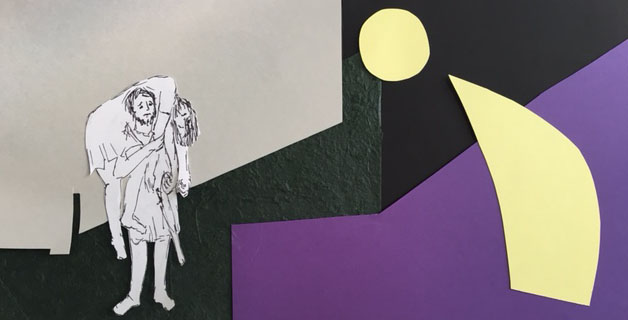
Nic hands me his dagger before he slumps into a faint. I hoist him onto my shoulder, iron shirt and all, and I’m handed his sword and girdle from the heap at the entrance as I leave.
It’s not a long heft to the inn. The innkeeper supplies the needle and gut thread, bandages and the ewer and basin so that this healing will leave only a fading scar marking the face of a man who no longer owns a helmet.
If it wasn’t the cold water, it were the pains of my needle that aroused Nic to open his eyes and stare straight at me still in his attack mode. I promise him a good night’s rest will center his pain and may help ease his wrath. And we will need to soak the bloodstains from our new clothes.
The wind turns from the North, and a crispy cool night speaks of a better day tomorrow when the winds will be right to begin a brand new journey.
Dear God, thank you for this promise of new, and while I can so easily offer gratitude for this changed wind, may I also beg for eyes to see beauty as you can see me and Nic, and his friend, Buff, with love for all people beyond our labels for one another – Imperial soldier or ancient Jew. Amen. Yes. My prayer seems like a simplistic solve just now, but what else do I have?
On this new day the shift in the wind brings the breeze to fill the sails for our crossing of this usually angry bay. This morning we board the ship to Hispania as the last heap of goods is laden into the hull. The captain is pleased he doesn’t have to wait for us, after all, humankinds are so less reliable than one hundred amphora filled with wine. We secure our packs on deck to join into the familiar symphony of sea travel: the rustle of the sheet, the creaking lines, and the lapping of the great and random waters, now so gently nudging at the hull — the groaning of wood on wood as the ship awakens for journey.
Nic still stares at me in silence. The pack of gauzes I tied to his face last night hones his stare from rage to helplessness, but he has no words. I try an apology.
“Nic, I am so sorry my presence sent your friend into his angry rage; were it anything I could change, I would. But I can’t change another’s attitude as much as I wish I could.”
Historical setting: 563 C.E., on the western shore of Gaul
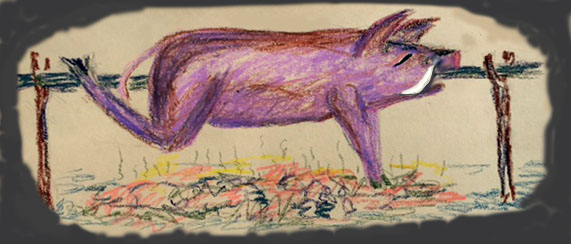
The pig on the spit looks familiar. Is this creature one-in-the-same as was choosing a rotted rutabaga instead of chomping into my nice and meaty man-foot just last month? [post #9.1] I think I’ll pass on the pork. Maybe it was my ancient Jewish upbringing but I’m not much for pork anyway. This is an abundant feast with fruits and cheese and bread. No one will leave hungry. So like the roasting boar himself, I bite into an apple. Our host notices.
“Hey, Nikolis, what’s the matter with your young friend? Why doesn’t he stuff his jowls with the best meat of the forest?” Buff sounds jesting at first, but then he becomes accusatory to me. “So you come to a pig roast and don’t eat the pig? What are you a Jew?”
I answer, “There’s such plenty. This is truly a fine feast!”
Nic spits on the ground then answers, “Maybe my friend is just too polite to take something he will only spit out on the ground. Your pig is a burnt crust of tough hide, if you ask me.”
As with any polite party of soldiers the swords were left by the entrance but no one has abandoned his dagger. After all, knives are the necessary utensil at a pigfest. Nic already has his blade in hand dripping with bacon grease. With a flick of his wrist toward his host, Nic seems ready for a challenge.
Buff taunts, “Oh yes! That’s it. This boy Laz of yours is a Jew!” Nic is seething in the stance of a wild bear up on two legs starring at the prey dancing the death circle around the man. Buff has his knife drawn now also, and continues his racial taunts at me, but directed toward Nic.
“Yes! Lazarus is The Jew! Look at all his black locks hiding his horns, no doubt. Look at him! He has those dark eyes and a goat face! He’s a Jew!”
Before I can even think of a way to explain that I am a Christian now, or “you know, Jesus was a Jew,” or “what’s wrong with being a Jew?” Nic’s face his a river flowing red, dripping down onto Buff, who is on the ground now with Nic’s dagger at his throat. Nic won the brawl. Buff pleads for mercy. Others around us are closing in a tighter circle with blades drawn.
“Let’s go Nic. Let’s mend your face while you still have strength for healing.”





 Lazarus Ink