Post #9.2, Wednesday, June 3, 2020

Historical setting: A dark age on the Shore of Gaul

         A waft of sea breeze doesn’t even ease the stench. Is it the swine, the rotting turnips or the children themselves? Four tiny faces, maybe the oldest no older than ten, and the youngest a toddler, all with round shinning eyes, all starring into me with these large, still, pools of blue jasper, peering from starving faces.

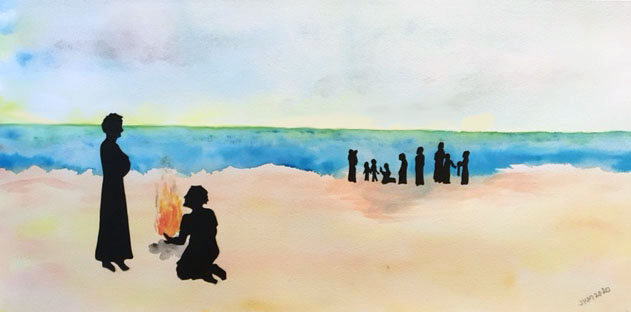
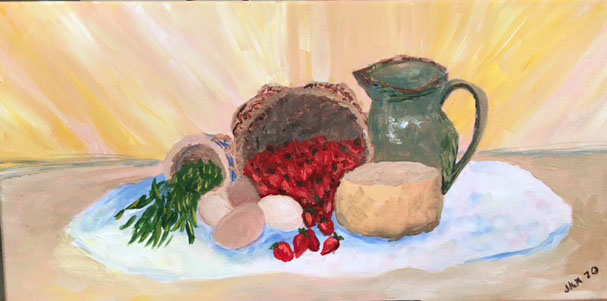
         My instruction is the order of the evening and we all go to the fresh water creek cascading toward the sea off the rocks nearby. Cold with the memory of ice is this water; I stand in the middle of the creek taking one child at a time, scrubbing each boy and his clothing also, free of stench and soil. I’m sure they will thank me for it, once we all stop our shivers. I think they will forgive my need to clean them all in the icy water when they find I also bring them a hot broth of kelpweed.

         I find that these children have been clever salvaging the ironware and remaining supplies from the burned out cottages, so here they have well-maintained fires: one for cooking, one for warding off predators and one for keeping the coals to secure the next fires — with all the grates and hooks and iron kettles of a household. Their shelter is branches covering over a dug-out hole against an inside corner of the garden wall lined with a thick layer of dried oak leaves for bedding. Any mother squirrel would be proud.

         “I am called Lazarus, what are your names?”

         The second to the oldest speaks for them all, “I’m Pudding, and my big brother is Pumpkin, and this little one is Piggy, and the baby is Precious but he doesn’t speak in words.”

         I repeat their names with a questioning voice noticed by Pumpkin.

         “Those were just our baby names. We have real names now I think. Mother said God would give us our names at baptism, but the pirates came here first. After that God gave us our real names anyway.”

         As we sit around the fire now, warm and fed I ask for the story.

         “Tell me about the time when God came and told you your names.”

(Continues tomorrow)

Post #9.1, Tuesday, June 2, 2020

Historical setting: A dark age on the Shore of Gaul

         This footpath leading into the wood from the ruin by the seashore is an easy path kept clean by someone. It is carefully cleared of brush and briars and branches. It appears to be used often — this path into a graveyard. It tells of the living whose grief is fresh. And in this direction out, it must be for the trudge back into the other world, the world of living, but of the particular living ones who must now walk into unknown days of constant grief.

         It ends at a piled stonewall marking the border between the what was, perhaps last season’s garden or a farmyard and this relentless, unkempt new growth of underbrush.  I hear children’s voices or squirrels’ chatter…

         Oh, now I’m being pelted with rotten roots – turnips left too long in the earth, rutabaga by another name. Big ones, stinky ones, old black cabbage root, flying in oozing hurls from behind the stone stacks!

         “Wait! I come in peace!”

         A courageous and raggedy child stands up behind the wall, “Go away soldier-ghost or we will send legions of wild boars to eat you up!”

         Yes indeed, I do hear the snorting and groveling of wild pigs behind me, and I look. They’re coming from the woods foraging for these missiles of parsnips and turnips.

         “I’m not a soldier ghost, I’m just a human living man with a meager white tunic, which maybe makes me appear ghostly. You don’t need to be afraid of me! I step carefully to avoid the feeding frenzy nearing my human and likely to appear meaty feet. More large round roots are hurled toward me, and the wild beasts again, come near to snatch the earthy morsels. “Please, couldn’t you feed the pigs in another direction? I really mean you no harm.”

         The courageous child ducks again behind the wall and conspires with another, or perhaps several more children all a-chatter with very young voices.

         He stands and speaks again. “Very well, you can come in and tell us why you are here, but if you walk through the wall we will know you are a ghost and surely the pigs will eat you up.”

         Wild boars eat ghosts? I guess I’ve never heard that story.

         I don’t even choose to climb over the wall; I walk around from the back where there is no wall. There, in a heap against the front wall fortress is a huddle of four children.

(continues tomorrow)

Post #8.12, Thursday, May 28, 2020

Historical setting: A Dark Age

The third day of rowing in the calm we come around rocks to see a small cove with charred pilings marking a one-time quay and now abandoned shore. At a deep distance we drop anchor and the officer tells me this is the harbor of Constantia.

         “Are you an able swimmer or must we all risk the rocks to take you ashore?”

         “I am able, thank you.”

         The water is still winter cold and I choose to wear my tunic in order to keep it with me. So with slow strokes stretching on the water I make my way to shore. Thank you God for strength and assurance. Amen.

         The sun has been high heating this sand beach for several hours, so my clothing is quickly dried and my shivers forgotten. Alone, I choose to simply bask in the quiet and warmth catching a day’s rest while nights have been spent on guard duty. With such a noble name as Constantia I was expecting a busy port city not a vacant beach. Only the gulls notice this stranger here.

         I wake rested, and find the tide is out, so I can ease these hunger pangs with an abundance of gifts of the sea. I dine on oysters. I don’t wish to be caught unprepared again, so I also gather arms full of deep and fresh varieties of kelp from this beach, and rinse it free of sand and crumbs of land twigs gone awash at sea; and I spread the salty leaves out on the sun-warmed rocks to dry. I don’t remember when I first learned to sip the deep dark broth made from boiling these dried sea ribbons but the opportunity to prepare in this way for another hunger answers my hollow hope with possibility. I find I’m nourished in optimism. Thank you God.

         Now I need to explore and find where this great city is thriving. It was named as though it were Constantine’s own child.

         Walking back through the saplings sprouting in the char I soon realize the silence hides a lost battlefield. Under the thickets are outlines of cottages seared unto earth. Just beyond these burnt dwellings are graves.

         Someone must have survived to bury these dead.  The road to this place is lost under the same underbrush that obscures the ruin, but there is a fresh footpath leading inland from these graves so I follow into a younger wood.

(Continues Tuesday, June 2, Chapter 9 “Keepers of the Light”)

Post #8.11, Wednesday, May 27, 2020

Historical setting: Said to be 6th Century on the channel near Gaul

This night’s port is one of the wilderness places added to the Gaul side of the patrol after the Saxons parted from Rome. The officer gives me no favors now so I’m assigned the forth watch from darkness to dawn. He reminds me we are shorthanded so my watch is alone. A fire is essential here, to mark a place of warmth and light, letting any night prowlers see that this beach is already occupied by thirty sleeping soldiers. The fog numbs the dawning light but my watch ends as the others rise and we prepare for the day at sea.

         I hope Constantia is soon at hand.

         The deep fog still muffs the day so we have a slow start and no wind. This promises to be a long row into the hollow of mist.

         No more is the officer watchful of my needs; and my lack of preparation for this voyage leaves me with no personal supply of foodstuffs. Now I must beg bread crusts and apple cores from those better prepared for this expected scarcity. 

         The fog continues so nothing is visible in any direction now that the shore is obscured. We have no way to know where we are. Without our bearings the officer chooses to anchor out here in the middle of the mist. A torch is posted so we can be seen were another ship passing by. But what ship would be passing us in this fog? I would think if a port like, say maybe, Constantia were near and the rest of the fleet was also landing at that port we would’ve seen the other ships going by us; or at least we would hear the sounds of them breaking through this stillness. It sets me to wonder if I will have my twenty-six years of this obligation filled before I meet Nic again.

         By midday the mist dissolves into light. Now visible is the shadow of shoreline so we set into a hard-row for the long hours of the lengthening day until the rocky shores we follow are nearly lost in the dark of night.

         This night we are at anchor as there seems to be no harbor or even a beach. Sleep is a crowd of snores from the benches. I would suppose the seabirds are fluffed by the noisy intrusion of our awkward human stir.

         Dear God, thank you for letting me keep hopes whispered on my imagination for finding again, my brother in Christ. Amen.

(Come again tomorrow)

Post #8.10, Tuesday, May 26, 2020

Historical setting: A forgotten time, on the Saxony Shore

The officer tucks the stone Nic gave him under his personal bag in the bow.

         I know I am breaking protocol, but I have to ask. “What is that stone Nic gave you, Sir?”

         The officer is honest. “He said he wanted you to have a message from him so he marked a stone. Who would have thought he could write? Surely he means to apologize for selfishly holding onto his armor. And we are all sorry you won’t get his beautiful shirt of mail. I guess it was in his family and he doesn’t want to sell it off.”

         I really just want his written message but it seems it is not forthcoming. “It’s okay, about the armor, Sir. But didn’t you say he wrote a message for me?”

         “I don’t expect it can be read, even if one of us were literate. It looks like pretend scribbles not real writing.  I don’t think he can read or write either. Maybe he just wanted to apologize.”

         “May I see it?”  He trudges to the bow and back with the rock. It is marked with letters. Nic may not pass a bishop’s penmanship standard on parchment, but on rock, it is clearly legible. I suppose the illiterate one is the head officer. In an exotic scrawl are the letters “C-o-n-s-t-a-n-t-i-a.”

         The officer is waiting for my opinion of the rock. So I answer,  “His letters wander, but I think he means for me to pay the due on my indenture when we reach Constantia. Is that one of our ports-of-call?”

         “Without Nik we are already shorthanded. Surely you will stay until we find replacements. And, my boy, whatever would you do in Constantia? You didn’t even know it was once one of our ports? You will surely be a stranger there.”

         “As I am also a stranger here.  And yet you have taken me in. I hope I will find Constantia hospitable to a stranger.”

         No more niceties. The officer turns on his heel and orders the coxswain to set us out to sea.

         We are immediately untethered from the quay and turned seaward at a fast pace. We slip lithely passed the other ships of our fleet as though we are racing on a mission for a win though it is really more an officer’s momentary rage. Once beyond sight of Granonna the rhythm of the oars sighs back to normal.

(Continued tomorrow)

Post #8.9, Thursday, May 21, 2020

Historical setting: A dark age in Gaul

         The stationed militia sends two guards for the next watch. I probably won’t sleep tonight. My thoughts and hopes are racing in a great cacophony of thanksgivings. My need and Nic’s longing is a beautiful synchronicity beyond my own mind’s ability to unscramble. It is good this moment to find myself basking in the Holy Spirit of God. I’m grateful for finding Spirit shared with another person.

         Dear God, thank you for opening this gift for me this night. Thank you for this new brother, Nic. Amen. I have no need to sleep for better dreams tonight.

         Our next port of call is Grannona, and our meeting place with the two other ancient and limping dromon of the old Saxony Shore Fleet. The centurion who oversees this fleet comes aboard and inspects our ship. Our officer brags on the find of me. He particularly mentions my strength and my youthfulness and a possibility that weapons and armor might be purchased from an older rower who has fulfilled his duty. The cost of these items could be billed onto my indenture. To me, all of this sounds horrifically thoughtful. But Nic steps forward to speak privately with the officers. Their circle of secret is intruded with a glance or two toward me, until the centurion instructs Nic to accompany him to discuss this more privately on the quay. Our ship’s officer tells Nic to leave his things here and he follows them onto the dock.

         We sit here waiting at the oars ready for what seems a very long time. I imagine we are waiting for Nic to offer to pay my due so he will officially become my patron. But of course, he has not yet received his wage.

         When our ship’s officer returns alone he removes Nic’s gear from the hook.

         “Sorry, Boy, I thought we would have a fine suit for you. Turns out Old Nik doesn’t want to sell it. I don’t know what use he has for a shirt of mail. He’s just being cantankerous. He’s trying to pay your price too. I think he wants a slave now that he’s a rich man.” With  Nic’s armor in hand he goes back to the enclave on the quay with Nic and the centurion. The officer exchanges the armor with Nic for a large flat stone that Nic picked up on the quay and marked. Again, the officer returns to our ship alone, while Nic and the centurion board the centurion’s ship with no more word.

(Continues Tuesday, May 26)

Post #8.8, Wednesday, May 20, 2020

Historical setting: A dark age in Gaul

I break the silence with a comfortable question of fact.  “Did you speak to the bishop at the monastery when you were turned away, Brother Nic?”

         “Oh yes, certainly I did. It was bishop himself who sent me away.”

         “Did he offer a reason?”

         “He said my penmanship was weak. But then I learned that even if I practiced, the only ones they were taking were from noble families or those with wealthy patrons. Now that I will receive my wage I will be wealthy so I shall be the patron.”

         “What does a wealthy patron do?”

         “Well, surely I can gift a monastery to make them take you in anyway, even if your penmanship is weak and your mind is scrambled.”

         “Thank you Nic, but it’s not my penmanship that is my weakness. I am one who is known as a heretic in these times.”

         “That’s okay, Brother Lazarus. I have a sword. I’ll keep you safe.”

         “Do you think God wants you to use your father’s sword to save a heretic?”

         “Brother Lazarus, God knows me well and yet God sent you to me.”

         “Do you receive me as a blessing or a curse, Nic? Have you no worry that God would judge you harshly for sponsoring a heretic?”

         “Brother Lazarus, you may think me a heretic also, but the god who judges heresies is not the Creator God of love I knew as a child. I met God before our tribe knew that Christians of Creed owned God. This is my secret. I keep it buried, because if others know I might have to draw my sword. These things might make me sound damnable to some other Christians.

         “I met God in the forest, when we had a forest. It was before we knew of the Creed. The priest of our tribe was Arian and chose not to adjust to the rule of Trinity. He knew well Genesis and Psalms and the gospel stories and he believed that God created the whole world and everything in it, even the sacred trees of the pagans. It was our secret together that the real God is bigger than kingdoms or earth or even the heavens, and that no matter what people say, God loves the whole Creation. I keep this secret close to my heart, and it feels so good, like some kind of sin or something. So I suppose I’m also a heretic.”

         Dear God, thank you for Nic. Amen.

(Continues tomorrow)

Post #8.7, Tuesday, May 19, 2020

Historical setting: A dark age in Gaul

         I, the newest recruit at the oars, am serving guard duty with one who has completed his full obligation. He seems to be contemplating his life and the opportunities before him.

         At the next tower turn on the wall with this man who calls himself Nic or Nik I choose to call him Nic. I’m thinking of Jesus, meeting in the dark of night to listen to the plea of Nicodemus, a wealthy Pharisee. [John 3] He asks Jesus, “what must I do to inherit eternal life?” For Jesus that was no harder a concern than this man Nic seems to worry over now. For Jesus the answer was easy, “You must be born from above.” For me, I can only think of scoffs and clichés. “You’re never too old to sign on again,” or “you just never know what lies ahead,” or maybe that great old unknowable therefore untruthful response: “God has a plan for you.”

         Dear God, guide my listening. Amen.

         I finally speak, “I will choose to call you Nic, not Nik.”

         “Thank you, Thank you, Brother Lazarus! I too am thinking of Nicodemus in the Gospel story. But my father, who seemed my namesake, was named Nikolas. So you surely must know what I’m asking. And if you were Jesus you would say simply, ‘become born of the spirit.’ Isn’t that right Brother Lazarus?”

         “Easier said…”

         “You, my brother in Christ, Lazarus, are surely the answer to my prayers.  I’ve begged God in every prayer every day, ‘how may I serve you with nothing to give but my father’s iron shirt and sword?’ And now has come this day when I am newly rich! And what would a newly rich man do with a wage of twenty-six years, and a shirt of mail and a sword and a dagger? I know!  He can be the patron and the guard of a holy monk with a scrambled mind! You, my friend, are my holy purpose!”

         “I see.”

         Dear God, what can I say? He surely has a good intention. Please guide my scrambled mind. Amen.

         We walk the next two turns in silence, but I can feel his creative sense of joy rising. No more is our silence born of nothing to say; now he has all his years of longing to share his deep Holy Spirit with one who also knows of this kind of joy.

(continues tomorrow)

Post #8.6, Thursday, May 14, 2020

Historical setting: A dark age in Gaul

With God thought to be on a distant shore we light the watch-fires on the fortress towers. Maybe any passing pirates will see our torches and fires and the moored dromon and know that this is a night for rest not war. There is a serene darkness over these waters that yearns peace.

         Looking for small talk I pick up the conversation. “Wouldn’t you suppose they would have more use for Roman ships in the waters near Constantinople now that Justinian has made a place over there to please God?”

         “I don’t seek God in the glorious buildings.”

         Maybe it’s my haircut, but I seem to emit some kind of holy judgment, so I try to ease acceptance for Nic’s likely pagan leaning, “So are you one who goes looking for God, or would you prefer avoiding the watchful eye?”

         He offers his silence. Perhaps I shouldn’t coax our chat to politics or religion. We walk without words all the way to the corner tower before we turn to the right for the next wall’s length. 

         He answers now. “Brother Lazarus, all those years ago I wanted to enter a monastery, be tonsured as a monk and speak the vows aloud that are in my heart. I was naïve then. I believed promises to God were sacred as my childhood prayers. Then I learned about the politics of it all, so I followed my mother’s wishes for me. I took up arms — the very arms my father left for me.

         “Before I was born he fought for our tribe, then our chieftain yielded and joined with Frankish-Christians we knew as enemy. In war both the winners and the losers die. This same shirt of mail I wear hardly saved my father when he was wounded. It did let him live long enough that he could return to my mother and die in her arms. Soon after I was born and his name, his armor, his sword, his helmet, even the Frankish Roman shield and cloak were all mine. But I never saw soldiering as my dream. I never even tried on this iron shirt until the day I was turned away at the monastery of the Saint. Then I dressed for war and left.

         “I hoped for a fatal wound, but what I got was twenty-six years at the oars. And now that I’m too old to sign on for another tour, I will soon be released with my wage.”

 (Continues Tuesday, May 19)

Post #8.5, Wednesday, May 13, 2020

Historical setting: A dark age along the channel off Gaul

         We’re landing at Aletum near a rumored haven for pirates. Two of us are assigned the night watch, I, in my hemp tunic, and he in his leather gambeson, tunic of chain mail, fine plumed helmet, scarlet cloak, shield and a clean, sharpened broadsword. He also hides a dagger. His Roman shoes lace to his knees over his britches. I don’t envy the fashion, but as we step onto the stones in the tide-wash I wish most for a pair of sandals.

         The others go to the shelter with their gear while this guard and I report to the garrison.  These ports of call are mostly left from older times and now many have local militia stationed, so my fears of being sent to the pirates alone and nearly naked, an unarmed pacifist, are greatly eased by the simple reality. Not only that, I find that this fully armed older man I seem to be partnered tonight is not, as I imagined, infuriated to be stuck with the least useful of us. He tells me he actually requested this assignment.

         “I’m called Nic, or Nik. (The difference is Nic has a more gutteral ‘c.’) And I guess you’ve already heard the names they call you – Godman, but sometimes, sounding a bit like Goddamn.”

         I hadn’t heard. But I’m not surprised.  I’ve enough life-sense to know that a tonsured pacifist isn’t a likely hero among the troops. Not only am I useless in war, they might suppose I’m measuring them all for some kind of holy judgment.

         “I’m called Lazarus.” In the awkward silence of ‘so what?’ I start, “So, I hear we’re in it for twenty-six years.”

         “Not I. This is my last run.”

         “You’ve been patrolling the sea for twenty-six years?”

         “I signed on when Justinian was promising to rebuild the empire. We had hopes. Apparently he put all the power and the glory forever and ever in the east, building the grandest of all churches in the rubble of Constantine’s dream.”

         “Really?” I’m trying to recall. Surely I would know of such a thing.

         “They call it the Holy Wisdom, the mind of God.”

         “Hagia Sophia?”

         “Yes, that’s what it’s called in Greek. It is said to be shining bright as heaven, but it is all the way across the seas on another shore.”

         “How do you know these things?”

         “When they were finished gathering the materials needing so many ships, sailors were sent on to other duty. Some came here.”  

(continues tomorrow)