Post #7.11, Thursday, April 23, 2020

Historical setting: 562 C.E. Gaul, but Lazarus is remembering Clovis in 495

“Why do I remember bits of times that make an argument with the kind doctor?  I want to refute these politics that Dr. Neifus doesn’t even think belong in this generation. I defend.

         “That King, Clovis, has no respect for the faith.”

         “Brother Lazarus how can you think the first baptised Christian King of the Franks didn’t respect the Church? He is a saint you know.”

         I should keep these thoughts to myself. I can hardly imagine Clovis a saint. Clovis is always blundering into sacramental things in a most unholy way. Some of us see his antics as heresy; others excuse power plays as signs of greatness. We have to wonder if it is by pagan superstition or by holy miracle that he declared himself Christian in the first place. He claims to have made his raucous style of negotiation directly with Christ.

         — [His prayer] If You grant me victory over these enemies, and if I experience the power people dedicated to Your name claim… then I shall believe in You… — [Footnote 1]

          He assumes God is like any other crowned head and is soon going to pay him écuage to keep the peace; which of course Clovis doesn’t keep. He only sells his promise then breaks it and executes his victim. He hasn’t the slightest thought of Jesus’s pacifism. He plays God like a chess piece.  Dear God, surely you must already know this, and yet…

         Now the doctor is questioning my knowledge of the King’s commitment. “How can you say the first Christian King of the Franks didn’t respect the Church?”

         I’m sure I saw this myself when I was working at the inks. The king’s guards came into the monastery where we were working. I can only try to explain to the doctor what I saw.

         “The King’s guards brought Clovis’s captives into the monastery.  Chararic and Chararic’s son were said to be disloyal to the king. Clovis demanded they both be shaven and shorn with the monk’s tonsure. Then the king demanded Chararic be ordained as a priest and his son as a deacon. Doctor, how holy could be those Christian orders? Clovis only wanted to humiliate Chararic before their executions. It was nothing like a king respectful of Christianity. Really Doctor, I do remember some things.”[Footnote 2]

         “Lazarus, my boy, you need to give yourself time to heal. Let not the ancient times bother you now.”

(Come back Tuesday, April 28)

Footnote 1   Gregory of Tours: The Merovignians edited and translated by Murray, Alexander Callander, series edited by Paul E. Dutton, “Readings in medieval Civilization and Cultures: X, Petersborough, Ontario: Broadview Press, 2006. p. 10.

Footnote 2 Ibid. p. 20.

Post #7.10, Wednesday, April 22, 2020

Historical setting: 562 C.E. Gaul, remembering 497 C.E.

I argue what I remember with the doctor. “I do remember Nantes when it was an important Roman shipyard and a thriving port.”        

         “It’s the Emperor’s dream that even here in Gaul the Empire will again be Roman.  The wish is called the ‘Justinian recovery.’ Perhaps you heard this from an old great-grandmother who would tell you tales of the magnificent Roman cities of times past.”

         “Doctor, I’m sure what I saw was Nantes. Seeing it now, I can clearly recall.”

           “Old stories abound. Before Clovis won the wars for the Franks, all along the Saxony Shore every Roman port had a thriving civitas with roads and bridges.  My grandparents talked often of the old Roman times when they were young. You have, no doubt, heard stories.”

          I know the reason for this rot and disrepair. It is Clovis himself. Clovis, the King of the Franks plunders everything for his own selfish gain. But I try to stay far away from the politics and wars in the writing room of the monestary. How can I explain?

         “You know Doctor, Clovis uses every sort of treachery and one-by-one subdues each king even of other Frankish tribes. Some pay him tribute. Regardless, in the end, they’re all assassinated or executed.”

         The doctor argues. “Clovis the King was of another time?  [Footnote]  Brother Lazarus, I’m telling you, these tales of the first king bringing the Franks together as one winning people are just stories.  If they happened ever, it was long before you or I were born.”

         He says I’m confused yet he tells me nothing of a time that is now if it isn’t then. And I so wish to weave together enough of remembering that I may find my way back to the familiar places and people.  The new bandages around my head now allow me to see clearly, and they leave enough space that I can touch my head and find that, indeed, my hair is tonsured as a monk’s. The doctor notices my hand exploring my tonsure.

         “Don’t touch the wound.” He must be watching me every minute just so he can worry over the wraps that he, himself wove from the nest of gauze.

         “I wasn’t touching the wound. I was just touching to notice that my hair and beard are indeed tonsured, and only slightly growing back. The bare part is fuzzy now.  So I am trying to think of a monastery to set my memory right.”

(continues tomorrow)

[footnote]  Gregory of Tours, Bishop of Tours, bshp. 571-595 wrote the “History of the Franks” c 594 CE. [(under a different title) Translated by Ernest Brehaut in reprint for First Rate Publishers.] The Christian conversion of Clovis was significant to the Christian history of Europe. Gregory’s history is clearly flavored with his own superstitions and biases. Most interesting to this blogger is that Gregory included the deceit and power-plays Clovis used while also presenting this first king as a worthy Christian saint.

Post #7.9, Tuesday, April 21, 2020

Historical setting: A dark age in Gaul

The doctor doubts my memory. But there are some things I know. “I know I am Lazarus, friend of Jesus, and I think I might work as a scribe and I remember that I’m often the one to take the gospels to the Christian fringe.”

         Through the dim shadows of gauze I see he gestures the “cross” on himself; but as I see so often, it is only a so-called “cross” of shoulders, head and gut – nothing of the Jesus pain or the laborer’s usefulness like the pierced hands and feet.

         He says, “So perhaps in a symbolic way you are saying that Jesus is your friend.” He is trying to offer me a comfortable escape from my admitted heresy of making Jesus sound human.

         This chat is no longer about who I am, but about what has become of Christianity in these times of excessive Trinity with its creeds and persecutions; it’s about heresy. I suggest we take a walk outside in case there is a better clarity among the things of earth.

         The split of my head is mending nicely and the seasonal re-leafing of greens seems to bring healing to all of the earth. A warm breeze wafts from the south and nuzzles the mist resting on nothing over the river like a levitating magic carpet ready to fly off into another ancient myth. With no wars or pirates to bruise the troops of Roman Navy the medic of the ranks has no one but me to mend, so he follows closely on my springtime stroll along the riverbank.

         “So, Dr. Neifus, I feel I have a recollection of Nantes from another time.  Once I sat here on this short wall waiting for a merchant’s ship to take me to my mission in Iberia.”

         “Give yourself time, Lazarus, my boy. Ports tend to look alike, one to the next. The merchant ships mostly use the port at St. Nazaire, so I doubt you are remembering Nantes.”

         Really, as I see now, it is quite the same only the shipyard seems more poorly maintained worn and out-of-use. And even the city wall shows the wear of time. I wonder when it was once, and when it is now.  But if I ask the doctor he will surely think my mind is fluffed. I do know who I am but apparently he has no imagination for that.

         (continues tomorrow)

Post #7.8, Thursday, April 16, 2020

Historical setting: A dark age in Gaul

         At this waking there is no river or soaking hull and I can see dimly through a loose weave of gauze. The ceiling is beam and stucco and the house is very small. Someone is here with me, and as I move he takes notice and comes near.

         “You must lie very still. And no more rowing, young fellow, until your wound is healed.”

         He must believe he is aged and I am not.

         “I am Dr. Neifus surgeon with the navy serving the Saxony Shore fleet, what there is of it anymore. I expect you will be here in my infirmary all the while your ship is in the ropes for repairs at the shipyard.”

         “I am Lazarus, friend of Jesus, but I don’t know how I came to be at the oars of a Roman Galley. Surely I’m not a soldier.”

         “You are tonsured as a monk. Perhaps your orders are holy?”

         “Possibly. And I heard mention that my robes and jewels were stolen, so perhaps I am a wealthy churchman.”

         “Possibly, but doubtful. You bear the muscle and sunscald of a farmer or a laborer.”

         “Of course. Jesus is also a builder. I too am probably a laborer. I have no memory of it, but it makes sense. My father was wealthy but my sisters and I choose to live in empathy for the poor. As a monk I must have been clothed in poverty. I’m just sure I wasn’t robbed of jewels or robes. Probably my robber was someone more needy even than this poor monk.”

         “So you also are supposing yourself a monk.”

         “I do have some thoughts and maybe they are memory. I’m sure that I am Lazarus, friend of Jesus.”

         “You probably don’t mean to say Jesus was a human friend of the physical substance of humanity.”

         “Doctor, I know you know human substance well. And Jesus was indeed my own flesh and blood friend, killed by the Romans on the executioner’s cross.”

         “Surely your mind is clouded. Perhaps Lazarus is the name of the saint you have chosen to emulate as you follow the great works of the Holy Son of the Three in One. You need to take your time in remembering.”

(Come back Tuesday, April 21)

Post #7.7, Wednesday, April 15, 2020

Historical setting: A dark age in Gaul

         At this waking I’m lying in the soaking hull, but now I can see a pale of light through strips of bandages.  That brings a promise of healing and an assurance of again having sight.

         “The hull is taking on water faster than men can pump the bilge, so you will have to move to the empty bench astern or you will be the first to drown. I will help you, Man.”

         He seems to be talking to me. I’m more surprised than anyone that I can be pulled up to standing and dropped again, seated on a rower’s bench.

         “Don’t mind the oar here. We won’t ask you to row today.”

         That assurance to me seems to draw a roar of laughter or maybe it’s just taunts from the others. Perhaps, in the eyes of the men at the oars I look so broken it would only be in jest that I could ever be useful to them.

         Seated on this bench I find resting my sore head on the ship’s hard rib-bone is nearly debilitating. And the dirge of the coxswain drum and the draw of the oars skews a sour dissidence with the pounding in my head. So I sit here upright and I choose to let the pounding head find the newer, better tempo. Possibly no one will notice if I should try dipping the oar that is here across my knees. Possibly I can help row. But in an instant the rage of river snatches the handle from my grip and it flies past, and snaps through the lock as another man has grabbed it fast and recaptured it, bringing it back in place before it would be torn away and lost in the river.  So much for my subtle attempt to help; all I can do now is apologize.

         “I’m sorry I tried the oar. I was hoping I could be useful.”

         I feel another next to me like a warm lion after a weasel kill shoulder-to-shoulder with me.

         “You want to row Lazarus, Man? Put your hands this way on the oar while it is flat inside.” He places my hands as though he were shaping the straw of a lifeless scarecrow in a field to make it appear alive and fool the crows. He seems surprised I actually have a grip on it. “Now, Man, when you are ready we can dip the oar, and immediately the instant it touches the froth, together we will draw it back with our full strength.” His hands are doing the work. My hands are pretending. It is indeed humiliating and…

(Continued Tomorrow)

Post #7.6, Tuesday, April 14, 2020

Historical setting: A dark age in Gaul

         At this waking I hear the sounds of the oars and the groaning in effort against wind driven current. I can feel the pulse of the river rills moving under my shoulders, as I lay here on the boards of hull, spine to spine with ship. Fresh bandages cover my eyes so at least there is cause for the incessant darkness.

         A cold dampness is rising inside this ship’s hull as if it were the tide breaching onto dry beach. Two rowers are summoned from the stern-most bench to man the bilges and those left at the oars are heaving and drawing at peak tempo with the plan to reach Nantes before the leaking hull drowns us all.

         I hear the officer and his assistant deciding what to do with me as I am in such a useless state. “Sir, I’ve heard that at the next bend in the river, where the shelf of rock juts out near a vineyard is the place where the gardens of remedies grow. We could just leave him there in the care of the pagan hag.”

         “But he may be a loyal Christian, and besides we need to move quickly to the shipyard or we will all be floundering in the river.”

         “And of course, Sir, he may also be fair at the oars when he has healed a bit.”

         “Good man. You share my thoughts. If we could add a loyal rower to our numbers as we rejoin our fleet the centurion will surely be impressed. In these times, adding one, even a bandaged one, would seem a hopeful sign of renewal. I say we decide what to do with him later. By the time the ship is repaired we will surely know of his possibility.”

         I have no recollection at all of ever having been in a warrior’s galley. My pounding head offers no glimpses of any goodness from this. I know Jesus is my friend and he will never find me here if I’m all armored and aligned in Roman battalions. But I do remember who I am. I know who I am; thank you God, for this clarity.        

         “You are awake now, Friend?”

         One is speaking to me. I answer, “I can hear you.”

         “We believe you were robbed and beaten. Do you remember what happened?”

         “I don’t remember, but I do know who I am.”

         “And who are you?”

         “I am Lazarus, friend of Jesus.”

         “Let’s give him more time. He may have lost his mind but surely he’s a Christian.”

(Continues tomorrow)        

Good Friday, Post #7.5.1, Friday, 4-10-2020

Historical setting: A dark age in Gaul

         The relentless love of God for all Creation riles the prayerless who fear the power of forgiveness.  The Romans feared. The persecutors of the Jews feared. …  Fear guises as power and commits executions.

            Jesus, I’m remembering you in this darkness. I hear the Roman guard coming close. The high Imperial officer asks who you are. How can I tell him? I am silent as they mock your kingship with thorns. I should get on my feet now and speak for you. What can I say? Pilate would be confused if I mention that your kingdom is not of this earth. Could I offer the truth that wealth and power and treasure are pointless? I should tell Pilate that his mighty rule is nothing. The Kingdom Jesus speaks of is not about a prize. Winning the power wars, leading loyal masses in a perfect lockstep parade, wreaking vengeance, paying homage – it doesn’t even matter to Jesus. Lifting up the poor, forgiving the cruelties, caring for sick and the imprisoned and the lonely, welcoming the stranger – Jesus doesn’t even play on a different game board. He has no game just human kindness.

         I remember now. Jesus was at the feast when we passed the cup to each of us and talked of the vineyard, drinking life from the single solid root, blooming, setting fruit. It’s not the season now for fruit. The sounds of heavy feet and Roman armor are all around. The anguish, I hear the gasps and the struggle.

         I remember dear friend! And still I fail you.  The darkness is a blindness and not a truth.  How can I come to you now?

         “This cross of Jesus — these nails, I’m failing him!”

         “Yes, he is a true Christian. He clings to the cross!

         “I told you he is a loyal Roman.”

         They don’t know!

(Come back after Easter – Tuesday, April 14)

Maunday Thursday, Post #7.5, April,9, 2020

Historical setting: A dark age in Gaul

         The wait is long. I remember in glimpses. We are pouring the wine – there is plenty yet we share. We are passing the wine and the bread. We have songs – the old psalms – the running over cup – the table spread before our enemies. Some are missing from the table. We have new songs and a shared grief for the earth things. There is no sign or sense of it at all except that there must be some sort of an earthy truth in it. The game they play by people’s rules of might and power are easily won by emperors and Roman political appointees guised in the robes of Chief Priest. They make the rules. They would write the rules and the story if writing were needed. They play for blood. They win.

         Jesus my dear friend, I can’t even remember that imperial name now — the one who ordered a tree to be cut and pounded full of iron nails. Maybe it is Clovis or Chilperic or Pilate or Sigibert by now. They look to your Kingdom for the omen of winning wars.

         I hear the jingling of the Roman chain-mail and the rustling of leathers at the knees of the soldiers…

         “See, there is a man here, through the wood over there and nearer the road. We suppose he was robbed and beaten. Except for his wound he would seem an able rower.”

         “He was flailing and talking for a moment. I think he was saying he is a loyal Roman.”

         No! How can Jesus think I would be Roman?

         “You don’t remember me now Jesus? Remember me? I’m your friend, brother to Martha, son of Simon?”

         “See what I mean? He speaks only of Jesus but offers us no words of Creed, no prayer of Trinity, no sign of Cross, so I’m not sure of his loyalty. He may be a heretic.”

         “David, you go back to the ship and bring some medical wraps. And Nik, you stay here. Right now it doesn’t matter his loyalties. We will see to his wounds and if he heals to wellness we can consider his purpose for us then.”

         He spreads over me his cloak. He is surely the saint.

         (Continues tomorrow briefly, and oddly for Good Friday.)

Post #7.4, Wednesday, April 8, 2020

Historical setting: A dark age in Gaul

         Jesus is here with so many followers even before our table servants are here. Martha is still in the kitchen instructing the cooks and probably arranging and rearranging the olives and bay leaves onto the platters for the still roasting meats. Martha does obsess over details. While Mary — of course is primping — oiling her beautiful flow of hair and shinning lightness from her checks with powders and fragrance as though she were a corpse and needed the look of a painted awakening.

         We’ve not even filled the ewers. The river runs by – I hear the river and yet I do nothing to fill the ewers. Our guests are too early or our servants are too late for the washing of these traveler’s feet. Jesus himself takes the basin and drapes the towel over his own arm then he kneels on our floor to wash the feet of every guest. I should argue this protocol and do our servant’s task myself but I can’t get up.

         Jesus I hear you so near, yet I don’t seem to rise up and help you. I hear your steps drawing nearer; I feel the ground quaking at your march. But the voices are of strangers.

         “Come look here! Just through the wood, a man is here with a bleeding head.”

         “…So near the road he appears to have been beaten and robbed.”

         “Even with that wound he seems to be flailing to get to his feet!”

         “Go and tell the officer. He might find him useful at the oars when he is able.”

         One of them is gone; the other is still here.

         “So, my man, our ship’s officer will be here soon and he surely will want to know your loyalty. Are you Barbarian or Christian?”

         “Jesus” I find I can speak now. “I’m a friend to Jesus.”

         “You are Christian then?”

         “I serve only the one God of Abraham and Jesus. Jesus is waiting for me to fill the ewers before the feast.”

         “Maybe our ship’s master will know about that. But you sound as though you be a Christian.  We can only use that loyalty. So if you aren’t a Roman Christian, best not to tell our officer or he won’t take you on.”

 (Remembrances continue tomorrow)

Post #7.3, Tuesday, April 7, 2020

Historical setting: A dark age in Gaul

The cold night wind comes down through this dark. I can hear the sounds of night terrors – the scream of a weasel loosing the life battle with a lion. This night is filled with beasts. I hear the ravages, licking and tugging at the meats. The winning beast is feasting. Now he is filled and nearing me on quiet paws…to touch me with a breath through cold nose. He circles near me, and he drops for rest beside me here, nearly touching me, as though human person were a harmless yet meatless find. His well-fed spine presses gently against my own ribs – soft and warm he is. And safe I am now from the cold clam of night.

         Thank you, for weasel’s loss, and this well-fed warmth. Is it a plan or a happenstance, Dear God?

         The lion runs away at a sound of oars and coxswain beat on the river. There must be moonlight enough for a warship sliding through the darkness on the river tonight.

         But we haven’t filled the ewers yet and Jesus and the others are already nearby in Jerusalem for Passover. I should go home now and help get ready for our guests. I can’t make myself get up but I have to go now. My head hurts. I should go now.

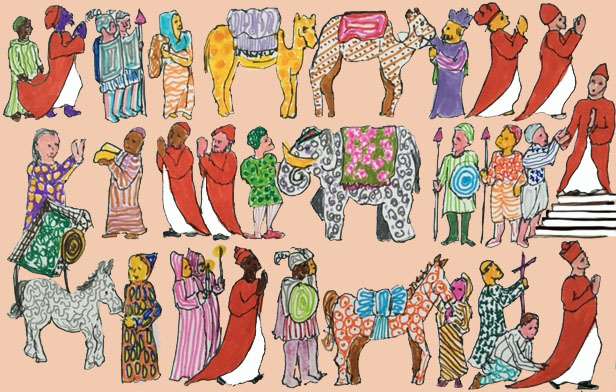
         The drums of the imperial parade won’t leave my head. For Jesus it was a strange parade. Hail the king. But Jesus had no pomp of percussion, only songs. Why this? The golden Imperial Roman, Pilate, infuses the Jewish celebration with all Pagan pomp through the wide gate on the regal stallion, descending the golden stairway of city into the Jewish holiday midst. Rome expects the largest crowd ever in Jerusalem. But then, here is Jesus sucking up the Imperial pomp flaunting his own example of a whole different pax. The crowds come for Jesus. They spread their cloaks for the feet of the borrowed donkey just outside the common gate. It’s a Jesus lesson to show his kingdom is not of riches and winning wars and prizes. His is the promise of the kingdom to come –whatever that promise means anymore.

         Why do the powerful fear Jesus? Yet earthly fears are heaped to edifice with tangible treasure – bricks of gold and weapons for wars for winning – and winnings measured only by other’s losses. Why would the powerful fear Jesus? Yet they seem so afraid.

         Jesus will be at our door soon, and I haven’t even filled the ewers.

(Come again tomorrow)