Post #6.8, Wednesday, March 18, 2020

Historical setting: 562 C.E. Gaul

George is determined to beat the life from Christianity and sanctify the deaths as he foists upon me the necessity for rotting saints. “I can assure you Heretic Lazarus, St. Lazarus was a true martyr for Christ.”

         I rebut. “They only died because the emperor of Persia feared Rome.”        

          “Your mistake, my friend in err, is in ignoring the sacrifice. The cause of veneration of saints is not of earth but of miracles. Consider the wonders in such things as the dust you claim to own. The very life energy of the suffering martyr is present within that walnut casket. The power is in everything the saint touches so even the mere hem of a saint’s garment can bring a great miracle.”

         He mentions the touching of a garment’s hem and I recall the Jesus story of such a healing. But in the Jesus story the spiritual energy in that moment was not some magic that can be mined from a corpse as it rots. It is the energy of love and life itself. [Luke 8:46] And surely it is not a tangible substance or a commodity to be swept up after a beard shave or a burning. That same energy I claim as Holy Spirit moved among the crowds when Peter preached on Pentecost. [Acts 2] No relic was needed; it can move like a breath of life among people. It is always with us, and moves away from death toward life and away from fear toward love.

         He badgers me on, “Ask your saint to show you a miracle with your relic. Hold it up in the face of danger and pray to your saint.”

         His instruction seems as meaningless as an empty shell. But that moving Spirit, breath of life, has for me, a voice of empathy for his plea so I hold my walnut of whiskers up.

           “Now doesn’t the dust of that suffering bring a great and holy miracle?”

         I see behind my elevated walnut the anxious face of a youth wishing upon me a moment of miracle. I see in his gaze at my relic his inheritance of an ancient, innocent faith rooted only in the material things of earth. It is no wonder God’s loving Spirit demands my empathy and openness, not an ah-ha of righteous win. He sees the wonder in my face as I see the anticipation in his and we are both awed by God’s beauty as we see it in the other.

         “So you have seen the power of the miracle now.”

         Dear God, how can I win this when you only fit me with empathy? Amen.

(Continues Tomorrow)

Post #6.7, Tuesday, March 17, 2020 (St. Patrick’s Day)

Historical setting: Remembering 5th Century Ireland

         Today, I venture again into young George’s crumbs of Latin, and I’m reminded of another Christian of awkward tenses whom I only caught in a glimpse about a century ago.[Author’s footnote] He cut a deep swath of Jesus’ love through the middle of the once pagan Ireland. But his sainthood is not because he died a martyr. He didn’t. He died as an old man among the friends he had gathered along his way. Yet it is very clear to me why he is called a saint.

         The story is told that Patrichus was captured by an Irish raiding party and taken from his life of privilege, his family and his home in Celtic Brittany, when he was a teen. He was sold as a slave. In his rare bits of writings he portrays this captivity as a time of cold and suffering, isolation and days-on-days of thankless work tending herds. He allowed himself to listen to God’s relentless presence and was driven by a voice of promise: first the promise to leave that place; then, some years later, forgiveness transforming his hurt and loss into the yearning to return to the people of Ireland as their faith leader. He brought the simplicity of the ever-present, loving God of Creation.

         He guided peacemaking among leaders in a warring land. He established and rekindled Christian monasteries into communities of caring for people.

         His magical or, call it miraculous power to bring Jesus’ love to the pagan world came through his gift of empathy — not by ecclesiastical councils or by winning arguments or wars. He brought order and guidance through caring and spiritual presence – not by rule and punishments.

          The trail he left was of love for all people and sacred appreciation for Creation. It’s still there, planted deep in that land forever. The music and the art of the people are never stifled by punitive order, rather the creative chaos is simply turned so people can see it clear and shining from the face of our one Creator, parent of love and life.

         I suppose, with the help of God, I do know of saints, so I ask young George “What do you know of St. Patrick?”        

         “Were he Roman or Frank?”

         “They say he was Celtic.”

         He asked, “Do you want to know how God made the Franks beat the Goths?”

         “Will I have to edit your grammar in that chapter too?”

         “Sooner or later I’ll write it all down.  It will be significant.”

(Come again tomorrow)

         [Author’s personal note] Before I started this blog, my spiritual journey into Christian history took me more deeply into 5th Century Ireland. I wrote a book After Ever, about the poem attributed to St. Patrick, “Breastplate.” I have no plan to market that book so it is a little read manuscript, never even run through the printer on my desk. But in 2018 and ‘19 I did a lot of research about ancient Ireland and set my Lazarus character there. Some of the things in this day’s blog (the basic facts) I learned from that research, and some conclusions are drawn from inferences of changes in Irish Christianity after Patrick.  

Post #6.6, Thursday, March 12, 2020

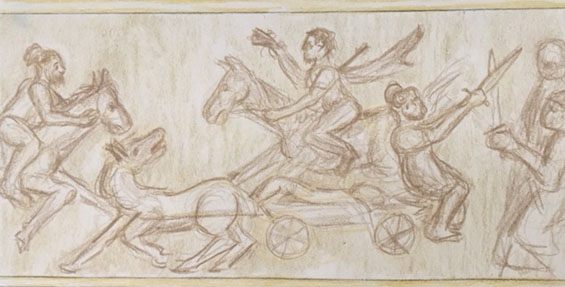
Art Note: This paper-cut-collage w/ink was inspired by a photo of an ancient bas-relief retrieved from Wikipedia, (and licensed for common use)  File: Nowruz Zoroastrian.jpg.  The English translation explaining – “the lion-bull combat in Persepolis” – has been variously interpreted, including as the symbol of the Nowruz (the Persian New Year’s Day) – the day of  spring equinox power — eternally fighting bull (earth) and a lion (sun) are equal.

Historical setting: 562 C.E. Gaul

         I’ve had this lingering question all these years. I ask George, “When I first learned of these persecutions I didn’t hear what happened after the deaths. I know that two other Christians visited the nine monks on the night before the executions and they were surprised to find the monks had been tortured. They brought comfort. I‘m sure they also witnessed the executions. But I wondered if there was any record of what happened next to those two?”

         “You mean St. Jonas and St. Barachius?”

         “You call them ‘saints.’ Were they martyred also?”

         “Of course you fool. How could you know only part of the story?

Two days later they were also tortured and executed.”

         “Oh no, I feared that. They were true martyrs while the others were just a happenstance of the politics of the day. Jonas and Barachius came to the jail because they were acting on their Christian duty to share God’s love.”

         “How can you say the first nine didn’t die for their Christian duty? And what of the thousands more Christians persecuted by the Persians?”

         “There were so many?”

         “The named saints were only the first. Obviously they were martyred for Christ not for any kind of politics.”

         “So George, I imagine for all you know of this you would also know the date of this execution.”

         “Of course, it were March 27, 326 A.D.”

         “You are very knowledgeable, young George.”

         “Yes, I am. And that were the same year as the Creed be born in the same council that declared Arius a heretic.”

         “Indeed Brother George. The sameness of that year is the matter of importance in knowing the reason they were not martyrs for Christ but simply victims of earthly power plays. I’ve long pondered this, and there was nothing holy in these deaths. It happened when Shapur II, the Persian emperor heard of Constantine’s declaration to make Rome Christian. He believed a Christian Rome was a trick by Rome to takeover the Persian territories. So he broke the long tolerance the Zoroastrians had for Christians. The executions were a political move against Rome. Would you also not say this was strangely ironic? The reason these Christian refugees fled into Syria was because they shared the same enemy with the Persians — Rome. They weren’t killed because they professed Christianity but because Christianity became Roman. T’was a very strange paradox don’t you think? They shared a peaceful fear of the same enemy until it became one of them. How does that make them saints?”

         “Of Course, Heretic Lazarus, this is not about earthly politics. They clearly died as Christian martyrs. They died for their faith.”

         “No. Actually, George, they died for Rome.”

 (Continued Tuesday, March 17, 2020, a brief thought of St. Patrick)

Post #6.5, Wednesday, March 11, 2020

Historical setting: 562 C.E. Gaul

         I don’t have to wade far into this lad’s scrawling inks to know my assignment is no less insurmountable than his. He is trying to lead me through the complexities of a religion laid out like a bridge of loose boards onto the wavering back of old paganism – Roman, Barbarian, Frankish with a tad of the Arab and African varieties. And the maze I have for his lesson in language is likewise woven of threads of cultural variety.

         First he must know how to scratch his Frankish errors from the parchment. With so many errors he will surely accomplish this skill but the work is tedious and takes up our whole day just in scraping errors away.

         Meanwhile he yammers on about my patron saint. “It be significant..,”

         I correct. “You mean ‘It is significant’…”        

         He accepts the correction. “It is significantly essential that you acknowledge the mortal suffering of your saint. Your prayers should pay homage to his sacrifice.”

         “I understand well the brutality and the suffering. And you must already know that this Lazarus…”

         “Saint Lazarus” he corrects me again.

         I hardly accept his correction. “This fellow was not alone. There were nine Christian monks taken that day and flogged.”

         “Yes,” Young George knows this history. He names them. “St. Zanitas and, of course, St. Lazarus of Persia, along with St. Maruthas, St. Narses, St. Helias, St. Mares, St. Abibus, St. Sembeeth, and St. Sabas.” [footnote]

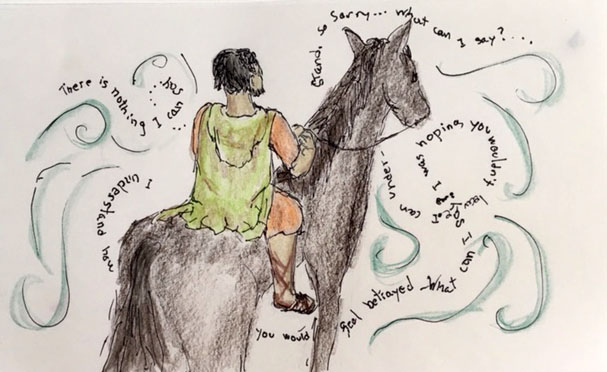
         He calls out each with the same hollow rote he uses reciting conjugations. But with each name sliding too easily from his Frankish tongue I picture each human person of them in my mind and recall their preaching in the peaceful times and I hear again each of their voices crying in agony but there is nothing I can do for them as the lashes fall across my own shoulders the same.

          “I am not numb to their suffering Brother George. Each bore witness to the other’s suffering so that their own helplessness to care for one another was also a terror each endured. Are you asking that my prayers are directed to renew the hurt I feel through my own empathy with them?”

         “How quickly you learn Brother Lazarus. I have no doubt you will soon be washed clean of your heresy.”

         “There is something else about that time I have longed to know. Perhaps you have read of it in your studies.”

(What is he longing to know? Continued tomorrow)

[footnote]https://en.wikipedia.org/wiki/Shapur_II Excerpt “Relations with the Christians.” (This article sources 5th Century historian Sozomen, in his Ecclesiastical History, Book II, Chapter XIV) retrieved 10-8-2019.

https://en.wikipedia.org/wiki/Zanitas_and_Lazarus_of_Persia

(also listing Sozomen as a primary source) retrieved 5-17-2019.

Post #6.4, Tuesday, March 10, 2020

Historical setting: 562 C.E. Gaul

I asked the young gentry, “Shall I open the reliquary so you can see the my relic for yourself?”

         “No, that won’t be necessary. I’m just surprised.” Young George does seem miffed.  “You do know veneration be needed before dust can be a true relic.”

         “So you are saying that an Aramaic speaking Persian Lazarus can be called a saint but his dust is a questionable relic?”

         “Yes of course he be a saint. He be canonized after his death so his language and lineage and all that stuff he did in his life don’t even matter. He died a martyr for Christ so he truly be a saint.”

          “Yea, that’s not a tactful way to describe an inconsequential life. And I would also suppose my namesake Lazarus was Arian being Persian and all. Knowing of him as I do I am amazed he would be a considered a dead saint.”

         “All saints be dead; do you know nothing? So how is it that you know of this saint at all? He’s obscure and nearly unknown among the saints.”

         “Yet you, my friend George, knew he was a Persian Martyr?”

         “It is my gift of knowledge. I’m writing a book of saints and miracles. But how be it that you know any of this?”

         “Lazarus is my namesake so of course I would have his relic and surely I would know of him.”

         “It be Saint Lazarus, mind you. So you be named on purpose after the saint? Your family had knowledge of the saints when they named you and yet you still be a heretic?”

         “Stranger things are true. Shall we consider your grammatical frailties, Young George?”

         I’m weary of his lectures and ready to play the teacher now. I suggest we look at his beginner’s works that I had called “great literature” in jest. Luckily George can give sarcasm, but has no ear for receiving it so he missed my joke. That’s good. There is really no harm in him thinking I have high regard for his writings.

         Dear God thank you for humor in this and for letting it go unnoticed and then for reminding me to be kind to him anyway. Amen.

(come again tomorrow)

Post #6.3, Thursday, March 5, 2020

Historical setting: 562 C.E. Ancient Tours of Gaul

Outside the monastery walls are those caves where I’ve come for long months of healing. Ascetics, seeking solace in hermitage come to these caves for lifetimes of prayer and fasting. I was here healing from death of plague most recently. Then two centuries before I came up this river to this very place after a long journey by sea, wounded from a brutal death I sought solitude for healing. It seems some come here to pray sacrificially unto death; but I come to pray unto life through healing.

         This day I requested a cave from the bishop but this time I’m assigned a monk’s cell in the monastery. Young George and I are each assigned to solitary cells each with bench and an opening – an arch for light and air and view. Perhaps there is a shortage of monks in these often warring times. There also seems abundant space at the copy benches to allow this heretic who I am to work with the parchments and inks while the dark world awaits sanctified scholars enough to fill a scriptorium.

         When I stay at a monastery I expect to be tonsured as a monk partly as my own personal sign of penance but mostly for the practical reason that vanities requiring a polished brass mirror are not favored, so the clipping and shaving is done to one by another. And those with the blades only seem to know one style. On this morning I gather a bit of the shaven fluff falling from my beard into a fine walnut shell I have found and fitted with a hinge and a ribbon then polished with oil and a glimmer of bronze rub. It’s tied closed as a locket to be a reliquary. Perhaps this would seem a sacrilege were I of this orthodoxy, but I am not.

         I’m early for my meeting with Young George but so is he.

         “Ah, Lazarus! I have been waiting to lay my eyes on that relic of the ancient saint you claim to own.”

         He seems skeptical when I show him my polished walnut.

         “A true relic would be saved in a golden reliquary.”

         “The relic is true. Only the reliquary is common. Would you like to have a look?”

(The relic is tested next week. Come again Tuesday, March 10)

Post #6.2, Wednesday, March 4, 2020

Historical setting: 562 C.E. The site of the Cathedral Fire in Tours

“I’ve no peapod with dust and yet I also have not been stricken by lightening. Are you sure a relic is needed to take notice of God’s grace?”

         Young George lectures. “Really, Heretic Lazarus, what could you know of grace if you pray to neither relic nor cross?”

         “I pray to God.”

         His laugh out loud stings with sarcasm.
          He argues. “God were known to be of spiritual substance. And that means God be not seen by any human eyes – so your prayers if you even make them, would simply vanish into nothingness.” He offers the “poof” gesture of magic as though even the gesture for God would be invisible unto nothingness.

         I defend, “If Spirit were nothing you would make a good point; or if I were taught as a child to fear the invisible nudge of Holy Spirit I would find safety in believing only in the visible and tangible things of earth. But I was allowed, in fact encouraged to embrace the spiritual nature of life as well as the tangible things of earth. I believe it is my good fortune to find the earthy Creation is the metaphor for the spiritual life. I often notice that the visible signs in nature are speaking God’s invisible truths. Take beauty for example. The flowers we could have here would remind us that Jesus mentioned beauty as a free and gracious gift. Wild flowers are clothed in radiance without any need of human prayers or intention or even our good works. In my opinion nature is God’s own artwork. Nature is not a pantheon of alternate gods.”

         “Lazarus, your heresies be something even more dangerous than mere demons of Arius. To cure such heresies I suggest you gather for yourself a blessed relic of your own patron saint so that when we next meet you be coming to your lesson only begging me to tell you proper form and gesture for your prayers.”

         “But I don’t worship saints so I have no patron.”

         “You have a saint who is your own namesake, The Persian martyr Saint Lazarus.”

          “Yes, a good idea George. Now that you remind me, the relic of my namesake has been in my family for my whole life long.”

         “You mean your family owns a holy relic? And I thought you be of common stock.”

         So little he knows. “Shall we meet next in the courtyard of the scriptorium so we may start your required lessons in grammar?”

(Come again tomorrow.)

Post #6.1, Tuesday, March 3, 2020

Historical setting: 562 C.E. The site of the Cathedral Fire in Tours

I have a suggestion for the young aristocrat. “If there is to be no rebuilding we could just turn this ash over with the clay saving the flowers of these weeds to make this place a great meadow of flowers! Imagine the wonder in that beauty! People will come here again for prayer and sanctuary where once there was only ash and here will be new life rising up, blooming beautiful, breathing life from light! Even the light and the life are metaphor for the invisible God.”

         “Fie, such heresy! An Arian merely humanizes the Christ. What heresy might this be called that sanctifies wild weeds and light?”

         “Really Friend George, we don’t need to summons a council of bishops to make another declaration of anathama. I’m not suggesting some kind of pantheism or pagan nature worship. Flowers are a metaphor. Of course, seeing the invisible through the metaphor of beauty requires opening one’s eyes to the power of symbol.”

         Dear God, why do I long to defend your free gift with an argument? Guide me to receive this insolent fellow in your way, with relentless love anyway. Amen.

         “I was just saying flowers would be beautiful here.  So, Brother George, what would you have me do to be useful here?”

         “We should take great care to preserve these ashes.”

         Then he draws from beneath his tunic a plethora of metal pieces — each noosed around his neck by chain or rope: first the familiar cross, then a bejeweled fleur de lis; a smithy’s rendering of a Chi-Rho with its prongs in all directions and a small but dazzling golden peapod. It is the pod he means to show me now. It is a locket that he would open if I cared to see his relic of dust of a “lesser-known source than could be these ashes;” and yet he tells me this relic has taken his father safely through trials, strengthened his mother against a flame and has miraculously preserved his own life from threat of dangerous bolts of lightening in a horrific storm. (Footnote)

         He adds, “It be here a true and blessed amulet empowered with the miraculous spirit of a saint. And here before us were a whole expanse of sacred ash.”

         I should just nudge him lovingly into fearless faith making need of charm pointless.  Dear God, guide me …

         (Come again tomorrow.)

 [Footnote: The young Frankish aristocrat in this fiction is drawn from a non-fictional source that includes this detail regarding the golden pea relic. This document was retrieved Oct. 19, 2019 https://sourcebooks.fordham.edu/basis/Gregory-hist.asp ] In 573 C.E. Gregory of Tours was ordained Bishop of Tours and his voluminous writings include historical tidbits about the Franks and much hagiography of his own times and before. At least three editors I have noted, for one: Alexander Callander Murray, editor and translator of the Gregory of Tours text published by Broadview Press, 2006, have questioned Gregory’s history. It is a reminder that history is neither standard nor stagnate. The dearth of provable fact is not just the flaw of a fiction writer’s imagination.

Post #5.12 Thursday, February 27, 2020

Historical Setting: 562 C.E. Gaul

         Speaking with young George, we find these fallen stones are a fine place for me to begin our chat.         “The bishop mentioned you had a interest in this place that was once a church and, like me, you are also a scribe. Maybe we can share gifts and find a common bond that will in one way or another serve God.”

         “Yes, Brother Lazarus the bishop hoped I be able to turn you away from your heresy and in gratitude you be setting your effort to check my writings for flaws in tenses. So now I shall banish your heresy.”

         “I grieve the loss of metaphor: ‘Word became flesh.’ Why must it be one or the other?” I wish to keep my heresy, but this child of Frankish nobility drills me, an ancient Jewish monotheist, on the nature of a three-in-one God. It’s the pointed ends of that infuriating triangle persistently prodding disagreement among Christians. Maybe it had a purpose once as a teaching tool to bring pagans, Romans and even these Franks, from notions of many deal-making gods into a new shape that is one God who rules with humanly unmanageable grace, in love with her whole Creation, not just the well-behaving Christians.

         “So common-laborer Lazarus, I shall teach you the righteous ways of the One True Faith. Are you prepared to listen and heed?”

         “I’m prepared for conversation to find our common ground. But if you only expect from me listening then we can both do that best in silence.”

         “Silence won’t fix things. My duty is to turn you from your heresy. You need to be humbled from your mighty notions of a God who would walk this earth in tatters as a man in order to befriend the likes of you.”

         Now the young gentry is standing and pacing as he continues to lecture me with his peculiar paradox. “You see, the God-head is a Mighty Emperor – Lord of all — Holy of holies — and not approachable by a mere un-ordained carpenter as yourself.” As he makes this grand proclamation he nearly gags himself lifting up a heavy cross on a chain around his neck. He comes uncomfortably close to me to put it exactly in front of my eyes.

         What can I say? “I fear you would have me turn my prayers away from the warm and ever-present love of God to pray to a cold and jagged symbol of Roman persecution.”

         “What?”

         “The cross. I see it as a symbol of suffering.”

         “Ah, as well you should!”

         “Then why would I pray to it?”

         (Come again Tuesday, March 3 Chapter, “Reliquary”.)

Post #5.11 Ash Wednesday, February 26

Historical Setting: 562 C.E.

“Oh No! Please. These ashes are sacred.”

         A tidily attired aristocratic youth struts with the flourish of an elder’s authority; or maybe it is simply the pomp of naive privilege. His accent and manor are conspicuously Frankish.

         “So you are young George, the one concerned over these ashes?

I’m Lazarus, here to offer myself as a builder.”

         “Are you Arian? See footnote You seem Persian and Persians are often of that heresy.”

         “And you seem Frankish. I’m not Persian by birth; I’m a Christian of Jewish heritage. And I might add my heresy is only of creed not of truth. I offer myself now as a builder so having an earthly friend who was a tangible human carpenter would seem an asset, would it not? And I consider myself to be a personal friend of Jesus.”

         “So that were a ‘yes.’ You admit you be a heretic of the heresy of Arius.”

         Young George easily reviews this one of my heresies. “Because speaking of Jesus as human friend denounces the sanctity of Christ as the same substance as the Father thus an equal in the Trinity; thus to say Jesus were of flesh there be no Trinity, therefore no one Catholic Church, therefore no Christianity, therefore you deny the one Church universal and of course God are to be on the side of the Church.”

          “Ah, my friend, you do know my heresy. But does that make me less useful as a builder? I find this church is in need.” I merely wave my arm to direct attention to the ruin in ash but he fears even my gesture.

         “Ah-ah! Don’t touch these ashes! They be a holy relic of sanctuary perhaps one day to fill amulets for devout Christians in need of God’s miraculous protection against the powers of woe.” 

         My argument plunders my restraint.  “A relic you would call this mess? How is a church in ruin a worthy sign of God’s grace? Ashes are a mere sign of penance. And a very ancient sign they are, even older than Jesus stories. They speak of the choice one makes to dismiss the old sins. Then the ash becomes the growing medium for the new garden. It is all here for the turning– the repenting – the new life from old hurt. Ashes aren’t magical. They are simply a reminder, a metaphor for our turnings.”

         From his sour face I have surely put my heel down right into another stinking heap of heresy.

 (Continues tomorrow)

footnote Arian?  Author’s note: In 326 C.E. the Council of Nicaea produced its creed defining Orthodoxy that included the anti-Arian statement that the Father and the Son are of one substance. Nuanced and politically divisive this had great bearing on both history and religion, though in the opinion of this blogwright had no affect on the true nature of God who is God. Among the many sources of details on the Arian controversy one that offers a readable historical context for this is Henry Chadwick’s, The Early Church [(1967) The Pelican History of the Church vol. 1, Penguin Books ltd. Harmondsworth, Middlesex England – pages 130-131.]