Featured

#76.2 Tuesday, January 6, 2026

Historical Setting: Monkwearmouth, 794 C.E.
 

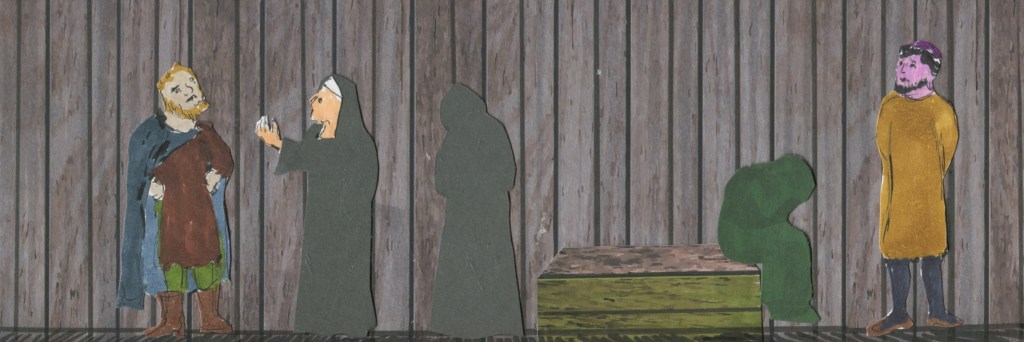
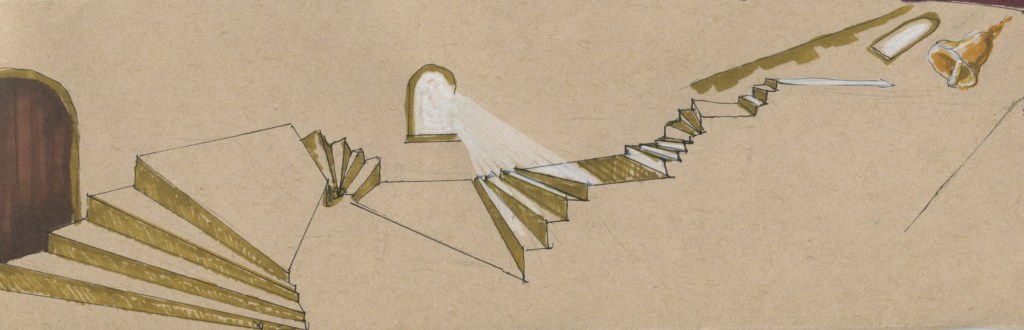
I follow the Reverend Mother to the tower entryway. The arch is just the right height for the Reverend Mother to pass through, but I have to bend down. There is hardly enough light to see the steps immediately before us. This wooden structure of stairs and precarious landings creaks and sways as we climb. The Reverend Mother seems accustomed to this climb probably only intended for one small woman at a time to reach the belfry.

She says it took the full power of two strong women to get the demoniac up this stairway.  And I imagine if they had a chain to hold her the chain alone would weigh more than any of them.  It must have been a struggle. As we near the openings at the belfry more light floods in. 

Here on the top platform where the bell cord hangs is a huge heavy chain and manacles lying in a heap. The Reverend Mother stares, stunned.

         “She’s escaped.”

It was easy to see the manacles are sized for a giant, and the grieving girl was tiny. All she’d have to do would be slip her hands out and she’d be free. The Reverend Mother looked down the high tower through a belfry arch. We both feared what we might see on the ground so far below. But there is nothing but the fresh snow.

         “She must have escaped down the stairs, and now she and her demons are loose on the land.”

Now, I go down ahead of the Reverend Mother amid the creaks and clatters of the rickety stairs.  We both know the young woman is in danger.

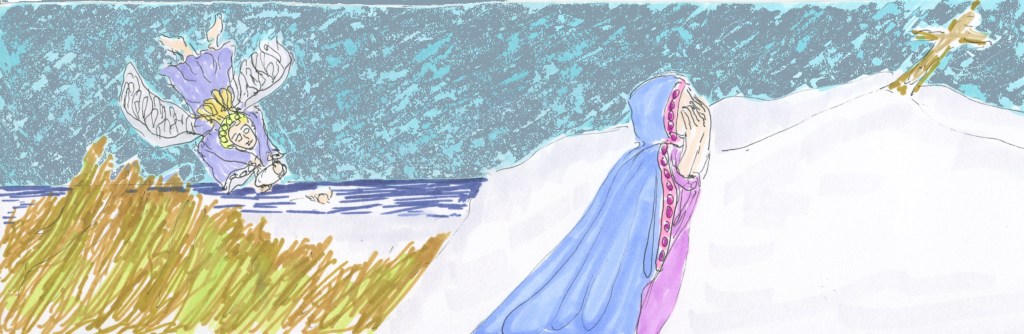
         “She’s probably going back to the sea to finish drowning her demon.”

Am I the only one who finds a need to hurry to find this young woman?

         “Her tracks are clear. I’ll follow her.”

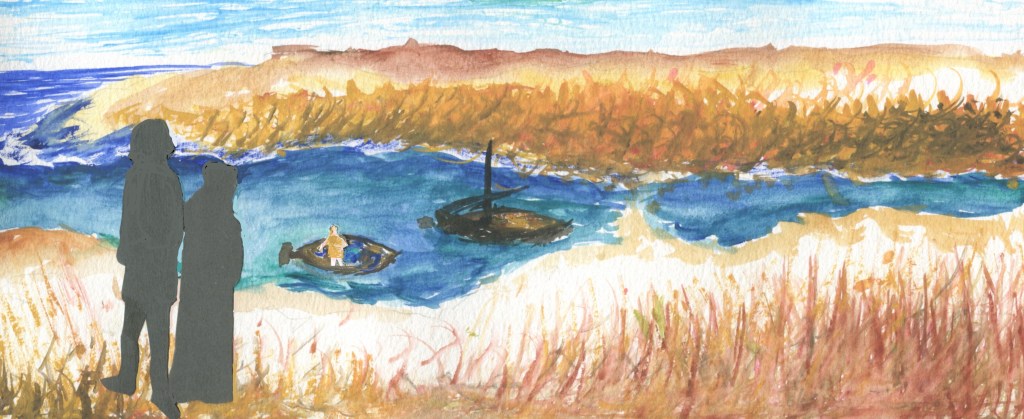
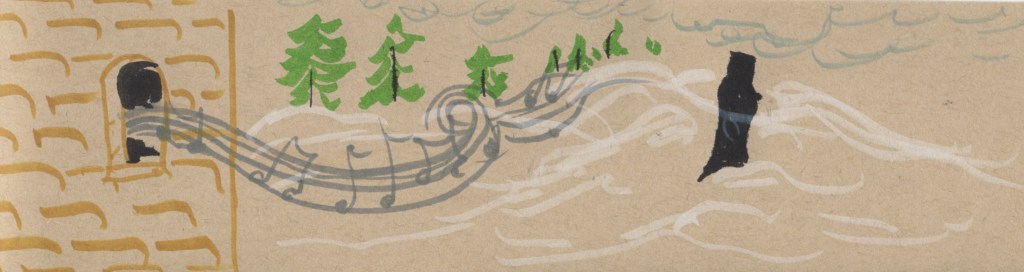
Only my own tracks lead toward this church from the sea. But at the smallest archway of the tower her footprints are as clear as if she was laying a trail for someone to find her.

         The Reverend Mother says, “She wasn’t walking toward the sea.”

        “She’s chosen the river.”

The Reverend Mother offers a prayer with genuflect and kneeling. She lists many titles for God, and I know the unspoken prayer behind the holy words is that the nuns can be free of this so-called demoniac once and for all. I slip away before the amen that I might find her before she reaches the river.

(Continues tomorrow)

Featured

#76.1 Thursday, January 1, 2026

Historical Setting: Monkwearmouth, 794 C.E.
 

Is this a magical time of year because of the particular songs and stories? I don’t think the season that Christians call the Christ Mass is sacred simply by edict or calendar. Now is when the sun begins a new light overtaking old darkness. There is no papal edict to set its day. It is an edict of Creation itself.  Lightness gradually returns gnawing away the edges of night at each rising. It would stay a Pagan thing, but Christians, also, keep the notion of the light overcoming the darkness. Epiphany marks this time of all things new.

Last night, at sunset I crossed back to the church at Monkwearmouth for the long night’s vigil of New Year. I was wondering what became of the waif I brought here on Christmas.

Now, after this Morning Watch, I knock on the study door of the Reverend Mother.

         “So, Joseph has returned?”

         “I am Eleazor, not Joseph. And I don’t believe the young woman I left at your door on Christmas would fit Luke’s ideal of motherhood. We’ve both seen her enraged.”

         “It’s been contentious. Her demons put us all to the test.”

         “The scratches on my face are quicker to heal than the scars on my conscience, were I intended to excuse myself from caring.”

         “So, she wasn’t just a stranger to you, washed up on the shore?”

         “She was a stranger then. All I know of her is what you told me. And also, that she was helpless and floundering in grief.”

         “This isn’t grief. This is possession of her soul by demons. We are equipped to handle grief here, but not demons.”

         “You mean grief is easier to manage, because it is a quieter infirmity?”

         “Grief heals with quiet prayers of sympathy. Grief has no comparison with this.”

         “Of course. I was just thinking, in her case, grief would simply drown its victim directly, but with demons, pigs are needed to carry it away for the drowning.” [Luke 8:32-33]

         She says, “We can pray for miracles, but while we wait, we have to do our best to deal with it any way we can.”

         “So, you have her here in chains?”

         “She is safe.”

         “May I visit her?”

         “Why? You said you don’t even know her.”

         “I know grief very well, and I want to offer a prayer of sympathy.”

         “It isn’t at all simple just to see her where she is now.”

I follow after the Reverend Mother to the doorway into the belltower.

(Continues Tuesday, January 6, 2026)

Featured

#75.14 Weds., December 31, 2025

Historical Setting: Monkwearmouth, 793 C.E.
 

The Reverend Mother, asks me how I know this woman I brought here to them.

         “The guards rescued her from the sea and I went down to help them but I don’t know her.”

         “We know her here. Last winter she came to us in labor and the Sister who is with her now delivered her baby. It seemed to us then, an allegory of the Christmas story but for the missing Joseph. We celebrated the birth of a strong infant, despite the deplorable poverty of the mother. She was a child herself, living as a pauper. We intended to keep her here and care for her and the baby properly, but she ran away and took the child with her.

         “No one could find her, and when we asked about her, there was no one who even knew who she was. All that we knew was that she once lived with the paupers in the wood. Alone, and with a child, they were both in danger. We searched for her and prayed for her. Apparently, someone took them in because no one ever saw her again.  But now, here she is showing up here again, now, a demoniac, raging against God. She is truly a child of the devil.”
“She is a child in grief.” I say.

         “If you say you don’t know her, how would you know she is grieving?”

         “You told me she had a child, and now she is alone. Any mother would be grieving at the loss of an infant.”

         “She was no mother. She was only a child who birthed a baby.”

         “You say she left here with her child, and now the child is gone, and now she chose to give up her own life to the sea. If there is a devil in this story, his name is Grief.”

The nun goes back into the little office and closes the door.

I know the girl will run away from here when she is able, and she will find a less guarded shore for her next walk into the sea.

         Dear God, I know my asking prayer risks that I will be sent to answer it, but this really needs asking.  Please be with this little girl, take her in your arms and comfort her in her time of terrible sorrow.  Send a Joseph, or at least some understanding of grief for this child. I know I am asking for a turning, again. Amen.

(Continues Thursday, January 1)

Featured

#75.13 Tuesday, December 30, 2025

Historical Setting: Monkwearmouth, 793 C.E.

The Christmas story is when the poor and weak are lifted up and the proud and powerful are cast down. It was the story Jesus was born into. And this too is that story. 

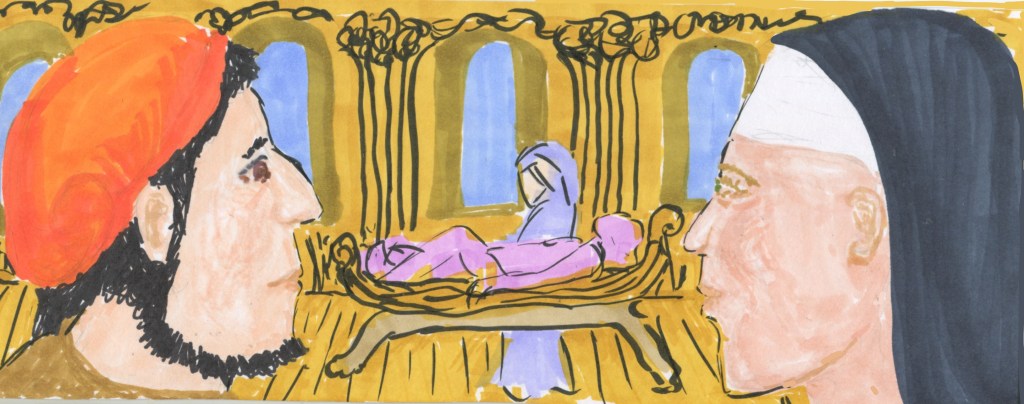
I take the bones of the near drown girl to the Reverend Mother of Monkwearmouth. She puts another in charge of the choir just as they prepare to process in, and she guides me to take this wailing bundle into her chambers off the sanctuary. This room is encumbered in brocades and velvets. I lay the waif on a golden upholstered couch. Then seeing the child is naked, the elder nun sends me away handing me back my cloak soaked and tattered. She asks me to fetch the tall nun, second to the last in the women’s choir.  So, I do, and now I step into the congregation late to worship but not too late for the reading of the Gospel.

In this so-called “women’s worship service” the Abbot of St. Peter and St. Paul rises to the pulpit fully adorned in his seasonal regalia: jeweled cross, silken robes and brocade chasuble. He proclaims the day. His voice is omnipotent, strong and powerful, quaking morning snoozers awake.

         “In those days a decree went out from Emperor Augustus that all the world should be registered. This was the first registration and was taken while Quirinius was governor of Syria.  All went to their own towns to be registered. Joseph also went from the town of Nazareth in Galilee to Judea, to the City of David called Bethlehem because he was of the house and family of David. … ” [Luke 2:1-4]

Thus begins the Christian paradox with familiar grandiose words –“decree” “Emperor” even the mention of “David” the nearly mythical greatest king ever — and this familiar reading ends with, “…they laid him in a manger because there was no room for them in the inn.”[Luke 2:7b]

         “The Word of the Lord!” And the song rises.

It is this calm of winter when we set the earth with spangles and candles and sing the songs and shout the toasts for the season, and clatter our mugs of ale with friends and strangers alike. It is the Christmas story, the same story as always upside-down. For every person born there is a birth story. It is one story when what seemed unimportant is suddenly all that ever mattered.

I see the Holy Mother at her chamber door, gazing over the gathered people, maybe, looking for me.

(Continues tomorrow)


Featured

#75.12 Thursday, December 25, 2025

Historical Setting: Jarrow, 793 C.E.
 

Some rise early for the mass. At Monkwearmouth the antiphons will be sung by the women’s choir this morning for this feast day celebrating the Christ birth.

The guards dressed as monks have their shift change at first light, so it isn’t just the monks stumbling through the Jarrow halls with a cloudy intention toward wakefulness which, just now, makes early seem contrary to the warmth of dark sleep. 

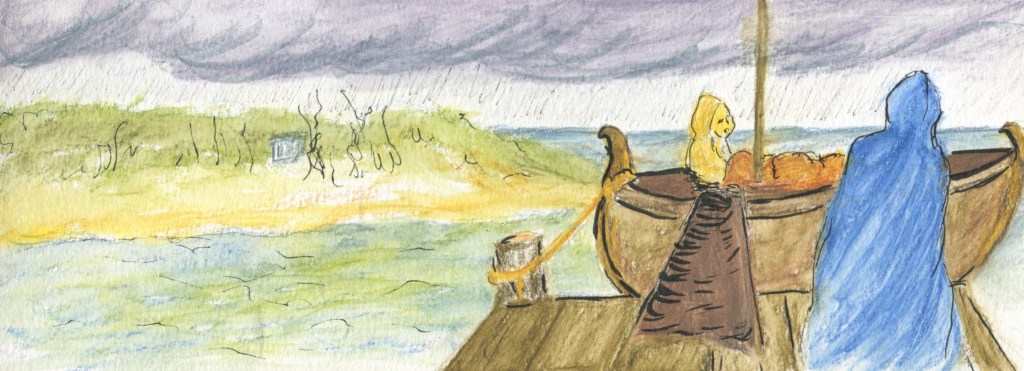
A guard I meet on the river path is breathless, hurrying to find a blanket because they just pulled a person from the sea near the river inlet. I run back with him to give my cloak.

         He said, “Keep this quiet, because the rescued girl sinned unforgivably by attempting suicide and the holy men will only chastise her.”

         “I’m sure the monks would only meet her need with kindness.”

         “You know nothing of the holy, my friend.”

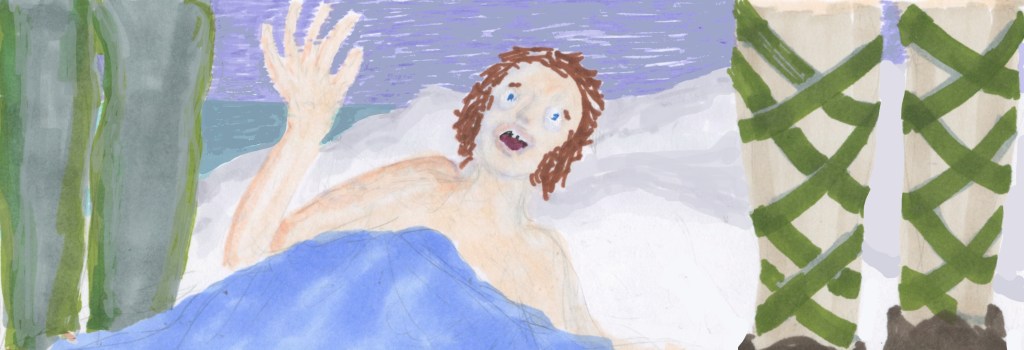
Here she is, a frail waif drenched in icy sea, naked, shivering, barely living. We wrap her in my cloak and a guard and I will take her to Monkwearmouth for the nuns to care for her. In my arms she is like a child, so little burden as she is so frail. She finds consciousness writhing, angry, clawing at my face, barring her broken teeth like a rabid beast. I stop and lay her in the snow in order to reclaim some reason and gentleness. Isn’t gentleness how it is supposed to be on this holy morning of Jesus’ birth? The guard takes a different tact. He shouts, “Behave or the nuns won’t have you!”

Now hysteria empowers her kicking, biting, flailing and her howls echo across the snows with amazing clarity for curse words against God.

         He says, ” We should just throw her in the river and let her have her way. She meant to drown herself after-all.”

         “I can’t do that.”

It isn’t any kind of relentless heroism that keeps me from letting her go. I just can’t do that for the simple selfish reason that I have to keep on living after this and it would haunt me.

         “I’ll take her on to the church. You can go back to your duty.”

Now he leaves. I carry her shaking and sobbing, on to the church.  Nothing is silent and holy here, but this is the Christmas story too.

(Continues Tuesday, December 30)

Featured

#75.11 Weds., December 24, 2025

Historical Setting: Jarrow, 793 C.E.

The librarian, Brother Wilbert, said the sounds of the people’s celebration of the season escaped these guest quarters again and danced among the snows of the cold December night, then music-ed up and down the halls of the monks’ quarters sending shudders of worldly drunkenness throughout the holy chambers.

Now, tonight, I’m down the hall to join the singing, with my empty cup apparently begging for ale, though actually, I am longing for human company and song. No one is surprised a stranger here, dressed not as a churchman but a scholar, already knows every song for this season. They don’t ask who I am. They fill my cup and one song is everyone’s song.

Every song is one song.  It is the first song — woman’s song, even before the lullaby — the rhythm of the birth pangs, then were added Latin verses, and an ancient tune is unsourced because it is everyone’s tune.  Personent hodie — “Id-e-o-o-o, id-e-o-o-o, Id-e-o gloria in excelsis Deo!”

Tonight, the celebration is the same as the song, lifting up what was unexpected by humankind, yet, simply the very nature of God who is love. It is the song of reversal — the infant is the king. The poor are lifted up. The pompous are humbled. It was Miriam’s song of victory when the Hebrew people escaped the might army of Egyptians, when Hannah in her old age welcomed Samuel, new born. Of course, before that, Sarah answered the angel laughing. But then, aren’t we all laughing, singing, joyfully now at the great reversal?

The word the missionary, St. Augustine, left for the English people was that God loves everyone, and the Christ Mass is the celebration of the upside-down world where women are honored, and the poor are fed and clothed and beloved as royalty; the greedy, and power hungry are cast down, and love itself rules.

“On this day earth shall ring with the song children sing

to the Lord, Christ our King, born on earth to save us;

him the Father gave us.

Chorus Id-e-o-o-o, id-e-o-o-o, Id-e-o gloria in excelsis Deo!

His the doom, ours the mirth;

when he came down to earth,

Bethlehem saw his birth; ox and ass beside him

from the cold would hide him. Chorus” [Footnote]

[Footnote] https://www.classical-music.com/articles/personent-hodie-lyrics  retrieved April 16, 2025. Historians can only make histories of tangible things — written records, archeological finds and real things. Carols aren’t documented in the 7th century. When music and songs were at last written down for history to never forget, they were already well-remembered and often sung.

(Merry Christmas continues tomorrow)

Featured

#75.10 Tuesday, December 23, 2025

Historical Setting: Jarrow, 793 C.E.

Tonight, I hear the ruckus down the hall as the soldiers, incognito as monks, shift their vigils: two go out and two return with shivers, welcomed by the third pair ready with the ale and the songs of the Christ birth. Even this seasonal welcome with ale is a tradition here.  This missionary, Augustine of Canterbury, now a saint, left a deep path from Pagan to Christian for the people of Anglia to follow.  What I assumed would be the Christ mass is so flavored with traditions of the new light rising and the New Year celebration of solstice when the eons become a baby.  So, the Christians give him the Christian name, and his mother becomes the new Queen of Heaven.

Luke offered this pathway from the beloved traditions of old into the Christian celebration, but in my own brief time of friendship with the man Jesus, these stories of his birth in the style of an upside-down Caesar, lifting up the poor and humbling the kings, were really about the ways of the followers, not the facts of his life. That is something I would never say aloud in these times.  To mention the possibility that Luke captured the beauty of the virgin birth and the magnificent infant from pagan tradition based on solstice, would surely be anathema to all those Christians who so loyally mouth the creeds, human and God, born of Virgin Mary.

Was Jesus, my dearest friend and teacher, some magical being in the sense of a pagan notion of a god, and necessarily definitive of God? Or is the Creator of all that is the invisible presence of love for all, Mother of life, intimate holy, bigger than words, Yahweh, awe, something more than a human being? I keep my wonder to myself. To argue again the old wars of Trinity is only divisive and counter to God’s love for all, and it changes nothing of the reality of God. God is.

Tonight, the beautiful carols of the season that seeped into the Christian love through a pathway from pagan are the love songs bonding earth with heaven. I will just go sing with them and not argue the nature of God from this mere hill crest of earthly shepherds, drunk on ale, seeing angels landing among us. I go down the hall with my song and an empty cup. “Weal hael” or “Ves heill” they say as they fill my cup.  “Good Health” to all. [Footnote]

[Footnote] Old English words that span from Pagan to Christmas becoming a tradition of caroling https://researchersgateway.com/wassail/ retrieved 8-20-25

(Continues tomorrow)


Featured

#75.9 Thursday, December 18, 2025

Historical Setting: Jarrow, 793 C.E.

Librarian Wilbert and probably others too, found the night’s noise from the special “guests” annoying.

         “This is a sacred season. It is the Christ’s birth, and there those fellows are bearing down on us with all that Pagan noise. They might as well be Vikings for all the disruption.”

He has no real idea of the tragedy of Vikings taking actual lives of people for no better cause than personal greed. These watchmen are assigned to keep guard on the vulnerable. They dress as monks to “fit in” here, but armed as they are with swords under their robes the silhouettes they cast would make them seem very hefty monks.

         “Brother Wilbert, I have to say, I rather enjoyed the irony in their choice of song, all the while they are keeping constant vigil for foreign invaders they are singing Latin songs of Jesus welcoming all nations.”

         “They are uneducated Angli. They have no idea of the Church Latin they were singing.”

         “It is seasonal.”

         “The season sings of the Holy Mother and the infant.”

Now he lifts his old bones from the stool at the welcome table, and waddles his way to the Bede materials to find the place where the historian wrote of this.

         “The Angli [English] begin the year on 25th December when we celebrate the birth of the Lord; and that very night which we hold so sacred, they called in their tongue ‘Modranecht’. That is ‘mother’s night’.” [Footnote 1]

It was Pope Gregory I who took on the gospel call to spread Christianity to all the corners of the earth. He sent Augustine and his band of missionaries to this place to Christianize the heathens. And the missionary did his work giving gospel names to the gods and goddesses who were already here, rather than capturing people to Christianity by violence. We call Gregory “great” now, and it seems, the Roman Christian way of greatness is the imperialistic part of Christianity because it is said that in the spreading of Christianity, greatness is achieved. [Footnote 2]

After this day with my mind cluttered with the bookish history of a joyful season, I’m leaving for vespers. And here is Wilbert still at his station.

         “Brother Wilbert, I have a better notion now for the drinking song I will teach my neighbors.”

         “As though they need any new songs.”

         “I happen to know some very fine carols of Francia that have as many verses from the gospel, as Luke has verses in the Shepherd’s story.”

[Footnote 1] https://www.whychristmas.com/customs/uk-christmas-history#early

Retrived 3-30-25

[Footnote 2] St Augustine of Canterbury was the person who probably started the widespread celebration of Christmas in large parts of England.  The first recorded date of Christmas in England was when Augustine baptised 10,000 Saxons in Kent on Christmas day 597. (There was some earlier Christianity in England before the fall of the Roman Empire, but there’s no records of the birth of Jesus being celebrated. After the Romans left, other Celtic parts of Britain knew about Christianity but again there aren’t many documents about if or how they celebrated the birth of Jesus.)

(Continues Tuesday, December 23)


Featured

#75.8 Wednesday, December 17, 2025

Historical Setting: Jarrow, 793 C.E.

Drinking songs of soldiers changes the music of this hall from arguments among novices to soldier’s seasonal songs enhanced with ale. Even those youngsters attempting chants with their changing and untrained voices are, to me, a worse disruption to my sleep than drinking songs. I oddly appreciate the change in the neighbors in this hall.

Even with their most ale afflicted “best” voices, the little dancing tunes escape their cell and call forth the celebration of the season throughout these dank and chilly halls.

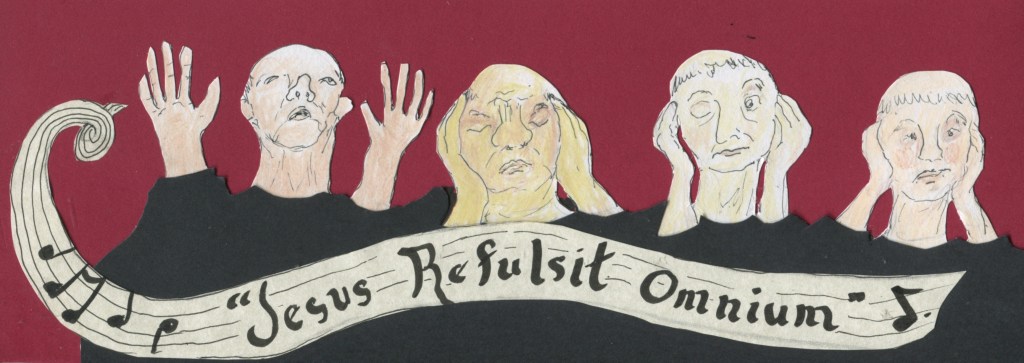
Jesus Refulsit Omnium[footnote] is hardly discernible now with so much fermentation, but I’ve sung this song in another time and place. Some centuries ago, we sang this when the bishops were encouraging the more Christianized celebration in mid-winter.  We kept singing it on the night of the Christ Mass — a band of monks trekking through the woods with frost bitten feet in the matins hour, returning to Ligugé from the nuns’ community in Portier.

It wasn’t a drinking song in Francia. But what else could it be on a cold Northumbrian night like this? When the tune meanders through my memories, it finds the better beat for dancing and consumes my grief in embers of joyful recollection. It gives Christmas a spirit of its own.

First light of dawn glistens over new fallen snow. Earth is new, in darkness anticipating new light. I can think of nothing else but this spirit of the Christ mass. It sings so long and deep with the woman’s song — the world upside down with the newest infant leading us. To worship this morning, I walk to the church of Monkwearmouth for the mass. The rivers run as usual, un-snowed and dark. The hums of the chants are usual. Everything tries to be usual, but it isn’t. It is Christmas.

At the library here is Wilbert at the sign-in table, all so ordinary.

         “Did the so-called ‘guests’ in the visitor’s hall keep you up all night?” he asks.

         “Do I seem drowsy? Really it was my own thoughts that kept me up all night; they only added the music.”

         “The noise corrupted the sleep of all of us, even in other areas in the monk’s cells. You would think they could at least pretend to be devout like you always do so well.”

         “I am devout? But they were cold and had suffered so long at their duty walking to and from the sea for the good of Jarrow. In their own task they are devout.”

[footnote] https://www.oldest.org/religion/christmas-songs/   Retrieved 4-7-25

(Continues tomorrow)


Featured

#75.7 Tuesday, December 16, 2025

Historical Setting: Jarrow, 793 C.E.

Winter is upon us, nearing the season of the solstice and I’ve chosen to stay here in the guest quarters at Jarrow. This is a double monastery, with the women’s community, called St. Peter, across the River Tyne on the River Wear. In that church often the worship is led by the abbess, and a women’s chorus chants. I go there often to stand for gospel to partake in the mass. The walk refreshes my library-stiffened bones, and taking of the Mass daily nourishes my spirit. Even, clothed as I am, as a layman, my old monkish ways still make me useful at Jarrow helping with daily chores and keeping the hours. So, no one is pushing me to move on from my cell in this hall set aside for visitors and novices.

Now there are some other long-term guests in the visitors’ quarters. They are also an odd mixture of holy and profane, but for me, my holy tradition is hidden in layman’s clothes. And for them, their holy monk’s robes hide the soldiers that they really are underneath. These are Ousbert’s men who have come to guard the monastery. No one says it, but we all know it. They draw their hoods over their tousled hair to appear as true monks as though they walk in pairs “with deep devotion” keeping their posts along to river all the way to the sea. When I go looking for a solitary place for prayer, there are always guards lurking, watching. These guards are assigned to always keep watch for those longships of the Norsemen.

I’m pretty sure this is not a season when Vikings will attack, with weather cold and stormy, unpredictable, and all the fickle changes into winter.  I know the Norsemen make careful plans before they cross the North Sea, so Ousbert’s order to set guards outside in this season is probably unnecessary, but who am I to say?  Besides, I rather enjoy the celebratory style of this noisy band of soldiers in the guest hall. Wilbert asked me if I minded their songs and drinking in their off-duty hours. I don’t mind at all. They bring the solstice celebration from the Pagan root, anticipating the rising light of a new year into the midst of all these long dark nights. We all need a celebration this time of year.

Dear God, thank you for this nature of your Creation that tunes the earth to celebration. Amen.

(Continues tomorrow)


Featured

#75.6 Thursday, December 11, 2025

Historical Setting: Jarrow, 793 C.E.

The King’s man, Ousbert, is also a lay visitor at Jarrow in the aftermath of the raid on Lindisfarne. Our purposes here are very different. I’m just looking for a history, but he’s looking for the vulnerabilities of coastal monasteries to make his recommendations to the king going forward. It’s a very different perspective, seeing a community as a long heritage of saints, or observing it as a future target for greedy marauders. Weren’t both views shaken by Viking attacks?

At Lindisfarne the Viking raid was blamed on lots of things, but none of the blame seemed to land on the Vikings.  One side was groping for the weaknesses in the Irish heritage of that community. Those who wanted to rankle the wrong in the Irish way couldn’t really blame the scheduling of Easter or a different tonsure, but they did find one little distinction between the Irish and the Roman that laid the blame for destruction squarely on the Celtic root. That was the first Church building not made of Roman stone, but it was made of oak and thatch.  The Romish fix was apparently covering it with sheets of lead. Footnote  But raiders were still able to sack the treasures from it before it was burned to the ground. The newer Romanesque stone construction, still stood, but the raid turned the lead a molten ooze over the bed of ashes.

Jarrow already has stone buildings, but here in the forests, unlike in Rome, there is an inherent appreciation for wood. So, despite the Roman exteriors, these interiors — the pillars and arches and rafters are tooled by local artisans in the warm, wooden ways of the Angles and the Saxons. And it should be considered that wood burns the same whether it is Irish, or English or Roman. The same wood that echoes our conversation just now and makes a simple monk’s choir into magnificent music, is flammable.

I mention this nature of wood to Ousbert but he ignores my concern. He has no wish to take this worry to the king, since the use of interior woods isn’t just in monasteries. It is in the castles as well.

It is terrifying to imagine that Vikings could raid anything coastal and the notion that Vikings could raid establishments even beyond the holy places, is something no one wants to consider.  In fact, until there was that written letter to Alcuin no one even acknowledged those coastal raids already happening.

Footnote: https://en.wikipedia.org/wiki/Anglo-Saxon_architecture retrieved June 4, 2025.

(Continues Tuesday, December 16)
Featured

#75.5 Wednesday, December 10, 2025

Historical Setting: Jarrow, 793 C.E.
 

The King’s man Ousbert is making a plan to save these coastal monasteries from the fate of Lindisfarne. Ousbert is asking for details of the cause of the raid, and since I was there, he’s questioning me.

         “People who put their trust in saints to be all powerful are blaming the enshrined saint for the failures to protect the monastery. A saint may offer spiritual protection but this wasn’t a spiritual issue.”

         I add, “And blaming is not the same as protecting.”

         “It is a dangerous vulnerability. The king is considering an edict that prayers can only be said within high walls with watch towers.”

         “Watch towers with armed guards?”

         “We’ve already offered guard towers here. But the abbot argues that armed guards stifle the prayers of monks and nuns. So why would all these experts in prayer need to gaze on the rivers and sea? Can’t they close their eyes for prayer, like everyone else?  After all, God gave us eyelids.”

         “Maybe the spaciousness of nature provides the spiritual sanctuary they seek. City walls with guard towers seem antithetical to prayer.”

         “You sound like them now. Even the most vulnerable, the holy women of St. Peter at Monkwearmouth are opposed to watch towers.”

         “Posting armed guards to keep watch really does seem like an imposition to the very nature of a monastic community.”

         “Whatever. My report to the king will push for a visible military guard. Swordsmen would’ve saved Lindisfarne?”

         “It is always the conundrum of what is saved and what is lost. Armed guards can save earthly treasures. But swords don’t save lives. The best a sword can do is terrorize and slaughter selectively.”

         Ousbert says, “Ugh! But here in the real world, if guards are at these doors then all the prayers and them that prays them will be safe.”

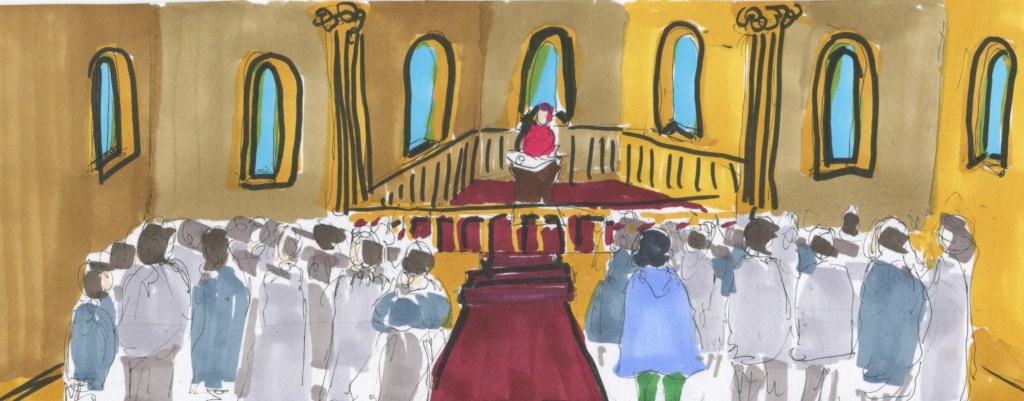
Our argument echoes in the high arches of this ceiling. In Jarrow the buildings are stone like Rome, but we aren’t in Rome. The outside may be stone, but English use flammable wood everywhere. This high ceiling is supported with wooden beams and the wood paneled walls carry every sound to the rafters. It’s no less vulnerable to torches than was the first building of Lindisfarne made of oak beams and thatch.  Then it was covered over with sheets of lead to be more solid like the Roman stonework buildings.

I ask Ousbert, “What if the Vikings bring torches?”

(Continues tomorrow)
Featured

#75.4 Tuesday, December 9, 2025

Historical Setting: Jarrow, 793 C.E.

The Lindisfarne raid raised concern throughout the kingdoms for the safety of all of the coastal monasteries.  Wilbert introduces me to Ousbert who serves the king as a military advisor. Ousbert has questions about the raid on Lindisfarne. We step out of the library hall, to talk more freely in a gathering place, though here this great hall echoes our conversation into grand pronouncement. It isn’t private.

         “Brother Wilbert tells me you’ve just come from Lindisfarne.”

         “Indeed. I was there at the time of the raid by the Norsemen.”

         “The poor fools, holy men, trusting a dead saint to save them. The king wants Northumbria to be better prepared with a force of armed guards to fight back when the Vikings come calling again.”

         “I think the monks of Lindisfarne believe they’ve always been well cared for by the Shrine of Cuthbert. But you’re right. I’ve also heard those grumblings that they believe St. Cuthbert should have saved them.”

         “So you agree it was Saint that let them down? Or, could it actually have been the monks who lacked military training?”   

         “Considering the hazards of earthly sins warring could befoul a monk so, for the soul, a saint seems a safer choice.”
 

         “This was a completely different kind of danger for a monk.”

         “There is plenty of blame — Alcuin, the scholar blamed sins of drunkenness and greed. Others simply attributed it to the wrath of God.”

         He asks, “As one who saw it, what do you think was the cause of it?”

         “I think it was the Vikings.”

         “Of course, but what caused the Vikings to cause it?”

         “It was definitely caused by greed, with a chaser of strong drink. But whose greed and whose drunkenness are to blame? That’s the question. Alcuin was blaming the brothers of Lindisfarne, but honestly, I still lay the blame square on the Vikings. There was plenty of greed and drunkenness among the Vikings. At Lindisfarne, their barrels and kegs were stolen, and their earthly treasures are gone, so any possible continuation of greed or drunkenness at the monastery is null.”

         Ousbert says, “As an advisor for the king, my assignment is to prepare the coastal monasteries, Jarrow and Monkwearmouth, so they can save themselves, should there be another attack.”

         “Still, preparation for any attack would need to consider the greed and weaknesses of the Vikings. They are, this very hour, trading the treasures of Lindisfarne. This is definitely about greed.”

(Continues tomorrow)

Featured

#75.3 Thursday, December 4, 2025

Historical Setting: Jarrow, 793 C.E.

         In the water walking allegory, stepping out of the boat is called “faith.” But then the word “faith” was usurped by religion as a uniform requirement for belonging —a shared creed. Back when faith was still raw and personal, Jesus told Peter he needed it. Then by religious use, faith changed its meaning to define the boat — the belonging to a shared religion. But faith is still personal for some water walkers.

         Dear God, you know my heart.

         I’m one who would drift free or maybe simply sail with the wind. But religion happens when the direction of the wind isn’t trusted and the captain calls for the oars then we all row in unison.  It is so Roman, this galley with oars, called religion. But sometimes it takes me where I need to go. When I dress as a monk, I expect the human being at the tiller will steer as God asks of us.

         As I read through Bede’s history, Christians are always groping the changing winds with steady oars for uniformity and order.

         So it is, when a Synod or a Council gathers within religion and the purpose isn’t to compromise, rather it is called to name a singular order. Even though the Synod of Whitby [footnote] was convened by Hild of the Irish tradition, it was purposed to establish a singular direction or rule. Those who could flex, yielded to those who could not. For the Irish, the side I’m drawn to, the internal, personal relationship with God isn’t by creed or calendar or rule, so on matters of rule the Celts flex. They fall in line with order and uniformity. Some argue, others, like Hild, do whatever we can to hold to the Irish tradition but an inflexible order apparently gives the pope authority over random currents and shifting winds of individual prayer. The Synod of Whitby eventually went along with the pope’s date for Easter and all the sameness implied in that.

         Jarrow wasn’t founded by an Irish bishop so the buildings are of stone, and the style is Roman.  It was, after all, Pope Gregory the Great who assigned Augustine and his band of missionaries to bring Christianity to East Anglia in the first place. This history of earlier centuries is well-known here, and it is also recorded by Bede in this history that I still have laid opened on the bookstand. Taking the pope’s side is as old as Christianity for these people.

         Just now a man signing in at Wilbert’s table is also a layman.  And he is asking Wilbert about the attack on Lindisfarne.

[footnote]Synod of Whitby, Chapter 25, p. 153 (Bede The Ecclesiastical History of the English People: The Greater Chronical, Bede’s Letter to Egbert (Oxford press, Edited with an introduction and notes by Judith McClur and Roger Collins. 2008.)

(Continues Tuesday, December 9)

Featured

#75.2 Wednesday, December 3, 2025

Historical Setting: Jarrow, 793 C.E.

         It could be that God is speaking to everyone all the time. But what one hears depends on listening. Sometimes I listen. But my experience in hearing God is always personal and never credibly shareable. Maybe it is out of fear or awe, but people – at least speaking for myself — learn to close ourselves from listening. I keep a secret plea always in the background of my personal prayers — “This I pray, but please God, don’t answer me too hard. Only tell me what I believe I am able to do. Set the bar as low as I do.”

         Listening to God speaking is a courageous dare that is deep and personal.  It is not something I can receive from another’s instruction for obedience, or even a saintly sermon or teaching. Even the greatest teachings only guide me toward the spiritual depths. So, the one-on-one with God speaking is always personal. It is the life of an ascetic — a lone mystic in the wilderness. But that is but a moment — the touch, the jolt to consciousness, the “ah-ha.” It is the driving force, but not the whole of life. Beyond the cave is the wind and the fire and maybe the loneliness calling — a still small voice craving people, and people muddle in chaos without organization. I reach for religion, order, politics, some kind of social unity.

         Religions are a human response. Religion is earthly organization of spiritual likenesses. Spirit flows as an invisible sea, an atmosphere, breathed in, and exhaled individually unique, but also a shared love, a unity. The things of Spirit we share become our religion founded in social human tradition, experience, music, art, religion. It is not a singular epiphany granted to one God-selected saint or pope.

         Religion is the boat in the water-walking allegory. But the walking on the water is an individual experience. Hearing God speaking, belief, faith, whatever earthly name we give it, it is shareable with others only within the boat. Faith is personal, and religion is communal.

         Peter was out there gathering the nets of fish into the boat. For Peter, it was outside the boat where things went deep. Even when Jesus himself was walking on the water telling Peter he could do it, it had to be personal for Peter, one on one with God. [Matt. 14:28-33] Religion is the boat that floats us above the everyday turmoil, but stepping over the side, bare feet, bare soles against the surface of the sea is one-on-one, deep and personal.

(Continues tomorrow)

Featured

#75.1 Tuesday, December 2, 2025

Historical Setting: Jarrow, 793 C.E.
 

     Since the third century, when I first left Ephesus to heal from the persecutions, I’ve seen the pattern of religion moving from personal individual mystical experience to a community following an earthly rule as a religion. This thing that my sister and I had been given by a mystical teacher was the deep and personal love for God and all Creation.

      People don’t hear God speaking because someone else is telling them what God is saying, even when it is the saints who are telling us. God among us is a love story, a poem or a piece of art, a song, a dance, a shared silence, but rarely a pedantic lesson. Art is untitled and faith is without definition.

     It was the political opposite of autocracy. But then we lived in a world dominated by the politics of hate so our private prayers were answered with our political conscience, God’s love for all people. Just the simple first rule of love for God and love for neighbor and ourselves, set us in the political controversy that led to the crucifixion of many Jews, including our own teacher as well. 

     At first, what was a personal wandering in spirit put us in political opposition with Rome at that time, setting up their crosses for executing political dissidents. We were left trusting only in the invisible, spiritual life of love for one another even in a hating world. Beyond the political milieu was the simple grounding — the love and the beauty – the handwork of God who is love. With the temple plundered and Roman propaganda and lies making good seem bad and love seem sin, we, who followed the Jesus way kept love the priority. So, we moved to safer cities beyond Jerusalem.

         In times of autocratic plundering on earth, prophecies of end times came with more and more specific details. But, like death, any human glimpses of end times are, at best, individual hopes. No universal nature of these things can be known by people. Endings are always unknown or they wouldn’t be endings. Even when God, all loving and invisible, speaks to the prophet, the message is always all loving and invisible and very personal. The wings, or fires, or monsters, or precisely numbered events birthed in human imagination are at best, metaphors to transfigure a personal spiritual experience into shareable, speak-able terms. Amid cruel political times doomsday is the hope, not a threat, seen as the promise of new Creation.

         Peter’s water walking lesson is a poignant explanation of this faith problem.

(Continues tomorrow)


Featured

#74.12 Thursday, November 27, 2025

Historical Setting: Jarrow, 793 C.E.
 

         Bede’s book unwinds with the story I came here to understand. When Bishop Aiden, the founder of Lindisfarne died, his successor was Finan [651 C.E.]   also “consecrated and sent by the Irish.” Finan constructed the church at Lindisfarne in the Irish method of oak and thatching. The Roman way would have been with stone. So later, Bishop Eadberht [688 C.E.] had the whole church, roof and walls, everything, covered with sheets of lead. (Now the new main building there is of stone.) You would think everything done in the Irish way was done away with, but no. Bede writes, “There arose a great and active controversy about the keeping of Easter. Those who came from Kent or Gaul declared that the Irish observance of Easter Sunday was contrary to the custom of the universal church.”

         Bede calls Ronan a “violent defender of the true Easter, who, though Irish by race, had learned the true rules of the church in Gaul or in Italy. In disputing with Finan, Ronan “put many right, but could not put Finan right; on the contrary, as a man of fierce temper, Ronan made him more bitter… and turned him into an open adversary.” [Footnote 1]

         This history lists bishops and monks, kings and nobility of East Anglia, and Northumbria, all struggling with the problem of two dates for Easter.

         A synod was called to decide this issue once and for all. This was at a monastery at Whitby where Hild was abbess. Bede called her a “woman of God.” What else is known of her is that she was of noble birth, and was guided in her faith by Irish Aiden, who ordained her as abbess. The list of church dignitaries attending the synod included the Irish. They were represented not only by Hild and her following, but by Bishop Colman of Lindisfarne and his clergy. But as I know from seeing this same issue in an earlier time, it isn’t resolved by allowing each his own way. In Roman style, it can only be one way in the end. So it seems the random strays from another Island are always just pitted against the pope.

         “First King Oswiu began by declaring that it was fitting that those who served one God should observe one rule of life and not differ in the celebration of the heavenly sacrament seeing that they all hoped for one kingdom in heaven: they ought therefore to inquire as to which was the truer tradition and then follow it together.” [Footnote 2]

         There wasn’t really room for compromise.

Footnote 1: Bede, The Ecclesiastical History of the English People Oxford World’s Classics 1969.  Pages 154-157.

Timeline https://www.angelcynnreenactmentsociety.org.uk/home/lindisfarne-pages/bishops-of-lindisfarne—list (the lack of info, even A-I assisted Google, affirms the footnote on p. 397, “little is known of this Ronan.”) Retrieved 5-25-25

Footnote 2: oop. cit. Bede p. 154.

(Continues Tuesday, December 2)

Featured

#74.11 Weds., November 26, 2025

Historical Setting: Jarrow, 793 C.E.

         I came to Jarrow looking for the hate words I thought Bede had planted in the written history of Lindisfarne.

         Those who gathered for the reading of Alcuin’s letter to Bishop Higbald were talking among themselves in search of the sins of Lindisfarne. Alcuin’s letter offered some sin options: greed and drunkenness. And there was that matter of the sinner buried among the saints.

         Then Bede’s history re-issued the misguided, narrow view of the ways of the Irish founders of Lindisfarne. Blame words for the disobedience to the pope’s edict requiring a certain date for Easter and what Bede called ecclesiastical matters, were referring to Roman rule. Whatever the sin, the tragedy of Lindisfarne set a devastated community searching itself for its own need for repentance.

         Sin needs to be acknowledged when a Viking invasion is understood as a doomsday kind of judgment against the community. Blaming the victim seems harsh, but finding something repent-worthy also empowers the victim to turn around and make it better. Never mind the crimes of the marauders, by changing from sin to repentance there comes the possibility for the community to control the holy judgment.

         The conversation of the visitors over the unsalted porridge blessed Lindisfarne with an abundance of sin. There were plenty of opportunities for repentance.

         This writer of the history, Bede, was a monk here at St. Paul’s of Jarrow, having lived his life in the deep and abiding love of the brothers. As a place that values learning, he was not only immersed in the book collection that started this library, he also used his opportunity to listen to others, particularly those who traveled to Rome, to draw his expressed conclusions on the power of the papacy.

         Wilbert knew Bede as a mentor and a friend. So now the stories of Bede’s life and work allowed me empathy for Bede, when I had clearly come with a dispute. Now my argument is soothed with wider words to be a lingering difference of opinion; Bede described it as “a great and active controversy.”

         Over the centuries I’ve seen this. Those who follow the Irish tradition call it a difference of Rule. But those from the Roman tradition put righteous truth on one side, against the so-called wrong-headed Irish. It is still political, though I say I came looking for the holy.

(Continues tomorrow)

Featured

#74.10 Tuesday, November 25, 2025

Historical Setting: Jarrow, 793 C.E.

         A technique to practice love in the work of learning to love God and neighbor and self, and even love for “enemy” is a technique of working through words of fear and hate, then widening the disparaging words to be positive words.  This exercise doesn’t pretend love, rather it discovers honest love through more complete understanding.

         1. The first step is easy: name the narrow angry hate words — those adjectives of blame and hurt that define the enemy and make the unlovable “other” appear as evil. Afterall, enemies are made of words — hostile; hurtful; greedy; lying; snooty; deceitful… hate words are everywhere. They are narrow and definitive.

         2.  A word cloud expands and broadens the narrow word. “Greedy” can  be said as “selfish” “inconsiderate of others” or maybe even “needy.” This expanding collection of synonyms widens in all directions, even into empathetic understanding like “needy.”

         3. Grab onto this thread of understanding, and when the reach for love emerges the pattern of escalating hatred loses power.

         When “needy” is a wider word for “greedy,” “the need” offers an opening to understand and care for an enemy. Perceiving the “greedy” as “empty” “longing” “needy” “grasping at anything to fill his void” “starved” “hollow.” Compassion for the suffering nature of greed emerges from the wider words until it becomes possible that honest love can overwhelm the hate. So, this one labeled, “enemy” mostly needs to share my pot of porridge with me.  Maybe he doesn’t even know that; but I know it.

         “Dear beloved enemy, come and eat with me.”

         And so I offer him the nourishment over and over again, until he sits at my table.

         This tool, widening the hate words into understanding realizes the Jesus command to “love neighbors as self.” It even works for the loving of self. In this way it is honestly acceptable to know that God loves me. It takes practice. Loving and being loved is a truth and not a hollow aspiration demanded in fear of judgment. Love is asked of all of us by God who is love. This tool for broadening hate words to caring, widens the possibility. It is actual love, not just an “ought to.” Love of self and others makes real the relationship with God who is love.

         The love sermon is still a hard one because the simplicity ignores and over powers the fearsome control of hatred.  No wonder the Romans crucified Jesus. They just couldn’t bear the love.

(Continues tomorrow)

Featured

#74.9 Thursday, November 20, 2025

Historical Setting: Jarrow, 793 C.E.

         Both styles of monks, the Irish and the Roman, are beloved by God. And maybe God answers the argument when a monk from the Roman Rule happens to lose his hair without even shaving it, but only in the front, giving this Roman Christian the Irish tonsure. And the Irish monk goes bald in the top, back of his head, so any hair he may have seems to be a crown. Our Creator judges with humor.

         This little joke told by nature in the ways men loose hair is an earthly metaphor for a heavenly truth. It is possible for a thoughtful, prayerful person to learn empathy for another they might deem as enemy, or more lightly, unlikable. This intentional thought pattern can offer an honest window on fearless love.

         Here, I am visiting a monastery staying in cell for travelers, in a less than hallowed hall of this community. Just outside this door I hear two novices dredging up old secular hates.

         “Arrogance! That’s what it takes to copy off my tablet then lay it before Brother Cowen and claim it was your own thought, Brother!”

         “Who’s to say it wasn’t my thought also? Obviously, my work was superior, with each letter perfect and nothing overwritten or scraped off as was yours. I handed our teacher a far better display of writing.”

         “May your demon friends curse your whole deceitful tribe!”

         As a stranger here, I don’t know what to make of these people. There may be a deep animosity already between them. Apparently, one novice had reason to call the other “arrogant and deceitful.” And the other eluded to the first fellow’s imperfections — poor lettering and strikeovers. Only God can intrude with the missing love here. And maybe one day these two novices will be brothers together and will find that love.

         But there are ways to find human understanding that releases the hurt, prayerfully, relentlessly begging for the power of love. One way I find for understanding is an intentional technique for widening narrow words of hate. The hate words between the novices, “arrogant” and “deceitful,” are narrow and negative apparently drawn from a history of tribal hatred.  But by searching for synonyms for these rigid hate words, little glimpses of understanding can emerge. “Arrogance” is a neediness and “deceitful” longs for forgiveness. There can be a wedge of understanding instead of rehearsed, on-going hatred. Actually, even this word “hate” widens into the word “fear” and “perfect love casts out fear.” [I John 4:18]

(Continues Tuesday, November 25)

Featured

#74.8 Wednesday, November 19, 2025

Historical Setting: Jarrow, 793 C.E.
 

         I’ve come to Jarrow following my own curiosity about what I, as a mere lay person, judge as wrong-headed. Obedience to the papal edict is demanded when it is actually the voice of God that calls us in the dark of night.

         I came here to argue against Bede’s historical writings that barely excuses the Irish founders of Lindisfarne for holding on to the traditions of Celtic Christianity. What I found here, visiting this library is Bede’s student, Brother Wilbert, still grieving for his beloved teacher. He is telling me of Bede’s life, while I came, only to measure Bede by his judgmental verbiage in his history of the neighboring community.

         My hackles, were I a bird or a wolf with actual hackles, are riled up whenever I read this style of religious authoritarianism, calling one with different traditions an “open adversary of the truth.” [Footnote] Judging  each little external difference of religious practice as divisive among Christians. Yet, here I am, judging the judge. I came here looking for an argument, but I found a human person in Bede simply doing his best to straddle the line between the voice of God calling him in the darkness and the obedience to the religious head, a pope. He would never even meet the pope. For Bede, the pope was mythical — more than mortal human —acclaimed to be infallible. I came to find Bede, an imagined adversary, and now I find a better understanding of Bede, the person.  The mysterious Jesus way of love washes over diminishing narrow divisions, not with better rules and stricter obedience, but with a simple, broader understanding.

         The monk with the Irish tonsure, with shaven forehead back to a line center from ear to ear, looks at the tonsure of the Roman Christian monk, and judges that the little circle of hair he wears as a crown, as a prideful flaunting of royalty. Then the monk with the crown looks at the Irish tonsure, and judges that man flawed, disobedient and unwilling to wear Christ’s crown of thorns. So where is God in all this so-called “truth”?

         I only see with human eyes, but God sees from the vantage point of Creator, all-loving.

         Dear God, grant me a wider view of your own beloved “others.”  Amen.

[Footnote] Bede, Ecclesiastical History of the English Oxford University Press.  pp 153

(Continues tomorrow)

Featured

#74.7 Tuesday, November 18, 2025

Historical Setting: Jarrow, 793 C.E.

         Perhaps Samuel, in particular, caught Bede’s interest as he, like Samuel, was dedicated to the priests at a young age.

         Samuel, whose mother, Hannah, gave him to the temple priest to fulfill her promise to dedicate her child to serve God. As young Bede served Ceolfrith, young Samuel also served an elderly priest, Eli.

         My own house with children was a simple house with few rooms, and a sleeping child is near enough that he can call out in the night for his mother, and my wife or, at times, I would go to him and take him in my arms to comfort him, wipe away his tears and promise the sun will rise again on a new day.

         But in this story, young Samuel awakens alone in the darkness, and he is the one called from sleep with no parent answering, comforting, he stumbles through the darkness alone to answer the summons of the blind old priest and finds Eli still snoring. The child touches him to ask what he needs.  He awakens, probably annoyed at first, then aware of the child asking him what he needs. Why did Eli call him?

         “I didn’t call you. Go back to bed.”

         I expect little Samuel goes back to that strange dark room again that echoes the emptiness, maybe thinking of his own mother, who we know from the story was also thinking of him. Every year she made him a new little robe to wear in these cold dark times. That was what she could do when she couldn’t rock him in her arms and sing promises of morning to him throughout each dark night.

         He was probably less able to fall asleep again, when he very clearly heard that priestly voice once more calling his name. Again, he went to the old man’s bedside. And again, he awakened Eli and asked what he needed. This time, the old man realized that the child was answering someone.  The old priest told little Samuel to listen to the voice of God calling him in the night.

         Surely, Bede’s commentary on I Samuel was impacted by his own relationship as the once small child, serving the Abbot Ceolfrith, answering the call, himself. Bede was at work on his commentary on Samuel when he was so deeply pierced by the accusation of heresy, and Ceolfrith was no longer available to answer his fears.

(Continues tomorrow)

Featured

#74.6 Thursday, November 13, 2025

Historical Setting: Jarrow, 793 C.E.

         I stand before the book stand that holds Bede’s ecclesiastical history, considering eschatology or thoughts of end times as a circle. History tries to be linear with a beginning and an end, a head and a tail, as a line, with only an untapped option to circle for eternity, biting its own tail. 

         Notions of end times are, by the mortal nature of living beings, always just guesses. Whether creative guessing or hypothetical calculation with the guesswork in the premise, the imaginary begs for validation in reality. Prophets of end times can never say, “see I was right after-all” because if end times are an end, there is no after-all. There is no need for fact, only for followers of the prognosticators. [Footnote 1]

         This becomes significant for Bede and his writings because he had to answer to a critic, Plegwin, accusing him of the heresy of putting Christ in the end times, and not in the linear now, in the argued calculation for “the sixth age” (which is the now). To Bede, historian who looks to papal decree for the facts of calculating epochs of history, his critic’s accusation of the heresy of getting Christ in the wrong epoch must have been devastating. That’s what happened. He answered the accusation of heresy with a letter. [Footnote 2]

         Heresy, or unfounded here-say, would be a horrific charge for anyone who names every opinion as either righteous or flawed depending on its source. If a pope said it, it is infallible. If it was spoken by a monk with an Irish haircut, it can’t be trusted. How then, does Bede hear God speaking? And how is he a trusted authority on God’s truth?

         The old man who once sat with Bede at his death comes back now to further guide my understanding of his mentor. I thought Wilbert’s intentions were to instruct me on the proper reading of the Venerable Bede, but actually, he wants someone to be an interested visitor who will listen to his own reminiscences of his saint. Maybe he doesn’t even mean to pester me by defending the writings.

         Wilbert says, “Bede’s teacher was Abbot Ceolfrith. This first abbot at the founding of Jarrow was Bede’s guardian and teacher from childhood, on through this crisis over an accusation of heresy. In Bede’s commentary on I Samuel he references the departure of Ceolfrith, considering his own first childhood teachers.”

[Footnote 1:]  https://en.wikipedia.org/wiki/Six_Ages_of_the_World

Retrieved: 5-8-25

[Footnote2:] https://blogs.bl.uk/digitisedmanuscripts/2018/05/the-real-venerable-bede.html  “The accuser claimed that in Bede’s Chronica Minora, he denied that Christ had lived in the sixth age of the word, as was commonly believed. Instead, Bede argued that Christ had lived in the seventh age. In the letter to Plegwin, Bede wrote: ‘If I had denied that Christ had come, how could I be a priest in Christ’s Church?’ (translated by F. Wallis, Bede: The Reckoning of Time, p. 405).”

Retrieved 2-20-25

(Continues Tuesday, November 18)

Featured

#74.5 Wednesday, November 12, 2025

Historical Setting: Jarrow, 793 C.E.

         My thoughts stray from Bede’s commentary on the history of Church among the Anglia. He wrote in a room with narrow walls. I was expecting to find in this history of the Lindisfarne the actual beating heart and spiritual energy of the creation of that community. It was stolen from them in the deaths of its monks and burials in the earth with saints sharing their earth space with sinners and this driving love force was overlooked in the history of the politics of rule and obedience.

         Dear God, is it all vanity to look for you in the closed circles of eternal repetition? Recently I’ve been gathering stones together with the survivors of Lindisfarne.  And they were chiseling a gravestone with a raw circle for sun and a raw arc for moon where time is measured against notions of a doomsday. It’s an eternity of wandering paths in a labyrinth, circles within circles and the other way around again, longing for clarity but not for conclusion.

         I’ve also been to the casting away. I’ve been to death and back again. In the sorrow lies the promise of joy. In the cruelty of greed, lies the promise of empathy, lifting up the lowly. Time is measured in the repetitious pattern of circles — the tail grabbing. Help me, guide me, release me from the futility of circle into to the vast unknowable eternity of Creative Love. With each circle expanding we find an eternal newness in pattern, restoring, resurrecting from earth stuff to life stuff to unstuffed spirit. Guide me, let me walk the labyrinth free of stagnation that confines imagination. Amen.

         Is it a longing or an observation: eschatological time, or the “end times” or “doomsday” or “the seventh and the eighth ages of the world or Word or “Ragnarök” which can never be now. It always must be then, and never visited by the living. If God speaks of it, human discernment of those utterances are as deeply personal and subjective as any mystical encounter. It isn’t actual prophecy. Time in human understanding is linear. Eternity is circular. This is a very ancient wisdom. In time, one thing happens after, or before another. But in a circular pattern of eternity the now is also the then, and maybe it is a present fullness, not so much an after and done kind of event — a circle — the endless tail grab. Always, by its very nature, the eschaton is unknown and unknowable. It is a page un-written.

(Continues tomorrow)

Featured

#74.4 Tuesday, November 11, 2025

Historical Setting: Jarrow, 793 C.E.

         Now, as I contemplate my own motives for searching Bede’s writings, I find myself clinging to the losing side in a petty debate over haircuts and calendar calculations. I’m still arguing matters of political opinion while I claim my reasons for studying Bede are purely for learning the history.

         The thing the Vikings didn’t steal from Lindisfarne was the Gospel. In another time, the same as this time, a monk inked each letter of St. Jerome’s translation of the familiar words “in the beginning was the Word, and the Word was …” and the contemplation of Word put that monk’s mesmerized spiritual state at work on the page marked with the grid of dots awaiting illumination. Dots and dots were laid out for guiding the wandering inks into a maze of creatures, patterns of human labyrinth, an uncountable continuous pattern of circles of birds with folded wings and grid-dot eyes, with their beaks grasping tails in an eternal grounding of more circles than could become a cross if a cross could be of circles.

         When I read Bede’s ecclesiastical history it is the frustrating sameness of politics– flightless birds grabbing their own tails in eternal repetitions. The serpent politics is always taking superficial issues like hairstyle and calendar days to chop up the universal holy love of God. There was this slicing and dicing into a threesome, the human concept of one God who is eternally beyond human comprehension, and setting anyone outside the law who doesn’t conform to the edict that attempted to define God. The relentless repetition of tail biting makes ancient circles of eternity. It is the Ouroboros. [Footnote]

         It wasn’t the Viking raid, as earth time was nearing the 9th century, that made Lindisfarne the vanguard of Doomsday. This notion of Ragnarök (a legendary end of times from Norse tradition) was woven into the art of the gospel inked at Lindisfarne well before the raid.

         Our human approach to the ouroboros is as we read Ecclesiastes. With each event of human existence offered as a time — “a time to reap and a time to sow, a time we may embrace, and a time to refrain from embracing,” [Ecclesiastes 3:1-8] with all these cycles perceived as “vanity,” is a human pointlessness, futility, observed by the poet. But there is a human point of view, and from this viewpoint a time of sorrow also promises a time of joy. Therefore, in the bliss of joy, there is always that sorrow when the circle turns again.

Footnote: https://www.petmd.com/reptile/conditions/behavioral/ouroboros-snake-bites-its-own-tail

retrieved 3-10-25

An article by Nick Keppler explains the legend of the tail-eating serpent, the Ouroboros in many cultures from ancient times. One is Norse mythology, the serpent is Jörmungandr, an enormous sea beast and one of the monstrous children of the god Loki; a being so large it encircles the whole world, holding its tail in its mouth. One day, prophecy says, it will release its tail from its mouth and rise from the ocean depths to harken Ragnarök—the end, and rebirth, of earth.

This is posted on PetMD.com along with articles like “How to tell if your lizard is sick” and “How much do turtles cost” including ads for reptile creams to sooth an itchy tail.

(Continues tomorrow)

Featured

#74.3 Thursday, November 6, 2025

Historical Setting: Jarrow, 793 C.E.

         I have a personal stake in this history, because, in all my years, I’ve felt the sense of belonging in monastic communities before there was a Benedictine Rule at Tours and at Ligugé. Then my need for community for sharing faith was met with the Irish missionary, Columbanus, who eventually established eight monasteries throughout Burgandy and the Italian Alps.

         St. Columbanus finally accepted the Benedictine tonsure and the Roman Rule for the Easter date as a concession for the blending of rules to include things that he felt were more essential to the depths of faith than hairstyle. For example, for Columbanus, obedience to God was first and foremost, over the obedience to the human hierarchy of Church.

         This is where the time-freeze of Bede’s writing frustrates me. In a world where scribes and authors pay homage to saints with fantastic stories of miracles and signs, the historical record of political controversies also becomes tainted with subjective opinions.  I call them subjective opinions, but when an opinion is accepted as fact, even wars can arise over seemingly meaningless differences. Opinion serves people better in debate where all sides are said with the fulcrum of the balance posting the resolution.

         Bede mentions the Arian controversy, not a controversy in these times. It was said to be settled once and for all at the Council of Nicaea in 325 when it was made official that God came in three parts. Trinity perfectly suited Christians, newly received from paganism where many gods do seem to rule. It also offered a decisive explanation made of functional human words, which, to the rising earthly emperor, Constantine, was a perfectly reasonable way to explain an invisible God with an unspeakable name. 

         Well, actually it was settled again and again and not really once and for all even at the Council of Chalcedon in 451, when nuances of the relationship of “Father” and “Son” seemed a worthy reason for clobbering unbelievers with wars. The wrong-headed, or losers in the wars that followed, divided people who were all nurtured in the teachings of Jesus, into the righteous and the flat-out wrong. Arians were the wrong, because they followed the wrong guy at the Council of Nicaea, and Arians didn’t accept the interpretation ruled by the “one universal Church.” Arians were anathema, and viewed as worse than pagan.  Since it was the Church that owned the vellum, the Church’s edicts of righteousness became facts of history.

(Continues Tuesday, November 11)


Featured

#74.2 Wednesday, November 5, 2025

Historical Setting: Jarrow, 793 C.E.

         Bede lived his life in the monastery confined by walls with books as his window on the world. His doorways were the travelers to and from Rome as he always kept current with papal decree and edict. He valued the pope’s intention to bring unity to the whole wide Church. Bede put the highest priority on papal rule, which I suppose is how a child nurtured in monastic Rule, once designed to fill the void of parental guidance, would grow. “Truth” [Footnote1]  as Bede called the pope’s proclamation of a proper date for Easter, was not simply a choice to make among human traditions; but this date for Easter was a defining foundation stone of “righteousness.”

         The first chapters weren’t tainted by his personal judgement, since they had the objective distance of time. He named ancient traditions and Roman rulers over these islands, including Ireland. Ireland was never Roman but it was Christian. Even the grasses of Ireland sprout Trinitarian.  So, in times when the sorting of peoples as Christian or heretic based on acceptance of the Trinity, the Irish were clearly not the heretics. But in matters of monastic rule, where the Irish and the English differed, as in the tonsures of monks and the calendar date for celebrating Easter, Bede’s words are flavored with his own Roman warp.

         Aiden, the founding first bishop of Lindisfarne, came to Northumbria with the Celtic Rule. But his supposed erroneous observance of the Easter date was “patiently tolerated” while he was alive, “because” as Bede said, “they had clearly understood that although he could not keep Easter otherwise because of the manner of those who had sent him, he nevertheless laboured diligently to practice the words of faith, piety, and love, which is the mark of all the saints. He was therefore deservedly loved by all, including those who had other views about Easter.” [Footnote 2]

         So, Bede’s grace toward Aiden didn’t extend to his successors, also from Iona with the Irish tradition. This apparently had gone too far when the King had Easter one day, and the Celtic Queen on another.

         He spent a whole chapter of his Ecclesiastical History on these lurid details of Lindisfarne’s sin. [Footnote 3]

            My own opinion, this was not without his personal bias.

[Footnote1] Bede Ecclesiastical History of the English Oxford University Press. Book III, 25 pp.153

[Footnote 2] Ibid.

[Footnote 3] Ibid.

(Continues tomorrow)

Featured

#74.1 Tuesday, November 4, 2025

Historical Setting: Jarrow, 793 C.E.

         I came to Jarrow for this library known to have a notable collection of books including the works of Bede. Bede was a scholar who had lived here since childhood, now revered by the patrons of Lindisfarne for his Ecclesiastical History of the English People. Wilbert, the now elderly student of Bede, once served him as a scribe. He attended Bede at his death. Today, Wilbert oversees this library and has taken me aside into this anteroom, because of my interest in the collection of Bede’s works. [Footnote]

         I came here because I’d heard so much talk at Lindisfarne. The clergy and lay who went back after the Viking raid carried their grief on a sin-seeking pilgrimage. If God allowed ravage and plunder of a monastery how could anyone be safe? Alcuin’s letter offered best practices for avoiding sin and its consequences but not much practical advice about avoiding Vikings.

         I’ve seen both the greed of the Norsemen and the display of wealth by the Christians so Alcuin’s emphasis on the material displays of wealth as “sin,” in a pragmatic way, is some protection against greedy pagans. His letter is being read aloud now for the very audience he intended. They came looking for sins of others, to place the blame for God’s wrath somewhere beyond themselves.

         The survivors arrived with all their rumors and small talk about Lindisfarne’s sin in burying a sinner among the saints, and Alcuin’s letter simply ignored that. He mentioned their own greed and warned these rich patrons, uncomfortably, against flaunting that wealth. Still, they persisted at laying the blame elsewhere. They were reviewing the old controversy over the proper date for Easter. Some believed that Lindisfarne was always on the wrong side of that one because it was founded by the Irish from Iona.

         For me, this is personal, so I’ve come to Jarrow to explore the root of the revival of this old controversy. In another time and place I was a follower of the Irish hermit, Columbanus who came to Gaul with a small band of monks and started communities at Anngray then at Luxeuil under the Celtic Rule. The Roman bishops were relentless in their opposition to the date he used for Easter and in opposing the Celtic tonsure.  Columbanus saw these outward differences as less important than the depths of spirituality, so he yielded on these matters but with revisions for a shared Rule. Again, the rift of rule still seems an opened wound here.

[footnote] Bede is known as an early historian. Wilbert is a fictional name here as this blogger found the name of Bede’s attending monk inconclusive.

(Continues tomorrow)

Featured

#73.14 Thursday, October 30, 2025

Historical Setting: Jarrow, 793 C.E.
 

         My plan to read the works of Bede has begun at the end of his earthly life, as told to me by his student Wilbert.     

         Wilbert says, “Then at the ninth hour he gathered everyone together and gave away the earthly things he treasured — pepper, incense and a swath of linen. Then he said, ‘The time of my departure is at hand, and my soul longs to see Christ my King in His beauty.’ “

         “When he had declared it finished, he asked me to raise his head so that he could see the church where he used to pray. He chanted, “Glory to the Father, and to the Son, and to the Holy Spirit” Footnote 1

         “So, he left his pepper and incense and a piece of linen, and all these books and books of words describing all of earthly time, everything in the world revealed to him in a tiny earthly room.”

         I ask Wilbert why he thought Bede’s Ecclesiastical History of the English People begins with the Romans and not with Creation or with the birth of Christ.  Apparently, that is a delicate issue here at Jarrow, and Wilbert thinks my concern over ages in time is just picking at an old sore.

         Wilbert argues, “You are referring to an old accusation made of heresy.”

         “Heresy? No, I am surely not accusing Bede of anything at all against God. I mean, I haven’t even read his books yet.”

         “He already dealt with that accusation made by that lewd rustic Plegwin accusing Bede of placing Christ in a Seventh Age of the Six Ages of Man.  I myself, and others of us here have prepared copies of Bede’s letter in response to the accusation. Footnote 2 He makes it very clear, because if Christ were born in the Sixth age, the sun and the moon would set all of the measures of time awry, and the date for Easter would not be as the pope in Rome declared it to be.”

         Oh, so that’s what this is about.

         I answer the old librarian, “I only intend to read the history not to argue it’s alternative.”

         But maybe I did come here looking for that argument. The controversy that seems narrow and set like an old Roman stack of stones in the midst of a spring garden, has spread to the great concentric realms of heaven, so that the blame for the wrong date for Easter is the edict of the sun and the moon, beyond human control.

Footnote 1: https://www.oca.org/saints/lives/2019/05/27/103796-venerable-bede-the-church-historian  Retrieved 2-20-25

Footnote 2: https://blogs.bl.uk/digitisedmanuscripts/2018/05/the-real-venerable-bede.html   Retrieved 2-20-25

(Continues Tuesday, November 4)

Featured

#73.13 Wednesday, October 29, 2025

Historical Setting: Jarrow, 793 C.E.

         By the time I can begin reading I will be so knowledgeable of Bede I might be able to read this history with his own voice. Now Wilbert says he, himself, was the scribe for the elder monk on his death bed.

         “I was called to his bedside with parchment and inks, expecting I would be writing down the summation of his life — his last words. But the venerable Bede was finishing up his translation of the Gospel of Saint John. So, there I was, for the long night of it, writing down reference material for a bible scholar. Those of us who were his students loved him and really would rather hear his parting personal words for us.”

         I’m just listening to Wilbert’s ramblings, having nothing more to say.  But I’m glad now, I used my Hebrew name to sign in as “Eleazor” since I’m curious about Bede translated John 11, “Lazarus” as he was nearing his own death. I’m glad now to keep a secret of my personal interest in the Lazarus story. Was Bede one of the translators who had so little regard for my sister, a wealthy follower of Jesus, that he picked up the label of prostitute from the Luke writer thinking a prostitute could obtain an expensive burial perfume? These gospels are personal stories for me. The flask of pure nard was purchased for my own first funeral that never was completed.

         Wilbert said he sat with Bede wanting the personal touch of his teacher. And maybe I, too, only want a personal touch of my teacher, Jesus. 

         Wilbert rambles on. “The saint would often quote the words of Saint Ambrose, ‘I have not lived in such a way that I am ashamed to live among you, and I do not fear to die, for God is gracious’ (Paulinus, Life of Saint Ambrose, Ch. 45). Footnote 1

         “After a sleepless night, Saint Bede continued his dictation… At the Third Hour, there was a procession with the relics of the saints in the monastery, and the brethren went to attend this service, leaving me with Bede. I remained taking down one more chapter to be written in the book which he was dictating. I really didn’t want to disturb my dying teacher, but he said, ‘It is no trouble. Take your pen and write quickly.'” Footnote 2

Footnote 1: https://www.oca.org/saints/lives/2019/05/27/103796-venerable-bede-the-church-historian  Retrieved 2-20-25

Footnote2: Ibid.  Retrieved 2-20-25

(Continues tomorrow)

Featured

#73.12 Tuesday, October 28, 2025

Historical Setting: Jarrow, 793 C.E.
 

         Elderly Wilbert is telling me of the life of the Venerable Bede who wrote the book I came to read. My condition of life and life again makes me feel argumentative. I’d mention that such writings are limited by a monastic life from childhood through death with only a narrow perspective. Maybe such a monk is disqualified from writing a history of the whole people. It’s not about the confinement of a monastery. I also find the welcome tranquility in times when I thirst for the closeness with God, as Wilbert describes this as being in the room with angels. So why do his ramblings annoy me so, bristling my hackles and making me feel argumentative? I find it particularly annoying when he speaks of the intimate spiritual life of a saint.

         Maybe it is his pontificating, or his own narrow perspective, or the assumption of a singular righteousness, or is it that he is an old monk and I appear more youthful so he has a duty to lecture me.

         Wilbert rambles on sanctifying the venerable — obscuring the vulnerable. It seems this room with angels is a narrow confinement limited to saints.

         Dear God, open my thinking broadly enough to accept his, as it is meeting his own need, not faulting me. I visit the “room with angels” often but it has no walls or log book at the door. Thank you, God, for spreading your close love to anyone just for the asking. I don’t have to make my argument to Wilbert as he answers his own need with these ramblings.

         He says, “It’s not that the venerable Bede was isolated from the world.  He listened intently to any visitor or traveler to Jarrow. “

         “I’ll read his books with that in mind.”

         Maybe these pontifications of an old man, are really his own dialogue between his memories and the reality of just now.  When he hears God speaking, like young Samuel [I Samuel 3], he still goes and wakes a priest to affirm what he has heard is not of heaven.  Wilbert keeps the angels safely locked away in a room ‘for saints only’, maybe secretly hoping he will never again hear God calling him.

(Continues tomorrow)

Featured

#73.11 Thursday, October 23, 2025

Historical Setting: Jarrow, 793 C.E.

Wilbert, the elder serving the library, sees my interest in Bede’s books of history and has taken me aside from the large hall to tell me something of the life of this man — his own spiritual guide.

         “The venerable Bede was delivered to the abbot at Monkwearmouth a couple of years before this part of the double monastery was complete, so he knew the saints of our foundation very personally.”

         Wilbert’s old fingers flip through pages of the book I prepared to read, he finds some particular chapters.

         “Bede was left in the care of St. Benedict of Biscop, then it was St. Ceolfrith, who came after Benedict, here.”

         These are the ramblings of an old man, gazing off as he lectures me in the names of saints.

         “I think it was Ceolfrith who was here at the time of the plague. It spread through the whole choir of monks taking away every last one of them who sang with the angels in worship. Only the child and the abbot were spared. Then, as young as Bede was, he saw so many others off to their deaths. It was possible he actually had a glimpse of heaven, even as he lived on earth.

         “They all feared that the singing of the antiphons is what brought down the deaths because it was the whole choir it carried off; so Ceolfrith, in an effort to save the monastery, ruled against singing antiphons after the chanting of the psalms. Bede felt the loss of the lives of the monks, but also, he grieved for the music. [Footnote]

         “When I was brought here as a young child also, a new assemblage of monks was filling the emptiness and the music was fully restored.”

         “I can only imagine the grief he endured as a child, called to care for the dying, then losing the music from worship.”

         “Of course, what would a common scholar know of this? For someone ordained in holiness, the prayers and the music of worship surround us every day with the full witness of angels.”

         I am so tempted to argue from my place, oddly knowing this wider and deeper, but I say nothing. My years of chanting those same antiphons and that nearness of God is not just a privilege for brothers with tonsures shaven as crowns. People touched with the holy are everywhere.

Footnote: https://www.oca.org/saints/lives/2019/05/27/103796-venerable-bede-the-church-historian — retrieved 2-20-25.

(Continues Tuesday, October 28)

Featured

#73.10 Wednesday, October 22, 2025

Historical Setting: Jarrow, 793 C.E.

         I shouldn’t be surprised by the practice of placing children out and into situations for learning at an early age.  That is when a precocious nature of a child reveals itself. I’ve seen it happening through my own generations as a parent. I’ve seen infants sparked to learn new things by an insatiable curiosity. It does seem to be a gift of angels. Or in some places, with girl children particularly, it’s seen as a devil’s curse. When it is blamed on devils the spark for literacy in a girl child seems hardly a blessing.

         My wife, Ana, from another time, was such a girl child. Named Anatase, after a stone laid loose in the mines, she was given up by her mother to a pagan tribe for fear she was cursed because she was discovering, without any tutoring at all, the use of letter sounds on a sign posts. Her mother saw it as frightening and abnormal and gave her up to the pagans. 

         One son, from an earlier generation, found her with this pagan tribe and arranged for her to be the student and the assistant to his sister, my daughter, Eve, who was a gifted healer. I knew Anatase when she was a child, and she was a great help to Eve. Then I met Ana again in the generation when she was a young woman. We were wed, and she I had a very fine family of our own. Some of our children were precocious also. All of our children were literate, eventually, as Ana and I were able to bring them through the rigors of learning to read and write and reason sensibly. When they were in their teens they were able to choose their own paths, but we continued to gather often as family. We were fortunate. I know, even since the time of Samuel, as was told in the ancient scrolls, parents have surrendered children to be educated by priests.

         My frustration with the Benedictine Rule, (or here, just called “The Rule” as though the Celtic option never existed) is that it was designed for a bishop or an abbot to manage groups of young boys. It was not really about the wandering spirits of desert fathers in tune with God. The nurture of mysticism just happens by the grace of God and the redundant practices of worship. It is God who lets themself be known, regardless of human plans or the rule.

(Continues tomorrow)


Featured

#73.9 Tuesday, October 21, 2025

Historical Setting: Jarrow, 793 C.E.

         Apparently, my simple sentence of purpose in the librarian’s log book reveals my long past connection with Luxeuil. What I thought was standard manuscript lettering is now only one of several styles used by monks. The style of lettering used can reveal when and where a manuscript was copied so my flourishes and downstrokes belie my Merovingian years, and the spread of the ink reveals my time as a follower of Father Columbanus.

         As I explore the books on these shelves at Jarrow, I see there are several different manuscript styles and the style used by the monks here spaces the letters apart more for a simpler clarity, fewer down-strokes tapering off below the line all clean and simple but with beautiful curves, making for faster reading and faster copying. That may explain this vast collection of books here and multiples of the books this monastery is known to have inspired at Bede’s hand.

         I first asked for the book The Ecclesiastical History of the English People by the Venerable Bede. [Footnote] That’s the book that brought me here.

         The old librarian says, “Copies of the sixty-two-year-old text are here to be read by anyone using this library.”

         I place the book on a reading stand, and I am preparing to fill the curious little place in my wondering with a whole new history of things. It is a blessing not to have to learn about this land in these times through an interpreter reading runes chipped in stone.

         I see, in Bede’s list of chapters of this Book 1, that this history begins with the Roman emperors.

         Old Wilbert interrupts before I even read the list of chapters and he asks me to sit with him at the table in a private room.

         “So, Eleazar, it is good to see a student, who, by his own accord, chooses to read this work by my own teacher and spiritual guide.”

         “You knew Saint Bede in his lifetime?”

         “I did. When he was very old and speaking his last, I was the one privileged to be the scribe at his side.”

         “He was prolific I see by this vast collection of his works.”

         “And he always worked in the company of angels.”

         “As I supposed. How did you meet him?”

         “Like Bede himself, I was brought to the double monastery as a young child. He was only seven years old when he was delivered here for his education.”

         “Is it usual for children to be left here?”

         “Only as God commands it.”

[Footnote ]Bede, The Ecclesiastical History of the English People, The Greater Chronicle, Bede’s Letter to Egbert  is still available for anyone to read in modern English through Oxford World’s Classics, Oxford University Press, Rev. 2008, edited with an Introduction and Notes by Judith McClure and Roger Collins. No monks with quill, inks and parchment were needed for this blogger to have this opportunity to read it, thankful for the gifts of 2025.

(Continues tomorrow) 

Featured

#73.8 Thursday, October 16, 2025

Historical Setting: Jarrow, 793 C.E.
 

         Today I’m still owned by God, but that’s my secret. I’m dressed as a student, not a monk. I find Jarrow’s renowned library has a magnificent collection of books. It is well-known among the monastic communities and that reputation enables this monastery to borrow more and more books to be copied and added. A collection that began a century or more ago with one abbot’s books increased many times over with this sharing among the monasteries and the industrious work of the monks copying the borrowed volumes. This is also home to an author of history and hagiography, Bede, who lived his life as a monk here in St. Paul’s. I was told of him in Lindisfarne, and that’s why I came.

The librarian sits at the entryway with the log book for visitors.  He asks that everyone who uses the library put, not only their name, but also a brief statement of purpose.  Maybe putting down a purpose gives this librarian a way to be helpful in guiding the visitors to the books they’ve come to find. Or, it is simply a literacy test, to catch commoners and novices who would pretend to use the library when they can’t read or write. He watches carefully when I sign in.

It has been a long while since I’ve held a quill and inked anything on parchment so I take care that my penmanship is exactly as was required at Ligugé and Luxeuil.  “My purpose is to read the works of Bede.” And my name? I choose not to use the Roman version of Lazarus with all that weight of a biblical sign for a monastery to ponder. Instead, I write the Hebrew version, Eleazor, which seems a better fit for my new secular appearance as a young scholar.

The librarian, Wilbert, is hovering over every letter as I write. He looks closer and closer at my letters with a scowl that wrinkles between his brows and gathers at the top of his nose and draws his nostrils outward. Clearly my letters are more beautiful than the person signing in above me. So why does this call for such scrutiny?

 “Eleazor?” he asks. “Is that a Frankish name?”

“No, it is old Hebrew.” 

         “So, you are Jewish, yet educated at Luxeuil? Who would have thought?”

         “Why would you think of Luxeuil?”

         “You make your “e’s” “a’s” with two strokes of the pen in the Merovingian style.”

         “Yes, I am from Francia.”

(Continues Tuesday, October 21)


Featured

#73.7 Wednesday, October 15, 2025

Historical Setting: Monkwearmouth-Jarrow, 793 C.E.

Monkwearmouth-Jarrow is a double monastery with both monks and nuns under one abbot, living in separate communities but sharing in some things. It makes common use of books and inks and abbess, and sometimes church. St. Paul is on the River Tyne, and St. Peter, Monkwearmouth, on the Wear. It’s a good long walk from one to the other, crossing the river near the mouth on the sand at low tide. This pattern of a double-monastery was also known by the Irish missionary I remember from an earlier time. He is now called “Saint” Columbanus granted sainthood when he finally yielded the Celtic to the Benedictine Rule. I think God always knew him as a saint.

A young man who is a novice here at Jarrow is trading his commoner’s clothing for the black robe.

He says “I’m so glad the merchant finally came with robes and I won’t have to appear prideful walking among the monks in these common clothes.”

Apparently, these long, black, skillfully sewn, robes of finely spun wool are “less prideful” than the loosely home-spun wool of a farmer’s tunic and rag bands for leggings.

All day the merchant Cloothar makes trades, starting with only the black robes which I recognize as the booty rejected by the raiders of Lindisfarne. He trades with novices for common clothing and he always trades up, for better and better items.

By the end of the day my own trade of the borrowed black robe provides me with a very “prideful” wardrobe: a linen tunic, leggings, a sash and shoes sewn in the new way, pointed at the toe, a brightly dyed hat, a traveler’s bag, and a fine wool cloak in a costly shade of blue.

Cloothar uses a coin for a room at an inn which he shares with me, in payment for helping with the rowing and the market. The innkeeper allows me the use of a vat of lye-water to launder my “new” garments. I spread everything out on the bushes to dry, but, as Cloothar warned, I’ll be wearing them damp all day tomorrow.

Dressed as I am now, I could be mistaken for a young scholar, a rising son of a newly wealthy commoner – prideful indeed.

In times of plague and wars, raids and thefts, material goods survive the first owners, and the heaps of these leftovers of lives become commodity. The humility of a monk’s robe fetches the highest price because having too much good stuff makes an odd paradox of wealth.

(Continues tomorrow)

Featured

#73.6 Tuesday, October 14, 2025

Historical Setting: Northumbria, 793 C.E.

         Here is this stout little fellow coming down from the village just now with a traveler’s pack over his shoulder. He’s wearing a loose linen tunic, just long enough to reach his bare knees, hiked up with a sash that his belly hangs over. His calves aren’t wrapped, I would suppose, so he can wade into the shallow water and push his boat away from the shore. This is surely that fellow Cloothar.

He sees me waiting here.

         “Aye, and there you are! I was told an ill-fitted monk was waiting for me to bring him a better habit.”

         “I was hoping to trade this robe for a layman’s tunic. But it looks like the selection is limited.”

         “Only temporarily, my man. No one is entering Lindisfarne anymore. But I’ll be going on to Jarrow where postulates are still abandoning their garb for the monk’s robe.”

         “To Jarrow? I’ve heard they have an excellent library there.”

         “Yeh, but the market for books is slim. Only them that writes, reads, so anyone who wants a book would already have written one.”

         “Do you need someone to help with the rowing on your journey to Jarrow?”

         “To Jarrow you would be faster walking there. It’ll take me a while to get there because as soon as we have a day with sun and fresh winds, I’ll be stopping off to air these wools on the rocks.  They need freshening before market.”

         “I can help you launder them if you wish.”

         “Launder? You mean soak all this wool in a tub of lye?  I think not. It would shrink them to felt and they’d be forever damp and moldy. No, a good airing will do.”

         “Whatever, I’d be glad to help you with it since I have to wait for you in Jarrow anyway to trade layman’s clothes for this robe.”

         So, it is a few days rowing the Jarrow. The mouth of the Tyne offers a harbor from the surf of the sea for this little boat. Up this river a short way is a flimsy little dock set over the sandy riverbank, apparently all familiar to Cloothar, where we unload the market goods. He sets up his booth as I’m sent up to the monastery to find his potential customers.

The sun shines today, brightening a shoreline said to be so often veiled in fog.  From the high view by the buildings, it seems the distant Sea is flat out drunk on the sweet azure of sky.

(Continues tomorrow)

Featured

#73.5 Thursday, October 9, 2025

Historical Setting: Northumbria, 793 CE.

         Here, in this Northumbrian village I do find some merchants’ stalls set out selling sacks of grains for winter stores, beets and chard; but today there is no one here dealing in fabrics. I ask at a wine seller’s stall where I can find Cloothar, the merchant who is known to provide black robes for monks. He casts his gaze up and down my ill-fitting robe, raising one eyebrow, finding my conspicuous need to be his entertainment.

         “Of course you are on a hunt for Cloothar. He must have had quite a lusty mead to fit you out like that. I mean, how hard can it be, to put a black robe on a monk?”

         “Indeed. How hard can it be?”

         “He’s been dealing in Viking loot these weeks.”

         “So, he is probably at the market places across the North Sea?” I ask.

         He gives me a sly eye, and leans in for a secret.

         “There is some Christian loot that won’t sell in the pagan markets, like monk’s garb, for example. So, I happen to know, Cloothar is, this very moment, meeting Norsemen’s ships in the Farne islands, making his trades with the Vikings before those Norsemen cross back to the markets at Jutland. He’ll be back on his way to Jarrow. Might you try a flask of wine while you wait?”

         “How long will I wait?”

         “No more than a week, I suppose.”

         “That would be a lot of wine.  I’d best beg bread from a baker while I wait.”

         I find a field of oats, ripened and late for harvest, and here the farmer welcomes my help in trade for shelter and straw for sleeping, and a fair share of gruel.

Here, I can watch the harbor for Cloothar’s so called “merchant ship” which, I am told, is nothing more than a leather currach. It is a week or more, and I begin to wonder if the dry goods merchant has chosen not to return to Lindisfarne after all. 

But now, on this Thursday, just such a craft is tied at the dock. It is a three-man boat with only two coracles for oars, and in the middle space, in a third rower’s place is a large bundle of monk’s robes, but no colors in linen or silks for any liturgical pomp.  This Viking booty has been picked over and the only things he has left wouldn’t be of value in the secular, pagan market.

         (Continues Tuesday, October 14)

Featured

#73.4 Wednesday, October 8, 2025

Historical Setting: Northumbria, 793 C.E.

                Religious rule is narrow. To a monk bound to the community by the Rule it may appear that another’s relationship with God is no relationship at all. Brother Ealdwin knows my robe is borrowed and assumes I am spiritually adrift because I don’t seem to value the Benedictine Rule. I seem to be on an opposite side of this centuries-old controversy.  Should we chant the Hallelujah of Easter on the day the Pope proclaims it to be, or should we follow the tradition of the Celtic saints who apparently founded this community?

         “Good Brother Ealdwin, I know you think I’m lost in spirit but God still knows me. I am only lost in the earthly sense, a stranger in a borrowed robe, showing up here amid all the sorrow, arguing against the Rule. I do keep a hermit’s spirituality.”

         “You are searching, Brother. Perhaps, you’re not ready to become a monk at this time.”

         “Maybe I should just shake the Lindisfarne sand from my shoes and go to Jarrow on this quest to learn the history of this place.”

         “What do you even know of Jarrow?”

         “I’ve heard it is one part of a double monastery, the St. Paul, of Peter and Paul.”

         He says, “If you don’t appreciate the rule here, just wait till you get to Jarrow.”

         “I’ve heard they have a very fine library there”

         “The writings of the Venerable Bebe are in that place. It was his home.”

“As I’ve heard.”

         “That will definitely put your studies on the righteous path. If you can ever bend to the rule, Jarrow is the place that will bend you.”

         “So, I’ve heard.”

         “There is a merchant, Cloothar who sails down the coast to the rivers Wear and Tyne to Jarrow. He trades in dry goods and will gladly take Jabari’s robe that fits you so poorly and provide you more suitable clothing for a layman.”

         “Of course – new clothes can make all things right. My tonsure, pretending a crown is already giving way to my common hair.”

         “Farewell Brother, may you one day learn to value the orderly teachings of Rome.”

         I walk the causeway to the mainland to find this merchant, Cloothar.

I hope Ealdwin’s parting wish won’t follow me. I’m not craving more Roman order for my prayers just now.

(Continues tomorrow)

Featured

#73.3 Tuesday, October 7, 2025

Historical Setting: Lindisfarne of Northumbria, 793 C.E.

         As we walk with the visitors to the causeway, I’m hearing more divisive talk of the old debate. The patron I walk with tells me of a monk at Jarrow who wrote a book of the history of these people affirming the singular righteousness of Rome. It’s written as history but it includes a biting commentary on this place.  Dressed, as I am as a monk with a crown for a tonsure, this chatty fellow assumes I fully agree with the Roman pope’s edicts. But the division between varieties of monasteries still seems a raw issue here.

         Once I was a victim of this controversy, (Note: Blog post #44.5, May, 2023). Yet, it still seems trivial to argue over uniformity of external matters among Christians. It is what it is.

         Dear God, your love is all around, never failing us.  Thank you.

         If God answers this prayer, it is simply to tell me, “You are welcome to love me uniquely as you do.” And I believe God heard my prayer and I am beloved too.

         If the spiritual nature of Christianity is a love relationship and we have so many models for love and they are all varieties and experiences, nearly always beautiful and gracious, rarely uniform and orderly, then… why do brilliant, respectful and holy people persist in finding a singular rule for religion.  There are many varieties of holy metaphor of love in our earthly ways of family. Even though each person comes as an infant into some sort of relationship of family yet one familial pattern is never the same as another. There is no orderly sameness of love among siblings and parents — brother to brother — mother to child, sister to father — and on. There is no particular righteous order on earth as it is in heaven. Love takes many forms. One person’s love is never the same even within a relationship. Love is always many faceted and often disorderly and usually completely unique and yet we are always calling it love regardless of how it is not exactly what another would call love.  So, over and over again, I am befuddled by our human controversies demanding a singular righteous way of being Christian. 

         I’m just wondering, or maybe I know, and this prayer is simply my prayer of gratitude to thank you for letting me love God and everyone else in my own way. Dear God, thank you.

 (Continues tomorrow)


Featured

#73.2, Thursday, October 2, 2025

Historical Setting: Lindisfarne of Northumbria, 793 C.E.
 

         Ealdwin and I are washing the dishes and I find it is a perfectly unsanctified time to ask Brother Ealdwin the questions I have about the Irish traditions of this monastery.

         “I’m hearing the patrons and the pilgrims talking among themselves, cursing an Irish root of Lindisfarne. But did this monastery once follow the Celtic Rule?”

         Somber and serious, Brother Ealdwin stacks another heap of bowls on the table, then answers.

         “We are obedient to the pope and follow the righteous Rule of Benedict now.”

         “Of course.”

         “You know, what you are calling a ‘Celtic Rule’ is no rule at all.  It is haphazard and disorderly with complete disregard for righteous obedience.”

         “It’s such an old matter; I didn’t expect to hear it discussed in this new time.”

         Brother Ealdwin doesn’t actually discuss it with me.  He just continues stacking the bowls in silence and I nod my gratitude for his help with the chore.

         I thought the divisive issues of Rule were more than a century in the past and at that time it seemed only a local issue in Francia. I thought it was a personal rift between Columbanus and the Frankish bishops and it was settled when Columbanus yielded to the Benedictine Rule calling for the date for Easter to follow the papal decree. And of course, there was that issue of tonsure.

         Over and over again I fall into the trap of thinking all of us humans in time progress from ignorance to wisdom. In this new awakening it is true that travel by sea is faster and new ways of navigating give sailors better direction. Towers are taller and horses wear iron shoes, and the plough horse wears a collar. But the olden ways of pettiness that divide God’s beloved Creation into warring factions seem only to grow deeper roots so ancient weeds of dissension keep showing up. Old controversies always find a way of sprouting back to life.

         Here, in this new time, this great future of humanity where I have awakened from darkness of death into the new, there still lingers the dearth of old Roman hates.

         Brother Ealdwin suggests I read the writings of a Northumbrian who was collecting the history of olden times here. As Ealdwin says, Bede thought more of ancient dust than new wonders. The tide will be turning soon, so we walk with the visitors toward the causeway before Vespers.

(Continues Tuesday, October 7)

Featured

#73.1 Wednesday, October 1, 2025

Historical Setting: Lindisfarne, 793 C.E.

         The reading of the scholar’s letter concludes, then the bishop blesses the squash soup such as it is – without salt. The benches are reset to face the dining board and the held breath of long-listening to the bishop exhales, relaxed now. Regardless, the fasting monks attend their prayers walking the shores with God.  After the meal visitors, pilgrims and patrons await the shift in the tides, mulling the emptiness they came here to see.

         Like little eddies roiling the waters in a rocky creek, the talk among the patronage and the episcopates is lots of little swirls of hates and not a healthy harbor for the flow of Spirit.

         Those who are only rare visitors here may have expected to find everything burned to the ground thinking all this was made of wood. That was just gossip to decry the Irish root of Lindisfarne. It was only the old church of wood, later sheathed in lead, that burned.  In these times the pope’s rule is kept. And in Rome, stone is used for buildings, so the newer oratorio didn’t burn.

         I walk quietly among the visitors as a borrowed monk in another’s robe but with the required tonsure I appear rooted here. I hear the talk among the dignitaries as I gather up the dirty bowls. I thought all this divisive worry over the Irish tradition was well behind us two centuries ago when Faither Columbanus, the abbot of the monasteries I knew in Gaul, finally rescinded to the wishes of the Frankish bishops, and yielded to celebrate Easter on the day of the Pope’s edict rather than following the Irish tradition.  But here we are again, in a completely Benedictine community of monks, resurrecting the same old arguments.

I would have expected to find the future of Christianity unfettered by seemingly petty issues of differences so we could all just celebrate the universal love of Jesus. To say I’m disappointed with the redundancy of all this political maneuvering is an understatement.  To me, all of the contrivances of division are a dark shadow of hates and hurts that continue to divide people in spite of God’s love for all people.

Brother Ealdwin is here feeding the kitchen fire preparing to help me wash the bowls.

(Continues tomorrow)

Featured

#72.13, Tuesday, Sept. 30, 2025

Historical Setting: 793 C.E. Lindisfarne
 

         I keep awakening in new times always born into a future and yet remembering the past.  Old people know this well.  We who lived in the past, also live here and now in this time we once called future. Now this future where we are, is harder to navigate than the past because future doesn’t know its outcome.

         The now explains monasteries emerging from the past.  What seemed like a natural merger with the Holy Spirit in prayer, became a pilgrimage, a movement, a democracy of many with a single song, a harmony of voices, a prayer, and of course, God only knows, it became deep and significant. Our spiritual nature starves for it. It happened with the early Christians. It happened in solitude, and it happens in monasticism. It is an intentional human closeness with God. Spirit is an invisible realty and like all of God, invisible like air surrounds and is our very breath.

         It isn’t a thing as much as it is a power, but not forceful — just present.  It seems beyond us and unfathomable but for the constant reality, the touching reach of it. Reality would be nothingness, without God, and that same nothing shows up as an emptiness longing for power. Vacancy of power yearns for something. And the yearning seems to the human spirit a need for control or rule. The wilderness seems a dearth, a weed patch, a mustard seed overgrown into a magnificent weed, and the controlling nature of humankind invents a scythe. The wilderness is shaven and shorn to become orderly and controllable.

And that is what happened in early Christianity when Roman order separated Christianity from Judaism and made a religion of it. It happened to an emperor’s army when the bind-rune or the Chi Rho became a good luck charm on a military flag — and when the emperor Constantine announced it was Christianity that won his war.  And it happened again when thirst for the invisible Spirit led people to find the quenching in ecclesiastical polity — making order of the hierarchy and designed the rule.

It turns out, the yield of all this order and control is the increase in wealth and power. We label that a good thing, right? So, religion should be good. right? But sometimes religion gets in the way of the spiritual connection, and the monastery that succumbs to the religious rule struggles to meet the spiritual need of its origin.

It is what it is.

(Continues Wednesday, October 1)


Featured

#72.12, Thursday, Sept. 25, 2025

Historical Setting: 793 C.E. Lindisfarne

         Before Alcuin signs off, he offers his own personal and political act in response to this tragedy. 

The scholar adds, “I plan to go to him, [the king] and if I can then do anything for you about the boys who have been carried off by the pagans as prisoners or about any other of your needs, I shall make every effort to see that it is done.“

This letter becomes the mark in history. It explains why a stone at Lindisfarne depicts a marching army in the end of times going into battle but not fighting as seen in carvings on the triumphal Roman arches commissioned by the winners of heroic battles. This ending war has no image for after the end.

This monastery is left with the unsettling crisis of Jesus’ own teaching and example of pacifism pitted against the realities of a warring world. As I am now, and as I have been before in many other awakenings into life wearing the garb of a monk, I see this through the eyes of an aesthetic.

These Christian communities began as cells of dessert mothers and fathers, isolating themselves from the world for purity of prayer. But it soon was apparent in isolating for prayer, that amid God’s constant answer to every prayer the law is not only “Love God above all else,” but that can’t be accomplished alone with God in a dessert or wilderness. There is something more, more than thirst, more than hunger, more than any suffering or punishment, “Love God above all else – and…”

I’ve prayed it many times. Dear God, I love you above all else, beyond my human comforts and needs, I love you more than even the beauty of this desolation, beauty that you send over the grieving and the pained, even though we, here, I included, didn’t ask for beauty. We did get beauty. Yes, I love you.

Then Jesus answers, “feed my sheep.” And the aesthetic realizes the law is “Love God above all else and.” The “and” is “and your neighbor as yourself.”

The “and” calls people together for the song – Psalms sung climbing the steps to the Temple in ancient times – Chants in the catacombs and in the caves — a convergence of separate “oms” into song, and song into the shared voices of choir, and the oneness of all, then the oneness with the neighbor, and the enemy, the needy and the thirsty, belonging one to another in God. So, these communities of monks were just a natural response, not an army or a plan.

(Continues Tuesday, Sept. 30)

Featured

#72.11, Wednesday, Sept. 24, 2025

Historical Setting: 793 C.E. Lindisfarne

The patrons and politicians, monks and pilgrims all expect to hear the scholar proclaim God’s side in the issue of the burial of a sinner among the monks. Alcuin’s letter does address sins as personal displays of wealth and drunkenness, but he doesn’t really speak to that one big issue some believe was God’s purpose in dispatching Vikings. There was an expectation for hearing Alcuin’s authoritative blame for a holy curse on Lindisfarne. But it seems, Alcuin listens to a God who is all loving and takes no side in political disputes. And now a curse is not a curse without the authoritative pronouncement of it – the “aha, I told you so.” [Footnote]

The scholar doesn’t curse the whole of this place, he concludes, continuing only with individual responsibility.

“Encourage each other, saying, ‘Let us return to the Lord our God, for he is very forgiving and never deserts those who hope in him.’

And you, holy father, leader of God’s people, shepherd of a holy flock, physician of souls, light set on a candle-stick, be a model of all goodness to all who can see you, a herald of salvation to all who hear you. May your community be of exemplary character, to bring others to life, not to damnation. Let your dinners be sober, not drunken. Let your clothes befit your station. Do not copy the men of the world in vanity, for vain dress and useless adornment are a reproach to you before men and a sin before God. It is better to dress your immortal soul in good ways than to deck with fine clothes the body that soon rots in dust. Clothe and feed Christ in the poor, that so doing you may reign with Christ. Redemption is a man’s true riches. If we loved gold we should send it to heaven to be kept there for us. We have what we love: let us love the eternal which will not perish. Let us love the true, not the transitory, riches. Let us win praise with God, not man. Let us do as the saints whom we praise. Let us follow in their footsteps on earth, to be worthy to share their glory in heaven. May divine goodness keep you from all adversity and bring you, dear brothers, to the glory of the heavenly kingdom with your fathers. When our lord King Charles returns from defeating his enemies, by God’s mercy, …

Fare well, beloved in Christ, and be ever strengthened in well-doing.” [Footnote]

[footnote—source] Source: Alcuin of York, Letter to Higbald, trans. by S. Allott, Alcuin of York (York, 1974). Reprinted in Paul Edward Dutton, Carolingian Civilization: A Reader (Ontario, 1993). Scanned and proofread by Eric C. Knibbs, 2006.

This text is part of Viking Sources in Translation. Unless otherwise indicated the specific electronic form of the document is copyright. Permission is granted for electronic copying, distribution in print form for educational purposes and personal use. If you do reduplicate the document, indicate the source. No permission is granted for commercial use.

© 2006 Anders Winroth

[Ibid.]

(Continues tomorrow)

Featured

#72.10, Tuesday, Sept. 23, 2025


Historical Setting: 793 C.E. Lindisfarne

         As the messenger, I told Alcuin only that the Norse raiders had a ready market for fine fabrics.

The scholar wrote, “Do not glory in the vanity of dress; that is cause for shame, not boasting, in priests and servants of God.”[footnote]

The richly dressed patrons seated in the front take no offense in this because they don’t consider themselves priests and servants of God. But Alcuin’s words set the monks atwitter with gossip over the ostentatious outfits of a few who chose not to return after the raid. Apparently, this had been an issue.

With the wine cellar raided, and barrels of ale taking my place on the longship returning to the fjords, drunkenness is not an immediate problem on this particular day, but the scholar chastises:

“Do not blur the words of your prayers by drunkenness. Do not go out after the indulgences of the flesh and the greed of the world, but stand firm in the service of God and the discipline of the monastic life, that the holy fathers whose sons you are may not cease to protect you. May you remain safe through their prayers, as you walk in their footsteps. Do not be degenerate sons, having such fathers. They will not cease protecting you, if they see you following their example.” [Ibid.]

I know Alcuin was working through the issue of human sin and God’s love, thoughtfully and prayerfully taking so many hours for the essence of this message. Alcuin binds love with sin, not as in the Pagan, superstitious way, but more as a touch point for God to humankind to open the channel for relationship.

“Do not be dismayed by this disaster. God chastises every son whom he accepts, so perhaps he has chastised you more because he loves you more. Jerusalem, a city loved by God was destroyed, with the Temple of God, in Babylonian flames. Rome, surrounded by its company of holy apostles and countless martyrs, was devastated by the heathen, but quickly recovered through the goodness of God. Almost the whole of Europe has been denuded with fire and sword by Goths and Huns, but now by God’s mercy is as bright with churches as the sky with stars and in them the offices of the Christian religion grow and flourish.” [Ibid.]

footnote: Alcuin of York, Letter to Higbald, trans. by S. Allott, Alcuin of York (York, 1974). Reprinted in Paul Edward Dutton, Carolingian Civilization: A Reader (Ontario, 1993). Scanned and proofread by Eric C. Knibbs, 2006.

This text is part of Viking Sources in Translation. Unless otherwise indicated the specific electronic form of the document is copyright. Permission is granted for electronic copying, distribution in print form for educational purposes and personal use. If you do reduplicate the document, indicate the source. No permission is granted for commercial use.

© 2006 Anders Winroth

(Continues tomorrow)

Featured

#72.9, Thursday, Sept. 18, 2025

Historical Setting: 793 C.E. Lindisfarne

         The purpose of this gathering is to hear the letter read from the bishop’s friend, the scholar for the court of the Frankish King Charles, who, at this time, seems to be a greater king rising over all the kings of Francia and maybe even Northumbria and all the villages of the Anglo-Saxons — the teacher, Alcuin is in his court.

         Alcuin addresses his letter to the bishops and the monks:

         “To Bishop Higbald and the whole community of the church of Lindisfarne, good sons in Christ of a most blessed father, the holy Bishop Cuthbert, [Cuthbert being the bones in the shrine] Alcuin, a deacon, sends greeting and blessing in Christ.

“When I was with you your loving friendship gave me great joy. Now that I am away your tragic sufferings daily bring me sorrow, since the pagans have desecrated God’s sanctuary, shed the blood of saints around the altar, laid waste the house of our hope and trampled the bodies of the saints like dung in the street. I can only cry from my heart before Christ’s altar: ‘O Lord, spare thy people and do not give the Gentiles thine inheritance, lest the heathen say, Where is the God of the Christians?’

What assurance can the churches of Britain have, if Saint Cuthbert and so great a company of saints do not defend their own? Is this the beginning of the great suffering, or the outcome of the sins of those who live there? It has not happened by chance, but is the sign of some great guilt.

“You who survive, stand like men, fight bravely and defend the camp of God. Remember how Judas Maccabaeus cleansed the Temple and freed the people from a foreign yoke. If anything needs correction in your way of gentleness, correct it quickly. Recall your patrons who left you for a season. It was not that they lacked influence with God, but they were silent, we know not why.”[footnote]

The bishop did recall those patrons mentioned here by Alcuin, to hear this reading. This is both the acknowledgement they awaited, reaffirming their “influence with God” as though rich gifts would make that possible, but also, the bishop’s earthly concern – that no one of means cared about the outcome of the monastery. He has gathered them here to see and hear it for themselves.

[footnote—source]

http://unamsanctamcatholicam.blogspot.com/2021/06/alcuin-to-higbald-and-christian-view-of.html  Retrieved 10-8-24

Source: Alcuin of York, Letter to Higbald, trans. by S. Allott, Alcuin of York (York, 1974). Reprinted in Paul Edward Dutton, Carolingian Civilization: A Reader (Ontario, 1993). Scanned and proofread by Eric C. Knibbs, 2006.

This text is part of Viking Sources in Translation. Unless otherwise indicated the specific electronic form of the document is copyright. Permission is granted for electronic copying, distribution in print form for educational purposes and personal use. If you do reduplicate the document, indicate the source. No permission is granted for commercial use.

© 2006 Anders Winroth

(Continues Tuesday, Sept. 23)

Featured

#72.8, Wednesday, Sept. 17, 2025

Historical Setting: 793 C.E. Lindisfarne

        The bishop is reading the gospel.  Everyone agrees it should be done as grueling as it is. Now there is wonder – is this the reading of only one gospel? Or is the reading of “the gospel” the whole four of them?  Two hours into it, with only a small portion of pages on the read side of the spine the bishop doesn’t look up from his reading.  The words mush into a drone of parables and more parables, with no surprises or suspense even in the miracles.

         The parts that are most interesting to consider are few and far between, but they are the prophetic words of the end times.  Here in their own Northumbrian skies, they have already seen wonders and omen.  Their own time of drought has passed, and some are missing now, taken up to heaven or to hell, God only knows. Or maybe Beelzebub has a counting of it. Truly this is the beginning of the great eschaton and all will be judged.  Best to stand for the reading of the gospel. And they have made it through now to the foretelling of the destruction of the Temple – the rumors of war – expectation of earthquakes coming soon.

         Matthew Chapter 24, the desolating sacrilege, then Chapter 25, the bridesmaids who ran out of oil, unprepared, missing the moment. How does the bishop read in near darkness, with only a strained beam of sunlight on the book? Only God knows. The judgment of the nations – sorting the sheep from the goats – here those wools that get saved again and then there is the pit.

         Knees numb for the horrific ending they’ve all heard it read over and over in Lent – the season of the hard ending — the betrayal — the denial — the trials — the God forsaken — the death by torture. Even the “rest in peace” burial was disturbed with resurrection. Over and over again, the angels say “Do not be afraid.” Do the angels mock our fears?

         The bishop reads, “… and remember I am with you always until the end of the age.”

         Everyone is gasping along with it, “the end?” “the age?” is this the end of the age now?

         The bishop pulls his face from the pages, and looks out over the guests, still staggering their stances.

         “Thus ends the reading of the Holy Gospel.” Exhale. And clamor to the benches.

(Continues tomorrow)