#70.1, Tuesday, July 1, 2025

Historical Setting: 793 C.E. Lindisfarne Monastery
 

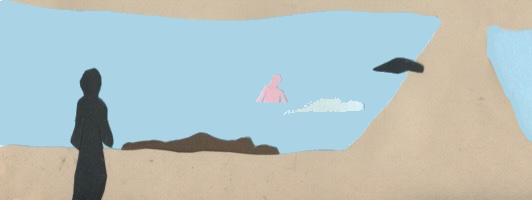
         The Viking raid on Lindisfarne was swift and brutal. I was a slave waiting with the ships and saw nothing of it but their return to the beach with the loot. Brother Ealdwin, watched from a slit in the tower door and saw it happen.

         The Viking fear of the Christian God granted the grace, at least for me, to change my slave’s shirt for a monk’s robe and return the great gospel to the Christian altar while the Vikings fled.

         In shock, seeing the slaughter, Brother Ealdwin looks deep for a message of God’s love amid the mayhem. “It was a blessing the abbot’s death was at the foot of the altar with the cross he loved. Here they all are, relieved of their earthly garb.”

         “God is weeping with us, now.” I answer.

         “God will get vengeance on his enemies.” Brother Ealdwin mumbles through his tears. “Surely God will sink their ships and drown every last one of them.”

         I understand Brother Ealdwin’s human rage in this, and yet, in all my years I know God also weeps for the hollow hearts of the Vikings. This isn’t the time to speak that sermon. The fervor that rises in our human wishes is for a vengeful God, who can make our own hatreds seem like justice. If God yields to these human prayers for retribution and bad things are because of our bad human nature, then why would a horror like this come to a monastery at all? I surely can’t believe these monks and Christians were murdered as  God’s judgment for their sins.

         Brother Ealdwin goes out to search through the monk’s hovels for any overlooked personal items that can be used for grave clothes. I take up a shovel and find a clear place of earth to make the burials sacred, but Brother Ealdwin is horrified that I would choose a place so near the burials of other monks. He leads me to a more distant site.

         I press the spade into the virgin earth to make a hole the size of a man. Earth shovel full, by earth shovel full, I am creating an emptiness — a shrine to what is no more. It is a project assigned by sorrow that uses every bone and muscle of this living person to match the deep emptiness of the earth with the depths and widths of grief.

         One grave is dug. How many more graves must we make here?

(Continues tomorrow)

#69.12, Thursday, June 26, 2025

Historical Setting: 793 C.E. Lindisfarne Monastery

         This one monk who saw the desecration has survived as he escaped into the tower to ring the warning. But it all happened so quickly there was no warning. Now, I see it will be our task to bury the dead.

         I tell him, “I was a monk in another time in another place, I was known then as Brother Eleazar, so this borrowed robe isn’t uncomfortable for me, it is only too long. And for that, I grieve for the one who wore it before me. You called him, Brother Jabari, from Egypt?”

         “Brother Eleazar, Brother Jabari’s body isn’t here among these. He was dark skinned. Even with the distortion of death, I can see he isn’t here. And I didn’t see him killed.”

         “He was probably the last one they slew because his robe was on the top of the heap of monk’s robes they took with them.”

         “I watched the marauders from the crack of the tower door, and they started with the abbot, taking his garb, then running him through with the spear. Here is his body.”

         The monk shows me to the top step, right in front of the altar. It is the body of an older man. We each take a moment to speak our prayers aloud. Then, it is he who breaks our longer silence.

         “I am Brother Ealdwin.”

         “Brother Ealdwin, ’Old friend’ that is, though you don’t seem that old. Sorry we meet in this hard time. It is a grueling task before us.”

         “Maybe not gruesome, so much, as my own chance to bid these, my friends, a glorious journey now that they are set free from earthly bonds.”

         “So let me help you with the hard work of it.”

         Brother Ealdwin goes into the vestry to look for linens to use as shrouds, and he returns, miffed by the thorough looting of every little corner.

         “Why would they take every fiber of fabric? First, they took the abbot’s priestly garb, dazzled they seemed by the fine silks and the deep blues of the dyes, but then, they took the clothes of the common monks as well, and now even the vestry was raided!”

         I know they trade in fabrics, and some, like I was recently, are, wearing mostly raw skins of hunted beasts. But I can tell you, if I were ever to see a Viking in a monk’s robe with a chism on his head, I would be appalled.

(Continues Tuesday, July 1)

#69.11, Wednesday, June 25, 2025

Historical Setting: 793 C.E. Lindisfarne Monastery

The monk with an unlit lantern was shorn just this morning as any monk would prepare for a normal day.  I think I had a glimpse of him, looking down from the tower when I was outside. But when I turned around now, he was startled by the sight of me, bearded, as I am, and unkempt as a slave. Or maybe he is terrified by me, because I am dressed as a monk in a robe cut for a giant. Surely, he was expecting me to be someone he knew – “Brother Jabari” — he called me. I try to explain myself.

         “I was just sent back here to return the book.”

         “Who sent you here?”

         What should I say? The Marauders? The fear of God? Was it God who allowed me to return to Christians, as wounded as Christianity is in this time and place?

         “I was a slave for them, but I am a Christian here.”

         He takes a small flame of a still burning candle tucked into a niche, and he lights the lantern illuminating the heap of pale corpses strewn on the altar steps, each step named for a piece of Trinity, “Father, Son and Holy ghost.” It is how the priest who ascends to the most holy place. It is the place where these guardians of the holy were felled.

         “I was a slave waiting with the ships when they returned with a heap of robes, and the stolen treasures.  They had no understanding of the gospel, so I was sent to return it to its place here. I traded my slave shirt for this stolen monk’s robe. It must have belonged to the one you knew as Brother Jabari.”

         “When I looked out from the tower, you were there and I thought surely Brother Jabari was safe also. He had the dark black hair – he was from Egypt, Alexandria, rich with the spirit of ancient saints.” This monk is weeping in his grief, “and now I see his robe was collected from him as he was slain. I saw them.  One-by-one everyone was stripped of their robes, then driven through with sword or spear. Some howled, some just gasped, no one fought. I ran into the tower to reach for the bell to toll the danger for others when I looked out and saw the looters tumbling their way over the rocks, and sailing off in their ships. Then I looked down, and saw you there.”

(Continues tomorrow)

#69.10, Tuesday, June 24, 2025

Historical Setting: 793 C.E. Lindisfarne Monastery

         The raiders were in this holy place at Lindisfarne an hour ago when I was still their slave.  They came here to find an unguarded stash of wealth, knowing nothing of the Christian nature of a place for worship. Unable to find the “Jewels and the gold” inside the precious covers of a gospel, they saw it as worthless and feared Christian magic and curses, so I was assigned this task of returning it. Now, from this high place just outside the walls of the Christian oratorio I watch the sea as the sails of the longships that brought me here catch the west wind to take them swiftly back to their own lands. I’m wearing a borrowed monk’s robe made for a giant, having shed my slave’s shirt. As they disposed of me along with this book that I’m returning to the altar they are set free of owning me and my Christian conscience. It was a convenient fix all around.

         Inside, the oratory the wash of light is tenuous in narrow shafts, harboring mostly shadows in dust. There is the smell of fresh blood. My eyes adjust. Naked corpses are at my feet splayed and strewn, each in his own dark pool. Walking in this long robe in this place has stained the hem of the borrowed garb in crimson. The altar here is stripped clean of linens by the Viking raiders and is an empty place now. There isn’t even a candle or a lantern. The sconces were ripped from the walls.  I place the gospel on the stand where it had been as though it was simply out of place for a few moments for the housekeeper to dust.

         With only my own voice in this void, I speak my prayer aloud.

         “Dear God, As I return this great gospel to your post, let also, these devoted and precious souls of your servants return to you, broadening the depths of love, as all of Creation weeps for them. Amen.”

         “Amen” I hear echoed.

         I turn around to see who is here. In a dusty shaft of light is a living monk, all properly shaven in shorn, in shock, frozen in terror at the glimpse of my face. I believe he is the monk I saw peering down from the tower outside.

         He stares hard into the darkness riveted on my face, trying to make sense of me, “I thought you were Brother Jabari.”

Maybe he doesn’t even see the horrors and deaths all around in front of the altar. 

(Continues tomorrow)

#69.9, Thursday, June 19, 2025

Historical Setting: 793 C.E. Lindisfarne Monastery

         I’m reaching the priory of the Lindisfarne Monastery, the gathering room used as a sanctuary and probably also the scriptorium. I find the marauders stopped here outside the walls. The stains on the earth mark their feet and axes soaked in the blood of innocent monks. Here they sorted through their sacks of loot to decide what was valuable.  In their way of seeing, a reliquary was valuable for its outside, the gold and jewels, so here they emptied out the contents of these little chests.  Here, mingled in the blood of unnamed monks are the treasured remains of more ancient saints – the gray dust of ash, the yellow spikes of teeth, the clump of silver beard hair, a bone or other remains.  These physical, earthly remnants of ancient saints, for some Christians, are a desperate grasp at something physical when possibly the need was really for something spiritual and invisible, the mingled namelessness in the fullness of the one love.

         I’m not the one who values this, who would be chosen to gather up these remnants of saints and return them to the altar from which they were stolen. But this gospel on its vellum pages, yes, I will return that to its proper place.

         Dear God, I know you don’t expect me to return the bones of the saints to make a shrine for lost pilgrims to come seeking their legendary three magical wishes.

         Looking up, I see someone in the tower here is looking down at me, but when I notice him, he is gone in an instant.

         I trudge my way around the outside of the wall to the entrance.  Out here, in front of this larger building in one direction are hovels for monks, made by hand as leafy shelters or rocks stacked, as the dessert fathers and mothers have always done. And in another place on this hill is a smoldering fire, oozing with molten lead perhaps a wooden chapel. So, this place was once in the Celtic style, even though the Benedictine rule was so prevalent when I last visited monastic communities.

         Now I see, stretched out on the steps just as he fell, the naked body of a man, reaching out an arm ahead of his fall, blood pooled beneath his wound, slaughtered as Jesus was by a spear to his side, a single cut in the same way young calves gave their lives for the vellum for the pages here.

(Continues Tuesday, June 24)


#69.8, Wednesday, June 18, 2025

Historical Setting: 793 C.E. Lindisfarne Monastery

         The robes of murdered Christians are laid out on the sand. I can see from the silks and brocades they also raided the vestry. In another heap are the robes of monks delivered to these sands unbloodied. I can imagine these monks were stripped of their robes before they were driven through with these weapons. What will I see at the altar when I return the gospel to its rightful place?  What has become of the monks of Lindisfarne?

         Gunnar would have me wear the finest garb to return the book, but I would rather pretend my way into the church as a monk than a father with higher authority. This is no task for a saint. As I choose the monk’s robe from the heap, there is talk among the raiders about the value of the haul and the risk of letting a slave possibly escape into the monastery wearing valuable fabrics. I leave the red shirt on the sand to assure them I am not coming back. It is obvious I am “escaping” and I will leave as a monk.

         I’m sure they were already of a mind that I wouldn’t be returning to the boats. Gunnar acknowledges a farewell to me, as the ships prepare to sail back on the westerly winds.  So now, I wear a borrowed monk’s robe and take up the weighty treasure to follow the path back from the sea to the church. I don’t look back.

         It is a steep climb with a heavy book and a robe too big. I climb onto each wide stone, setting the great book ahead of me for each step upward. All this way I see where the feet of the marauders left their footprints in the sands between the large stones. 

         Now, reaching the edifice walls that saved no one, the path of the raiders returning to the sea tells the gruesome story. Stains of blood – droplets & stained footprints, become more intense as I near this summit. And here is a place with sanctified debris – ashes and teeth and bits of bone – this is where the marauders stopped to open the reliquaries when they found no jewels. They, no doubt, kept the golden and bejeweled boxes anyway. 

         Dear God, I only come as a borrowed monk, not a true pilgrim seeking miracles, forgive me if I don’t seem appropriately devout. You know my heart, and for all the terrors and losses in this, I still grieve. Stay near. Amen.

(Continues tomorrow)

#69.7, Tuesday, June 17, 2025

Historical Setting: 793 C.E. Lindisfarne Monastery
 

         This beautiful treasure of Lindisfarne, a magnificent work of art is a gospel now laid out on the sand before me, right in front of the thieves. They were expecting a great hoard of jewels and discover now, that all they have are pages of artwork and inked letters imagining words not even carved as a rune stone. It is opened to the beginning of the gospel, where, amid the scrawls of Latin words, is a great illumination of the Chi Rho. I know these Greek letters are the initials for Christ. Even before the symbol of the cross was venerated, Christians understood the Chi Rho. And now, that is questioned.

         “Look” Gunnar, is standing right behind me, seeing this right side up and he wants everyone to take notice of this. “It is a bind-rune!”

         Gunnar reaches over my shoulder, with a pointing stick and traces the “x” of the Chi, then the Rho, to show these letters to us as the whole symbol.  How does he know this?

         “What is a bind-rune?” I ask. That was the word I heard Sjókona say as I was leaving her, “I hadn’t learned the bind-runes,” she shouted at me.

         “It is when runes are stacked together to make one meaning. Here is the Gebo,” he points again to the Chi, “It means ‘gift’” And this other, Wunjo is joy.”

         What can I say?  What can anyone say? We are awestruck by the presence of the holy in this. What do these murderers know of holy? Yet this circle of men is muffed in solemn silence. It is such a quiet that the blood dripping from an unsheathed sword makes a wailing sound as it slides off the blade.

         Gunnar speaks for all the men. “This will have to be returned to the place it was.” There are nods and whispered “aye’s” and someone says “keeping it would be a Christian curse on us all.”

         Now there is an expectation that the one who brought it out will be the one to return it. Gunnar glances back toward the ruin, then he looks at me, and says to the men, “It should be a Christian slave who returns it.  We should dress him up as a Christian brother.”

         Is a thrall in a red shirt not already dressed up a Christian? They paw through the booty of silks and satins, deciding what of their loot they will render for the Christian to wear who returns the book.

(Continues tomorrow)      


#69.6, Thursday, June 12, 2025

Historical Setting: 793 C.E. Lindisfarne Monastery

         Some of the marauders are returning to the boats with blood on their swords and laden with the booty they’ve stolen. No one from the monastery is chasing them.

         Gunnar knows my Christian nature and he chooses me to help in opening what might be Christianity’s greatest treasure, since it was placed as the centerpiece of the elevated table in the main oratorio. But it is no chest of jewels as they hoped for when they carried the heavy thing off. It is a beautiful book in a jeweled binding.

         The marauders and slaves crowd around as I open it before us all on the sands of the beach. I open from the back of the book, at the end of the fourth gospel, where Jesus is on the beach amid the boats pulled onto the shore, asking Peter, “do you love me?” [John 21:15] Opening from the back, I turned first to these pages in John hoping to catch sight of the dialogue on the beach. This gospel was copied into the language of the Romans so I find myself translating the words into the Norse language I barely know. There seems an annoyed sense of disillusionment among these Vikings in finding no jewels inside, but here, instead, these written pages.

         And it surely makes no sense to these marauders that the human-God shape-changer who is the subject of these gospels would end, not with a proclamation of victory, but with a begging for an affirmation of love. Instead of orders for retribution, Jesus orders the feeding of his lambs.

         I flip the pages from back to front, pondering the details of the artwork. From end to beginning, it is ever more brilliant — full pages of color and miniscule decoration – beasts and birds, spirals and leaves, all good things of nature, monsters, dogs and cats, inked in the style these Norsemen recognize as their own. 

         This is an odd wealth for these who would steal riches of gold and silver. It is the human response to nature with art and imagination they already know well.

         Turn back, again, each page nearly to the front, and here it is in Matthew 1:18, right at the first shape change story, the Incarnation, [Footnote] when the holy became a human infant, now with the murdering horde looking down on this page in awe. All spread out on the page like a great living form, are the Greek letters, “Chi Rho.”

[Footnote] Eleanor Jackson adds text to the picture book The Lindisfarne Gospels, Art, History and inspiration, The British Library guide, “With their apparent ability to metamorphose, expand, contract, progress and interact, the letters seem to be living beings, reminiscent of the interlaced and contorted creatures that are so prominent to the decoration.” (p,59)

(Continues Tuesday, June 17)

#69.5, Wednesday, June 11, 2025

Historical Setting: 793 C.E. Lindisfarne Island

         The slaves wait with the boats while the monastery at Lindisfarne is being raided. We talk among ourselves about our own Christian ways. I find these men who once called themselves Christian, in these times, have no idea of the Jesus peace.

         How does God answer the prayers of people when twelve slaves on a beach are praying different prayers and each one of us trusts God to be just, though we have vastly different notions of justice? 

         Dear God, how have our human ways taken us so far from the constancy of love for neighbor? I know the slogan from the teachings “Love your neighbor as yourself.”  It should be simple, except maybe for that “self” part. It is the human way to come before you despising the self, claiming sin as our spiritual nature. Dear God stay near us.

         From this beach we can see nothing of the raid. We heard the battle cries as they went ashore, but nothing now. 

         Now, one raider, Gunnar, comes dragging a bag of loot. He comes right to me, with a wide, flat jeweled case. Others are coming now. Everyone gathers around to see this thing. He believes it is a chest of sorts or a drawer that contains the most treasured jewels because it was found in the most special place on the high altar. It has a beautiful case with what looks like locks and hinges though has no real lock or place for a key. Gunnar suggests I will be able to open it because I know “Christian magic.”

         It is wide, but not very deep as a chest of jewels. It’s very heavy, and yes, it is beautifully set with gold and silver and precious stones.  It’s clear why they would think it is a chest to display gems, because they have never seen a book before.

         “It has no lock because it isn’t meant to be locked.” I simply unhook the clasps, and it is the most beautiful rendition of gospels I have ever laid eyes on.

         “It’s nothing!” someone shouts.

         “Let’s just keep the jewel case, and cast these innards into the sea.”

         I know that is what they would do. Others are returning from the raid with their swords bloodied and armloads of silks and satins — brocades cut into liturgical garb — golden crosses on heavy chains –and here are simple weaves of wool — the robes of monks. There has been a terrible devastation.

(Continues tomorrow)

#69.4, Tuesday, June 10, 2025

Historical Setting: 793 C.E. Lindisfarne Island
 

The red shirts have the longships pulled onto the sand facing the sea waiting for the signal. We talk among ourselves.

         “I was once a Christian.”

         “I am still a Christian.” I answer.

         “How can you be a Christian when we belong to the pagans and have no priest?”

         “I guess Christian is who I am and not what is done to me by the Church.”

         “That’s what the poor blokes in Christian robes say as they are getting bloodied by the swords of our pagan masters! This is not the time to hold fast to old ways, my friend.”

         “It is who I am. And didn’t each of us just make the sign of the cross as we watched the raiders running through the grasses toward the monastery?”

         “Aye, my friend, but our prayers were silent then. We could have been blessing our masters on their ways.”

         “And you think God doesn’t hear your silent prayers?”

         “Even if the masters don’t know it, this raid was clearly the work of the Triune God of Christ.”

         “A Viking raid the work of God? How is that possible?” I argue.

         “It’s clear when you read the signs.  First the signs of doom filled the heavens, then, the longships were carried briskly and directly to this exact island they set out to find. [Footnote] The Christian God brought this down on the monks and it is the Norsemen’s duty to God to carry out this raid.”

         “No,” I know that can’t be, “I’ve known the God who is and worshipped by Jews and Christians throughout all of my years, and God doesn’t manipulate violence.  God doesn’t punish people with pagan warriors. I know God well and God is love.”

         “Haven’t you heard the ancient stories man? People, even whole tribes and nations are always at the mercy of God’s mighty justice!”  

         What can I say?  Here we are, twelve men on a sandy shore in a respite of worldly violence.  Jesus served the fish that morning and begged Peter to affirm his love. Peter said you know I love you. And Jesus didn’t say, then punish my sinful sheep. He could have said, “Bring your swords and slaughter my lambs and eat well, you deserve it.” But Jesus said, “Feed my lambs.” [John 21] If I would say this aloud, it would make no sense to these men whose Christian vision is clouded with narrow notions of justice that simply means paying back hurt for hurt.

[Footnote] That early navagation tool would have allowed Vikings to approach an island from the sea, without having to follow the land. It was the Norse Bearing-Dial (based on sun shadows) Ibid, the drawing of this is on page 193 of Gwyn Jones’s A History of the Vikings Rev. Ed. (Oxford University Press, 1984)

(Continues tomorrow)