#64.8, Thursday, January 16, 2025

Historical Setting: 789 C.E. Jutland
 

         There is a lot I don’t know about where I am.

         Apparently, after the raids on northern river towns of Gaul, all that is left of the villages I once knew are these captives. Since the thralls here speak familiar languages and these masters do not, I take my questions to the slaves. I know the shortness of daylight so I know it is the solstice, but I don’t know the names for the gods. I asked Marian and she tells me these gods are bigger and louder than the Christian God with the Jesus on the cross. And they are always whining and fussing about honor and power, demanding sacrifices of mortals and otherwise ignoring the humankinds. Marian can find no connection at all with this and a crucified God. But, she explains, that if I really want to know how to speak to these gods I will have to go to the seiðr, and she is the one who would also know if there are any scribes here doing any writing. Marian promises to take me to this seiðr after the feast is done. She tells me the seiðr will tell stories in the circle tonight. So when the drinking horns are emptied, everyone will gather around the fire to listen to her.

         “Mostly people already know the stories, so when they come to listen, they will wait for the places in the stories for the shouts and hisses. But when you hear the stories for the first time, you might not know what it is about.” 

         “Will you translate the stories for me?”

         She giggles, “Of course I can’t do that. People don’t talk during the story time, unless everyone is supposed to be making the same noise.”

         “Of course.”

         In the end the abundance overflows the boundaries of station. Late into the feast this night no one is making anymore plans to distribute so much moose meat. My arms have a long reach to get whatever I want, and if I’ve made any enemies of these people they’ve forgotten already, so I can enjoy the abundance of it all. In fact, the horn of beer for the master’s circle is handed to me often now.

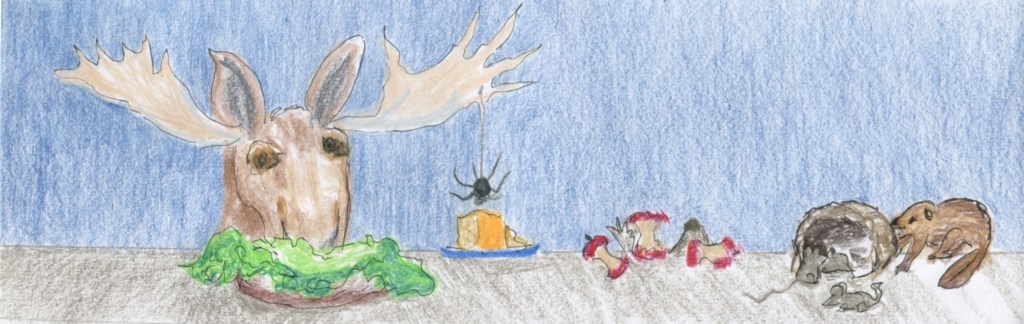
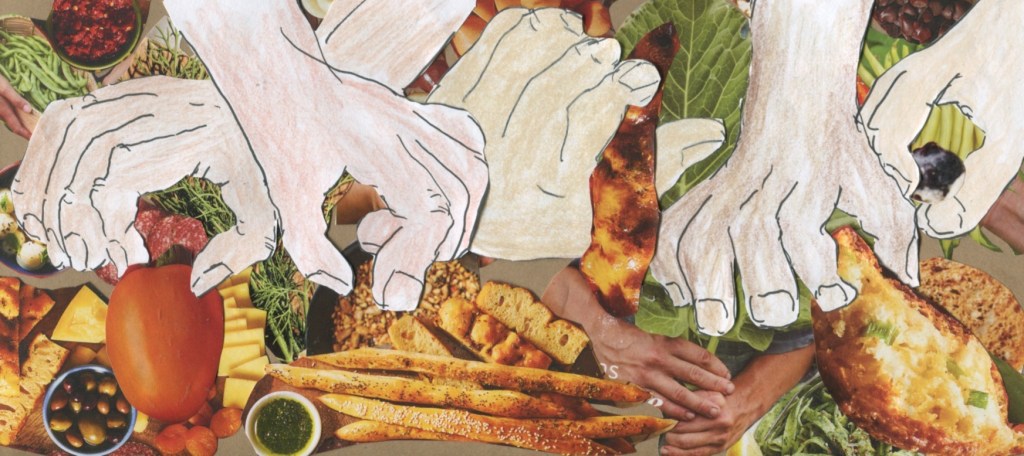
Everyone is taking from the board yet the dwindling morsels are still delicious. The stews of dried apples and pears are nearly boiled away to sugar, perfect sweetness for dipping the breads. And cheeses are still plentiful. Everyone, Christian, Pagan, thralls, all are well-fed this night.

(Continues Tuesday, January 21, 2025)

#64.7, Wednesday, January 15, 2025

Historical Setting: 789 C.E. Jutland

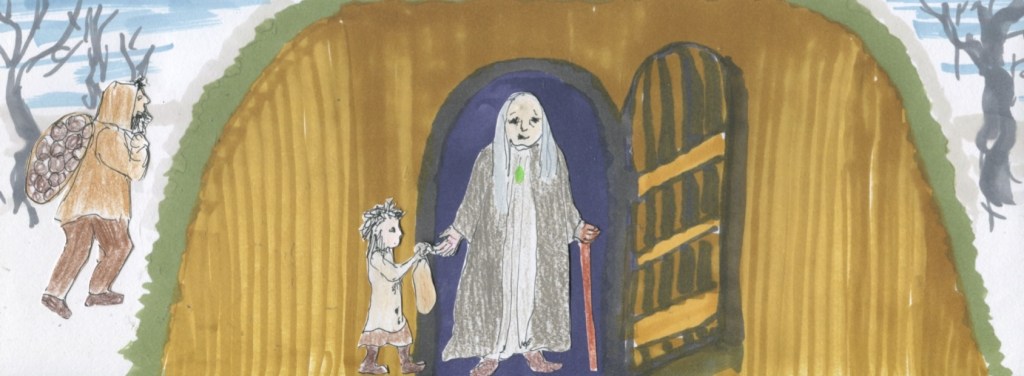
         Apparently, Marian’s value as a slave has soared by her ability in bread baking, and a woman here, among the masters is willing to battle for her.

         “Marian,” I speak to her in our language, “If you want to be the cook in this woman’s house, tell her the smiðr will need someone in his house; a trade is better than a fight.”

         Slave trade is the business of the masters and not of slaves themselves.  But in this case this child was cast off, or “gifted” to the old man maybe in gratitude for years of work. Or maybe gifting a child slave is a way of dealing with elders who would otherwise be alone. She wasn’t marketed as a thrall. But apparently, the gifting arrangement was temporary. Little Marian, orphaned in the raid, was only loaned to the cantankerous old man. Now he is older and more needy and the child is wiser, and the masters are taking her back as a marketable commodity. A new owner is claiming her. The woman claiming her assumes Marian is a mindless puppet gesturing to the little girl as though she were not even a human person. Her treatment in a house where she is needed has led Marian to think she bakes bread and keeps the house and makes the meals, not as a slave, but by her own choice to meet a need.

         Of course, I’m also a stranger to this communal slave ownership so I simply ignore these rules of ownership, as Marian has done. And I guess I am guilty of giving her the advice to simply behave as a free person. That seems to work for me, or maybe if put to the test, I may not have the freedom I thought I had either.

         Marian tells me in our language, this woman is known as a mean master and she doesn’t want to go with her. I suggested Marian could teach other thrall her bread making if she could be allowed to stay where she is, which would appease the dagger wielding smiðr who seems willing to fight to defend his property. And it would allow Marian to participate with others, freely as she does anyway, offering her own traditions and gifts.

         My prayer is in the language of silence, just between me and God. Dear God, thank you for teaching me my freedom as a human within Creation is granted as choices from first light. Help me always notice and value the choices that come with freedom.  Amen.

(Continues tomorrow)

#64.6, Tuesday, January 14, 2025

Historical Setting: 789 C.E. Jutland

         The hollowed horns of cow are passed around among those seated at the board filled with a beverage. Shaped, as they are, the horns can’t be set down on the board while filled, so they are guzzled then passed along to the next and all around the table, until they are nearly empty enough to set down without wasting any beer, but then they are filled again.

         Here, seated at the board, are the fellows with the sled and the chain I was wrapped in for nearly a night. They seem not even to recognize me now as that man.  I was pretty sure all they really cared about was the chain and I did set that free for them. Maybe not knowing how a stranger came to this table now, one of these fellows invites me to sit with them. My new host insists I share in the beverage as the horn is passed.  I find that it is a strong beer in that horn, at least at the first passing around the board.

         Still new to this language, I have no idea what the conversation is about at this table but as the evening wears on I see it might be about trading slaves.

         At the masters’ table the few of the women and, once in a while a man also, will rise and go to the place where the thralls are seated. One or two of the thralls are selected and called out from the group to be “inspected.” The masters seem to be negotiating buys and trades of these captives even within this village.

         A few more rounds, and now the keg is brimmed up with well water, so I suppose this feast is drawing to a close.

         One woman has taken a piece of Marian’s fine braid of bread over to the thrall line, and she picks out Marian, using no words, only lots of pointing and gestures, assuming Marian doesn’t know the dialect here. It is easy to see she is telling Marian the bread is delicious.  Had she spoken to Marian, who does know the language, it might not have caught the attention of the elder smiðr Marian looks after. It seems we all know what this woman is proposing here, and the smiðr of our household, tipsy on beers as he is, goes to the woman with his dagger drawn. Apparently, our smiðr and this woman are willing to bleed over the possession of a child slave.

(Continues tomorrow)


#64.5, Thursday, January 9, 2025

Historical Setting: 789 C.E. Jutland

         This place is not Christian and the feast we are preparing will be celebrating the solstice. The moose that fell into the pit provides plenty of meat. The moose is roasting over the embers of a huge central bonfire with breads rising on every hearth in the cluster of dwellings. Now the board is spread with all this abundance.  — heaps of breads, nuts and apples in bowls. The house that sends the milkmaid to the shed each night provides cheese; and where gardens were planted last spring, the root cellars are tapped for the winter stores of vegetables to make a very fine feast for celebrating longer days to come. Here is a pair of hollow bovine horns, and a large keg of beer.

         As people gather, the celebration has chanting and ritual, maybe prayers, rough and shouted. They definitely are not the tepid prayers of obedient monks to a god whose heroes are often martyrs and not always winners. These are the songs of warriors. I only know that from the sound of it. And maybe I’m hearing enough repetitions to catch some meanings.

         I’m looking for my place among these people.  The men are at the benches around the board and they seem not to reject me, only to ignore me. Already the bones of the beast are showing through the gnawed meats of moose.

         The outer circle at the feast is where the thralls find their places. And though I’m not actually a slave, I’ve decided to choose my place among them. Most here are women captured from their villages. The one I called Mara told me these people are marauders who came up from the waters and attack the Gaulish villages, murdering the men, plundering the riches, and capturing the women for the slave market. Mara was terrified of me when we were chained in that hovel. All she knew was my gender and my language and when I gave her the option for freedom, she chose to be owned by her captors instead. I can see here, that these marauders, first to eat, include the few women of their own people as the inner circle of masters. It is not a Roman feast where those at the table are only the men. Yet in Roman style, it is sons without beards and women slaves who stand aside until the inner circle has their fill.

         I have so many questions.

(Continues Tuesday, January 14, 2025)


#64.4, Wednesday, January 8, 2025

Historical Setting: 789 C.E. Jutland

Mostly I’ve been hauling and stacking logs for the feast. Day’s end, I return to the house of the smiðr with a load of thick hardwood for a hot fire and having seen the shipyard I can understand a purpose in this man’s work.

         I ask the child thrall, Marian, who shares my language, “Having seen this art all around here, I am wondering what there is of writing? Who are the readers and the scribes here?”

         “What are scribes?”

         “Scribes are like Christian monks, smiðr maybe, who copy the scriptures.”

         Marian was probably raised Christian, so she might know what I’m talking about. Finding written pages would relieve my fears, even in this language I have yet to learn. I have a dread that this future world where I find myself leaves nothing written anymore. Is it odd to fear a future without writing?

         I ask her, “where is reading and writing done here?”

         “These people aren’t Christian here.” She answers.

         “And yet the art and the designs on all sorts of things appear to me like the illuminations on manuscripts.”

         “All that writing would make it Christian and I just said they aren’t Christian here.”

         Maybe my questioning is confusing because Marian seems to think that the difference between pagan and Christian is simply that Christian has the written word and pagan only uses the illuminations.

         I ask again, “For me, this is a new time and a lost place. I was hoping there would be someone very old who might remember written language?”

         Apparently, Marian has no idea of the distinctions between old Christian and new pagan, but she does recognize my confusion and believes it can be met with a visit to a seiðr. She says, “but that will have to wait until after the feast.”

         “Of course.”

         The last bundle of logs I hauled for the day I delivered to this house because the old man is feeling especially cold today. Even though I’ve just filled the log bin he calls for me, “Heitzman! More heat!” It doesn’t even need translating, when he uses that title in my old language.

         He just sits in that chair by the window grasping each second of daylight. No wonder he’s constantly cold. If I stir the fire into a huge blaze, it will make Marian’s baking uneven and scald the soup and he will still be cold.

(Continues tomorrow)

#64.3, Tuesday, January 7, 2025

Historical Setting: 789 C.E. Jutland
 

Straying from collecting of firewood, I’ve wandered into a shipyard just north of the houses. No one is here. I suppose there are more of these artists working inside these houses.  And now I find plenty of wood stacked on the scrap piles maybe set aside for the burn, so why do I work so hard bringing fallen logs to the fire pit? 

         On closer look I wonder, maybe these aren’t scrap piles at all. Maybe these cut and planned pieces of hardwoods are here for the artists to use for the detailed carving projects yet to be started. I guess it would be thoughtful of me not to throw these onto the burn pile. What seems scrap to one man, might already be a great work in an artist’s imagination.

         And here is the purpose for the work of the smiðr. Each ship being built has lap strake of oak with the same curve as the wood piece the smiðr carves to make an elegant top edge. And each ship requires the art.

         This village is much larger than I first thought. I wonder how many more artists are working with a monks’ intensity to use what there is of winter’s light to chip away the art?

Every useful tool, even the sled that I followed here displays designs with details of knots and repetitious borders mingled with monsters and mazes. In these years that are lost to me the world apparently has become obsessed with finely made edges and trimmings.

         At first, I thought this was simply one smiðr’s obsession.  My imagination spun up stories of the smiðr coming from the Island of Columbanus, maybe as a slave, or a captured monk, an artisan with the inks but having no vellum here for his letters, he used the blade to make the details of the borders that would have been done to a manuscript. So, I invented a story in my imagination to account for the similarity of the carving to the manuscripts known among the monks.

         It could have been. But maybe it went the other way. Maybe these pagans, worshippers of different gods went to the Irish islands to live among the monks, thus the artwork with pagan images oozed its way onto the liturgical documents giving dark beauty to everything it touched. Who would know the order of the history of this?

(Continues tomorrow)

#64.2, Thursday, January 2, 2025

Historical Setting: 789 C.E. Jutland

Dear God, All day I did the rote collecting of wood, walking, mindless work, releasing the bonds of earth in repetitious devotion. Thank you.

         I’ve been stacking logs at the hearth in this little house of the wood carver intensely devoted to his work.

Now my task is to bring many more fallen trees from the forest for a village bon fire to celebrate Solstice.

         Marian, a child, and the smiðr’s slave from Gaul, prepares the bread as this house’s contribution to the feast. It’s braided as was the tradition in my own home many centuries past.  I was thinking that the only things that could be saved throughout the generations were made of iron and stone, but this child knows a tradition for braiding a loaf of bread that comes from a well of history, maybe never written, but always known. She, herself, probably doesn’t know the long root. But she still makes the bread. Like tangible heirlooms, traditions pass through generations uncounted by time.

         I continue laying firewood at the fire pit on the shore near another cluster of houses to the north.  These logs are burdened with the dampness of the winter. It will be a smokey fire but long burning.

          After every heap of logs I drop, I take a stretch to remind my shoulders and back there is more joy in being human than simple work.  It feels good to stretch these new muscles and to stretch my imagination to encompass the whole view of this sea coast from this point of land – all so beautiful in its winter glaze and brilliant azure sky.

         Resting a moment, I take a stroll further to the north and here I see a whole shipyard. One ship, complete with mast and oars, is moored in this bay and others are in various stages of construction. These look very much like ships the Wends were using to ferry our horses over the river those years ago when I traveled with my son and his partner. The boats had a solid keel that could support a mast but were made to navigate rivers then portage over land.  This ship is longer with a slightly deeper keel, maybe suited for sea travel. It has more elegant lines as so much attention is given the detail of the art.  Could art be tradition?

(Continues Tuesday, January 7, 2025)

#64.1, Wednesday, January 1, 2025

Historical Setting: 789 C.E. Jutland

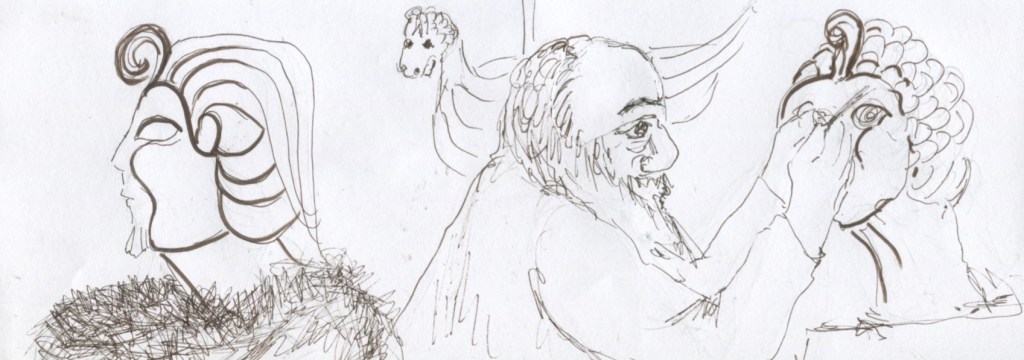
         The mystery that pricks my imagination just now is the work of the smiðr. I watch him work for a few minutes here, thinking of purpose for his art and I see how this is so much like the work of Celtic monks illuminating the sacred Christian texts.

         And here, these carvings of snakes and dragons slither over every civilized thing in this house, the carved bench, the walking stick, the fire poker, everything, like fang marks left in the hide of the wolves’ prey, this decoration lays claim to every possession. Maybe these ribbons of monsters own all of humanity in this untamed land. They say “All things decorated here!”

         Or maybe the purpose of the art is not just to make the human claim, but maybe it is to please a pantheon of otherwise oblivious gods? Or maybe it is a game, a competition among smiðrs for the finest carving — the deepest cuts and the most flawless curves.  Maybe it is done for all of these reasons.

         I’ve felt this intense focus on repetitious detail before. As a monk in a more ancient time, I, myself, sat in silence with so many others like me, capturing the daylight on our stands in a scriptorium, in order to copy manuscripts precisely. We intended our work to pass the abbot’s human inspection, yet our spoken purpose was that we were working to glorify God. Didn’t we all say that even when we cared most that we glorify ourselves in the abbot’s assessment, or maybe glorify our own standard of perfection. 

But there is one deep and hidden reason for such intense work that I know well also and surely the smiðr is aware. It is never spoken. But art serves that moment of deepest devotion when the redundant task busies our hands or feet or voices so Spirit finds us in timelessness. This is the traveler on the labyrinth. It is the repetition of the prayer words in the rabbi’s ritual. It is the stopping of time where Spirit finds spirit, and only a oneness with God exists.

         Of course, this pagan smiðr, whose gods have names and powers, probably doesn’t expect to discover a holy oneness with Spirit, or does he?

         Maybe we all experience the mystical moment in the same way, and only our names for God and Spirit and Holy differ. It is even possible to live outside of the one Spirit of Creator love, while only some prideful taboo or numbness keeps us from acknowledging it.

(Continues tomorrow)


#63.13, Tuesday, December 31, 2024

Historical Setting: 792 C.E.

         I ask Marian the question that has been most on my mind, “In the Christian way of counting, what is this year?”

         Marian tells me she thinks it may be 792 at least for the measure of time in Gaul after the start of time. So, with my strange nature of life and life again I was buried as a dead man for 161 years. With so much time passing I can’t expect to return to my loved ones and find my life as it had been – except the grieving for those I once loved is always familiar to me. Even my grandchildren would be gone by now. I wonder if the hill behind the ruin of Annegray is still a farm — such a fine farm we had then. 

         So, is a gift of continued healing and life and life again a blessing or a curse? Without holes in my memory as might be gifted to some of us as we are old, remembered grief is always grief. It sneaks into my imagination when I least expect it – a familiar sound or a fragrance …

         This unquenchable grief was there when I awoke into life in the cache of a grave-robber when I saw my soldier son’s byrnie hanging lifeless, leftover, with earthen bits still clinging.  As tattered and empty as it was, its limp chains hung there along with other maybe marketable grave goods unearthed from other graves with strangers’ griefs attached to them. In a century or more already passed it was only the chain mail that remembers Greg. In life, he and his partner were fine men who sang and danced and loved. When they took me traveling with them, I had already cut Ana’s name into a stone. So, passed life is only known as a stone and steel now, and whatever love is lingering lives deep in my memory.

         I push the flaming log on the hearthstone closer to the center of the flame, and some sparks rise up, always rising from the embers, ever here, even in this unknown time and place.

          Dear God, thank you for staying close, sharing my grief, keeping my loved ones close to you, in the oneness of all love, so that the bright sparks of moments recalled are not all there is, but let me keep the full flickers of remembrances and thoughts of the wholeness of the warmth and light and love.

         Marian interrupts my quietude. “We finally have a warm fire in this place. Thanks.”

(Continues Tuesday, December 31, 2024)

#63.12, Thurs., Dec. 26, 2024

Historical Setting: An unknown time in a cold land
 

         I’m hearing from this girl Marian how life is done in this place. Small as she is, she isn’t able to provide bathwater. And she believes bathing is necessary. The human smell of this place affirms that. So, I can make myself worthy of my cup of porridge. She shows me where the village shared things are stashed and I bring the half-barrel tub around so the three of us from this house may go clean into the solstice.

         The smiðr accepts my offer to help him into the bath. He is stiff and bent, and he needs a strong arm to support him. He’s not one to speak gratitude so I’m affirmed by the simple fact that he didn’t put his dagger to my throat. Marian chooses to have the tub emptied and refilled before her bath. She was probably stolen from a wealthy household where she herself had servants. So, we refill the tub.

         I am last to bathe. My clothing could also use a good airing. But this is not the time or place for that.  All I have to wear is just what I have stitched from the cleaned hides of deer and those skins I retrieved are still pierced by wolf fangs. I would like to find a weaver for a finer garment but, I’m just grateful deerskin seems to be common here and I don’t appear inappropriate or worse yet, as I actually am, naked.

         I see the smiðr has some garments of hide but he also has a wool shirt. Marian wears a linen tunic, once elegant, now in tatters. It is probably the dress she was stolen in. She has a bear skin for a wrap, and that is also her sleeping place.  The smiðr has a fine elevated box built of wood for his bed. It has a bearskin and a weave of wool for a blanket. So, I’m sure there are spinners and weavers somewhere.  Maybe one day I will have a shirt.

         Marian sees my need for a sleeping place and tells me, when I return the barrel, I can take a bear skin from the shared village stash to use as my bed.

Then returning the half barrel I do find a bearskin for my need.

         It is a true blessing to sleep tonight, clean and warm, well-fed, and in the company of an old man who snores. It is good to be with humankind. Again.  Thank you, God.

(Continues tomorrow)