#65.3, Thursday, February 6, 2025

Historical Setting: 793 C.E. Jutland
 

         The seiðr seemed surprised I would know of an auroch, which was a rare beast three hundred years ago. Considering the nature of hunting and poaching, I’m sure there are no more aurochs now. She asked me how I knew of them and now Marian offers to explain.  “I will just tell her you don’t know anything because you are new.”        

         “No, tell her I am very old and have a good memory.”

         “But you aren’t very old. The seiðr and the smiðr are old. You are no older than my father was when they struck him dead.”

         The seiðr interrupts and tells Marian what to tell me.

         “She wants you to come to her house again tomorrow and she said you won’t need a translator.”

         Now the old woman presses her walking stick firmly into the earthen floor, and rises on it, to turn her attention away from our conversation looking off into nowhere, yet far away. She tells me, “The ancient stories are of heroes and grief. Children don’t need to know what you are asking me.”

         Apparently, she will feel free to answer my questions if I don’t bring a child with me. And I wonder how might that conversation go with no translator and the hard questions I’m seeking answers to, like why must writing be limited to stone and wood and iron? Why are the inks only for Christians? What tragedy came to these lands that shattered families, leaving no respect for age and little use for children? What is the source of this same art? Was it gifted to this land, or was it stolen from them by others?

         I don’t need to ask if slaves always grieve. Of course, grieving for one’s homeland is the deepest nature of the thrall. But apparently, the seiðr chooses not to acknowledge the grief of slaves. She doesn’t wish to have grieving Marian come with me tomorrow.

         On this new day, it’s late in the morning when I go back to the house of the seiðr alone. Even though she dismissed my translator my ear for understanding the language is improving, so maybe we wouldn’t need a translator unless she wishes to tell me something that requires rare words. And I guess the child translator’s editorial input was clouding the issues. Maybe it is better to try this without a translator.

(Continues Tuesday, February 11)


#65.2, Wednesday, February 5, 2025

Historical Setting: 793 C.E. Jutland
 

         When my question about writing in this new world is finally passed along in translation to the seiðr, the wise woman shows us the carvings on her walking stick. The seiðr calls them “Runes.” But I perceive this as some kind of numbering system. These people are near a hub for world trade. That was how it was when I came on that journey with my son and his partner. That journey we took nearly two hundred years ago began at a world trading post at the mouth of the Rhine. Now, here I am north, in this winter-hardened land. Yet, all around us are influences of distant traditions, not only of the ancient Celts and Christians, but little treasures and traditions from all four corners of the wind. The seiðr is wearing a brooch carved from jade with a distinctly eastern design.

         I ask a simple question about the runes on the cane, expecting the answer will be about the need for recording numbers for trade. But not so.

         With Marian’s translations the elder seiðr tells me runes are each complete ideas in their own way. Each is poetry. They are more than letters on a page would be – more than the writing of Christians.

         “Runes each have a depth. It is not just a fraction of a word as is a letter in languages of Roman and Greek. A rune is already a completeness of thought.”

         I’m thinking of that far traveler who imagined a Sphinx while staring off a ship’s prow considering ancient omnipotence. It riled the traditional wood carver. So do carved glyphs from faraway places teach these people to savor language that can be chiseled in with straight lines?

         She points to one little set of lines on her staff and tells me its meanings. “This one is bravery, and here is Odin and the gods.”

         I point to one and ask.

         “That one means ‘Auroch’” She says.

         “Auroch?”

         “Wild ox”

         “I believe an auroch hasn’t been seen on earth for more than two centuries.” I know these things.

         Marian translates.

         The elder woman asks and Marian translates, “And how would you know something like that when you seem to be a man who knows nothing at all?”

         I know enough of these words to know Marian’s translation was rough.

(Continues tomorrow)


#65.1, Tuesday, February 4, 2025

Historical Setting: 793 C.E. Jutland

         Here I am so far in the future where my language is only spoken by slaves.  Here the god that is God isn’t known and writing isn’t valued because no one reads.

         Dear God, maybe people always imagine a future inventing a life that will be the same or better than the present. Then, here I’ve come into the future, and now I find the world has gone Pagan. Are you still here with us, God?

         This is one of those prayers where I ask God to show presence with me. And God answers, not with a vision, but with my vision and so I am suddenly seeing beauty all around in everything. These strangers were feasting with me, laughing, singing, smiling, nearly welcoming if only they could welcome a stranger – surely God is here, even unseen.

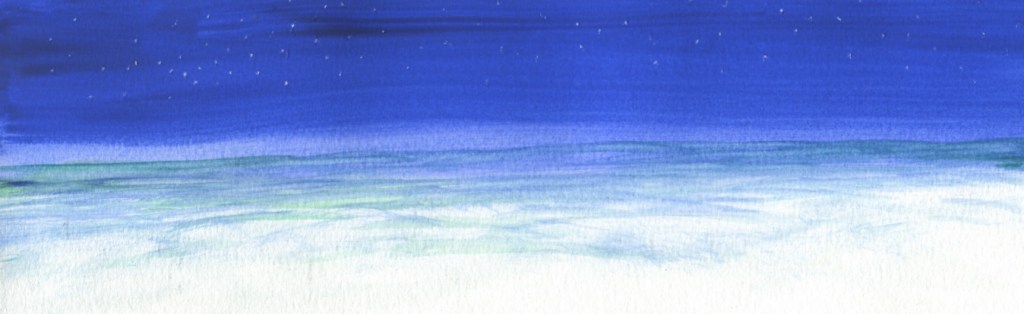
         Here the cold waters of the sea are rising up in all their translucence, tumbling onto the shore in foam with every next breath of sea – surely God is stirring the waters, yet unseen. And at night when the sky is still stained with lost sun on the western horizon and a glitter of stars spread in the east – surely God is setting each in place to guide the sailors and comfort night shepherds with an eternity, yet unseen.  Thank you, God, I knew you were here all along. Let me not forget.

         My questions are hard ones and not easily answered with the simplicity of words even if I knew the words.

         May the seiðr be my source for understanding this strange new world. Marian and I sit down in her house and Marian translates my first question.

         “I see lots of art work done in the style used by Christian monks in copying manuscripts. Do people also read and write in this time and place?”

         The woman doesn’t answer with words. She rises from her great chair and walks slowly to the wall rack with cloak and the wineskin. She takes another long swig from the wine skin and hangs it back on the hook, then brings the walking staff to this bench where Marian and I are seated, and she points to the carvings on the staff.

         It could be letters for making words, but it looks to me, more like a numbering system because each little mark was spaced and spread out like numbers were independent of the others, for the meanings.

(Continues tomorrow)

#64.14, Thursday, January 30, 2025

Historical Setting: 789 C.E. Jutland

The feast of the solstice is over but days don’t seem long.

         I remind, “Marian, I would visit the seiðr after the feast.”

         I still have my questions about the nature of literacy here and also, why this population is oddly, mostly middle-aged men.

         “I can’t imagine why you would want to know that stuff. They aren’t Christian here. And you already heard her tell a story as she does.  So, what is there to read?”

         “I can’t know that without knowing what is written.”

         “And how might that matter if you don’t even know the language?”

         “I’m just asking for your help as I try to understand things. I expect I will know the language soon enough. I caught some of what was happening in the story, just not the reason why all that shape-changing happened.”

         “There didn’t have to be a reason. It was a story.”

         So today little Marian and I go to the seiðr. Marian says we need to take a gift so I bring a bundle of wood and Marian brings a skin of wine she says she stole from the community cache. That’s where our food comes from and it is the source of furs and the pelts we use. It may not be stealing, as I think it is for community sharing.

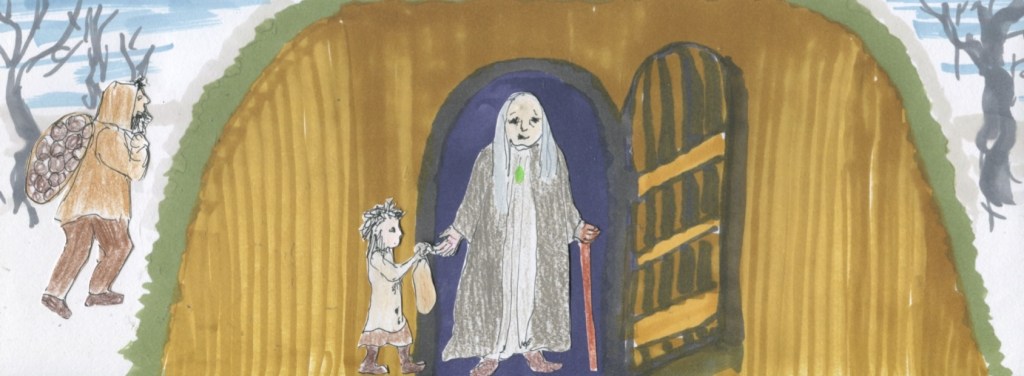
         The seiðr answers the door seeming more haggard than at the feast last night. She isn’t animated by story. Her long silver locks are laying limp and her dress is uncinched, spreading wide and free, but also, large and unkempt. She lives in a house with lots of others, and it has the fragrance of mint tea, boiled dry, burned in an iron pot. She tells me where to put the wood and takes the wineskin from Marian, thanking the child profusely as she guzzles a good swell, then hangs the satchel of drink carefully next to one of the cloaks and her walking stick.

         Marian explains who I am to the seiðr and all I understand of her explanation is “heit” because I did bring the wood for the fire.

         “Ah-ha! viðarhlass!”

         “She calls you ‘load of wood.’ She thinks she already knows you.”

         She says something more and Marian translates.

         “’Logs aren’t heat until they meet the fire.’ That’s what she said.” Marian interprets, “So it is probably something to make us think it into meaning. And making us think things into meaning is what a seiðr does.”

         May we continue?

(Continues Tuesday, February 4, 2025)

#64.13, Wednesday, January 29, 2025

Historical Setting: 789 C.E. Jutland
 

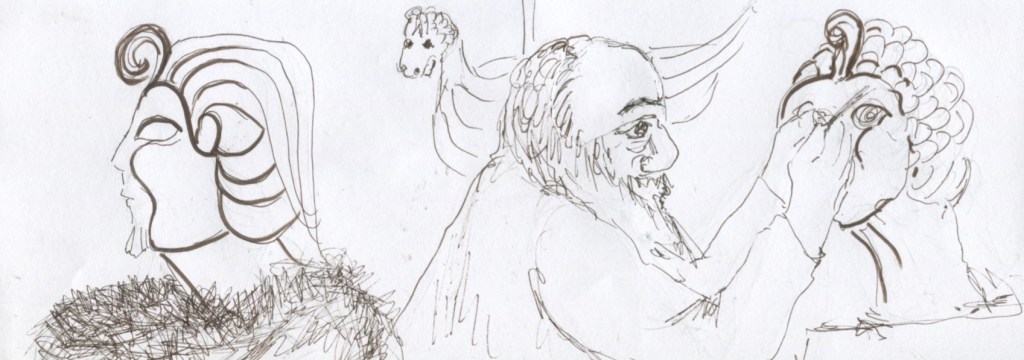
The elder woodcarver is complaining about the erroneous carving by a younger smiðr which was prepared for the new ship being built. The elder brought the failed art back to his own work table to “fix it.” He will have to magically shape-change this thing into a properly ferocious dragon. When he removes the bear skin, unveiling the art, it is very clearly a fine carving, but not of a toothy, scaly, dragon’s head. It is a regal and all-powerful head of an Egyptian Sphinx.[Footnote]

         Apparently, the younger smiðr assigned to this artwork is a well-seasoned world traveler. And the elder art critic only values local dragons and sea monsters. So maybe it is sometimes possible that tradition demands shape-changing.

         The old man sets the head with a Pharoh’s face onto his work stand, not even imagining the lion’s body with outstretched paws needed to transform a boat into a rightful sphinx. He might have missed the point of the mythical hybrid altogether, because clearly this thing he calls tradition does not flex for exotic foreign creatures.  He flicks his chisels on the whetstone and taps away at the nemes (or Pharoh’s striped cloth) changing the stripes to scales, cut deep, in a staggered pattern, row upon row of perfect dragon scales.

         Marian, as young as she is, believes she also knows the power of tradition. The wrangling over her as a slave, empowered her belief that it is tradition that gives a person value – even a slave. At least tradition, drawn from some other time or place where she was raised before capture, seems to be what gives utility to her person. She found that knowing the tradition of baking bread has become her bargaining chip. But she doesn’t get the coins for the bread. And that pittance of coins that were argued over is the price of the slave who bakes the bread.  Maybe, only in the mind of a ten-year-old, lost and grieving for her family, desperate to belong somewhere, is the price offered for the tradition she remembers worth the total value declared for her humanity.  It is a grieving child’s perspective.

         I ask her, “Is it different for you now that a price was asked to make you into a bought slave?”

         “You make it sound like a bad thing.”

         “Are you allowed to make your own choices, or must you only do what a slave does?”

         She laughs, “I’m a child. I do what I’m told.”

[Footnote] This element of a ship’s carved head is fiction here. What is sustainable history is that the trade routes through the Baltic and beyond were vast and included Egypt and areas to the east.

(Continues tomorrow)


#64.12, Tuesday, January 28, 2025

Historical Setting: 789 C.E. Jutland

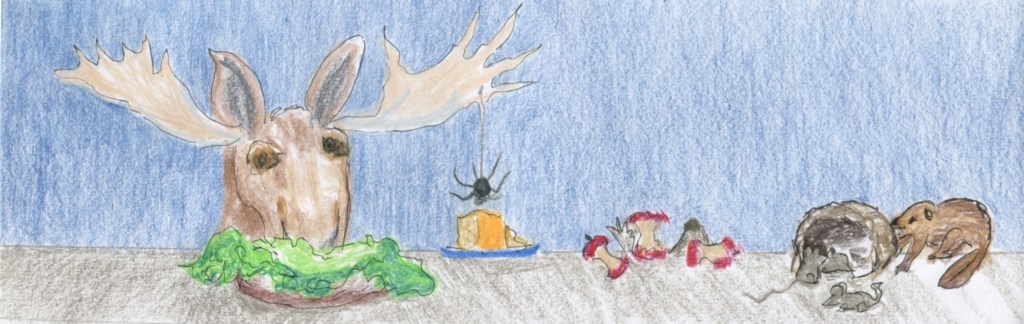
         This morning men and the few women who passed around the horn last night are groggy with hangover. No one is here at the feasting board when I come out to clean up the dregs of celebration. Everyone who listened so long to the stories told by the seiðr must be sleeping or hiding or maybe there’s been some shape changing from drunkin’ partiers into woodland creatures that I see have visited this place in the early hours of this morning.  There is really very little left here to clean up.

         First thing this morning, at the house of the smiðr where I’m staying, Marian is already setting beans to soak for supper. The elder smiðr isn’t here just now. Marian tells me while I was out, he went to take his carving of a ship’s border to the building site for the new ship. But I was just out there, and I didn’t see him.

         Now he returns from a visit to another house where one he calls an “apprentice carver” was working the on the center piece of art for the new ship. He has the bear skin I’ve been using as a sleeping mat wrapped around this, something big and nearly too heavy for him to manage.

         Apparently, this elder smiðr considers himself the master carver and he stopped to assess the work of a younger artist. Now he is cursing, all twisted in knots over the “poor standard of workmanship” youngers get away with in these new times. Agism again.  It works both ways.

         Of course, I’ve seen this method of teaching before, when an elderly abbot inspecting the work of a novice speaks only the woes of youthful flaws, then the would-be teacher takes to the inks to do it over by himself.  It may sound like an exemplary teaching style, but really it is this old monster agism gnawing away at generational harmony. This elder smiðr who only works alone, had no intention of guiding an apprentice to do better work. In all his cursing and fuming he just plans to fix it himself.

         Unwrapped this whole ship’s head is nearly too large for the smiðr’s worktable. These ships are intended to look fearsome and dangerous, when they approach a village for a raid, so it is important that the carving, the vanguard of the attackers, represent the ferocious presence of a horrific monster, but here, is a…

(Continues tomorrow)


#64.11, Thursday, January 23, 2025

Historical Setting: 789 C.E. Jutland
 

With fire only embers now, the “seiðr” sops up the last of the juices with a broken crust and takes a long guzzle from the horn of beer then speaks.

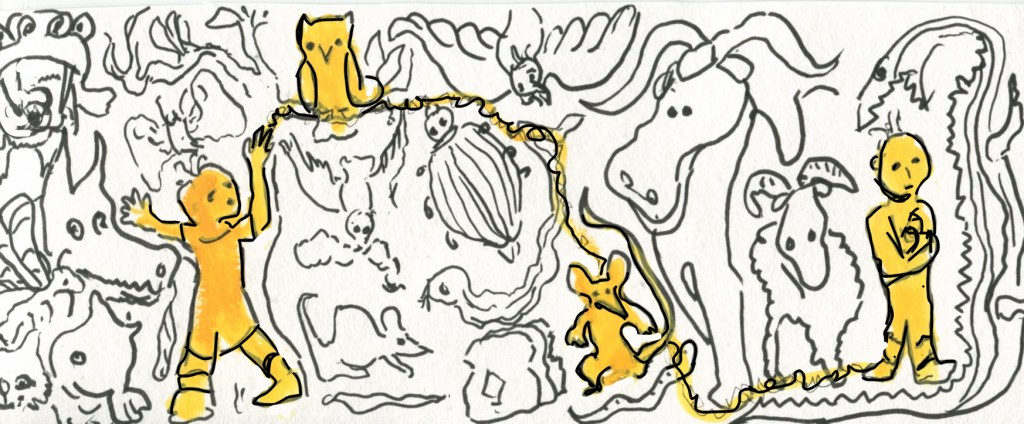
         She spins a yarn, layer upon layer, starting with a boy with special powers that allow him to change his shape from one thing into another, like a caterpillar into a butterfly. But this story takes an imaginative tour through all of creation.

         I’m only beginning to learn this language, but I know from the sound of her voice and response from the gathered, that this protagonist wandered into a dark place amid shadows with strange creatures lurking. Or maybe it is his imagination making the lurking presence fearsome. I’m missing the subtleties. In fact, not understanding the language leaves me wondering.  I believe the boy changes himself into an owl that can see through the darkness and rise above the mayhem. Then, this essence of boy becomes the mouse that escapes an owl’s grasp. I wonder why he didn’t become an eagle, and simply snatch the owl from the sky.  There are so many things appearing and reappearing as the story is woven.  But somehow, knowing the language might help make sense of the motivation for all these shape changes. At least I would understand some reason for the fears that send this ever-transforming essence of character into new dangers, requiring even more new transitions. [footnote]

         Marian is sitting at the feet of the storyteller, shaped, as she is, into an avid listener to this tale. She isn’t about to step out of the storyteller’s spell just to translate it for me and answer my questions. So, I just do the best I can knowing only a few words here and there that tell me lots of the who’s and what’s but nothing of the why. Does this strange fantasy even have a reason?

         The embers are low and offer no heat now, so I glance over at the fellow who told me not to add a log, wondering if it’s time for another log. Apparently, the story has gone on long enough that everyone is cold and tired and some are leaving, and the essence of boy transfigures into a human again.  Those who stayed awake for the ending offer up a polite cheer of approval. But mostly they just wander off — everyone but Marian and me.

[footnote] shape changers stories are common in Celtic and Nordic Tales. (2019 Chronical books, L.C.C., Nordic Tales illustrated by Ulla Thynell)

(Continues Tuesday, January 28, 2025)

#64.10, Wednesday, January 22, 2025

Historical Setting: 789 C.E. Jutland
 

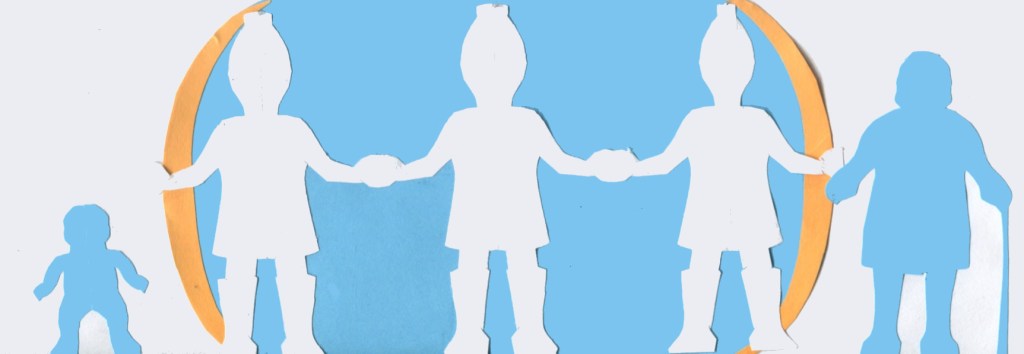
I have questions. When a people pull themselves into community after a devastation — a war or a famine – it happens with plague — anything that selectively removes a generation from the population — taking all of the children from families — or taking all of its young men — or leaving no old people watching and knowing. It happens that the survivors of a mass destruction of a generation aren’t grouped as families but as winners and grievers. I’ve seen this happen with plague and wars. I’ve seen it when the strong, able-bodied people in that life-stage between vulnerable child, and waning elder, sail away to trade goods, or raid villages, or win wars. They are striving to gain whatever it is that fills the emptiness in the loss of belonging in family.

         I’ve seen it before. And it happens again and again.  Even in a wolf pack, one little brother leaves a fine family of wolves to go off and become something more, and there is a loss in valuing all ages until new pups grow to meet the missing age. Then in another turn these become the elders.

         So why does this village have so few women and rarely a child, and these they do have are mostly slaves brought from other places? Why is conversation with children artificial and meaningless and conversation with elders avoided altogether? Something was lost from these people. The reason for the loss is a mystery to me, but the remnants of this loss of family show as a community ruled mostly by brutal men striving for the win. Love bonds seem frivolous, and love itself is misunderstood to be a lurid trick or obsession.

         Everyone gathers around the fire. I would add a log, but a fellow mumbles in his language, then takes the log from my hands and pitches it back onto the wood pile. I understand this is the time for embers.

         Marian told me, when the village gathers for the feast, maybe then the seiðr will come out and tell the stories. A brass plate is passed around the table collecting leftovers as though a platter is prepared to serve a royal. And here she is now, a pale northern woman with eastern eyes, straight statured, amply filling abundant robes. Her long silver locks spread on the wind like the feathered wings of seabirds giving her a near mythical halo. Her matriarchal presence answers the yearning of these people, the mother to this lost family. She is served the brass plate of food as people gather to listen.

(Continues tomorrow)

#seiðr, #storyteller, #lost family, #matriarch, #family function, #population devastation,

#64.9, Tuesday, January 21, 2025

Historical Setting: 789 C.E. Jutland

         That misunderstanding of Marian’s freedom or enslavement seems rooted in a common misconception having very little to do with freedom and slavery. In the case of a child and an old man, this perception of them as less than human is all about agism. Sometimes there seem to be only four stages of life, not counting dead: 1st Infant, 2nd, Child, then some amorphous stage which seems to be the ruling class, and 4th Old. According to the fallacies of this 3rd stage, in this nondescript life stage known as adulthood, a child is a thing and not a life stage, and old is always a lame curmudgeon, also, not really the same as a human.

         That would be an easy assumption if the world were peopled with time travelers such as I am, always healing back to life as a man in his thirties.  But I’m not the vanguard of an ageless reality.  I am simply a sign, a literary device, a creation of human imagination invented to reveal the history of us. It is only by human imagination that a man could live throughout time, always as thirty something. The human error, common, even among human beings who themselves are passing through these stages of life, is to think childhood is a permanent condition and old age is always someone else’s swan song. But the truth is, all living beings are moving through predictable phases of life. Trees, frogs, birds, bugs, even flowers have their season.  The same person who is old now, was once a child. But agism causes the same person who is in this random state of adulthood, to see children and elders as a different species altogether. And that, too, is a fantasy of human imagination — a fantasy, though it happens in real life.

         It is only by the good fortune of life continuing, that oldness can become half again as long as a whole lifetime.

         So how is it that a whole culture becomes agist? How do we lose sight of the value of children and the usefulness of old people? It is obvious to me, having recently lived in a wolf pack. This disrespect for life stages happens when people are not living in complete families. They’ve been organized by purpose, not family.

         So, I wonder, what happened in this north land that cost this whole culture their empathy for the seasons of life.

(Continues tomorrow)


#64.8, Thursday, January 16, 2025

Historical Setting: 789 C.E. Jutland
 

         There is a lot I don’t know about where I am.

         Apparently, after the raids on northern river towns of Gaul, all that is left of the villages I once knew are these captives. Since the thralls here speak familiar languages and these masters do not, I take my questions to the slaves. I know the shortness of daylight so I know it is the solstice, but I don’t know the names for the gods. I asked Marian and she tells me these gods are bigger and louder than the Christian God with the Jesus on the cross. And they are always whining and fussing about honor and power, demanding sacrifices of mortals and otherwise ignoring the humankinds. Marian can find no connection at all with this and a crucified God. But, she explains, that if I really want to know how to speak to these gods I will have to go to the seiðr, and she is the one who would also know if there are any scribes here doing any writing. Marian promises to take me to this seiðr after the feast is done. She tells me the seiðr will tell stories in the circle tonight. So when the drinking horns are emptied, everyone will gather around the fire to listen to her.

         “Mostly people already know the stories, so when they come to listen, they will wait for the places in the stories for the shouts and hisses. But when you hear the stories for the first time, you might not know what it is about.” 

         “Will you translate the stories for me?”

         She giggles, “Of course I can’t do that. People don’t talk during the story time, unless everyone is supposed to be making the same noise.”

         “Of course.”

         In the end the abundance overflows the boundaries of station. Late into the feast this night no one is making anymore plans to distribute so much moose meat. My arms have a long reach to get whatever I want, and if I’ve made any enemies of these people they’ve forgotten already, so I can enjoy the abundance of it all. In fact, the horn of beer for the master’s circle is handed to me often now.

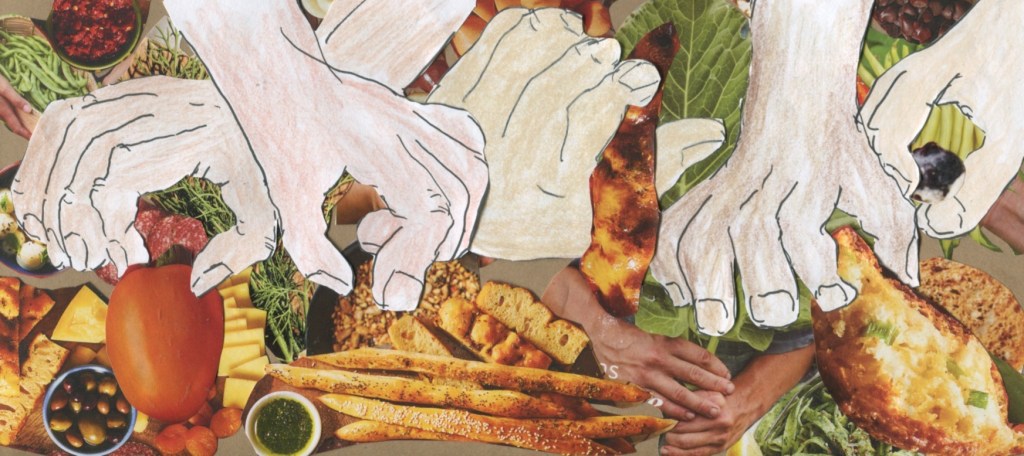
Everyone is taking from the board yet the dwindling morsels are still delicious. The stews of dried apples and pears are nearly boiled away to sugar, perfect sweetness for dipping the breads. And cheeses are still plentiful. Everyone, Christian, Pagan, thralls, all are well-fed this night.

(Continues Tuesday, January 21, 2025)