#75.8 Wednesday, December 17, 2025

Historical Setting: Jarrow, 793 C.E.

Drinking songs of soldiers changes the music of this hall from arguments among novices to soldier’s seasonal songs enhanced with ale. Even those youngsters attempting chants with their changing and untrained voices are, to me, a worse disruption to my sleep than drinking songs. I oddly appreciate the change in the neighbors in this hall.

Even with their most ale afflicted “best” voices, the little dancing tunes escape their cell and call forth the celebration of the season throughout these dank and chilly halls.

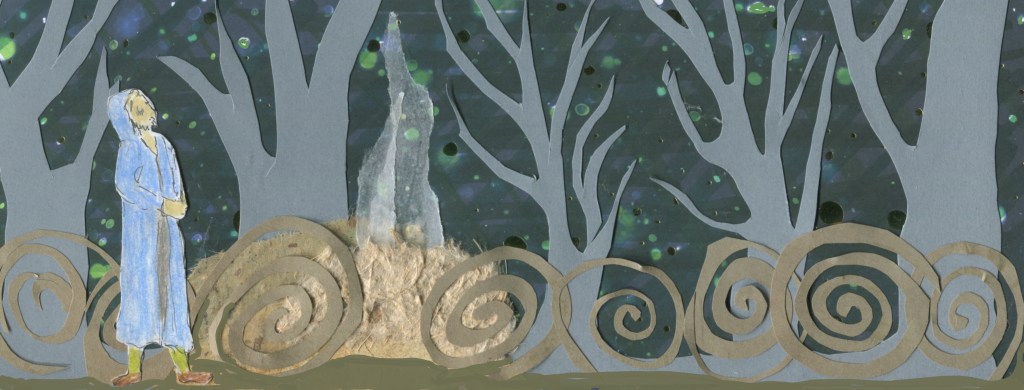
Jesus Refulsit Omnium[footnote] is hardly discernible now with so much fermentation, but I’ve sung this song in another time and place. Some centuries ago, we sang this when the bishops were encouraging the more Christianized celebration in mid-winter.  We kept singing it on the night of the Christ Mass — a band of monks trekking through the woods with frost bitten feet in the matins hour, returning to Ligugé from the nuns’ community in Portier.

It wasn’t a drinking song in Francia. But what else could it be on a cold Northumbrian night like this? When the tune meanders through my memories, it finds the better beat for dancing and consumes my grief in embers of joyful recollection. It gives Christmas a spirit of its own.

First light of dawn glistens over new fallen snow. Earth is new, in darkness anticipating new light. I can think of nothing else but this spirit of the Christ mass. It sings so long and deep with the woman’s song — the world upside down with the newest infant leading us. To worship this morning, I walk to the church of Monkwearmouth for the mass. The rivers run as usual, un-snowed and dark. The hums of the chants are usual. Everything tries to be usual, but it isn’t. It is Christmas.

At the library here is Wilbert at the sign-in table, all so ordinary.

         “Did the so-called ‘guests’ in the visitor’s hall keep you up all night?” he asks.

         “Do I seem drowsy? Really it was my own thoughts that kept me up all night; they only added the music.”

         “The noise corrupted the sleep of all of us, even in other areas in the monk’s cells. You would think they could at least pretend to be devout like you always do so well.”

         “I am devout? But they were cold and had suffered so long at their duty walking to and from the sea for the good of Jarrow. In their own task they are devout.”

[footnote] https://www.oldest.org/religion/christmas-songs/   Retrieved 4-7-25

(Continues tomorrow)


#75.7 Tuesday, December 16, 2025

Historical Setting: Jarrow, 793 C.E.

Winter is upon us, nearing the season of the solstice and I’ve chosen to stay here in the guest quarters at Jarrow. This is a double monastery, with the women’s community, called St. Peter, across the River Tyne on the River Wear. In that church often the worship is led by the abbess, and a women’s chorus chants. I go there often to stand for gospel to partake in the mass. The walk refreshes my library-stiffened bones, and taking of the Mass daily nourishes my spirit. Even, clothed as I am, as a layman, my old monkish ways still make me useful at Jarrow helping with daily chores and keeping the hours. So, no one is pushing me to move on from my cell in this hall set aside for visitors and novices.

Now there are some other long-term guests in the visitors’ quarters. They are also an odd mixture of holy and profane, but for me, my holy tradition is hidden in layman’s clothes. And for them, their holy monk’s robes hide the soldiers that they really are underneath. These are Ousbert’s men who have come to guard the monastery. No one says it, but we all know it. They draw their hoods over their tousled hair to appear as true monks as though they walk in pairs “with deep devotion” keeping their posts along to river all the way to the sea. When I go looking for a solitary place for prayer, there are always guards lurking, watching. These guards are assigned to always keep watch for those longships of the Norsemen.

I’m pretty sure this is not a season when Vikings will attack, with weather cold and stormy, unpredictable, and all the fickle changes into winter.  I know the Norsemen make careful plans before they cross the North Sea, so Ousbert’s order to set guards outside in this season is probably unnecessary, but who am I to say?  Besides, I rather enjoy the celebratory style of this noisy band of soldiers in the guest hall. Wilbert asked me if I minded their songs and drinking in their off-duty hours. I don’t mind at all. They bring the solstice celebration from the Pagan root, anticipating the rising light of a new year into the midst of all these long dark nights. We all need a celebration this time of year.

Dear God, thank you for this nature of your Creation that tunes the earth to celebration. Amen.

(Continues tomorrow)


#75.6 Thursday, December 11, 2025

Historical Setting: Jarrow, 793 C.E.

The King’s man, Ousbert, is also a lay visitor at Jarrow in the aftermath of the raid on Lindisfarne. Our purposes here are very different. I’m just looking for a history, but he’s looking for the vulnerabilities of coastal monasteries to make his recommendations to the king going forward. It’s a very different perspective, seeing a community as a long heritage of saints, or observing it as a future target for greedy marauders. Weren’t both views shaken by Viking attacks?

At Lindisfarne the Viking raid was blamed on lots of things, but none of the blame seemed to land on the Vikings.  One side was groping for the weaknesses in the Irish heritage of that community. Those who wanted to rankle the wrong in the Irish way couldn’t really blame the scheduling of Easter or a different tonsure, but they did find one little distinction between the Irish and the Roman that laid the blame for destruction squarely on the Celtic root. That was the first Church building not made of Roman stone, but it was made of oak and thatch.  The Romish fix was apparently covering it with sheets of lead. Footnote  But raiders were still able to sack the treasures from it before it was burned to the ground. The newer Romanesque stone construction, still stood, but the raid turned the lead a molten ooze over the bed of ashes.

Jarrow already has stone buildings, but here in the forests, unlike in Rome, there is an inherent appreciation for wood. So, despite the Roman exteriors, these interiors — the pillars and arches and rafters are tooled by local artisans in the warm, wooden ways of the Angles and the Saxons. And it should be considered that wood burns the same whether it is Irish, or English or Roman. The same wood that echoes our conversation just now and makes a simple monk’s choir into magnificent music, is flammable.

I mention this nature of wood to Ousbert but he ignores my concern. He has no wish to take this worry to the king, since the use of interior woods isn’t just in monasteries. It is in the castles as well.

It is terrifying to imagine that Vikings could raid anything coastal and the notion that Vikings could raid establishments even beyond the holy places, is something no one wants to consider.  In fact, until there was that written letter to Alcuin no one even acknowledged those coastal raids already happening.

Footnote: https://en.wikipedia.org/wiki/Anglo-Saxon_architecture retrieved June 4, 2025.

(Continues Tuesday, December 16)

#75.5 Wednesday, December 10, 2025

Historical Setting: Jarrow, 793 C.E.
 

The King’s man Ousbert is making a plan to save these coastal monasteries from the fate of Lindisfarne. Ousbert is asking for details of the cause of the raid, and since I was there, he’s questioning me.

         “People who put their trust in saints to be all powerful are blaming the enshrined saint for the failures to protect the monastery. A saint may offer spiritual protection but this wasn’t a spiritual issue.”

         I add, “And blaming is not the same as protecting.”

         “It is a dangerous vulnerability. The king is considering an edict that prayers can only be said within high walls with watch towers.”

         “Watch towers with armed guards?”

         “We’ve already offered guard towers here. But the abbot argues that armed guards stifle the prayers of monks and nuns. So why would all these experts in prayer need to gaze on the rivers and sea? Can’t they close their eyes for prayer, like everyone else?  After all, God gave us eyelids.”

         “Maybe the spaciousness of nature provides the spiritual sanctuary they seek. City walls with guard towers seem antithetical to prayer.”

         “You sound like them now. Even the most vulnerable, the holy women of St. Peter at Monkwearmouth are opposed to watch towers.”

         “Posting armed guards to keep watch really does seem like an imposition to the very nature of a monastic community.”

         “Whatever. My report to the king will push for a visible military guard. Swordsmen would’ve saved Lindisfarne?”

         “It is always the conundrum of what is saved and what is lost. Armed guards can save earthly treasures. But swords don’t save lives. The best a sword can do is terrorize and slaughter selectively.”

         Ousbert says, “Ugh! But here in the real world, if guards are at these doors then all the prayers and them that prays them will be safe.”

Our argument echoes in the high arches of this ceiling. In Jarrow the buildings are stone like Rome, but we aren’t in Rome. The outside may be stone, but English use flammable wood everywhere. This high ceiling is supported with wooden beams and the wood paneled walls carry every sound to the rafters. It’s no less vulnerable to torches than was the first building of Lindisfarne made of oak beams and thatch.  Then it was covered over with sheets of lead to be more solid like the Roman stonework buildings.

I ask Ousbert, “What if the Vikings bring torches?”

(Continues tomorrow)

#75.4 Tuesday, December 9, 2025

Historical Setting: Jarrow, 793 C.E.

The Lindisfarne raid raised concern throughout the kingdoms for the safety of all of the coastal monasteries.  Wilbert introduces me to Ousbert who serves the king as a military advisor. Ousbert has questions about the raid on Lindisfarne. We step out of the library hall, to talk more freely in a gathering place, though here this great hall echoes our conversation into grand pronouncement. It isn’t private.

         “Brother Wilbert tells me you’ve just come from Lindisfarne.”

         “Indeed. I was there at the time of the raid by the Norsemen.”

         “The poor fools, holy men, trusting a dead saint to save them. The king wants Northumbria to be better prepared with a force of armed guards to fight back when the Vikings come calling again.”

         “I think the monks of Lindisfarne believe they’ve always been well cared for by the Shrine of Cuthbert. But you’re right. I’ve also heard those grumblings that they believe St. Cuthbert should have saved them.”

         “So you agree it was Saint that let them down? Or, could it actually have been the monks who lacked military training?”   

         “Considering the hazards of earthly sins warring could befoul a monk so, for the soul, a saint seems a safer choice.”
 

         “This was a completely different kind of danger for a monk.”

         “There is plenty of blame — Alcuin, the scholar blamed sins of drunkenness and greed. Others simply attributed it to the wrath of God.”

         He asks, “As one who saw it, what do you think was the cause of it?”

         “I think it was the Vikings.”

         “Of course, but what caused the Vikings to cause it?”

         “It was definitely caused by greed, with a chaser of strong drink. But whose greed and whose drunkenness are to blame? That’s the question. Alcuin was blaming the brothers of Lindisfarne, but honestly, I still lay the blame square on the Vikings. There was plenty of greed and drunkenness among the Vikings. At Lindisfarne, their barrels and kegs were stolen, and their earthly treasures are gone, so any possible continuation of greed or drunkenness at the monastery is null.”

         Ousbert says, “As an advisor for the king, my assignment is to prepare the coastal monasteries, Jarrow and Monkwearmouth, so they can save themselves, should there be another attack.”

         “Still, preparation for any attack would need to consider the greed and weaknesses of the Vikings. They are, this very hour, trading the treasures of Lindisfarne. This is definitely about greed.”

(Continues tomorrow)

#75.3 Thursday, December 4, 2025

Historical Setting: Jarrow, 793 C.E.

         In the water walking allegory, stepping out of the boat is called “faith.” But then the word “faith” was usurped by religion as a uniform requirement for belonging —a shared creed. Back when faith was still raw and personal, Jesus told Peter he needed it. Then by religious use, faith changed its meaning to define the boat — the belonging to a shared religion. But faith is still personal for some water walkers.

         Dear God, you know my heart.

         I’m one who would drift free or maybe simply sail with the wind. But religion happens when the direction of the wind isn’t trusted and the captain calls for the oars then we all row in unison.  It is so Roman, this galley with oars, called religion. But sometimes it takes me where I need to go. When I dress as a monk, I expect the human being at the tiller will steer as God asks of us.

         As I read through Bede’s history, Christians are always groping the changing winds with steady oars for uniformity and order.

         So it is, when a Synod or a Council gathers within religion and the purpose isn’t to compromise, rather it is called to name a singular order. Even though the Synod of Whitby [footnote] was convened by Hild of the Irish tradition, it was purposed to establish a singular direction or rule. Those who could flex, yielded to those who could not. For the Irish, the side I’m drawn to, the internal, personal relationship with God isn’t by creed or calendar or rule, so on matters of rule the Celts flex. They fall in line with order and uniformity. Some argue, others, like Hild, do whatever we can to hold to the Irish tradition but an inflexible order apparently gives the pope authority over random currents and shifting winds of individual prayer. The Synod of Whitby eventually went along with the pope’s date for Easter and all the sameness implied in that.

         Jarrow wasn’t founded by an Irish bishop so the buildings are of stone, and the style is Roman.  It was, after all, Pope Gregory the Great who assigned Augustine and his band of missionaries to bring Christianity to East Anglia in the first place. This history of earlier centuries is well-known here, and it is also recorded by Bede in this history that I still have laid opened on the bookstand. Taking the pope’s side is as old as Christianity for these people.

         Just now a man signing in at Wilbert’s table is also a layman.  And he is asking Wilbert about the attack on Lindisfarne.

[footnote]Synod of Whitby, Chapter 25, p. 153 (Bede The Ecclesiastical History of the English People: The Greater Chronical, Bede’s Letter to Egbert (Oxford press, Edited with an introduction and notes by Judith McClur and Roger Collins. 2008.)

(Continues Tuesday, December 9)

#75.2 Wednesday, December 3, 2025

Historical Setting: Jarrow, 793 C.E.

         It could be that God is speaking to everyone all the time. But what one hears depends on listening. Sometimes I listen. But my experience in hearing God is always personal and never credibly shareable. Maybe it is out of fear or awe, but people – at least speaking for myself — learn to close ourselves from listening. I keep a secret plea always in the background of my personal prayers — “This I pray, but please God, don’t answer me too hard. Only tell me what I believe I am able to do. Set the bar as low as I do.”

         Listening to God speaking is a courageous dare that is deep and personal.  It is not something I can receive from another’s instruction for obedience, or even a saintly sermon or teaching. Even the greatest teachings only guide me toward the spiritual depths. So, the one-on-one with God speaking is always personal. It is the life of an ascetic — a lone mystic in the wilderness. But that is but a moment — the touch, the jolt to consciousness, the “ah-ha.” It is the driving force, but not the whole of life. Beyond the cave is the wind and the fire and maybe the loneliness calling — a still small voice craving people, and people muddle in chaos without organization. I reach for religion, order, politics, some kind of social unity.

         Religions are a human response. Religion is earthly organization of spiritual likenesses. Spirit flows as an invisible sea, an atmosphere, breathed in, and exhaled individually unique, but also a shared love, a unity. The things of Spirit we share become our religion founded in social human tradition, experience, music, art, religion. It is not a singular epiphany granted to one God-selected saint or pope.

         Religion is the boat in the water-walking allegory. But the walking on the water is an individual experience. Hearing God speaking, belief, faith, whatever earthly name we give it, it is shareable with others only within the boat. Faith is personal, and religion is communal.

         Peter was out there gathering the nets of fish into the boat. For Peter, it was outside the boat where things went deep. Even when Jesus himself was walking on the water telling Peter he could do it, it had to be personal for Peter, one on one with God. [Matt. 14:28-33] Religion is the boat that floats us above the everyday turmoil, but stepping over the side, bare feet, bare soles against the surface of the sea is one-on-one, deep and personal.

(Continues tomorrow)

#75.1 Tuesday, December 2, 2025

Historical Setting: Jarrow, 793 C.E.
 

     Since the third century, when I first left Ephesus to heal from the persecutions, I’ve seen the pattern of religion moving from personal individual mystical experience to a community following an earthly rule as a religion. This thing that my sister and I had been given by a mystical teacher was the deep and personal love for God and all Creation.

      People don’t hear God speaking because someone else is telling them what God is saying, even when it is the saints who are telling us. God among us is a love story, a poem or a piece of art, a song, a dance, a shared silence, but rarely a pedantic lesson. Art is untitled and faith is without definition.

     It was the political opposite of autocracy. But then we lived in a world dominated by the politics of hate so our private prayers were answered with our political conscience, God’s love for all people. Just the simple first rule of love for God and love for neighbor and ourselves, set us in the political controversy that led to the crucifixion of many Jews, including our own teacher as well. 

     At first, what was a personal wandering in spirit put us in political opposition with Rome at that time, setting up their crosses for executing political dissidents. We were left trusting only in the invisible, spiritual life of love for one another even in a hating world. Beyond the political milieu was the simple grounding — the love and the beauty – the handwork of God who is love. With the temple plundered and Roman propaganda and lies making good seem bad and love seem sin, we, who followed the Jesus way kept love the priority. So, we moved to safer cities beyond Jerusalem.

         In times of autocratic plundering on earth, prophecies of end times came with more and more specific details. But, like death, any human glimpses of end times are, at best, individual hopes. No universal nature of these things can be known by people. Endings are always unknown or they wouldn’t be endings. Even when God, all loving and invisible, speaks to the prophet, the message is always all loving and invisible and very personal. The wings, or fires, or monsters, or precisely numbered events birthed in human imagination are at best, metaphors to transfigure a personal spiritual experience into shareable, speak-able terms. Amid cruel political times doomsday is the hope, not a threat, seen as the promise of new Creation.

         Peter’s water walking lesson is a poignant explanation of this faith problem.

(Continues tomorrow)


#74.12 Thursday, November 27, 2025

Historical Setting: Jarrow, 793 C.E.
 

         Bede’s book unwinds with the story I came here to understand. When Bishop Aiden, the founder of Lindisfarne died, his successor was Finan [651 C.E.]   also “consecrated and sent by the Irish.” Finan constructed the church at Lindisfarne in the Irish method of oak and thatching. The Roman way would have been with stone. So later, Bishop Eadberht [688 C.E.] had the whole church, roof and walls, everything, covered with sheets of lead. (Now the new main building there is of stone.) You would think everything done in the Irish way was done away with, but no. Bede writes, “There arose a great and active controversy about the keeping of Easter. Those who came from Kent or Gaul declared that the Irish observance of Easter Sunday was contrary to the custom of the universal church.”

         Bede calls Ronan a “violent defender of the true Easter, who, though Irish by race, had learned the true rules of the church in Gaul or in Italy. In disputing with Finan, Ronan “put many right, but could not put Finan right; on the contrary, as a man of fierce temper, Ronan made him more bitter… and turned him into an open adversary.” [Footnote 1]

         This history lists bishops and monks, kings and nobility of East Anglia, and Northumbria, all struggling with the problem of two dates for Easter.

         A synod was called to decide this issue once and for all. This was at a monastery at Whitby where Hild was abbess. Bede called her a “woman of God.” What else is known of her is that she was of noble birth, and was guided in her faith by Irish Aiden, who ordained her as abbess. The list of church dignitaries attending the synod included the Irish. They were represented not only by Hild and her following, but by Bishop Colman of Lindisfarne and his clergy. But as I know from seeing this same issue in an earlier time, it isn’t resolved by allowing each his own way. In Roman style, it can only be one way in the end. So it seems the random strays from another Island are always just pitted against the pope.

         “First King Oswiu began by declaring that it was fitting that those who served one God should observe one rule of life and not differ in the celebration of the heavenly sacrament seeing that they all hoped for one kingdom in heaven: they ought therefore to inquire as to which was the truer tradition and then follow it together.” [Footnote 2]

         There wasn’t really room for compromise.

Footnote 1: Bede, The Ecclesiastical History of the English People Oxford World’s Classics 1969.  Pages 154-157.

Timeline https://www.angelcynnreenactmentsociety.org.uk/home/lindisfarne-pages/bishops-of-lindisfarne—list (the lack of info, even A-I assisted Google, affirms the footnote on p. 397, “little is known of this Ronan.”) Retrieved 5-25-25

Footnote 2: oop. cit. Bede p. 154.

(Continues Tuesday, December 2)

#74.11 Weds., November 26, 2025

Historical Setting: Jarrow, 793 C.E.

         I came to Jarrow looking for the hate words I thought Bede had planted in the written history of Lindisfarne.

         Those who gathered for the reading of Alcuin’s letter to Bishop Higbald were talking among themselves in search of the sins of Lindisfarne. Alcuin’s letter offered some sin options: greed and drunkenness. And there was that matter of the sinner buried among the saints.

         Then Bede’s history re-issued the misguided, narrow view of the ways of the Irish founders of Lindisfarne. Blame words for the disobedience to the pope’s edict requiring a certain date for Easter and what Bede called ecclesiastical matters, were referring to Roman rule. Whatever the sin, the tragedy of Lindisfarne set a devastated community searching itself for its own need for repentance.

         Sin needs to be acknowledged when a Viking invasion is understood as a doomsday kind of judgment against the community. Blaming the victim seems harsh, but finding something repent-worthy also empowers the victim to turn around and make it better. Never mind the crimes of the marauders, by changing from sin to repentance there comes the possibility for the community to control the holy judgment.

         The conversation of the visitors over the unsalted porridge blessed Lindisfarne with an abundance of sin. There were plenty of opportunities for repentance.

         This writer of the history, Bede, was a monk here at St. Paul’s of Jarrow, having lived his life in the deep and abiding love of the brothers. As a place that values learning, he was not only immersed in the book collection that started this library, he also used his opportunity to listen to others, particularly those who traveled to Rome, to draw his expressed conclusions on the power of the papacy.

         Wilbert knew Bede as a mentor and a friend. So now the stories of Bede’s life and work allowed me empathy for Bede, when I had clearly come with a dispute. Now my argument is soothed with wider words to be a lingering difference of opinion; Bede described it as “a great and active controversy.”

         Over the centuries I’ve seen this. Those who follow the Irish tradition call it a difference of Rule. But those from the Roman tradition put righteous truth on one side, against the so-called wrong-headed Irish. It is still political, though I say I came looking for the holy.

(Continues tomorrow)