#50.2, Thurs., Nov. 2, 2023

Historical Setting, 610 C.E. Fortress Besançon

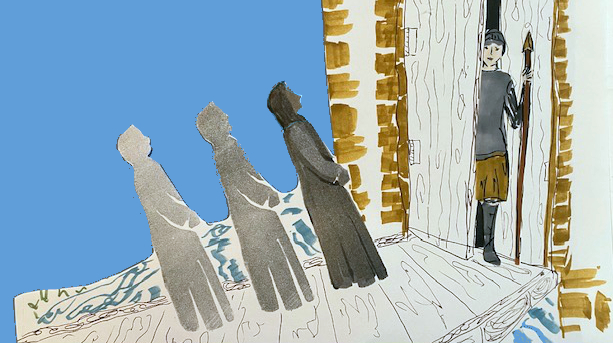
I’m following the first instruction in Gaillard’s intricate escape plan for Father Columbanus. I introduce myself to the guards at the gate as “Brother Ezra, here to pray with Father Columbanus.” They are expecting me because the father called for “Ezra” as they were taking him away.

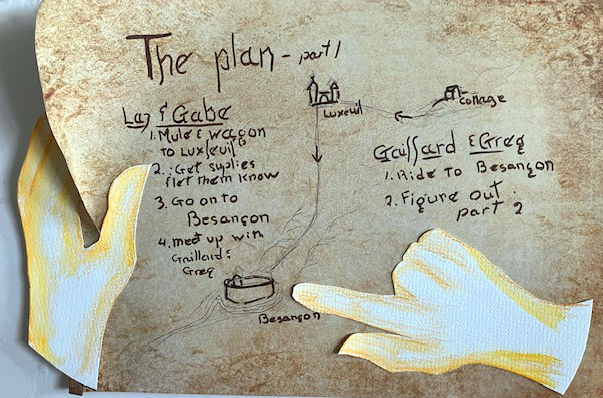
         Gaillard’s plan calls for me to meet with the Father and let him know of our plan, then to scout out the inside opening to the tunnel under the distant wall. We need to find the way out of the fortress to the rock heap in the pasture at the far tunnel entrance.

         Gaillard explained it all. He will be the century waiting at that place in the pasture with the wagon and he will also have a sword, may it not be needed. The other two, Greg and Gabe are also monks who go inside the fortress.  In fact, we are all three, the same monk named Brother Ezra.

Gailliard stressed, “Three Brother Ezra’s isn’t confusing, as long as we never let ourselves be seen together. It will allow Brother Ezra to be three places at once: one who comes with prayer, another the tool for breaking chains, and the third, a sword.”

         So, my task, once inside the walls, after prayer with the Father and informing him of the plan is to locate the inside entrance to the tunnel. Gabe will go back in with the chain cutter and cut all the prisoners free. Greg will follow, with the sword. Then Gaillard may decide to send me back through the tunnel and help create the confusion with three identical Ezras, while the Ezra with a sword will guide the Father safely to the wagon. We will all meet at the safe farm, then go on to Luxeuil.

         Now, inside these old Roman walls I can see that this is an old city. Here is the church butted up against the east side of the wall which is the wall not protected by the river. In Tours the church is built right into the wall. It was an ancient pattern. And I suppose it is the logical place for a secret door to a tunnel.

         Besançon is the see of an archbishop. So here we have both the guardsmen of the nobility to contend with, and also one of those ever-pesky Frankish bishops with his own guards, and of course, lots of young soldiers in training, each longing to become legend.

(Continues Tuesday, Nov. 7, 2023)
#50.1, Weds., Nov. 1, 2023

Historical Setting, 610 C.E. Besançon Fortress

         We’re starting the plan to go into the dungeon to set free Father Columbanus and other prisoners. We assume the soldiers at the north gate expect a “Brother Ezra” to arrive as the Father called for at his capture.

 In time, this story of rescue may be attributed to a legend with a saint’s name.[Footnote] Maybe that’s how tradition gives history students fewer names to remember. Of course, God knows all people and notices each sparrow and every other little breathing bit of creation. So none of these details of fact are lost to God.

Plodding on alone toward the fortress, I’m pondering. Maybe rote legend is why so many kings had the same baptism story, and why only apostles write gospels. Except maybe not so much the gospel writer of Luke, who also wrote Acts and was said to be a follower of Paul who did claim apostleship though he wasn’t a disciple. And that accounts for my own thoughts of Jesus becoming skewed by popular opinion in Luke’s tales. I still blame Luke for starting the rumor that my sister was a prostitute. But I digress.  

         So maybe Matthew, Mark and John are really just names that were attributed to the works honoring those apostles. They were named after named apostles, in the same way Ana and I named Gabriel after the angel and Gregory after some Gregory. I know John was named for John the Baptist. And a mysterious secret I have no proof of is that the ‘beloved disciple’ who claimed the authorship of John was an enamored teenager and follower of John the Baptist.*

         Now, here I am approaching those foreboding walls of Besançon. This fortress is in the center of an oxbow on the river Daub. The hills rise into the mountains to the east and I’m walking the path toward the wrinkle in the river that serves as a moat on three sides of the fortress. Over on the south-east, the land-side, is a slope of pasture land where we plan to deliver the Father to the wagon we brought for the escape.

         “Are you Brother Ezra, follower of Father Columbanus?”

         The guards glance passed me for the army I don’t have, and now seem pleased to see only me, alone, and not those thousand armed and vengeful men. But maybe they assume there is only one Brother Ezra.

         I answer, “I’ve come to pray with your prisoner, Father Columbanus.”


[Footnote] Jonas, the best-known hagiographer of Father Columbanus, wrote nearly a century after Columbanus lived, and Jonas tells this story of the prison break at Besançon. (Munro, Dana, ed., Translations and Reprints from…Life of St. Columban Sections 34 with ref. to 16) Jonas names the helper in the escape as the “little boy, Domocalis” who also served Columbanus in his wilderness quietudes. This blogger of fiction uses different characters for this rescue, and replaced that child named with Brother Servant in most other places in this blog, because our modern perspective takes issue with a priest using a child as a personal servant. Maybe we are better people in these times, or maybe we simply hide different sins?

*It’s only a theory, picked up and used in this fiction. At this time it doesn’t reflect credible scholarship, but maybe someday more definitive information will be available about some of the parts of John.

(Continues tomorrow)

#49.13, Tues., Oct. 31, 2023

Historical Setting:  610 C.E., Vosges Mountains

         Greg tells us what he and Gaillard did late into last night.

         “First, while it was dusk, after we found this safe farmhouse, we went to circle around the fortress looking for gates and openings and analyzing possible views from walls and watchtowers. The river runs wide in an oxbow on three sides of the fortress and the main entrance uses a well-guarded bridge to cross the water.

         “Gaillard’s plan was to watch the fourth side of the fortress to find an entrance on the land side. He was sure there would be a secret way in and out. He found this by learning the location of the alehouse that young trainee soldiers visit on their clandestine nights’ outings.”

         Greg explained, “So Gaillard went on to the alehouse dressed as a woman, and I followed separately as my usual soldier self. My assignment was to mingle with the young soldiers while they were drinking and learn as much as I could about how many guards were on duty at one time, where they were posted, and when the changing of the guard would happen.  Surprisingly that wasn’t very hard to gather all those secrets from them — just a bit challenging to decipher the factual information from the drunken braggadocios of these young fellows.

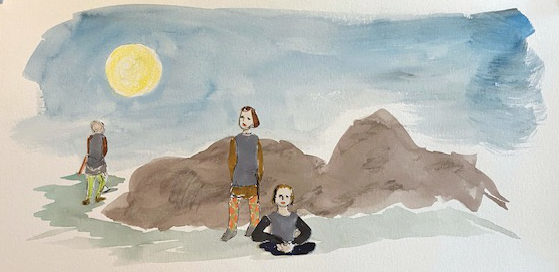
         “Meanwhile, Gaillard was with the women who stayed at the alehouse inn. Then, with the bright moon, some women went out across the fields to a particular place with a rock heap in a pasture. That was the place the women he was with expected to find soldiers emerging from the fortress tunnel. Some very young soldiers would be in search of new adventures seeking the truth in rumors they’d heard about the nature of women.”

         Gaillard adds, “One tender youth took one look at me and probably thought ‘tall and weathered, must be a safe person to try this with’ but, of course, I guided him into the waiting arms of an actual woman prostitute.”

         Greg adds, “Why? You might be just the one he was looking for.”

         “Really, Love, if I don’t need a concubine, you don’t need a prostitute.”

         So maybe that is what they decided between themselves. Maybe Gaillard has surrendered his family obligation to be true to Greg. Pleased as I may be, I’ll leave my thoughts unspoken and let them keep it between themselves.

         Greg asks Gaillard to give us the plan and the details of our orders.

 (Continues Wednesday, November 1)

#49.12, Thurs., Oct. 26, 2023

Historical Setting:  610 C.E., Vosges Mountains

         Gaillard continues telling his plan.

         “The guards will be expecting you Laz, and when they see you are peaceful, you will be escorted in to see the Father.”

         “And how is that going to bring about his release? Are you assuming magic in our prayers?”

         “No magic is needed.” Gaillard answers, “Just a good plan.  For now, Greg and I will go as fast as we can, to Besançon to gather more detailed information. And Gabe and Laz, you will take the wagon with the mule, and find a smithy willing to lend you a tool for opening links of chain. Then go on to the monastery and tell the teacher who is acting as abbot that if all goes well, the Father will be back later this week. It would be a problem for us if Eustasius were to send others with a different plan.

         Then, you can gather up a monk’s robe for Laz to wear, and one for Greg. And…” turning to Ana he says, “… and I will need to borrow a women’s tunic with a wide skirt. I could never pass as a matching monk, and I need a long flowing gown so I can ride a horse and hide my sword.”

         I catch the eye of Haberd, and squelch his near laughter with my threatening glare. He elbows Brandell and both bow their heads to hide grimaces.

         Gabe and I are to start our tasks immediately, and when we leave Luxeuil with the wagon we are to follow the river road south. “When it is dark,” as Gaillard has instructed, “wherever you are on that road, stop and camp right out in the open by the roadside, and in the morning, Greg will find you there and tell you what to do next.”

         It is a moonlit night, and the road is straight and easy to follow, so we made it a good distance toward Besançon before we made camp.

         It is hard to sleep now. Dear God, stay near. Amen.

         Greg finds us here sleeping into the morning light.  He has lots of instructions for us as we follow him on down the road into the region of the River Daub.  He takes us to a cottage of an Irishman said to be a follower of Father Columbanus and an ally in this project.

         Gaillard’s plan is ready to act on now. 

 (Continues Tuesday, October 31)

#49.11, Weds., Oct. 25, 2023

Historical Setting:  610 C.E., Vosges Mountains

         Father Columbanus was taken away by soldiers in the night. He wants no soldiers to follow. He specifically asked for me, probably because he knows I won’t bring on a fight.  I hope his ask was not because he knows me by my actual name. That would imply he thinks this mission is deadly dangerous, and here I am with two of my sons and one of their lovers jumping headlong into this.

         Gaillard argues his qualifications to make a plan because he says, “In a family of holy people everyone learns chants and bible stories; in a family of noble warriors children are set in the library to learn the fortresses of Burgundy. So, I know that Besançon is less than a day’s ride on a fast horse south by the River Daub.  And I can assume that is where they’ve taken the Father.”[Footnote]

         We all want to know his plan.

         Gailliard explains, “I am sorting out the knowns from the things we still need to learn, and I’m considering whatever resources we have with only four of us to free someone from a prison probably having chains and lots of guards.”

         “What about the risk?  What are you expecting of us?” Greg asks aloud what we all are wondering.

         Gaillard unwinds his plan in small pieces according to our need to know. It requires our unfathomable trust in this man whom I’ve noticed carries a sword, though he may have never used it — even to butcher a lamb or take a hen. I want to ask Greg if he trusts Gaillard completely or if he is just going along with it because …

         “Don’t worry Papa, Gaillard is good at this.” Greg knows my thoughts.

         To begin Gaillard starts with the ending. “The expectation of the Father, and also, of the soldiers who captured him, is that someone named Ezra will show up for him. The Father knows who Ezra is but the soldiers don’t know if Ezra is a monk or a soldier with a huge army, or maybe even a commoner farmer, as he is. What do you think the Father is expecting you to do?”

         “I think he wants prayers and no weapons.” I answer.

         “So that is your part in this.” Gaillard explains. “You bring this expectation of the man, Ezra, now dressed as a monk and make yourself known at the main gate of the fortress. Tell them you are Brother Ezra, and you want to pray with the father.”

Footnote: Besancon was the headquarters for the archbishop of Burgundy when Columbanus was captured, presumably to await execution by King Theodoric and his grandmother.(Ibid. Jonas)  The Catholic Encylopedia (accessed via https://en.wikipedia.org/wiki/Roman_Catholic_  Archdiocese_of_Besancon #To_1000 retrieved 2-27-23) leaves a bit of confusion over the archbishop at this time. After  “Vitalis I, would come St. Rothadius, a monk at Luxeuil, then Nicetas who died c. 611.” Marilyn Dunn’s text The Emergence of Monasticism possibly offers clarification that the Luxeuil monks were archbishops at Besancon following this incident of taking St. Columbanus captive  p. 160.

 (Continues tomorrow)

#49.10, Tues., Oct. 24, 2023

Historical Setting:  610 C.E., Vosges Mountains

Gabe arrived with the news that Father Columbanus was taken away, arrested by the King’s men. Greg and Gaillard had been on the road to Luxeuil and when they met up with Gabe they turned to come back here.  Gaillard is certain he knows where the Father was taken so there is less hurry to follow the ruts and the soldiers’ tracks to find him. Greg and Gaillard are recommending we take this calmer moment to make a good plan.

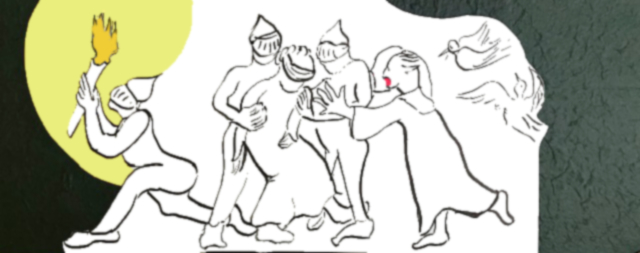
         Gabe tells of the abduction. “It happened in the dark for sleep between Vespers and Matins. I was awakened by a ruckus – men shouting — the Father’s voice in a panic. He called out our teacher, Eustasius, who would be the abbot while he is gone. Then they all came down the hallway passed my cell on toward the dovecote and the stables. I went out after them and saw soldiers dragging the Father away, blindfolded and bound. Some others of us monks were chasing after them shouting to the soldiers to let him alone. I shouted too, and when he heard my voice he called me by name. He said. ‘Brother Gabriel, send no soldiers. Your papa, Ezra, will know what to do!’”

         “He said that?” I ask. “How would I know what to do?”

         Greg explained to Gaillard, “At Luxeuil they call Papa, ‘Ezra’. He meant Father Columbanus doesn’t want soldiers to follow, because he knows Papa is a pacifist.”

         “Oh, that puts a crimp in my plan.” Gaillard says.

         Greg affirms, “no swords.”

         Gaillard amends, “no swords — visible, and definitely no armor. And yet, I have a plan. The four of us…”

         Haberd interrupts, “make that five of us, men,”

         I look around at my family standing silently around us with their grim faces. Ana, holding back tears, twisting her hands together, her teeth clenched. Our daughters are clinging to their mother to offer their strength together. Brandell and Haberd are of the mind of warriors.

         “No Haberd you’re needed here.” I order him to stay.  “Five can do nothing more than four.”

         Gabe speaks a prayer aloud, “Dear God, watch over the Father that he will be safe and unafraid. Guide Gaillard in making a good plan, and give us the courage to trust in the plan. Stay close. Amen.”

         “Good!” Gaillard observes, “With the magic of prayer we will have God on our side.”

         I would amend that, but Greg already answers, “Trust God for courage, my love, not magic.”

(Continues tomorrow)

#49.9, Thurs., Oct. 19, 2023

Historical Setting:  610 C.E., Vosges Mountains

         I don’t have to wonder over this message very long.  Here is Gabe sharing Greg’s horse, and following is Galliard.

         Greg tells me he and Gaillard were on the river path and there was Gabe, running this way in a terrible hurry.

         “We got your message,” I told Gabe, “But what does it mean?”

         Greg speaks for his brother as they dismount.

         “Gabe is anxious to immediately follow the tracks of a wagon and a battalion of soldiers, going south from Luxeuil.”

         “And you have to go too, Papa!” Interjects Gabe.

         Gaillard speaks to Gabe with his always, gentle calm, “It is okay now, Brother Gabriel. We won’t need the fresh tracks to know where the soldiers took him. I already have an idea of that. And we need to take our time and make a good plan for this.”

         Gabe is still riled.  He argues, “Surely you can’t just guess where he is! They’ve taken him someplace in secret!”

         Gaillard answers, “They’re undoubtedly following orders from King Theodoric – and they were going south you say? It has to be to Besançon – the Roman fortress where the king’s soldiers train. And that happens to be the archdiocese that sends you those pesky Frankish bishops.”

         Gabe argues, “But it wasn’t the King! He and his men were visiting Luxeuil, the King was meeting with the Father to try to make amends. Then, when he realized he couldn’t change the mind of Father Columbanus over a moral-spiritual issue, he just left with some of his men. But he left behind the nobleman Baudulf, along with the rest of the soldiers, and that was who carried off the Father in the night.” [Footnote]

         Gaillard affirms, “Of course, Baudulf is the noble lord of Besançon. Of course they were following the King’s order to take the Holy man there.  It’s a dreary place with dank, dark old barracks, still with its old Roman rusting chains hammered to the walls to hold lots of prisoners. And who would be better prison guards than battalions of young soldiers in training all just chomping at the bit of justice to behead any culprit said to be escaping the chains?  Any slip of a novice soldier’s sword could eliminate the need for trial and the wait for execution. If we follow the captive abbot to Besançon, we have to have a good plan.”

         Gabe adds, “The Father asked for, ‘Ezra.’”

[Footnote] The arrest and imprisonment of Columbanus is described by Hagiographer, Jonas, Life of St. Columbine #34.  trans. & ed. Dana Munro, A.M. (reprint Original sources of European History)

(Continues Tuesday, October 24)

#49.8, Weds., Oct. 18, 2023

Historical Setting:  610 C.E., Vosges Mountains

         Histories are told in statues and epitaphs carved in stone to be handed on from generation to generation purposed with tethering the noble-born to their ancestors. The generations are designated heirs to nobility or even royalty according to these markers. And yet, without heirs the eternal line of title is broken. In that way maintaining a lineage protects the separation of the classes that keeps us common.

         But what if, simple romantic love would break the lineage and produce no heir? I see monks and nuns and ascetic desert mothers or fathers with passion for the spiritual who break the lineage with every life of them, and yet humankind continues on. After all, all the varieties of love aren’t limited to the threads that bind us to particular ancestors; and without names carved in stone each person is simply part of the whole fabric of people.  We are all the poorest of us, and we are all the kings. I can say that easily as a commoner. 

         But for those born noble it is not a convenient thing to acknowledge. And maybe I don’t understand it at all. Maybe it takes a special self-identity when our spiritual natures all just mesh together into one big humanity, unsorted, and unmarked.

         So here this ivory-fingered fellow, Gaillard, is a guest in this house where we slaughter our own chickens for food and butcher our lambs for feasting. It is our own hands that milk the goats and turn the cheese. And when we call for servants, they are us. Now our commonness requires Gaillard’s choice to either sever his obligation to his birth family, or cut his bond with Greg. We all know in our minds that mere fragments of relationships won’t survive. And a broken heart dies slowly in love’s own time.

         Greg and Gaillard return from their walk together and without speaking, they prepare their horses to leave. Ana offers to send them off with a bit of food and she prepares a bird in a traveling cage so they can send us word. They choose not to take a bird or the food. They don’t tell us where they are going or what they’ve decided to do. I imagine they are going to Metz where Greg will stay alone in a castle chamber until his lover comes calling.

         Now, even while the day is still fresh with morning, a bird comes from Luxeuil with a message. “Abbot taken, Papa needed.”

(Continues tomorrow)

#49.7, Tues., Oct. 17, 2023

Historical Setting:  610 C.E., Vosges Mountains

         Gratitude in this darkness that ends a day of homecoming and feasting should be all we have in our hearts. But Ana and I both want each of our children to be loved as we know love, and now for Greg, this love is tenuous.

         Ana whispers to me, “We know that just as Greg is formed in this family to be forever in the ways of Jesus’ love, Gaillard was, in his family, pressed into the mold of Frankish nobility. If there is any resolution for these differences it will have to be sourced in love, not parental edict.”

         “What advice did you offer?” I ask.

         “I told Greg we love him and he said that isn’t the problem. So, I asked him if he wants to make you take up a sword and a spear and go visit Gaillard’s uncle to make him tremble and quake in terror until he completely changes his wishes for an heir.”

         “He laughed. Sorry, Laz, he thought that was funny, and he really did laugh.”

         “Laughing could be good.”

         “We both know this can only be between Gaillard and Greg. If Greg chooses not to be the object of pretend love, then it will be Gaillard who must decide between an assigned wife or Greg. He didn’t like my suggestion either. If Greg had a third parent, he would have gone away for that parent’s advice. As it was, he just walked back here and said nothing.”

         Dear God, stay close to Gaillard and Greg, as we know your wings are wider than the bounds of our imaginations. Amen.

         And so, it is a bright autumn morning when the four guards ready their horses and prepare to return to Metz. Greg waits on the forest path, while Gaillard bids them a safe day’s journey. Then these two young men walk toward the wilderness, hand-in-hand. I know they’ve been released from the simple plan of assigning one to be a concubine, precious or not. But when they return for their horses will they leave here together, or will they part separately? Ana reminds me they must choose their own way now; we can only love them. It is, of course, something we’ve learned about love from God herself in the metaphor of being parents. Unconditional love is letting our children make their own choices regardless of our wishes that they might never know pain.

(Continues tomorrow)

#49.6, Thurs., Oct. 12, 2023

Historical Setting:  610 C.E., Vosges Mountains

I’m trying to make sense of this, and at the same time, be the voice of wisdom for my son.

          “Greg, I think the trouble the abbot finds with the king taking a concubine is the moral issue of a concubine. This dilemma is rooted in the notion that, with a concubine, a marriage becomes a love lie. When someone is added just for the sexual relationship the fullness of the relationship is incomplete or broken. So even if it were known that you were Gaillard’s only lover, the arrangement of adding a woman, simply purposed with having children, would mean you are sharing your intimacy, God’s physical metaphor for creative love, with someone who was selected to intrude for the sake of nobility’s power. Is that how you wish to continue throughout your life long?”

         “Momma knows better. I will hear her approval of this.”

         “Greg, your mother and I both want you to find a loving relationship to carry you on.”

         Greg cleans his blade, and says nothing more. He goes into the house.  Now, as I finish up here, I see Greg and Ana walking away from the cottage to have this conversation.

         Nothing is spoken of any resolution. The feast with our family and guests is nearly silent — uncomfortably silent.  Greg and Gaillard say nothing. There are longing glances between them, and even the four guardsmen and our children all know there is nothing to say. The wine is served with no toast.

         Now, in the quiet darkness made for soaking worries with sleep, Ana and I talk.

         I told Ana, “Greg wouldn’t listen to me because I wouldn’t give my approval to their idea that Greg could just be a third person in a marriage.”

         “Yes, he told me you were dug in on this, making metaphors of kings and politics. But really, it seems the whole problem here is Gaillard’s family requirement.”

         “So you think I should go have it out with his uncle, the castle builder, who is right now chopping down the hunter’s wood?”

         “Laz, he’s a warring nobleman — you are a peaceful commoner. Of course, you can’t confront him over this – at least in the warring, noble way. But really it this between Gaillard and Greg and isn’t that what has to be considered? I suggested Greg and Gaillard either have a bond together, or they don’t. Neither of them can base this on a plan made by fathers and uncles.”

         “Of course, Gaillard is obligated to produce heirs.”

(Continues Tuesday, October 17)