#38.4, Tues., Nov. 8, 2022

Historical setting: 589 C.E. Châlons to Luxeuil

         I know of three ways to plunge ill-prepared into a journey on the wilderness edge of winter: brut ignorance and suffering strength; clever schemes using sparse resources; or we could simply trust the grace of God. Based on my long years of forever I suggest we first rely on the grace of God. God will undoubtedly assign us to care for one another and that will utilize all of our other resources. So we begin.

         The four monks offer ceaseless prayers with calls quoting Psalms and responses that seem to come as grunts and snores from the barbarian hoard with the mules.

          I suggest we place that book of Psalms in the donkey cart. Then the waxed cloth over the monks’ hand-cart can be spread on the ground under the wagon so these men can all crowd together finding warmth for sleeping. We hang the buckskin down the windward edge of the wagon for extra shelter underneath. No one argues. There seems no better option.

         Does useful suggestion make me the leader? Maybe.

         I proclaim, “Tomorrow we will leave the creek path and go in search of supplies for the trade of these tools and chains that weigh the wagon down. Surely replacements of this can be found when they are needed. I know the iron merchant visits the Vosges often.”

         Assuming I am the leader whatever I suggest is simply accepted just because I say it. Of course in my mind my logical plan is to head straight across the fields to find people to trade our tools for food and shelter. And of course when everyone just accepts my plan without question there can be no other idea considered. Ana has suggested we follow the creek to find a crossroad that will lead to people, but our plan is my way.

         Sleep is good and now on this new morning we set out to find the farmers of these fields by driving the mules and the wagon straight across the barren field. We turn the mules and the wagon off the creek path and up the embankment onto the fresh turned earth. But the field isn’t frozen and immediately we are deep in the mud and the mules only sink down with every step.  How can everyone just do whatever I say, even when it’s obviously an ignorant plan? Only Ana had argued. She said we should follow the creek until we met with a roadway. Yet the men all listened to me.

 (Continues tomorrow)

#38.3, Thurs., Nov. 3, 2022

Historical setting: 589 C.E. Châlons to Luxeuil

         Now I’ve learned this band of men who were supposed to have a leader were sent to help turn the ruin called Luxovium into a substantial refuge for the Irish father and his monks. These pilgrims and workers thought it would be only eight miles to Luxeuil. That was a misunderstanding.  Eight miles is the distance between Annegray and Luxovium so here they are on this long journey unprepared.

         The four who absconded with the purse were King’s soldiers sent to lead the others. Of the eight left, four are monks on a pilgrimage sent by the Father Felix to help establish a scriptorium. They brought the handcart well supplied for the work of copying scriptures. And they each have the small traveler’s bags as monks carry on a pilgrimage. The other four are powerful men who, when set on a task for pay will probably do a good day’s work. But they have nothing with them. I think they too would turn back if they could, but now we are a whole day into this trek and here we are on a cold night in November with eight men and two mules with no source of food or shelter or even enough resources to walk back to Châlons. Hungry and angry and tired they could become a fearsome danger to the four monks and also to Ana and Colleen and probably me too, and of course to little Jack the donkey, and maybe the cow would get eaten.

         Dear God take care of us here. My prayer echoes back that ever familiar holy answer: “Don’t be afraid; don’t let these men starve; care for them; never forget they are beloved too.”

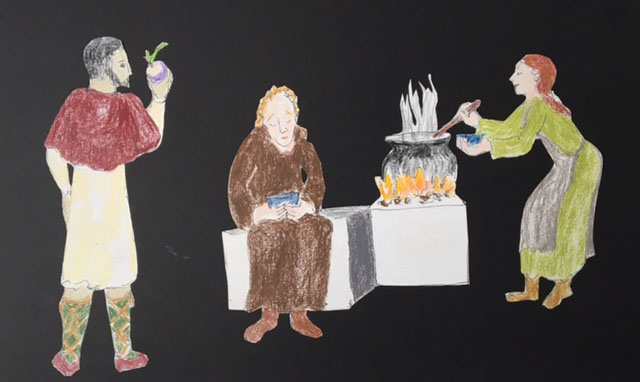
         The nine of us men gather at this fire and pass around the pot of porridge the women have provided. The food is thinned out enough that everyone can dip a cup. The monks then consider the story they’ve heard of the feeding of the multitudes from the Gospel of John. That is unlike the other gospel’s stories of miraculous feedings by Jesus. In John, a child steps forward and offers his own little lunch, three loaves and two fishes, and somehow, by the holy sign of God’s love for all people, sharing makes the little become plenty. The sign is in the sharing. [John 6:1-14] Blessing the bread the monks have brought, and passing it, there is enough for everyone.

(Continues Tuesday, November 8)

#38.2, Weds., Nov. 2, 2022

Historical setting: 589 C.E. Châlons to Luxeuil

         I’ve seen merchant caravans purposed with selling and armies driven by power of a hope for victory. I’ve been on pilgrimages, and I’ve been in a band of refugees — Jews leaving Jerusalem for Ephesus — but I’ve never known an entourage to travel with no known purpose but to obey some abandoning leaders and a distant king. Maybe we can have better clarity for this journey once we are fed and warmed by a fire.

         As we search firewood I ask one worker what supplies they have with them in the cart and the wagon.

         “The wagon is for the building; the handcart is covered over with a tarp because it has the message scroll from the king to Columbanus. The king also sends a copy of the Psalms and some of that other stuff monks use with inks.”

         Another straightens himself after a struggled contortion to bend for a burnable stick. “But we could use that cart stuff for kindling now that the king’s men have left.”

         I fear his suggestion was serious.

         “We have enough kindling right here without burning any pages of writing.” I offer, “But have you any barley or beans for food? Have you a cooking pot? Did you bring fleeces or mats for sleeping and food for the mules?”

         “We brought a biscuit for the walk, and the four brother monks from the abbey brought stuff for a stay-over at the Roman ruin where they haven’t even a roof we hear; but none of us thought it would be an overnight journey just getting there.”

         While the men gather around their fire I walk back to Ana and Colleen to explain the predicament. They’ve been waiting for me with a pot of porridge ready. We have plenty so I can take the pot and the bowls back to the men who have nothing.

         “Tomorrow we will need to stock up on supplies for all of you, because it’s a long journey to Annegray, and you were told correctly, much of it has no roof. I don’t know if the build at Luxovium will start with ready accommodations, but we should be prepared for winter if it also has no roof.

         “Did the king send a purse with you to pay for this journey?”

         The fellow who suggested burning the Psalms explains, “Our leader who left with the King’s guard had the purse. We were supposed to be paid when our work was done at Luxeuil.”

(Continues tomorrow)

#38.1, Tues., Nov. 1, 2022

Historical setting: 589 C.E. Châlons to Luxeuil

         Winter is already showing up in this land. It’s a cold morning.  The women are glad to wear wool monk’s robes today. Jack is feisty in all this icy morning clarity so the donkey cart moves right along but now the cow can’t keep up tied to the cart. So I will just walk her in the front to set a slower pace. That entourage of monks and workmen is well behind us.  The monks are hauling a hand-cart and the others have a mule-team with a wagonload of pulleys and tools so this isn’t anything like a liturgical procession. Any holy chants aren’t intended as prayer. Every rut along this river path catches a wheel of the workers’ wagon creating a constant whine of woes sounding like a wagon-load of baby goats back there.

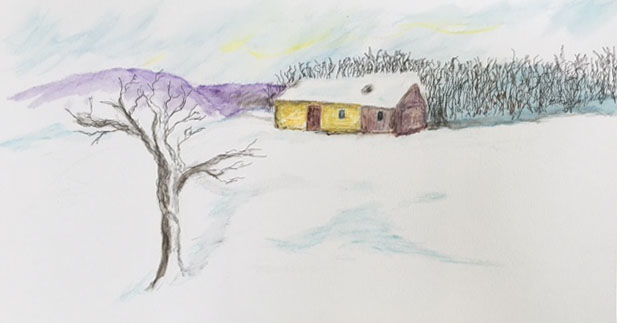
         Our first day on the road will soon be our first night. The winter wind sweeps from the north in gusts and swirls on the path that follows the frosty edges of creek beds. The streams and creeks are ever-forking eastward widening at every bend.

         By dusk and nearly dark the caravan of monks and workers is far behind us as we stop for night. So while the women prepare to make camp in the cart drawn up under the shelter of a steep embankment, I walk back to find the leader of these men.

         Now I learn that leader along with the small contingency on horseback had already given up and turned back. These workers are left here with a wagon-load of tools and only a frail loyalty to the king who sent them, or maybe they come just for the promise of a purse. And now they are more disgruntled than ever.

         Four are monks loyal to God, but there is a gaping span between a pilgrimage and a band of men chosen only for their rock moving heft. And now with their leader gone I suggest a stopping place where they can circle up and make a fire, and we’ll figure this out. I can already see smoke rising ahead where Ana and Colleen have made camp. The women will eat hot porridge and sleep warm and safe with blankets and fleeces in the tarp-covered cart.

         For now I help these fellows gather the wood and start the fire, and maybe hear them tell me their thoughts of this project they find they have been bound to.

(Continues tomorrow)

#37.12, Thurs., Oct 27, 2022

Historical setting: 589 C.E. Châlons

         I learn that the King was expecting me to take a message on to Father Columbanus to tell him everything will change.  In fact we will be leading the construction crew — the same workers who already know how to build a monastery as they have done here in Châlons and they will restore another ruin to become a new monastery at Luxovium.

          Also, Ana heard that the envoy from the Bishop of Rome brought the news of a death of that bishop. Now the bells will toll everywhere that has bells. And the tolling of Châlons’ newly cast bell is heard throughout this city voicing a shared sorrow that falls on everyone with a deep dirge regardless of one’s awareness that Rome had a bishop. It is a grief born in the fear of plague even if the Bishop of Rome was of no importance to these people. In Rome, as in Tours, the autumn rains filled the rivers over their banks so the Tiber flooded the city and spread plague.

         Ana, a woman of science, tells me it is a natural cause and effect. “The floods swam with the rats, and the rats swam from building to house with plague, and the plague struck down Pope Pallagius.”

         Dear God, I know you share grief with the whole of humankind now. The prayers we speak aloud with others are for a named bishop, but I know you also care for each of us, even the cow and the donkey, not just kings and popes. Amen.

         Some ask, “How is it that Rome disobeyed the will of God so these plagues would fall upon that city – the floods, the rats, the death of the bishop?” The Christian magic of these dark times so long after Jesus, only sees God’s judgment in this.

          Some Christians fear the curses of a distant and angry human-like God. Pagans with many gods can see it as a power play by one talisman or charm over another visiting humankind in magic and signs. As for myself, and maybe Ana too, we are affected by these patterns of death and life, but also we swim in the love so vast it envelopes every person and all of nature whether or not one notices that it is God’s love that is with us. Simply, God is, and God is love.

         We need to know that just now.

(Continues Tuesday, November 1, 2022)

#37.11, Weds., Oct. 26, 2022

Historical setting: 589 C.E. Châlons

         Father Felix is telling me about King Guntram’s plan to move Father Columbanus from Annegray to Luxovium. Columbanus has not yet heard of this plan but already preparations have begun to send the workers who are completing this project on to begin another similar build in the foothills of the Vosges.

         “It is the King’s plan to move the Irish monks to a new location.”

         “So the Romans planted another rock heap in those mountains?“

         Father Felix explains, “It would seem the Roman emphasis up there was on baths and strategic outposts. So ruins are in places without cities. And now, we find the wildernesses have fine ruins that the king thinks would be places where monks would thrive. Maybe he  doesn’t understand that the Holy Spirit is flexible and can show up anywhere.”

         “Yes, I guess a king would suppose monks can only thrive in a sparse land. But, Brother Felix, the ways of the Irish are different than that of the Franks. In Ireland, where there were no cities in Patrick’s time they made their monasteries into full communities where people eventually gathered for farming and trade followed.  So in Ireland, the monasteries become the cities; in Gaul the cities add the monasteries to places that are already known for their saints and churches.”

         Felix points out, “But the pilgrims to Annegray are mostly monks; they aren’t the common people who will build their homes all around there.”

         “Then here we are, Ana and I making our home in that wilderness place which may soon to become even more obscure than it seems right now if the monastery moves. I was kind of expecting we would find ourselves in an Irish-like town very soon.”

         Father Felix means to offer assurance. “Well, it could happen in the Irish way. And if they had a holy relic or two, then who knows how people would flock there.”

         This thought of an economic purpose for relics answers the question I’ve had for years. Maybe relics are kept to make a place into a popular destination for superstitious visitors so that the wealthy donations will follow. It’s not the suffering wilderness that is the economic boon for a holy place. Rather it’s the rumors of earthly miracles. So here I am, a sign of the spiritual resurrection of life, when what people are really looking for is just rumors of magic said to inhabit old bones of saints.

         “Dear Friend Jesus would you ever have guessed it?”

(Continues tomorrow)

#37.10, Tues., Oct. 25, 2022

Historical setting: 589 C.E. Traveling to Châlons

         So now we are a great procession of cow, donkey and cart, followed by four fully armored servants of the Bishop of Rome on fine horses, all laden with swords and shields and horse covers of rich silks, prepared to deliver a message to the king of Burgundy and all those other holy bishops along the way. I’ve noticed, when someone approaches us on the road from another direction, these four horsemen fall much further back behind us so not to be mistaken for our guards. Colleen believes God sent them to guard us. After-all, on this road there could be robbers lurking to empty a well-laden cart and take our cow. And what-if some father of a starving family did rob us and capture our cow and bag of oats? What treasure is ours that can allow us to thrive in this narrow circumstance between enough and excess?

         Thank you God for enough and for safe journey. We’ve reached Châlons, well-guarded, or maybe just followed after.

         I point the envoy to the palace where the king resides and we go on to the basilica.  In just these few months the workers have built very discernible walls and roof for a monastery.

         “Father Felix, good to see you again; this building project is coming along so well!  You’ve had a busy summer.”

         And Father Felix looks at the donkey cart at the rail and the cow, and now two women, not just one, and Ana has loosened her tunic sash a bit.

         He answers, “And you have also had a busy summer, I see. Many things change.”

         “When we were here before the king was preparing a message for us to take on to Father Columbanus. So we’ve come to learn if we are still needed for this task.”

         “Yes, that message from the king to the father has taken a form that is more than you alone can deliver. Guntram thought Father Columbanus would make good use of a more intact Roman ruin in the King’s hunting grounds; it’s in the foothills of the Vosges called Luxovium. Do you know of it?”

         “No, not at all.”

         “It is said to be an easy day’s walk from Annegray. He wants the father to move to a better accommodation for his community maybe so he won’t be getting all these complaints.  He was going to make a plan and send you with the simple message of that idea, but now…”

(Continues tomorrow)

#37.9, Thurs., Oct. 20, 2022

Historical setting: 589 C.E. Along the Loire from Tours to Orleans

       Preparing for our journey we have bent willow reeds over the bed of the cart to make the tarp into a roof and we’ve filled the cart with fleeces and wools and bags of grains along with the herbs we gathered where Eve’s cottage had been.

         In this season of shortening days we often are in the autumn drear, but today a bright golden sunshine is sparking the trees to brilliance as the green canopy of summer has already fallen away. Great stalks of sunshine beam through the newly barren limbs all the way to earth where we go so humbly to start our journey this morning.

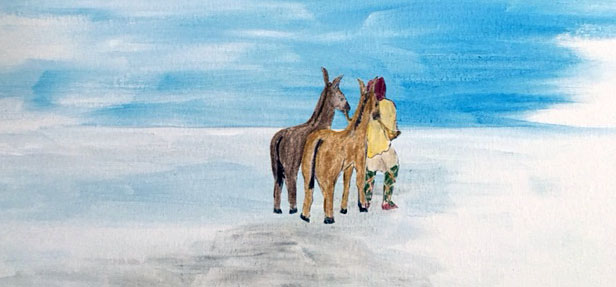
         Colleen is a proper donkey master. She expects obedience, and offers consistency and kindness — never the whip. This donkey, with no other name than Jack which means boy donkey learns his commands in the Irish dialect from a human named simply, girl.

         We pass by Tours, outside the wall to follow the river on toward Orleans. This donkey has a good trotting gait so we might easily reach Orleans in two or three days except the cow is not as quick.

         Eventually we do reach the Burgundy city where there is a suitable stall for a cow in the public stable, but the frisky little Jack donkey isn’t a very welcome guest among the stately steeds. He is relegated to a shed behind the public stables. Colleen worries, but he seems fine here just to get in out of the howling winds for a good night’s rest.

         Here at an inn in Orleans we learn the see of Rome has sent an envoy to bring some kind of important news from Rome to all the kings and bishops of this land. They are here seeking Guntram; but we already know he’s not here. He can be found in Châlons.

         “Is Châlons found by following this river?” one asks me.

         “It won’t take you all the way there. You will need to find another path when you reach the city of Sens.” I can answer, because Ana and I have been all of these places now. “And we are on our way to Châlons.” I nearly offer to be their guide, but then I realize it would be humbling for a bishop’s envoy to have to find their way to the king by following after a donkey cart and a cow.

         Ana’s kindness isn’t curtailed by petty social norms. She invites them to follow us, and they are grateful.

(Continues Tuesday, October 25, 2022)

#37.8, Weds., Oct. 19, 2022

Historical setting: 589 C.E. Bertigan’s Estate near Tours

         Tonight we are guests of the Count’s where the people are my own family. Here, my son Ezra is now the elder patriarch. Everyone calls him “Papa” and they help him from the chair. When he speaks they listen. When they speak I wonder if he even hears them. He sits in a soft chair with a view of the whole hall and he finds pleasure in watching the children at their games. It’s my family, but by my odd circumstance of life and life again my son is the patriarch.

         If I told this to someone just arriving, like Colleen, I might explain that in the year 543 my family was taken by plague, except Ezra and Eve who were discovered as abandoned orphans. They were taken to a pagan practitioner of healing. When they regained their health, Ezra was adopted out to learn the vintner’s trade. He returned to our abandoned farm and planted it in vineyards.

          All those years ago Ezra married a Christian woman, Colletta, and they had children; the two who are still living are Daniel and Celeste. Celeste married Count Bertigan. Daniel is his secretary and recently married. Daniel and his wife have a small child I am told.

         When Eve was an orphaned child she learned the art of healing. Eve recovered from the pox but lost her sight. Ezra provided her a cottage on our family land where she had gardens of herbs and was a known practitioner of healing. She always had the help of child apprentices. Ana was an apprentice to Eve. And before Ana, the guide for Eve’s blindness was Thole. His father Jesse is the Count’s stable master here. As is well known now, Thole chose to follow the Pagans because they listen for individual ancestral spirits and Thole grieves for his own mother and for Eve who was like a mother for him. He feels their closeness in being with the pagans.

         For the newly born into a nature of changing seasons this ever-new of life must seem amazing. Or not. Does finding who we are require the long look of generations to find ourselves in time? And in not knowing our histories are we all just floundering strangers in the guest rooms of pompous little counts in a foreign land as Colleen must see all of this. She longs for community.

         Dear God, Thank you. I’ve noticed all these ways you bring us into belonging to one another. Amen.

(Continues tomorrow)

#37.7, Tues., Oct. 18, 2022

Historical setting: 589 C.E. A Pagan village near Tours

         The custom of Largin’s tribe is to give gifts even for little things. They show joy by giving. Maybe we all do, but this practice actually marks who these people are. So midwives who arrive on time surely are gifted.

         It would complicate our journey were we to be gifted a herd of these sacred white bulls they keep here. I think of Jacob driving his vast herds ahead of him as he returns to his brother. [Genesis 31] So I’m grateful they only offer one fresh cow. One peaceful cow can cross on the ferry with us and will walk nicely behind the donkey cart.

         Ana and Colleen want to start back immediately to Annegray. We don’t have to visit far-flung bishops now, so surely a shorter route will be long enough. The women tell me these months into winter would be the best time for Ana to travel.

         “How can three months into winter ever be the best for travel?” I ask, still naïve to the ways of women after all these years.

         “If we wait for spring,” Colleen confides, “it will be too hard for Ana to travel because the baby will be due. Then if it is born here, where we must stay, we will have to wait for the mother and baby to have strength to travel, and then we might be taking the journey in the summer heat always worrying over the baby. No, Sir, this is the best time to go.”

         “I think it could be that the Count will let us stay as guests here for a year or more. I can find some way to make myself useful.”

         Ana speaks for Colleen, “Laz, she is not just coming with us for our own need. She has a deep longing to be with people from her own homeland.”

         “The Irish of Annegray are monks, Ana. It’s a men’s monastery.”

         Ana argues, “Colleen says the monasteries in Ireland are not places for withdrawing, but are communities where monks may have solitary ways, but all around people gather as a village. She has that hope and a longing to be in that kind of place.”

         “Maybe all three of us yearn for community. I fear Colleen will be disappointed by the loneliness of our cottage.”

         But here we are now, returning home in this season of transitions, leaves on the hardwoods flaming farewells, baring limbs to embrace winds of winter to come.

(Continues tomorrow)