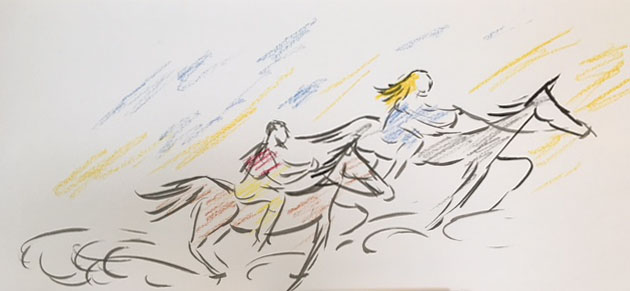
Post #35.3, Thurs., Aug. 4, 2022

Historical setting: 589 C.E. Châlons

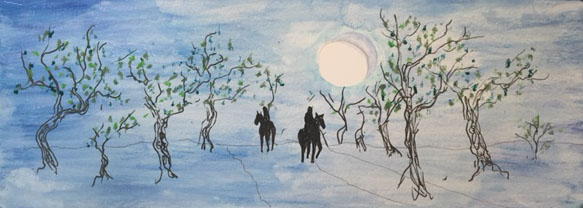
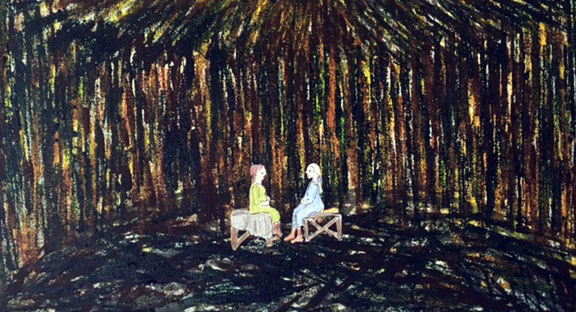
         This morning I deliver Father Columbanus’s message to Father Felix a bit hesitantly, asking him for whom it might have been intended. Even though it is addressed to “The Bishop of Châlons” he opens it and glances over the letter while we wait; then he explains to us that he knows Father Columbanus and he addressed it “Bishop” with a glimmer of humor. He showed me the letter. It begins “Greetings, Father Felix.” [Footnote 1] So now I see two church fathers who oversee monasteries subtly mocking the pomp of an elevated title.

          While we are here, also, Ana continues her relentless search. She asks the young priest if this building houses an ancient library. He suggests we ask about books at the King’s castle as the king has a number of recent acquisitions.  And he also affirms what we heard yesterday.  The king often stays in Châlons so I will be able to deliver that last message I have for the king directly to him while we are here.

         Now at the king’s castle the gatekeeper adds us to the list of visitors as ‘Envoy from Father Columbanus.’ I hand the gatekeeper the message I have brought from Tier without the same care I have for safe delivery of the father’s message to the king.

         Here Ana again asks about books. The King’s library, Ana discovers, is very much the same as King Chilperic’s. Actually Ana finds a whole section of volumes that King Chiperic once owned. We can only suppose that is because King Guntram inherited the books when his half-brother, Chilperic, was assassinated.

         King Guntram is the last surviving son of Clothar I who divided these lands of the Franks into the four kingdoms that now battle each other incessantly. The next generation of kings of Franks are yet very young and are ruling under regencies, whom it happens are the wives of Guntram’s brothers.[Footnote 2]

         One nephew of Guntram, Childebert II, rules Austrasia, the kingdom with all the disgruntled bishops we’ve been visiting on this journey. In the Vosges, Austrasia and Burgundy share a vague border. In some places the southern border of Austrasia is more clearly defined with Nuestra, which was Chilperic’s kingdom, and Nuestra also borders Burgundy.

         The books are not the only thing King Guntram has of Chilperic’s.  He also has his son. He adopted that nephew to be his heir, as he has no sons. Clothar II is a young child now, living in Orleans with his mother, who is currently the regent of Chilperic’s swath.

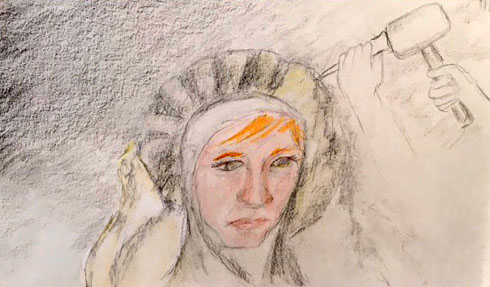
[Footnote 1] https://en.wikipedia.org/wiki/Felix_of_Burgundy retrieved 12-1-2022. It is an enigma for historians, but a fiction writer’s ‘ah-ha’ that Châlons of Burgundy, while missing a bishop, did have a “Felix” who showed up several decades later in Britain, as a bishop, then a saint, related to St. Columbanus. He was called Felix of Burgundy. (The bishop’s portrait copied into the art of this blog is from St. Peter, Mancroft, Norwich. posted in this wikipedia article noted.)

[Footnote 2] Navigating the political scene of the Merovingian dynasty is easier with a genealogy chart. A good one is Appendix A, (p. 232-233) of Geary, Patrick J. Before France & Germany: the Creation & Transformation of the Merovingian World, New York: Oxford Press, 1988.

(Continues Tuesday, August 9, 2022)

Post #35.2, Weds., Aug. 3, 2022

Historical setting: 589 C.E. Châlons

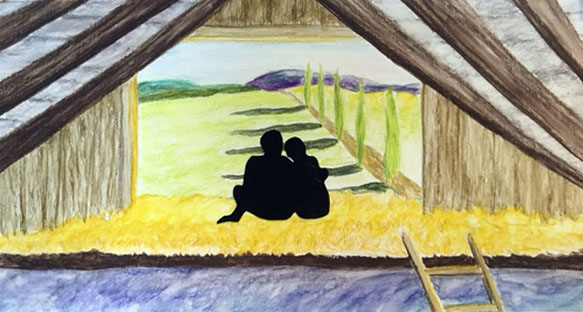
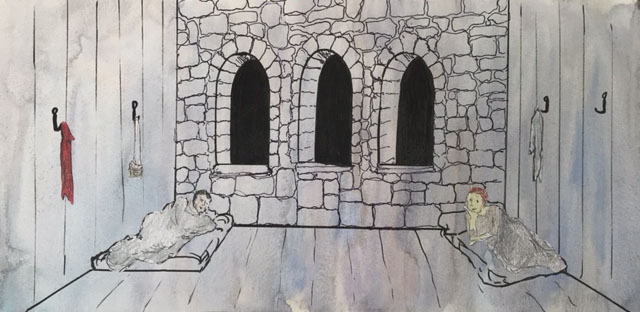
         The stable master directs us to an inn with a private sleeping room for a man and woman together. I don’t think either of us will sleep until we settle this hurt between us. We talk in the dark, long into the night.

         We decided we will spend the coin and stay at this inn another night before we look for this priest so I can deliver to him the message addressed to the “Bishop of Châlons.” Today, all we will do is search for a knowledgeable shepherd.

         It turns out the stable master here knows exactly the person Ana is seeking. This is the one he calls on for wisdom with horse woes, and this fellow happens to be a shepherd. So this morning we find this wise man at the shearing shed in the countryside we had passed through yesterday when we were seeing all the sheep. He hears Ana’s need and they talk for several hours. He marks with charcoal on a freshly shorn sheep showing the location of the internal parts so that she can see the place on the sheep for a surgeon’s blade that could save both the lamb and the ewe. Ana studies it carefully and uses the charcoal to mark a flat stone with her own notes.

         As we mount our horses to go back to the city this elder shepherd takes me aside to tell me he understands her fear. “A young bride often fears for her life in birthing her first child.”

         He must think Ana is with child and asking this for herself. He has a firm warning to me that sheep are nothing at all like human beings. I would argue that she is a physician planning to help another woman. But really, we only have to thank him for his guidance whatever was Ana’s reason for learning this.

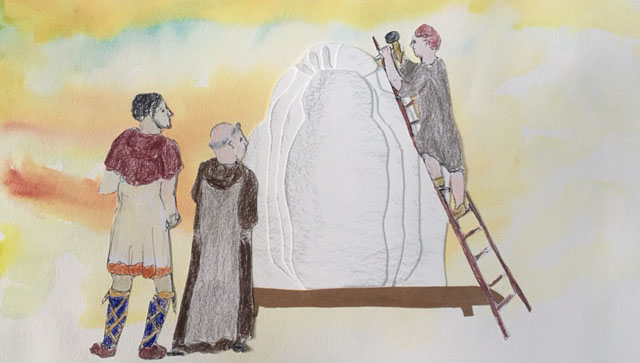
         This afternoon we find this church in Châlons. Everywhere it is bustling with activity. Monks are meeting with the builders working from a vast foundation of an ancient basilica still used as a church. Father Felix is with a messenger for the King and he isn’t available just now so we make a plan to return in the morning.

         Two nights now, we’ve paid a royal price for a private room in an inn. The public stable we found has no traveler’s loft, and the monastery isn’t built yet.

(Continues tomorrow)


Post #35.1, Tues., August 2, 2022

Historical setting: 589 C.E. Châlons

         On this new morning we are riding toward Châlons. There are sheep grazing all around us by this road and Ana hasn’t forgotten my promise to take time to find a sober shepherd for her questions.  Somehow, what I intended as simply the point of view of drunken shepherds, that phrase “vexatious woman,” has come between us. Even though I clearly didn’t mean that was what I thought. I only meant the drunken shepherds might draw that generalization of all women. It was a misunderstanding. Our long ride is silent, except for her reminders of my promise.  I won’t try to twist it into an excuse, but I could mention that bishops perceive themselves as shepherds and right now we on our way to visit the Bishop of Châlons. But I think better of mentioning this thought of bishops as shepherds.  My jest wouldn’t lighten the mood, or even inform. I do know when not to speak.

         These silent hours of riding take us into the city. I ask a stranger to tell us where we might find the Bishop of Châlons. His answer is much more informative than a simple finger pointing to a direction.

         “There was once a Bishop of Châlons they say. St. Peter sent him here. These days we have a young priest minding the duties of the church.”

         “So there is no Bishop of Châlons?”

         “No. But Fr. Felix is a fine young priest.” He glances at Ana. “He will gladly hear your confessions.”

          “Which way is the church?”

         He takes a long look to the north, so I can guess it is north. Then he explains, “It’s under construction these days. The monks who oversee the work answer to the young priest as though he were an abbot or bishop. King Guntram has an interest in all the new ways of the church and he guides our young priest in the upbuilding of Châlons. The King assures us Burgundy doesn’t need the sour notes of an old bishop in these new times.”

         Then Ana asks, “…and has Châlons any knowledgeable shepherds?”

         He ignores her question, and points me toward a construction site to the north.

         “It’s like no one can hear me,” she laments.

         We could go on to the church, but the sun is already setting and Ana and I, and our horses too, are hungry and irritable and tired. We’d best find a common stable with an inn.

 (Continues tomorrow)

Post #34.12, Thurs., July 28, 2022

Historical setting: 589 C.E. An inn on the road to Châlons

         Ana has serious questions about birthing sheep surgically, but these men aren’t at all interested in her need to learn. It might be my own wisdom of the ages, or just my gender, but I can see Ana’s persistence and fearlessness is how she finds her way into troubles. Doesn’t she notice that these drunken men aren’t safe instructors in midwifery?

         “Ana” I interrupt, “let’s find a teacher for you among the shepherds near Poitiers. We should get some sleep now. We have a long ride tomorrow.”

         Now alone with Ana in the loft of the inn she’s angry with me; blaming me for calling her away from her instructors.

         “Ana, those men were drunk. And they had no concern at all about your need to learn how to deliver a lamb. They were eyeing you as an object of vexatious womanhood. They weren’t trustworthy.”

         “Vexatious womanhood?” She says that slowly with her teeth clenched, and her glaring blue eyes icy cold and piercing me.

         “I didn’t mean that as it sounded.  I meant, they aren’t seeing you as the wise physician, but as their own idea of woman… But clearly they aren’t knowledgeable of women.”

         “’Vexatious’ is not a shepherd’s word. It’s your word Laz. First you soothe my fears of men, showing me only pirates and my own wayward imagining makes me afraid and now that I’ve learned to trust, you say I actually should fear men even when they know something I wish to learn. I think you are trying to control me.”

         “Control you? Ana, no one can control you. Not even me, your husband who only wants you to be safe!  Don’t you see how your fearlessness sets you in danger?”

         “In danger of what? Two drunken shepherds?”

         “Especially two drunken shepherds. They’re the worst kind of shepherds. I promise you Ana, we will search out some sober shepherds with all the lambing experience you wish to discuss, and you may meet with them in a way more suited to your gifts for learning.”

         “You have to promise we will take time out for that. I need to know this, Laz. I really need to know.”

         “I promise. Good night Ana. I love you.”

         Dear God, thank you for letting me be the safe arms for Ana while she learns what to fear. Amen. I can see fear is a necessary boundary she hasn’t yet learned to navigate.

(Continues Tuesday, August 3)

Post #34.11, Weds., July 27, 2022

Historical setting: 589 C.E. An inn on the road to Châlons

         Men gather on their way at the board of this inn where ale is served. It seems it may be unusual here to bring one’s young wife to this place, but they also serve a fine dish of porridge and we are both hungry after a day riding. Two shepherds snarl and glance at one another to assure us they see Ana as an intruder. And she’s not one to go to a women’s table with her porridge just to suit the norms of gender, and besides, I’m here.  She doesn’t fear men’s glances in this circumstance, so she makes it her intent to break the social rule by asking them more about their work than they offered.

         “Were all of the lambs born this year without the need of a midwife?”

         This elicits actual laughter; then one wipes the foamy drool from his lips, and notices she has a serious question. 

         “No, not this year.” Said that one. “Old Shlag had to come out to the pasture with his blade, and sliced the old ewe right in her belly and fetch out that twisted lamb.”

         “Really?” Ana is incredulous.

         “It were bloody.” announced the other shepherd.

         “Really? More bloody than a normal birthing?” Ana asked in all seriousness.

         Then the two shepherds argued among themselves about this comparison. They needed extra ale to figure this all out. One staggered back a bit to make the great pronouncement.

         “The lamb and the ewe both walked away from it live!”

         “Both the mother and the baby lived?” Ana asked.

         “It were the miracle of Shlag’s blade!”

         Now Ana’s questions have purpose. She wants to hear the details bloody or not.

         “Shlag is an old shepherd” said one.

         “Shepherd of shepherds” said the other.

         “Like a master of shepherds,” encourages Ana.

         “More like the king of shepherds,” says the first.

         “Kings are born of kings. Shepherds are born of shepherds, and they have the knowledge of the ages – Just like kings know saving the rule, shepherds also only know one thing — saving the sheep.”

         “So would you say this gift for surgery is something common that comes from ancient knowledge of shepherding?” asks Ana.

         “Shhh, yes’m.”

         “Is it common? Or is this the first anyone has seen it?”

         “It were a first for me, but Shlag says it happens.”

         “How did he know where to put his blade for the cut?” asked Ana.

(Continues tomorrow)

Post #34.10, Tues., July 26, 2022

Historical setting: 589 C.E. An island in a river

         Ana says she will be glad to spend these soft summer nights camping by the river washed in the beauty of earth. The river invites these mythical meanders in our imaginations. And we are under the the waxing moon that rises in the afternoon and sets Ana into what she calls, the rigors of woman. I happen to think the whining of it is the rigors of man. I have no experience as a base for my empathy. I’m not sure if it is just grief in knowing there is no baby growing toward birth this month or if it is a physical hurt. But we do take a slower pace these few days. And we make our camp on one of the secluded wooded islands between the river and the shallow fresh water creeks tatting the plain of this valley.

         So here we are, like first man and first woman, basking naked in the warm sun of this place; we are like the people of an Eden but here we are in the middle of a real world.  The horses dine on oats and beautiful grasses. They dip into the water, refreshed, as we are also. These waters are rich with écrevisses, as good as any lobster from the sea.  Add to that the gathering of fresh berries, and our own loaves of barelybread, and we could never think of our necessary tasks again.

         Now the moon has waxed to gibbous rising in the daylight, and setting softly brushed in the summer breeze. The last thing Ana said tonight with words were, “let’s just stay here for ever and ever.” The good things said with no words fill the whole of this night. Thank you God. 

         In the morning we will cross the river and go on our way back to our appointed tasks.

         Our clothes are clean in the cold creek and fresh in the sun, and the horses are rested and fed.  We are ready for the rocky ruins, the mud paths, and arguing bishops of the tangible world as we cross over the river toward Châlons.

         We find an inn this night, and here there is a dining board where they serve ale. Two shepherds imbibe, preparing to go off to the pastures tomorrow with the new lambs of last spring, old enough now to join the flocks for their first taste of summer grasses. We try to seem interested then Ana asks them what may seem a prying question. 

(Continues tomorrow)

Post #34.9, Thurs., July 21, 2022

Historical setting: 589 C.E. Reims to Châlons

         I know Bishop Gregory is not one to use his high ecclesiastical office to make political accusations, but in his secular writings, like the “History of the Franks” for example, he might float rumors supporting his own grudges. All these twisty tales of kings and bishops settling with the dusts of Gaul in the ruins of Rome could be completely ignored by an Irish father, a foreigner to these shores. Columbanus came here for his wilderness pilgrimage. He was seeking desolation and solitude. But, unknown to the father, Columbanus’s journey might have turned political when he and his followers stopped to ask permission from King Guntram to establish an isolated community for his little band of Irish monks. Now it is obvious this so-called, “wilderness” that seemed to belong to no one is really the heartland of Gaul with roads and bridges, rivers and cities and overlapping boundaries of three kingdoms of the Merovingians. Here boundaries are usually settled by annihilating warfare, assassinations and atrocity. 

         I can see here what happened. The humble, but well-spoken father from the Celtic islands took his request to the King, and Guntram graciously offered him the Roman Ruin of a fort in the Vosges mountains. The desert father saw it as a wilderness. The king saw it as a far away, hard to reach borderland he wished to secure because it pushes into the kingdom of Austrasia. So here I am delivering the father’s kind letters to a bevy of power hungry bishops in the midst of it all trying to reconcile details of tonsure style and the choice for an Easter date.

         Our Journey to Reims has nothing for Ana’s quest, and my simple task of handing a letter to the bishop was hardly successful either. But we’ve learned a bit more about the nature of this place.

         We are heading to the last stop on the iron seller’s map, Châlons. 

         From there we will go on as best as we can find our way with no map. From Sens we will be but a day’s ride to the headwaters of the Loire.

         This leg of our journey will take us a few days and will have less of the aristocratic accommodations like city inns, so we prepare by purchasing some oats and several loaves of barley bread to accompany our foraging through an ironically well-populated “wilderness.”

 (Continues Tuesday, July 26)

Post #34.8, Weds., July 20, 2022

Historical setting: 589 C.E. Reims

         The edges of kingdoms that meet in this vague land we travel may explain Reims. Like the aristocratic heritage of bishops, this city itself is steeped in ancient politics. It’s the legendary place of baptism and coronation of Clovis and Kings of the Franks to follow.  Now the bishop is Egidius. But he isn’t here today to receive this messenger in person. So I must trust his assistant to pass the father’s letter along to him. The assistant tells me the bishop is off with an envoy of dukes and royals visiting kings, not with words of peace in the name of God, but with rumors and accusations. Apparently Egidius has far worse issues with the kings and bishops of these lands than does Father Columbanus.

         The assistant doesn’t tell me this.  But Ana learns of it in her inquiries about medical books and women practitioners. She doesn’t find what she is looking for here, but rumors run rampant through huddles of women who aren’t stopped from gossip-mongering by any rules of silence or by the decorum of royal politics.

         Ana said it is rumored that Bishop Egidius had been touting a close friendship with the late King Chilperic. That’s the king, of course, who made the commoner Bertigan into a count and gave him land. It was not unusual for Chilperic to give away lands, so part of this rumor could have merit. But I know Bishop Gregory of Tours considered himself to be that King’s bishop because Chilperic was King of Nuestria. Then, of course, he and Chilperic had that little tiff over the essence of Trinity. But I’m certain Gregory wouldn’t want to hear that this other bishop, the Bishop of Reims claimed to be good friends of Chilperic. And now Childebert’s kingdom of Austrasia is trying to lay claim to villas that once had belonged to Chilperic as the dead king’s riches are divvied up. It is discovered that Bishop Egidius claims some of these valuable estates were gifted to him. He even seems to have the personal papers from Chilperic that support this. So the kings and even Gregory Bishop of Tours are all wondering how it happens that Egidius’s folio is so fattened by gifts from a king too dead to speak for himself. There seems to be a question of signatures. [footnote]  

         In these times kings and bishops are both ruling aristocracy. Kings wage wars with atrocities. Bishops wage wars with rumor.

[footnote] In 599 Egidius was defrocked and exhiled to the city now known as Strasbourg, found guilty of conspiracy to assassinate King Guntram’s heir. The notion that Egidius had forged Chilperic’s signature on the documents proving the gifting of the villas has not been substantiated by any source but the “History of the Franks” by Bishop Gregory of Tours and he had some skin in that game. Information for this note is from Gregory of Tours: the Merovingians, edited and translated by Alexander Callander Murray, Broadview Press, 2006. Page 227

(Continues tomorrow)

Post #34.7, Tues., July 19, 2022

Historical setting: 589 C.E., Laon

         We’ve made a long trek to deliver the message to the Bishop of Loan. While kings who are earthly brothers have wars among themselves, I wonder, do bishops who are spiritual brothers make a better peace? I’m discovering competition among these noblemen of the high church office. In their outward display of civility, dissension is cloaked in undercurrents of unrest.

         We’ve reached the farthest bishopric for messages, and I find this bishop was probably not one who was complaining. Yet the father particularly wanted his message delivered here to encourage this fellow.

         While I go my way to deliver the message, Ana continues her quest asking always to find the midwives and women physicians.

         Now Ana has found some devout laywomen here with an interest in medicine especially considering women’s needs. She came here to learn but they are the ones asking her questions. They’re as young as Ana but without the medical training or opportunities for observation that make Ana such a fine physician. One of these young women invites us and the others to her home where they ask questions of Ana long into the night. I can only sit on the side and be amazed by her gifts as a teacher.

         While Eve’s, now Ana’s, teaching in ways of nature can be an enigma to Roman Christians because it seems pagan to them, here there is an openness more like Irish Christianity. I think they consider themselves nuns in search of a community. Ana defers that question to me, and I can assure them not all monasteries follow the strict rules of the Rule for Virgins as the nuns in Poitiers follow, or the male specific Benedictine Rule. Before I can even mention the work of Father Columbanus one said they were already aware of the Celtic Rule. So now we learn that these young women are hoping Father Columbanus will consider opening a double monastery, one that has a community of men and another community for women all under one abbot and rule. [Footnote] I will mention that when I return.

         After such fine hospitality, this morning we are turning south for a long day’s ride to Reims. 

         This is the land where three warring kingdoms draw their vague boundaries. It is possible King Guntram of Burgundy, Columbanus’s sponsor has a keen eye on these frayed edges of kingdoms.

[Footnote] https://en.wikipedia.org/wiki/Double_monastery Retrieved March 12, 2022. It is noted in this article that Father Columbanus did establish a double monastery at Luxeuil.

(Continues tomorrow)

Post #34.6, Thurs., July 14, 2022

Historical setting: 589 C.E. Trier

         In Trier we’ve been granted permission for Ana to visit the storage of old writings.  We asked about a library, but it seems what they call a library is damp cellar room stacked with books and old manuscripts. I’d call it a dungeon, but the only crime punished here is that of writing in unspoken languages. I remember Hebrew. I remember Greek, and I even have a recollection of five hundred-year-old Latin. While my very brilliant wife seems lost in a moldy mire of strangely twisted lettering, I can be of assistance in her search. I’ve located some ancient medical books in Greek. It appears that in a far, by-gone time scholars writing in Greek performed autopsies on cadavers and came up with some maps of human anatomy. [footnote]  Ana poured over these papyrus pages always turning to the next hoping, hoping to see the thing she needs to see most: the anatomy of a pregnant woman. Where is the baby kept? How is it placed among the vital organs of the mother? The one source we did find had only sketches of men. Several of the ancients mapped the anatomy of animals, but Ana has a very specific question.

         As we bid our departure to our hosts here in Trier the bishop’s assistant asks if I may take a message from this bishop on to the King of Burgundy. That would be Columbanus’s benefactor, King Guntram.

         “Yes, we will be going on to Orleans. That’ll be our last stop to see the king before we go on our own way to the vineyards on the Loire. So surely we can deliver another message to the king.” Apparently this bishop has chosen to make his argument directly to the king, rather than simply read the letter making little asides to this messenger.

         It will be a two-day journey parting from the riverside, and following a horse path through the forests to Laon.

         We are riding north, and it’s such a distance I’m wondering if the bishops of the north are also making complaints to Father Columbanus based on reports from their own pilgrims, or if the argument against the Celtic Rule is simply based on rumors among bishops.  It’s a puzzlement to me, because I think each of these churchmen considers himself a sovereign. His authority would not be swayed by opinions of distant bishops.

[footnote] This was not a likely find because, as explained in a document: retrieved by this author on 11-21-21, https://www.ncbi.nlm.nih.gov/pmc/articles/PMC2589595/ Yale J Biol Med. 1992 May-Jun”;65(3): 223-241. “The discovery of the body: human dissection and its cultural contexts in Ancient Greece” by H. von Staden,  an idea of the connection between body and soul prohibited such investigation even in ancient Greece. If fictional Ana had found any trace of this she would have seen the work of Herophilus of Chalcedon and Erasistratus of Ceos.

(Continues Tuesday, July 19)