#71.9, Thursday, August 21, 2025

Historical Setting: 793 C.E. Marmoutier

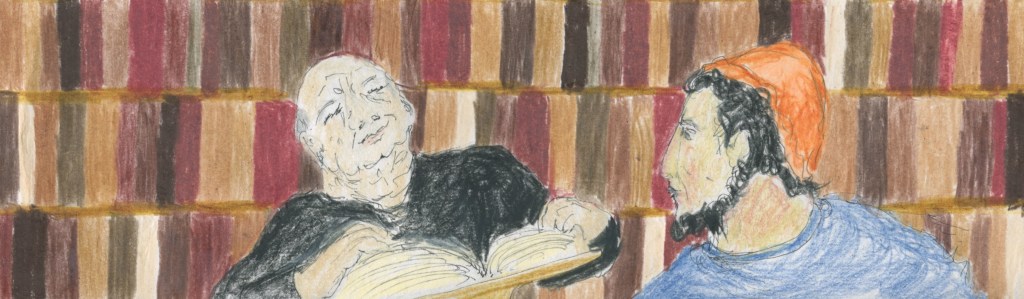
         He says, “No doubt, Bishop Higbald is begging my answer on this matter of Lindisfarne’s sins because he is in need of a statement that he can read to both the surviving monks and also the political foe that will address this matter of sin from a scholarly distance. It needs to be a matter of sin but also allow for a heavenly peace.”

         The scholar is contemplative, thoughtfully studying the letter he is preparing to answer, then he goes to his row of books, and draws down St. Augustine’s City of God. [Footnote1]

         “Thank you. You’ve been very helpful. I will have the answer to the bishop’s letter for you to carry back to him tomorrow at first light.”

         I’ve been dismissed to await the response.

         This new morning the king’s children are turned away from lessons while the scholar is in solitude. Taking his time, responding to his friend’s need for better words, is his priority. Surely, Alcuin will take the story of this raid to the King and it will be entered into the chronicles of history.

The dangers of the Norsemen Vikings in their stealth vessels, raiding villages along the rivers and the coasts were probably already known.  It’s been going on for some time, rumored among all who have heard the howling in the night and the cries of women taken captive then in the dawning, burying the dead. It has been known to the broken communities left in plunder. But only when it is written is it known to history. So, these letters exchanged make the danger of the Vikings officially historical.

I’m summonsed back to the scholar’s study and I receive the letter to carry back to Lindisfarne. The children are left waiting again, while Alcuin invites me to listen to his answer through the ears of the people who will gather to hear it read.

It begins with his personal greeting, then he speaks his words of woe for all of Britain’s Christendom. And then there is the issue of Christian pacifism.  He offers his opinion on that right up front. He expects the fight to come from the bones of the saints rising up.

“What assurance can the churches of Britain have, if Saint Cuthbert and so great a company of saints do not defend their own? Is this the beginning of the great suffering, or the outcome of the sins of those who live there? It has not happened by chance, but is the sign of some great guilt.”[Footnote2]

[Footnote1] http://unamsanctamcatholicam.blogspot.com/2021/06/alcuin-to-higbald-and-christian-view-of.html Retrieved 10-8-24 Blog subtitled, “Defending the goodness, truth and beauty of Catholicism  The letter is interesting because Alcuin’s method of consolation is to remind Higbald that calamities are a reminder of God’s love.” This ref. is the source connecting Alcuin’s letter to Higbald with the work of Augustine of Hippo’s, “The City of God” [apparently this page disappeared into the blogisphere so I will quote the whole section here] Alcuin is here offering a classical explanation for evil that comes from St. Augustine: temporal misfortunes fall equally on the good and evil; the difference is not in what befalls, but in how people respond to it. The purposes for suffering amongst persons are distinct, despite the external similarity in the nature of the ills. In City of God, St. Augustine says: There is, too, a very great difference in the purpose served both by those events which we call adverse and those called prosperous. For the good man is neither uplifted with the good things of time, nor broken by its ills; but the wicked man, because he is corrupted by this world’s happiness, feels himself punished by its unhappiness. Retrieved 12-5-24

 [Footnote2] https://web.archive.org/web/20170506102223/https://classesv2.yale.edu/access/content/user/haw6/Vikings/higbald.html   Retrieved 12-5-24 Source: Alcuin of York, Letter to Higbald, trans. by S. Allott, Alcuin of York (York, 1974). Reprinted in Paul Edward Dutton, Carolingian Civilization: A Reader (Ontario, 1993). Scanned and proofread by Eric C. Knibbs, 2006.

This text is part of Viking Sources in Translation. Unless otherwise indicated the specific electronic form of the document is copyright. Permission is granted for electronic copying, distribution in print form for educational purposes and personal use. If you do reduplicate the document, indicate the source. No permission is granted for commercial use.

© 2006 Anders Winroth

(Continues Tuesday, August 26)

#71.8, Wednesday, August 20, 2025

Historical Setting: 793 C.E. Marmoutier
 

 Alcuin has the difficult task of answering Bishop Higbald’s need to address the earthly political power struggle in a time of the bishop’s own personal grief and loss at Lindisfarne. This teacher is asking me about my brief few days in that grieving land and I don’t have any happy ending to tell him. It seems he wants to speak for God and say God doesn’t punish a monastery by sending heathen marauders. He asks about sins. I can only describe fears that envelope the place that was simply founded for the purpose of receiving and spreading God’s love.

         What was taken? What was left?

He asked me about valuables that were taken in the raid. But we both know the real loss – the lives, and the peace that a community shares as holy purpose.

I know the attackers found no value in the gospel. They sent it back after discovering it wasn’t a marketable chest of treasure. Had the Pagan invaders kept the holy book, it would have allowed an imagined happy ending: like, maybe, the marauders read the gospel and were changed to Christian.  But that’s not what happened.

 We know it takes more than words and beautiful pages to change a people from the worship of many distant and demanding gods, to one (or three) who is love. Pope Gregory the Great knew that when he sent Augustine to the people of East Angles to change a people. Human touch was needed. And that was how that island first met Christianity centuries before there were monasteries on the British Island.

As much as Alcuin values literacy and books, he also knows that it is the human touch of God’s love for which a heathen tribe longs. There is also a hope in the possibility that monks were captured so the Vikings would have the human Christians to teach them.  But no one could name anyone who wasn’t accounted for. And I know from my own release, these Norsemen often find enslaving men more trouble than it is worth.

So, what was it that the Christians had that the marauders wanted? It was simply goods: fine fabrics, silks and dyed linens, gold and silver, jewels and the like. They raided the vestry and the pantry and the wine cellar.

The weighty bell stayed in the tower so Brother Ealdwin who went to ring the warning, was safe. But we buried other monks, murdered for the market value of their robes.

(Continues tomorrow)

#God’s love, #human touch, #sin and repentance, #Alcuin, #St. Augustine — missionary, #heathen Vikings,

#71.7, Tuesday, August 19, 2025

Historical Setting: 793 C.E. Marmoutier

         The king’s teacher, Alcuin, is considering his response to Bishop Higbald particularly asking what he meant by “sins of Lindisfarne.” The bishop referred to “sins” as though the Viking Raid was God’s retribution for the monastery’s sins.

         Alcuin says, “It seems unlikely the sins were the peaceful nature of any monastery, though that did leave the monks unarmed and vulnerable. No, I think he was referring to a specific incident that he assumes I know all about.  I do not. So, I ask, do you know of any such incident?”

         “I was only there a short time to help bury the dead… But now, as I recall, Brother Ealdwin did mention something very dark, as though it was a sin.”

         “What?”

         “When I started to prepare the graves in the burial grounds for monks, Brother Ealdwin stopped me, suggesting we find another area away from a recent burial place.”

         “Why?”

         “Apparently the monastery became caught up in a political issue. He said a novice died and was buried in that place and a controversy arose. This fellow had come to the monastery seeking tonsure following the death of a Northumbrian king.”

         “Is this related to a long running rebellion and the regicide of King Aelred by a group of rebels?”

         “Apparently so. This man was one of the rebels. Brother Eldwin said this fellow brought a terrible burden of conscience, but before he accepted the holy orders and even as he was asking for penance, he killed himself. The abbot, since murdered in the Viking raid, took pity on this man because he had begged for mercy. There was an on-going debate about the burial of such a sinner among the monks. The bishop handled the situation acknowledging the abbot’s mercy and recognizing God who is love. But, Brother Ealdwin said, the political supporters of the king were still critical of the bishop for leniency given in the burial of this rebel.  Some who were secular patrons of the monastery wouldn’t let this issue go.”

         Alcuin says, “So, apparently the bishop finds these political supporters of Aelred are using the sin of regicide and one repentant but unpardonable suicide to smudge the whole community and the earth it stands on, now continually corrupted in sin.”

         “Yes. It put the bishop in a hard place.” I personally never appreciated the need for bishops, but here, a bishop in his fine silks and two-pointed hat, one of earth and the other heaven, bears the incongruence between omnipotence and omniscience — power and love. 

(Continues tomorrow)


#71.6, Thursday, August 14, 2025

Historical Setting: 793 C.E. Marmoutier on the Loire

         I was called to meet with Alcuin at this, the matins hour. He is anxiously seeking someone who can listen to the letter he is writing in response to Bishop Higbald’s letter. And he is particularly concerned about an issue that Higbald refers to, as the “sins of Lindisfarne.”

         “My dear friend talked of signs of God’s judgment on the monastery, both in heaven and on earth leading up to this heathen attack.”

         “I was aware of the signs and portends seen in the heavens. Often the northern skies are brilliant with colors just appearing with no apparent source. As the heavens prepared for the raid these brilliant markers in the skies came as columns of light that moved in a pattern of soldiers marching to battle. This was after some months of drought when there also came dry flashes of lightening until finally, there was a deluge.”

         “You saw these signs and portents?” he asks.

         “When the skies are ablaze in such brilliance, everyone notices. In the north the Pagan marauders on one shore of the North Sea shouted war chants and believed Thor was sending the best winds to carry them, and the lights to guide them. They believed that Odin had extra places set for them in Valhalla, so they didn’t need to fear any army of brutal monks the Christian God might send.”

         He smiles at my use of the Norsemen’s image of “brutal monks of Lindisfarne,” knowing what we both know having been to the holy island.  I continue.

“But the Vikings prayed to their own gods for courage, believing they were in danger from the monks.” 

“Maybe the sin was that the monks weren’t prepared with proper weapons.”

          “It is an enduring argument: are Christians an earthly army, or are we following Jesus, forgiving the enemy all the way to the cross?”

         “I know that debate well. So maybe the bishop believes he failed to prepare his followers for warfare.”

         “Failure?” I ask.

         “It may be so. And I see you are a messenger who comes with a horse and yet no sword.”

         “It’s my personal choice to carry no weapon.”

         “But, a bishop can’t make such a ‘personal choice.’ He speaks for many. My friend may feel his encouragement here, but in facing danger only with prayer he may have given leeway to the heathen invaders.”

 “So, you are suggesting, by not preparing monks with weapons, the deaths are on the conscience of Higbald?”

“That was likely not what he was referring to as the ‘sins’ of Lindesfarne.”

(Continues Tuesday, August 19)

#71.5, Wednesday, August 13, 2025

Historical Setting: 793 C.E. Marmoutier on the Loire

         Tonight, I’m staying in a guest room at the monastery near the shrine of St. Martin of Tours waiting here for the king’s scholar, Alcuin, to prepare his answer to Bishop Higbald’s letter with news of the Lindisfarne raid.

         It is the dark of morning, the prayer time when monks stagger from sleep with their worries to hear God’s answers and receive anew the creative “ah-ha.” In this thin space of night before dawn the teacher Alcuin has been mulling the tragic words in the letter I delivered here from Bishop Higbald. 

I was awake and reading the psalm for this day by candlelight when a monk came to the door of this guest cell. He said Alcuin requests the presence of one who knows the depth of the sin Bishop Higbald spoke of in his letter.

         “Depths of sin” isn’t normally my morning nourishment. I am friend to Jesus whose message was love, though it is often wedged awkwardly amid human fears of sins, hates and end times. And Jesus was a follower of John, who preached the turning, the repentance and the cleansing in baptism. So, the popular rise in sin-wallowing doesn’t much appeal to me. Maybe it is spoken often by holy men in these times because it lays the emphasis on human control of our own circumstances. By blaming our own behavior, we can blame sin as a reason for things we otherwise can’t control. Then human beings are empowered to heal the woes of the world, simply by un-sinning, confessing, repenting…

         As I follow the monk down the hall to Alcuin’s chamber, I am thinking through the details of blame/sin in Higbald’s letter.

         Here at his door –

         “Ah, good messenger for my dear friend the bishop. I apologize for waking you at this hour.”

“I was already awake for prayers.”

“I’ve not slept with my worries over my friend’s plea. And I need a listener to hear my words as Higbald would hear them.”

         “I know he wrote to you to hear words of God’s forgiveness for what he called the sins of Lindisfarne.”

         “Please try to listen to my answer with his way of hearing it.  He speaks so much of God’s retribution for a particular sin. What possible sins are there, that could be committed by a whole monastery?”

         “I do know of the incident that concerned Bishop Higbald.”

(Continues tomorrow)

#71.4, Tuesday, August 12, 2025

Historical Setting: 793 C.E. Marmoutier on the Loire

         Alcuin, one of the king’s chosen intellectuals, receives the letter I am delivering from Lindisfarne, now shadowed in tragedy.  He seems hesitant to open the seal of his friend the bishop. He holds it in his hand and studies the seal and folds of the envelope. Then he asks me.

         “So, you, yourself know the contents of the message?”

         “I am aware of the news it brings.”

         “Are you literate?”

         “I am indeed, Sir. But I assure you, I didn’t break the seal on the envelope to read the letter. I was already aware of this terrible news of which the bishop is informing you. If you care to be alone, I will wait outside for your return message.”

         “No no, wait here. I don’t want to read bad news alone. Will you stay and read it to me?”

         “Of course.”

         The teacher opens the bishop’s letter and hands it to me to read.

         He sets his gaze beyond the walls here, on the river running by.

“On the day of June 6, in the year of our Lord, 793, heathen Vikings came ashore at Lindisfarne near the shrine of St. Cuthbert…”

As I read to the teacher of the foreshadowing of the raid, the drought and the hardships, the wonders and portends seen in the heavens, remembering a recent tragedy, the teacher stares through the window slit, with his jaw tight, clenching and releasing his fist. There is a long pause after the letter ends, and I fold it back to its closed form. Then he turns to me.

“Were you there?”

“I was, Sir. The monk who rings the hours, Brother Ealdwin, was witness to the raid. I was a slave with the boats of the marauders on the beach. Then I was sent back, set free from possession as a slave, freed for the reason to return the Gospel of Landisfarne to its proper stand in the priory.”

“So, the Gospel wasn’t taken?”

“They didn’t understand its value, Sir. Brother Ealdwin and I buried the dead, and, on the third day we welcomed back Bishop Higbald and the brothers who were spared. The actual Shrine of Cuthbert was spared desecration, though other treasures were taken, probably it was spared because the shrine itself was not encased in gold. When the bishop returned, I was sent on with this letter.”

“I’ll prepare an answer to the bishop. Thank you.”

(Continues tomorrow)

#71.3, Thursday, August 7, 2025

Historical Setting: 793 C.E. Visiting the Monastery of St. Martin

The monastery, Marmoutier, named to honor St. Martin whose shrine brings pilgrims to Tours was also renovated to keep up with the times. It is fully following the Rule of Benedict now. Even in places once Celtic, Benedictine Rule is used, because revisions in the rule now allow, and even assume, an individual’s mystical relationship with God. Maybe it is no longer about enforcing the power of abbots and bishops over the monks and naming requirements for obedience. These were worthy changes in my opinion. But the written Rule now calls for a longer page to read, laid out here on the entryway bookstand. It is a good read while I wait for this teacher to the King’s children, Alcuin. 

He was already informed a messenger is here and I am told he is lecturing, just now, on logic, a favorite subject of his. He’s known for making some intriguing puzzles for his students. [footnote] 

I hear classroom noise echoing down these otherwise solemn hallways — young voices — a billowing teacher and now there is laughing.  Where is any laughter in the strict rulebook posted on the bookstand here?

         While I wait a matron brings two little girls with wax boards and styluses for practicing letters. Waiting together here, I ask the matron if it is usual here, for girls to learn to write.

         “Their father is King Carulos, and he wants all of his children to be fully educated.” [footnote 2]

         “So, this Frankish King values education, even for girls?”

         “Of course.” She seems to wonder where I’ve been that I know nothing of King Charles. 

“It isn’t unusual at all. Are you not aware that in these times, even the Byzantine emperor is a woman, Irene?”

         The teacher comes to the hallway arch, his solemn face is creased pontifically, until he smiles, then that air of omnipotence melts with the warmth of his presence.

He says to the little girls, “Good morning Huldrud and Thedrada. We will start our lessons in moment. Practice your letters until I get there.”

The matron follows them down the hall.

         “Ah, Father Alcuin…”

         “It is ‘Deacon’ I am a teacher not a priest…”

         “I was sent with a message from Lindisfarne.”

         But this teacher, Alcuin seems much too cheerful for this letter I bring.

         “Ah, the seal is of my dear friend, Bishop Higbald. Is he well?”

         “He was well, when I saw him last, Sir, but I am sorry to bear the sorrowful news this letter brings.”

[footnote 1] https://en.wikipedia.org/wiki/River_crossing_puzzle

[footnote 2] Charlemagne’s view of education, https://courses.lumenlearning.com/atd-herkimer-westerncivilization/chapter/charlemagnes-reforms/  retrieved 6-2-25

(Continues Tuesday, August 12)

#71.2, Wednesday, August 6, 2025

Historical Setting: 793 C.E. Visiting Tours
 

This journey, visiting the bones of my loved ones along my way, is really about finding the spiritual life and life again of those I once shared bread with. It is the joyful side of life — the weedy overgrown vines of remembrance.

Dear God, thank you for this happenstance to take the message I am assigned to carry on to Marmoutier. Thank you for these generations of shared times with loved ones and my gift for remembering these things. Though, I have to say, remembering often feels more like grief, revisited.  Amen.

         I choose my route to follow the Loire to Tours, passed the fields I once planted, and the houses with roofs where I laid the thatch. In those times we first learned of plague in the worst way. So many died. And the Roman rule of the ancient times was waning. Then it was the Christian Church, not the kings as much, who were stretching to fill the earthly power vacuum. Maybe that didn’t change, as we simply became accustomed to some rulers claiming castles on earth and others, in miter hats, claiming heaven. Yet the tender prayers of children soar to heaven naming gratitude for mothers and fathers and loved ones though rarely for kings or bishops.

         I slow this horse’s fast trot, and dismount. I walk along with the horse, beside this river I remember.

Here, where houses once stood are paths that in another time marked the journeys of friends and family coming to our door. Then these stones were stacked to enclose the gardens we kept. Here, these wild tangles of vines that make havoc with the landscape on the untamed edge of the road, speak remembrances of the vineyards filling the wine cups of the generations who once lived here. The river still runs its path, and the Church, the basilica at Tours built into the city wall, still stands as it was rebuilt after a fire. Keeping things the same is always a matter of rebuilding. What once seemed new is always another time’s relic.

Tonight, I stay in an inn by the river. Maybe this innkeeper is someone’s great-grandson I might have once known. Even if this inn is made of fresh cut wood, nothing is really new.

Tomorrow I will deliver the letter to Alcuin.

(Continues tomorrow)


#71.1, Tuesday, August 5, 2025

Historical Setting: 793 C.E. Visiting Metz
 

         Before I leave these hills and ride off on that journey to Tours, I take this day to follow the familiar creek and visit the hill that was once my family home.

         Mostly the stones that marked the fields are scattered now, and the house is in ruin. But the stone I named for Ana is in place, still incised with the lines that are the letters of her name, though the incised lines are worn by time. The chiseled scars of my grief are still deep in my heart.

Further on, the secular church is overgrown in forest and vines. I find hardly a trace of the building. But here, where the clearing was cut behind the church are more named stones of my family.

         I see that Brandell passed before Gaia, though the stones aren’t carved with dates. I know that because the engraving for Brandell’s stone is cut deep, and it is decorated with carvings of birds and flowers, hardly visible to the eye, but to touch it is an abundant garden of all things beautiful. And next to Brandell is Gaia, and next to Gaia is Mater Doe. The two women’s names are together on one stone. Other markers here are names I’ve never heard spoken, but they could well be grandchildren I’d never met.

         Having the blessing of life and life again might seem to be all about finding names on stones and grieving for loved ones.  But I know something else about my strange circumstance of ever renewing life.

         Jesus made me a sign.  Of all the seven signs, not miracles, I am the sign that was given to speak of death though really of life.  A sign is a physical image, visible and tangible, that speaks of a spiritual reality, invisible but true. The sign I am is the physical life and life again, announcing always the spiritual life and life again. So here is spirit.

         This place where we once danced at the wedding is now completely overgrown with thickets of vines far beyond any earthly vintner’s imagination. Called weeds now, it is really just a garden we have yet to understand.

         Dear Jesus, my friend, I’m the sign of earthly life, finding little shoots of vine we once nurtured, are now this wild thicket filling all the empty space with huge greenery, twisting, wandering vines rich with leaves and ragged bark and little clinging curls reaching, clasping, like a baby’s fingers around her parent’s touch. Thank you.

(Continues tomorrow)

#70.15, Thursday, July 31, 2025

Historical Setting: 793 C.E. Metz

         Metz is hardly as I remembered it.  There are new walls and towers, and the once mud streets are paved in stones. But musicians still test their songs in the town plaza and probably the commoners still come dancing for the mid-summer celebration. It was a favorite venue for my son, Brandell, the poet, so many generations ago.

Now this village has booths for vendors and craftsmen. The public stables are as I remember, but with more stalls.  The stable hand tells me this fellow Odo plans new constructions and he sells his ideas to the rich.

He directs me to Odo’s house.  I see here old Greek notions for buildings are remembered. It is created first, not of stone and mud, but in the imagination of a mathematician, as a drawing on parchment. And that seems to be the function of Odo’s workplace where I wait for him. Here is not one stone or chisel, but rulers and inks. The worktable is spread with parchment. The book stand is overflowing with ledgers and maps. And here is Odo in a builder’s leather apron, but a demeanor clothed in the finery of a nobleman.

         “I have a letter for Alcuin from Bishop Higbald.”

         “Alcuin, the scholar for the King?”

         “I was told you would know where the king has his court in these times.”

         “Yes, but Alcuin is the teacher for the King’s children. So, he isn’t traveling with King Charles at this time. The children are at Marmoutier Abbey.”

         “Thank you, this is very helpful.”

         “That is near Tours on the Loire…” [Footnote]

         I knew that. I used to live near there also.

         “So, you would go all the way to Tours, just to deliver a letter?”

         “I find that travel a blessing.”

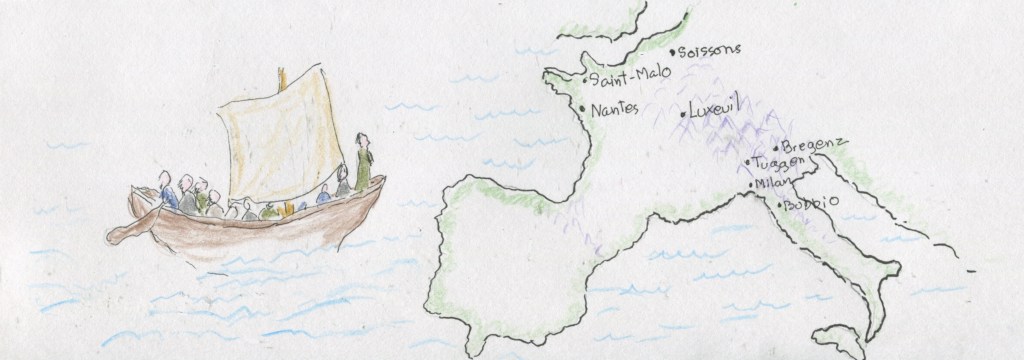
         I go on my way, passed the Waldelanus castle fields, where my son-in-law was a serf along with Layla and their children. There are standard shelters for serfs now. But here the burial place for all those who worked the fields has only nameless rocks left in places by loved ones. Even in death serfs are nameless.  I travel on, and tonight I will stay at Luxeuil.

         The monastery is the same as always. The guest rooms are unassigned monk’s cells. Brandell’s artwork isn’t in perfect condition, but it is still here, at the healing pools. And I find the grave of my son Gabe, marked only with a carving of a dove. That suits him well.

[Footnote]plodding through history, this blogger finally has come to an era when actual details of names and places were recorded and still available for us to find. So, Wikipedia searches found Alcuin at Marmoutier, and Odo of Metz in the record, and the route of this journey didn’t have to be contrived as fiction. Bishop Higbald’s message was sent, but finding no record of the messenger who carried it – Lazarus’s part in this is still fictional.

(Continues Tuesday, August 5, 2025)