Post #22.12, Wednesday, July 28, 2021

Historical setting: 584 C.E. Ligugè        

         Changing the subject, I just asked Brother August if The Rule made allowances for an artist who cuts stone.

         He answers, “At Ligugè we don’t concern ourselves with The Rule yet the abbot here has been generous in allowing me to continue my prayers with a hammer and chisel in hand.” 

         “That’s good.  I can imagine there would be no room for an artist in all that order and routine of The Rule.”

         “Oddly enough, Benedict’s Rule Number 57 [Footnote] would allow for a craftsman to do such work. But The Rule of Benedict isn’t about the works of art, so much as the sin of pride an artist may have. And indeed, pride was my own burden of sin. But The Rule doesn’t address ‘pride’ as something that would intrude into my love for brother with the striving and envy I had been practicing. Rather Benedict’s measure of sinful pride by a craftsman comes in the selling of the art. Apparently, for Benedict, value is only measured outwardly, according to the monetary worth of something. So the artist is not to receive money for the work or The Rule assumes that may lead to pride. In the instance of selling one of my works which Nic purchased from a dealer to bring as a gift to this place, I received nothing for the work but I benefited from the opportunity for a long walk here with Nic and your father. So by The Rule I showed no sin of pride because I received no money.

         “Ligugè has been a good home for me all these years, and for Nic also; We added Brother Joel to our numbers but lost your father along the way. Brother Joel was truly a spiritual guide for me in considering my actual sin of pride. Thankfully Joel lived a very long life and his bones are only recently in this graveyard.”

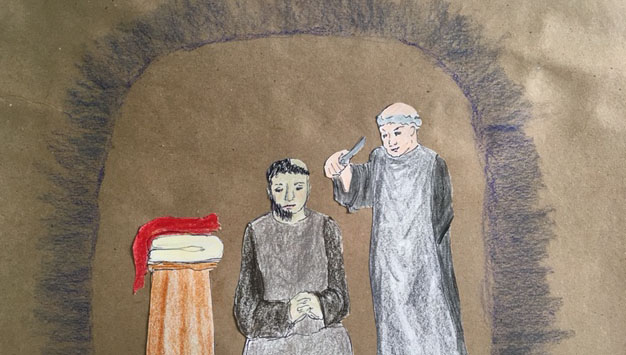
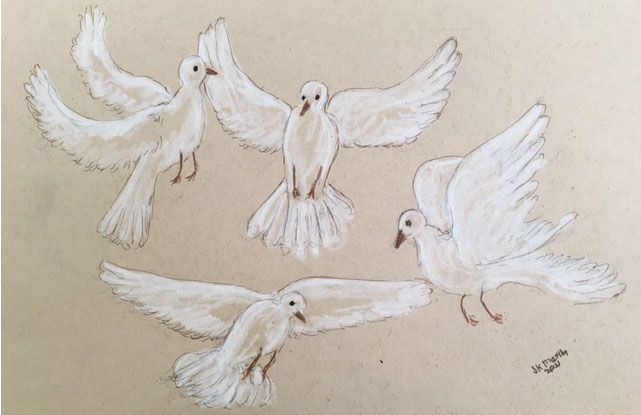
         Brother August shows me a marker he made for Brother Joel. On this, Brother August has carved a bird in flight — soaring. It is a perfect image of this elder monk, since Brother Joel’s spirit was always gliding and soaring as a bird. But chiseled into a weighty earthen stone I can also recognize Brother Joel’s awkward paradox of earth and spirit.  

         “So what did Brother Joel have to say of pride?”

[Footnote 1] White, Carolinne, Translator,The Rule of Benedict, London: Penguin Books, 2008. page 84.

 (Continues Tomorrow)

Post #22.11, Tuesday, July 27, 2021

Historical setting: 584 C.E. Ligugè

         Here I am at the monastery visiting the place where Nic is buried. Brother August came over when he saw me here. Now Brother August remembers me from twenty years ago but even though he has heard about it, he doesn’t believe the story of my very odd gift of ever healing, even from death to life in a never-ending sameness of age. So Brother August assumes I must be someone else.

         “Really, you look just like Nic’s friend, Lazarus.”

         “So I have been told. And I’m named Lazarus.”

         So he assumes I must be my own son. It could be a bit creepy for me to try to make a correction of that, since I suppose the shock of seeing my bloodied dead bones is seared forever onto the minds of the on-lookers of the Bordeaux tragedy.

         “I’m Brother August. I journeyed with Old Nic and your father, so many years ago. I had no idea Lazarus had a child. Your father’s death was such a tragedy for all of us who knew him.  I know Brother Nic visited your family’s vineyard often whenever he could. So you’ve probably known Nic since childhood.”

         “I knew Old Nic well.”

          Brother August yammers on in eulogy, “I know Old Nic loved children. He probably taught you to read, didn’t he? He was always taking lessons along for the children of your family.”

         It’s hard for me to be silent in this wrong assumption Brother August is making especially when he assumes it was Nic who taught me to read. I catch myself weaving into all my generations a deep vein of personal pride. I learned to read and write ages ago in order to become a man in a Hebrew speaking family and in a Greek reading world. For this moment a monastery is a good place to practice silence.

         I answer, “I know of his reading lessons. He was a dear friend. And I know that you are the artist who prepared this stone marker.”

         “Nic told you everything didn’t he.”

         “Only up to a point. He mentioned monasteries are now minding The Rule of Benedict.”

         “Well, here at Ligugè we are aware, but this is a very old community so we already have our patterns. We borrowed a copy then sent it on.”

         “That’s good, because what I have heard of the Rule from Brother Nic, it would probably allow no place for an artist.”

         “I guess you didn’t hear everything then.”

(Continues tomorrow)

Post #22.10, Thursday, July 22, 2021

Historical setting: 584 C.E. Ligugè

         As night creeps over I see ahead of me the hulking peak of an old villa roof.  I’m coming upon the monastery that was a Roman villa centuries ago. In a time long ago St. Martin repurposed this rich gift of a grand Roman edifice for use as a spiritual refuge for monks coming in from the wilderness to be in community. I know this place as it is now with a sunny atrium for the scribes and an oratorio for worship and dining. The cells for the monks are dug into the clay beyond the walls or built of thatch and rock scattered around the back areas of this land.

         If I knock on the door tonight I will only intrude on the silence after the vespers. So tonight I’ll sleep in hayloft of the stable. Tomorrow I’ll meet the abbot and beg a guest room or a cell. I might not mention I once had a cell of thatch that was burned up by the abbot who feared I brought plague to this place. All these years later I’ll only confuse people I’ve known in a long ago time with my incessant look of youth. My circumstance requires me to pretend I know nothing of the past. Always, it seems, history is most comfortably spoken from the present so the out of style and unpopular truths it keeps can be edited out.

         Sun rising now, silvering the morning mist and I walk through the open place of the wall of stacked stone surrounding the graveyard for monks. Here is the newly made grave with some stones already gathered. I’m sure this is the burial place of my friend. Already there is a marker — a partly carved sandstone with an artist’s bas relief showing an ox head. Yes! I know this artist was one of us who knew of Nic’s love for such simple beasts. I already know the one who placed this blessing here for those of us who knew Nic well.

         Dear God, thank you for nurturing this hope I have of meeting Brother August once again and for this celebration of Nic’s gentle nature.

         “Hello Mister. Did you know Old Nic?”

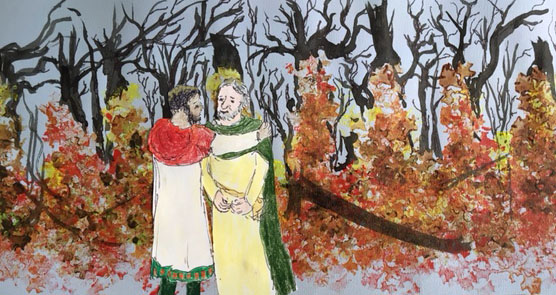
         I turn around and there is Brother August with a snowy tonsure like a great halo of heaven crowning his brow.

         He continues, “Oh, excuse my surprise, but you look just like the brother’s old friend Lazarus.”

 (Continues Tuesday, July 27, 2021)

Post #22.9, Wednesday, July 21, 2021

Historical setting: 584 C.E. the road to Ligugè

         I’ve walked this road to Ligugè before. But all these years later so much has changed from human neglect. When inattention defines our spaces the buildings don’t just sit still and empty. There come first the little creatures, the insects, mosses and mushrooms, then the grasses come with spiders and mice, then birds. Squirrels make their homes in rafters, and the roof beams become saturated with rain-dampened thatch sagging and caving until only a few stones and a flat place once a foundation are left to mark a house.

         I imagine the God’s-eye view of this isn’t really of sorrow and loss. Maybe where we see decay God sees all things new. Where once there was a house filled with the chatter of people now a whole new nature sways in the creeping of unkempt vines.  How many times do we assume our ways are the same as God’s ways, with all our branches trimmed back neatly into tidy straight edges? Yet God forgives our shorns and trims and blesses us with life in all these eternal lands anyway.

         Along this road a small group of guardsmen pass by on horseback with a banner identifying their belonging. I can step aside for them because the simplicity of walking gives me that humble choice. I had a horse in a prideful time. And Christians have another story of walking humbly that speaks of crossing social mores for the sake of love of neighbor.  [Acts 8:26-39] There is a story of an Ethiopian Eunice riding in a chariot while reading from a scroll named for a Hebrew prophet. The basic love of God is not complicated theology. In all the Holy teachings there is a simple repetition — the rudiments of ancient Hebrew law. Love God above all else, and your neighbor as yourself. [Leviticus 19:18] Here is this wealthy person of rank from wise Africa, whom we pale Christians of the north hold in awe. Dark is the shade of early wise men and saints, the early Church Fathers and Augustine, … Story goes, while walking on the road Philip steps aside for this very important Eunich. Yet the aristocrat humbled himself for the sake of a broader wisdom and he invited Philip onto the chariot to explain the scroll. In this telling of it, Philip baptizes this Ethiopian Eunich. It’s a story of looking beyond the tribal prides and social prejudices, putting aside isolating barriers of “othering” and stretching ourselves into the broader unbounded nature of love for all people and creatures.

 (Continues Tomorrow)

Post #22.8, Tuesday, July 20, 2021

Historical setting: 584 C.E. Leaving the vineyard

         I’m preparing to leave at dawn to walk to Ligugè. My bag is a bit weighty. But Anatase has something more. It’s a secret. She has the book of remedies with flower stems marking pages and she asks a favor.  Could I copy these pages onto a parchment end so she can attach dried herbs onto the written descriptions. She wants her teacher to receive a gift that has smell and touch so Eve will know what the words say. 

         “That’s a very thoughtful gift, Anatase. I will take great care of the book. But what if it’s needed before I return?”

         “It won’t be needed forever while I‘m here. I worried that it would be lost so as soon as I could read I learned it all by memory just in case.”

         “Of course you did. Why would I wonder?”

         The rumor of my leaving has spread, and now Celeste and her children are coming with river rocks, marked by each great-grandchild in charcoal for me to remember them by. I can promise I will remember, but I choose not to add rocks to my pack. So we stack them into a cairn for all of our remembering as Jacob stacked stones for the Mizpah with Laban. [Genesis 31:51]

         My strength is nearly complete so I needn’t borrow a horse or wait to ride a cart. And with a pale haze of summer morning ousting dark this promises to be a fine day for a journey. Thank you God. 

         Yesterday set my mind on this as we were reading about humility. Nic’s humor applied to the paradox of being proud of humility came to me with all the demands of grief. I have so many memories of Nic I need to share with others who knew him. The story I was telling Anatase yesterday, which tradition calls “The Good Samaritan,” recognizes the human penchant for taking pride in hatred. Pride in hate is prejudice. People, who are fearful of being cast out of their tribe create exclusions of others in order to form a bond of hatred. The Roman military bonded over hatred of Jews. But of course, this tribal pride is antithetical to the Jesus message of love of neighbor. So it was that by Nic’s most humble nature he forfeited his fellowship with the Roman anti-Semitism simply to befriend me, a stranger who was born a Jew.

 (Continues tomorrow)

Post #22.7, Thursday, July 15, 2021

Historical setting: 584 C.E. Eve’s Garden on the Loire

         Anatase is politely listening to me as I tell a Jesus story she may have already heard.  But I wanted to tell it again, thinking of Nic, and his way of abandoning his well-earned pride in order to enact the humility of the “love of neighbor” command. I was telling the story in Luke 10. The respected and proud people who passed by the suffering man were too busy or too important to stop and help. Then along came a guy who was from an outcast neighborhood, a Samaritan, or it might have been a Christian heretic. Or in Nic’s case, the story was a Roman soldier, a navy rower who found a Christian pacifist beaten and left for dead by the side of the road who turned out to be born Jewish. This neighbor is the kind who is very hard to love. We think of him more as the “other” rather than a neighbor. But Nic not only took the time to help the man, he paid all his money from his years at the oars to be this man’s patron. And to do all of this kindness he had to give up his own plume of glory — his well-earned affirmations of prejudice – he had to yield his own tradition and his pride in maintaining popular warring hates simply to follow the love command. That is what Jesus meant by ‘love your neighbor’.”

         Thinking of Nic in this way I feel an urgency to go to Ligugè to visit Nic’s grave.        

         At a good pace a man of my newly returned strength can start at sunrise and arrive at the monastery just as summer’s darkness swallows up all traces of the road ahead, so I prepare to leave at dawn.

         Eve and Anatase are filling my traveler’s sack with every imaginable weighty object to remind me of their cares. It will be good to have a cloak and a biscuit and a boiled egg, and of course, flowers for the grave I plan to visit. Eve asks me to take a gift with me for the monastery. She is searching for something – may it not be a stone statue I must carry on my back.  Thankfully, she has only several of her beeswax candles she keeps to light a room for others who don’t know the darkness as she does. Surely I have every imaginable thing to carry on this journey. What more can there be?

 (Continues Tuesday, July 20, 2021)

Post #22.6, Wednesday, July 14, 2021

Historical setting: 584 C.E.

         Nic’s pages continue to argue the rule of God’s love against a rule to manage sprouting monks, and now Nic takes issue with flaunting humility. It’s a paradox that doesn’t slip by Nic easily.

          Anatase reads on, “The old monk wrote, ’There are twelve steps and yet not much of true humility. Humility is what comes in awe of stars, or discovering one’s small place in the fullness of God’s love that speaks of the grandeur of all of Creation, even the grand value of you and me. But this written humility rule is driven by horrors, threats of angels reporting pride back to God and flat out fear of Hell. And just to be sure the exemplary righteous and ruly monk should appear humble he should ‘tip his head downward and look only at the ground.’ [Footnote ] But in doing so, I would expect he might see a true worm. Yet that very worm is a critter of nature beautiful in its own way and purpose. So how is pretending to be loathsome ever a display of humility? I ask you, dear friend Laz, please burry me with the worms before I accomplish this rule’.”

         “Anatase, I’m certain the old monk Nic needed no rule to be humble in the sight of God; so any nosey angels watching to report back to God surely found no shred of inflated pridefullness in him to tell of. After all, he gave up his soldier’s plume of glory just to be my friend. Humble kindnesses came naturally to him simply because he was close to God whom he knew as love. In fact, for me, born a Jew, he gave up the hardest pride of all simply to practice love for neighbor in the same way Jesus taught. He gave up his well-honed personal prejudices — a big sacrifice that is. Did you ever hear the story Jesus told to explain what a neighbor is?”

         “Maybe I already heard it; but you can tell me.”

         “In this story Jesus was answering a lawyer’s question. He had to get the answer right, because this fellow knew every single little rule and he followed the law to the letter. So when Jesus said ‘love your neighbor’ the lawyer said, ‘and who would that be?’

         “Jesus had a story for that. He said ‘A man was attacked by robbers and left for dead by the side of the road in a bad neighborhood. The man was a Jew, like Jesus and also like the lawyer asking the question.’”

[Footnote] White, Carolinne, Translator,The Rule of Benedict, London: Penguin Books, 2008. pages 22-26.

(Continues Tomorrow)

Post #22.5, Tuesday, July 13, 2021

Historical setting: 584 C.E.

         “Maybe we have done enough reading for the day, Anatase. Do you wish to take a rest from this? I could just borrow these pages if you would let me, and read them ahead myself. And I promise to save any that are interesting for you to read aloud.”

         “No. I can keep on, now that I know The Rose he was talking about was his horse. When first I read it I thought he was trying to practice giving orders to the flowers, bossing them around, expecting they would obey his slightest whim. Knowing it was his horse makes a lot of difference.

         “He wrote, ‘I’ve always thought there were two reasons for obedience, one was my soldier duty to the officer, and the other was something I do simply because God is God and my love for God makes me delighted to follow. Holy obedience is like the difference between following a military officer and training The Rose. Everyone said to teach obedience to The Rose I needed to teach him rank and show him I was the boss. But what actually worked was when I said to The Rose, ‘I am Nic, and you are The Rose and we belong to one another each in our own way.’ So that is also how I am obedient to God.

         “’The Rule of St. Benedict says, ‘As soon as the superior gives an order, they carry it out as promptly as if the order came from God, either because of the holy service they have promised to perform, or because they are afraid of hell, or for the sake of the glory of eternal life.’” [Footnote 1]

         “’It seems to me,’ the Old Monk writes, ‘obedience driven by threat or gift is not actually obedience at all. It is simply a fear or a lust greater than the respect for the master giving the order.’

         “’And the emphasis on humility is even a more disagreeable pretend of virtue. Clearly the paradox is that one who claims ‘to reach the highest peak of humility’ would not actually be humble. There are twelve steps and not one of them is of the true humility of discovering one’s own small place in the awesome love of God that speaks of the goodness of all of Creation, even the goodness of me.”

[Footnote 1] White, Carolinne, Translator,The Rule of Benedict, London: Penguin Books, 2008. page 19.

[Footnote 2] Ibid. pages 22-26.         

(Continues tomorrow)

Post #22.4, Thursday, July 8, 2021

Historical setting: 584 C.E. Eve’s garden bench

         The pages Nic left for Anatase to read aloud describe this world I’ve awakened into. Nic must have known I soon would be seeking a place in a monastery scribing the gospels. He knew me well, and he understood my calling to keep my friend Jesus always in sight of us who are of earth. So of course I will be heading back into the inks. He tells me that all around us are these powerful bishops, overseers like shepherds for an earth of mindless sheep. Here we walk the crumbling roads of an empire gone, following the flickering torches of imperialism into the deeper darkness.

         Here these shepherds no longer trust the patterns of nature or the direction of stars and phases of moon. Things of Creation that once served as psalm for all varieties of worship are sorted from Christian and declared Pagan. Yet Christian holds tight to the magic and manipulations always looking for omen but rarely for metaphor. And like the Pagan Romans the daily journey of the sun is even numbered by hours. Now the routine of each day for a monk is set down in a rule of old paganism. It is the abbot who decides the waking and the sleeping, the times for prayers and the times for song. And it is the voice of a distant bishop that declares a silence despite the chirping cricket under the door.

         I know Nic gave Anatase and I these pages affirming the Roman yen for order so that an ever-curious little girl may learn of the ways used now for educating young boys so often in the hallowed halls of a monastery. The Rule of Benedict seems mostly to be a method for managing aristocratic youth who have been sent from their homes to learn the vows of poverty, humility and obedience. But as we explore this, it seems outward practice may supersede spiritual poverty and humility along with obedience to God alone. With The Rule, a human authority, the bishop or abbot as fine as he may be, becomes the one to whom obedience is given. God seems only an assumption.

         Anatase has looked ahead and says these upcoming pages are truly “dull.” Yet I’m curious to hear Nic’s voice in this to know if it matters to Nic if the orders come from a bishop or the Creator of the Universe and ever present Spirit of love with us always? Does Nic agree that all this detailed instruction is simply intrusion in individual personal prayer?

(Continues Tuesday, July 13)

Post #22.3, Wednesday, July 7, 2021

Historical setting: 584 C.E.  Eve’s garden bench

         Anatase chooses to continue picking through the hard words on “Page 5, The Rule

          “‘First off,’ he writes,  ‘The Rule tells of four kinds of monks and only the one who lives to obey the earthly offices of the church, the coenobites are the good ones.’”

         “I see what you mean about the hard words in this. You’re doing well with your reading.”

         “I shall continue. ‘Then there are anchorites, hermits who ‘lost their fervor for monastic life’ and now must ‘fight the devil on their own.’ [footnote 1] Upon hearing this Brother August decided this surely was written by one who had never actually ventured into the wilderness where the angels still linger. And upon hearing this Brother Joel’s deep longing for thin places and the nearness of God sent him grieving to return to the wilderness. Even an old and lame fellow would rather meet God without the hurdles of these human judgments as good a man as Joel is.’”

         Anatase interrupts Nic’s explanation, “Doesn’t God love all kinds of monks?”

         “I would have thought so but maybe that’s only my view as a Jesus-following heretic. I tend to think God made us and we are God’s people, even us heretics. So surely God loves the monks.”

         “Oh.” She resolves, “Then the old monk goes on to tell about the other two kinds of monks. Do you want to hear that part too?”

         “Sure.”

         Anatase reads on, stumbling into more strange verbiage, probably intended to put the fear of God’s bishops into young boys who were given over to the church. “He writes, ‘Then we have those untested sarabites, ‘most detestable’ who wander from the sheepfold to gather in groups of two or three or even one alone ‘calling every whim holy’ and everything they don’t want to do ‘unlawful.’ [footnote 2]”  

         Anatase adds, “The old monk says that is who he and you were. Do you think that’s so?”

         “I suppose that is why Nic included it here, unless the fourth variety is even worse. You know, Anatase, Nic was very humble – and honest to God — even if an honest look was a hurt for himself.”

         Anatase already knows what else he says, “But there is an even worse kind of monk. He writes, ‘Then there are those gyrovagues [footnote 3] the worst of the worst, wandering around from one monastery to the next…’ “

         “Well, that wouldn’t be Nic; but that would be me.”

[footnote 1] White, Carolinne, Translator,The Rule of Benedict, London: Penguin Books, 2008. Page 11

[footnote 2] Ibid.

[footnote 3] Ibid.

(Continues Tomorrow)