#70.14, Wednesday, July 30, 2025

Historical Setting: 793 C.E. Aachen, Francia

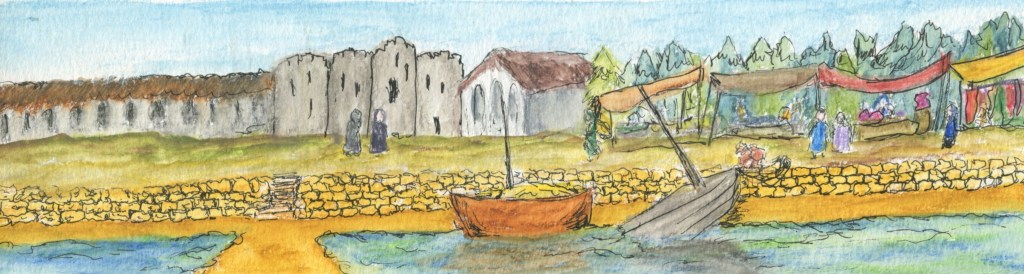
         When I was a hermit at Tours new to the lands of Gaul, before the Merovingian kings were steeped in their own fratricides, Clovis was the head of that clan. He ruled from Aachen. And now these centuries hence, the lands of Burgundy, Aquitaine, Nuestra, and Austrasia are bound together again as Francia. The boundaries are easily lost in this unity. So, I’ve been sent to find the wise man for the king of all of Francia, who is known as Charles. Apparently, King Charles has chosen to restore the palace of Aachen and rule from that place once again.

         Here, now, I find the old palace a construction site. Walls are dreams marked with scaffolding. The population is men in leathers cutting and hefting great stones quarried up from the bowels of the earth. It has no intricacies of a royal court. Only a plan.

         I ask. “Where will I find Alcuin, the wise man for the king?”

         “The king isn’t here.”

         “I don’t need to see the king.  I am looking for the scholar of his court, Alcuin. I have a letter to deliver.”

         “The king isn’t here.”

         This is not a problem of language. We speak the same words here.

         “I do see the palace is under construction. So where is the business of the king being done?”

         “We work for Odo of Metz. He will know where the place to put messages will be someday.”

         “Is Odo of Metz here?”

         “No.”

         “Where can I find him?”

         “In Metz.”

         “Of course. When do you expect him here?”

         “He will inspect on Friday in a month.”

         “So, who is in charge here while Odo is in Metz?”

         “I am.”

         “Of course.”

         Riding on to Metz is no obstacle for me.  I wanted to find a reason to travel that way and perhaps wander through my lost homeland.

         These summer days I follow rivers with familiar names. And so many years ago I knew the names of the innkeepers on this path, and they gave the wines their family names. All that is left now of what I once knew are the names of the rivers. Even the river path is called a particular road with a name. This road laid low in the river’s edge will soon carry the king’s entourage to the renovated palace.

(Continues tomorrow)


#70.13, Tuesday, July 29, 2025

Historical Setting: 793 C.E. Francia

         This horse and I are strangers to one another yet, so my traveling chatter is set loose on Creation itself.

Dear God, thank you for the eternal flow of goodness – the river running down, always – the winds coming new across the grain fields – the stars and the skies, — the patterns of caring for one another, always growing richer in love and beauty, despite grief. Thank you.

When last I was crossing through this land it was peopled with common farms, cottages, forests, simple paths laid among old Roman ruins. But now, the patterns are of changing ways of farming. The start of the change I’d seen at the Waldelenus castle fields with rich land-owners dividing the lands to be worked by the poorer classes.

Now everywhere are castles surrounded by smaller and smaller parcels of agricultural land farmed by those without the power of choice called serfs. As happens in patterns of power, the arrangement isn’t as we’d thought it would be when it began. The expectation was for the plenty to be shared. The ones who turn the soil would share with the Lords of the Manor who provided the land and the safety. What seemed like a good plan, sours when lived to become simply servitude and more poverty for those who till the soil. It is just more wealth and power for the already powerful. The rich get richer, and the poor get poorer. Now castles are being stacked in stone everywhere.

It is a very old story, older than all my lifetimes. I first saw it as Roman. But it comes around again and again. Wealth seeds greed. Then when greed is perceived as normal, even the poor believe the flawed notion that wealth is an earned accomplishment.  But wealth is a striving not an end. Because there is no definitive amount it is always simply, more. Like a mirage, wealth is always beyond and never attainable. The aspiration is a famished dead end.

 Jesus wasn’t being absurd but truthful saying it was easier for a camel to go through the eye of a needle, than for a rich man to enter the Kingdom of Heaven where love and joy are the measure of success.[Mark 10:25] That is not a curse on the rich, it’s a simple fact.

Passing through this land now, I wonder if these serfs ever gaze into the heavens or see beyond the mountains and bask in the beauty of this earth. Do they see this most beautiful day?

(Continues tomorrow)

#70.12, Thursday, July 24, 2025

Historical Setting: 793 C.E. Francia

         With the good fortune of finding a ship and fair winds I am a passenger on a trade vessel. It is less arduous than was the clandestine journey to Lindisfarne on the Longship — catching only storm winds, and rowing much of the way. Now, fully into the summer season a good wind still blows. We land in the lowlands where I spent my last days with my son, Greg, and his partner so many years ago. At that time this place was a newly rising market, now it is a city with established buildings, steeples and houses. It has accommodations for travelers with abundant stables and the custom of providing travel advice.

I’ve been told, the King’s palace has returned to the ancient city of Aachen now, north and east of my old homeland near Metz. Bishop Higbald knows this wise man from Northumbria, Alcuin, who is now a teacher in the King’s court here in Francia. And Alcuin is the man who is to receive this letter from the bishop informing the world of the Lindisfarne raid.  It isn’t a spy’s secret. I’m free to speak all I know of the desecration, telling it to every cook and stable-hand and fellow traveler along the way. It is truth to spread.

A horse will be ready for me at first light. So, this afternoon I walk through the marketplace wondering if I will see the reliquaries and fabrics stolen from Lindisfarne already on sale here. But not so. There are lots of other stories among the merchants about raids by the Norsemen but only a few survivors have witnessed these things. And no one before Bishop Higbald ever wrote of it. The bishop’s letter I carry now will help those who must protect Francia know the threat is real and not simply made of rumors among commoners. I know it was more than a century ago that the King of the Franks sent his spies to learn of this.

Those spies, Greg and Gaillard, did not get the warning of it sent off. And I still grieve for them and for the others who are gone who were once my family.

This morning, here is a good horse already fed and bridled ready to take me on to the King’s palace.

Dear God, thank you for fair winds and beautiful creatures and for people I find along this way who remember ancient kindness despite the fears and worries we have this day.  Amen.

(Continues Tuesday, July 29, 2025)

#70.11, Wednesday, July 23, 2025

Historical Setting: 793 C.E. Lindisfarne Monastery

         Bishop Higbald prepares to bless a new abbot chosen from among these monks. A stranger here would assume I am a monk, but of course, all here know I only wear a borrowed robe so, I simply observe.

         I see that the bishop has the full administrative duties for the shrine also, and now, the role of the abbot is simply to give voice to the few monks who will stay. The bishop oversees the judgment and it is the sins of Lindisfarne that are at the forefront.

A monk is chosen as the new abbot, then the bishop asks for parchment and ink as he prepares to send a letter to Alcuin, a friend and scholar now in Francia. I’ve found a few things while looking for salt, so I bring inks and vellum to the bishop and I offer to be the messenger who will carry this letter.

With my circumstances as they are, I am still groping for this future I have awakened into and I would really like to journey to “Francia” as it is now called.  I would like to visit, once again, Frankish Gaul, and learn if the changes that make all things new are a matter of time; or is it only power and wealth that change the world?  I don’t expect my old homeland will be the same.

Now I will be traveling from Northumberland then across the British Sea by ship. When I reach the Lowlands at the mouth of the Rhine, I will use a fast horse to take me on to Aachen Castle to deliver the letter. The bishop provides a purse for my costs and for my expected return with a response from Alcuin.

It will be good to cross through the lands that were once my home, and now are my own places of grief.  On other journeys I’ve visited old homelands and I know not to expect the longed-for familiarity, except maybe the scent of the land itself and the same skies everywhere and always. I once visited Bethany only one hundred years after the destruction of the Jerusalem temple and there the old battles between Romans and Jews were still simmering deep in the earth and the Christians, in their own little groups, had simply wandered off.

When Ana and I traveled, before the children were born, we saw the place near the Loire that was her childhood home. We found it to be a garden of stunted memories.

(Continues tomorrow)

#70.10, Tuesday, July 22, 2025

Historical Setting: 793 C.E. Lindisfarne Monastery

Brother Ealdwin tolled the bell and when he comes down from the tower I ask his help to lay out a meal to serve these brothers and visitors. Brother Ealdwin is guiding me as I look for the supplies and the utensils left here so we can serve food.  The wine cellar was raided.  The larder was picked clean of cheese, and neither Brother Ealdwin nor I thought to start bread rising. But we do have a sack of barley and one of peas so porridge will be abundant. We can’t find the salt.

While we were alone here, Brother Ealdwin and I have been feeding the animals, milking the cow and gathering the eggs. We’ve had plenty of fresh dairy for just the two of us here, but now we have more of the monks and guests besides. When finally, everyone is seated at the benches with a cup of porridge for sustenance, the bishop stands to offer the prayer.

It is no humble table grace, blessing these morsels, thankful for a gift of food and asking God for the useful strength of porridge where hunger had been. Instead, it is a prayer such as an earthly king might offer to the High King of Heaven, gilded in unctuous, holy phrases and verbose addresses of importance, both on earth and in heaven. My wandering mind frees me from the actual words of the prayer and, in fact, from the actual experience of praying.

My thoughts are on those who are grieving here, feeling the pain of losing their fellows in this community and their heavy hurting hearts of guilt for abandoning those who were suffering and dying here. Today they have visited the bleakness and the losses, the abandoned monks’ cells, the oratorio stripped down of all its silks and satins and gold. Has no one noticed the gospel is still in its place?

When the section of the prayer for penance comes around, the sins are not the “secrets of our hearts,” but, it seems these returning to this community are in search of this community’s own personal sins that saved their physical selves.  What was the sin that Lindisfarne committed against God that caused such a horrific judgment to be imposed here in the name of holy justice?

Everyone saw the signs in the atmosphere, the drought, the raging displays in the skies, and everyone guessed at sins to explain why God was speaking so harshly. The judgment was obvious. It was against Lindisfarne.

(Continues tomorrow)

#tolling the bell, #food for the mourners, #table grace, #guilty hearts, #Lindisfarne’s sin, #sin search,

#70.9, Thursday, July 17, 2025

Historical Setting: 793 C.E. Lindisfarne Monastery

         Brother Ealdwin speaks his gratitude to God for each of the monks who escaped the slaughter and here they have come back today. But things can never be as they were before the raid.

The monks are grieving.  We are seeing the devastation and the grief. We are told many of the pilgrims who would come to the shrine are waiting on the mainland. Maybe there is a fear with these would-be visitors that, were they to come here, they would be flaunting their own good fortune simply by living — survivor’s guilt.

         As a dark-clothed mourners, all of us on this island, move as a group from the burial places to the priory. This oratorio is bleak appropriately matching the hollowness in everyone’s hearts. There are no golden sconces on the walls, and the tables that held the reliquaries are stripped clean of cloth and purpose. The golden boxes are gone. I won’t tell them that I witnessed sacred bones and saintly relics discarded in the beach grass. Knowing that can only transfigure the marauders’ disregard for Christian tradition into more hate. I’ve already gone to that eastern beach, unnoticed by Brother Ealdwin, and gathered up what I could find, then I, alone, buried the discarded relics to lie with the saints properly venerated in the cemetery.[Footnote]

There is concern circulating about the Shrine of St. Cuthbert. Brother Ealdwin assured them no harm was done to the shrine itself.  But the earthly treasures brought by pilgrims bearing gifts, were all taken. The treasury was sacked. The specially carved Roman styled chair where the presider of worship once sat as royalty is gone now. The altar itself is still here, but empty of the gilded carvings. What will pagans do with a carved relief of Jesus ascending? They took the altar clothes and raided the vestry. Someone remembers there was a carpet under the altar which is probably already being traded as a rare treasure with no mention of the Christian source.

Does no one wonder that the gospel remains here? It was surely the greatest treasure of Lindisfarne, and yet it is still here.

Brother Ealdwin is sent to the tower to toll the dead. He did that when we buried the monks, but these men didn’t hear it, so he goes again to toll the bell. And I should feed the fires here, and start a pot of porridge. People will be hungry later. 

[Footnote]https://rumblinginthewind.wordpress.com/2017/10/31/veneration-of-saints/

(Continues Tuesday, July 22, 2025)

#70.8, Wednesday, July 16, 2025

Historical Setting: 793 C.E. Lindisfarne Monastery

I came looking for the Gospel of John to read again John Chapter 15 because I wanted to remember Jesus dancing the vine dance or sitting at the table with us, all of us, the world of us, and saying, once again what he says so often, “We are all one vine, beloved together.” It was that oneness that took us through the pain of seeing Jesus himself and so many others murdered on crosses by the Romans. It wasn’t a passionate murder, rather an abuse of love. It was simply a fear that a great unity of love, which Jesus revealed in his simple words, that must have seemed so terrifying to those who had staked their lives on power and wealth. If God is all there is and God is love, then empire is meaningless. Now, here I am, reading from this beautiful rendition of the gospel that the marauders couldn’t see as valuable while my own imagination, sees all the glosses by the inks of imperialists striving for power.

         The Norsemen came for the simple things that would sell for gold at earthly markets.

         It is high tide now and Brother Ealdwin runs up here to tell me to come to the shore.

         “They are coming back!  I see the boats – There is a whole flotilla of boats rowing toward us from the mainland.  Come and greet them!”

         I follow him, running down, down to the shore just as the little hide currachs are being drawn onto the shore. Each little boat is peopled with men dressed in the monks robes familiar here, dark clothes for mourning.

         “It is the bishop, himself who leads them.”

         Brother Ealdwin runs into the waves, and I follow after him to help haul the boats higher onto the sand. These mourners who had fled, return today and wade ashore.

         Brother Ealdwin is crying on the shoulder of the bishop. Bishop Higbald will soon see this tearful greeting is not the only thing here that will shatter his stately presence. Brother Ealdwin guides this procession to each station of destruction.  He shows them the stone he is carving so any visitor will know that on one side is an army of endings, and the other the names of their Norsemen’s victims. When finished, that will mark the newer place where we buried the dead. Brother Ealdwin speaks the name of each mound of earth we’ve heaped here. The mourners genuflect and weep. At each little mound of earth, stories are shared of the remembrances.

(Continues tomorrow)


#70.7, Tuesday, July 15, 2025

Historical Setting: 793 C.E. Lindisfarne Monastery
 

         I opened the beautiful pages of this gospel to a place where I know I will find Jesus’s love for all the people interconnected as the vine. [John 15] Usually, I can look past these intrusions of fear and judgment and just picture Jesus as I remember him with his friends, pleading to us to keep the deep love connection. He was begging for his love to be both his and ours, as one love together. Then, after the cross, we were left empty and terrified. Reading that gospel aloud it sounded too personal — too touching — for a the newly baptized Christians, so maybe some carets of corrections evolved, reading it and copying again and again, it becomes less intimate and more about the Roman style of judgement.

         The imagery of beautiful vines — lush leaves and curlicues at every turn, along with cascades of grapes, sweet orbs of fruit, quenching, comforting, answering every thirst with the vintner’s clippers of judgement – then, the “fruitless” encumberments get lopped off.

Every time Jesus says the metaphor “I am the true vine and you are the branches” Someone fixes it to say, “well, except for…” 

Somewhere the words of God’s love for everyone, when Jesus speaks of a vine that connects all people as part of the vine of God’s love, comes with the weight of human requirements on our own earthly selves. Fruitfulness hangs heavy in the Jesus words.

Or maybe these discriminating exceptions could simply be a shoring up of the gardening instruction for a vine metaphor offered by carpenter Jesus who serves wine, yet knows very little about vines. Or it could be adding more of that Roman anti-Semetic jargon already edited into this gospel, or it could mean as the sin-seeking Christians believe, that God prunes the sinners from the beloveds.

How many times and how many ways did Jesus have to say the fact of the matter, “we are all one together in God’s love.” Even though that would include the Roman soldier whose ear was mended in Luke, and Judas sitting at the table. It would include the monks we buried here yesterday far from that sinner novice buried among the saints and the pure. God’s love would include the Pagan raiders who didn’t find value in keeping the gospel as a treasure, or even as keeping me for their slave. Maybe God really also loves fruitless vines.

Or maybe God is sharpening the pruning shears just now.

We are human, and we can only know some things.

(Continues tomorrow)


#70.6, Thursday, July 10, 2025

Historical Setting: 793 C.E. Lindisfarne Monastery

Ealdwin still chips away at the stone.

 I say, “Seeing everything from a Christian point of view may have skewed my understanding of the Vikings.”

“How is that possible that truth can only be known from a Christian point of view?”

“I’ve heard that said.”

From this place by the sandstone outcropping, Brother Ealdwin keeps a watch. I think he expects the others will return any day at low tide. I leave him to his work and go back to the priory where the altar holds the gospel. That’s what I would most like to see now.

This gospel is so beautifully rendered.  St. Jerome’s translation keeps the holy words holy so the readings in worship sound as grand as the psalms. But the parts I read over and consider so often are the bits and pieces of reminders of my friend and my first family in Bethany.

Those times have become the Christian gospels that we copy and translate and study now. None of us knew anything of Christianity then, even though we were already everything there was of it. We were survivors of a crucified leader and a plundered temple when this gospel was finally put together from old diaries and told stories.

Ealdwin watches the pathway relentlessly hoping for familiar faces as I am looking for the familiar in the gospel stories. We all look back at our own history in each era.  With the destruction of Solomon’s Temple it was generations before the people returned to build anew. They were the grandchildren of the Hebrew people who were taken as captives. Sometimes a homeland is a history and not a memory.

The history of the Jewish people is kept in sacred scrolls for the generations. But instead of debating the discrepancies from one generation to the next, until tiny sprouts of truth can be gleaned, Christian stories were newly told to fit the Roman politics. The Jesus words [John 15] that all may be one in God who is love [I John 4:18] all people connected like a vine but somehow in the writing of it, useless, fruitless vines infiltrated and needed righteous prunning. So now, Jesus is the true vine but the chapter begins with some version of an imperialistic God, like the Roman army raiding the Temple, pruning the vine and putting the whole Jewish heritage in the burn pile. [John 15]

It is a good thing to keep history on a carved stone.

(Continues Tuesday, July 15, 2025)

#70.5, Wednesday, July 9, 2025

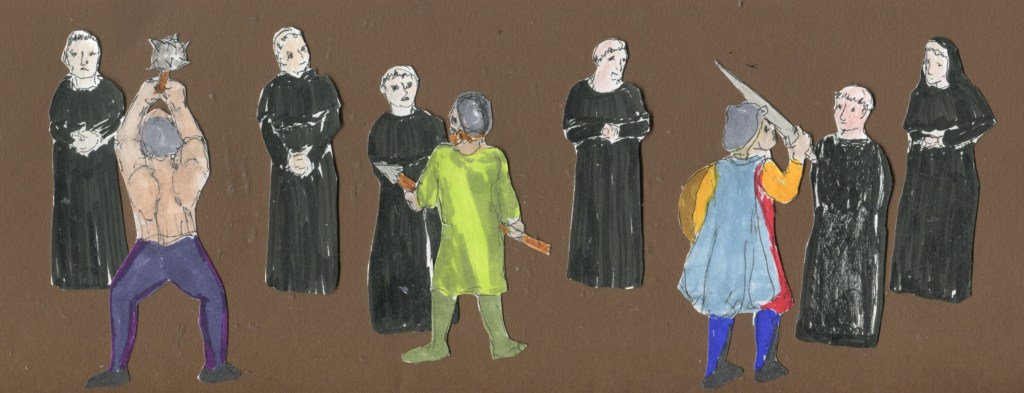
Art Note: This is a rough rendition of the military procession on the verso of the so called “Domesday stone,” now in the Lindisfarne museum. This blogger chose to draw it, rather than print out a copy, in order to gain a better personal understanding of the artwork .

Historical Setting: 793 C.E. Lindisfarne Monastery

         This is our second day for assessing the horror. Brother Ealdwin splits off a piece of sandstone from a layered rock. With a chisel and a hammering rock, he is chipping a picture into the stele. 

         “Carving a stone honors those slain.”

          On one side he’s marked his plan with a scratch of a rock. I ask if those men with weapons are the Vikings.

         “No, Vikings weren’t that orderly. This army is the last earthly thing.”

          Then he shows me the other side of his rock. In a lower section he is using runes to inscribe the names of those we buried here. 

         It’s a remembrance, but also, it is something for him to do with his hands to share his grief for ever and ever. It is a marker here, for any others who return searching.  He says he has yet to carve the panel above the names. That will be the heaven side of earthly life.

         He says, “If I were more skilled in the craft I would make a large cross for this garden of graves, and it would have deep pictures of these who are lost and would tell this story far better.”

         “I think the story is told well just with the sorrow that is left here. And from what I’ve seen of runestones, this one is very fine.”

“A runestone maybe, but have you not seen the high crosses on the mainland?”

“No, I’ve not visited any Christian lands in these times. I was taken from Gaul by happenstance and landed among the Norsemen. I’ve only recently learned of runes when I was asking for books. And there I saw the Norsemen carving boarders in wood similar to the illuminations in the great books inked here and in the monasteries founded by Irish saints. I assumed Norse people had some kind of writing. But they are pagans there. So of course, there are no crosses but I also found no writing other than rune stones. Now I suppose writing on vellum is just a Christian thing.”

         “I’m sure some of the Norsemen are Christian. They are known to come in numbers to trading cities and line up for baptism. Did you not meet all the Christians there?”

         “I met no Christians except for one little girl who was a slave captured from a Christian land.”

Footnote: O-Sullivan, Deirdre, and Robert Young. Lindisfarne Holy Island. (London:B.T. bateford Ltd. English Heritage 1995.)

(Continues tomorrow)