#73.14 Thursday, October 30, 2025

Historical Setting: Jarrow, 793 C.E.
 

         My plan to read the works of Bede has begun at the end of his earthly life, as told to me by his student Wilbert.     

         Wilbert says, “Then at the ninth hour he gathered everyone together and gave away the earthly things he treasured — pepper, incense and a swath of linen. Then he said, ‘The time of my departure is at hand, and my soul longs to see Christ my King in His beauty.’ “

         “When he had declared it finished, he asked me to raise his head so that he could see the church where he used to pray. He chanted, “Glory to the Father, and to the Son, and to the Holy Spirit” Footnote 1

         “So, he left his pepper and incense and a piece of linen, and all these books and books of words describing all of earthly time, everything in the world revealed to him in a tiny earthly room.”

         I ask Wilbert why he thought Bede’s Ecclesiastical History of the English People begins with the Romans and not with Creation or with the birth of Christ.  Apparently, that is a delicate issue here at Jarrow, and Wilbert thinks my concern over ages in time is just picking at an old sore.

         Wilbert argues, “You are referring to an old accusation made of heresy.”

         “Heresy? No, I am surely not accusing Bede of anything at all against God. I mean, I haven’t even read his books yet.”

         “He already dealt with that accusation made by that lewd rustic Plegwin accusing Bede of placing Christ in a Seventh Age of the Six Ages of Man.  I myself, and others of us here have prepared copies of Bede’s letter in response to the accusation. Footnote 2 He makes it very clear, because if Christ were born in the Sixth age, the sun and the moon would set all of the measures of time awry, and the date for Easter would not be as the pope in Rome declared it to be.”

         Oh, so that’s what this is about.

         I answer the old librarian, “I only intend to read the history not to argue it’s alternative.”

         But maybe I did come here looking for that argument. The controversy that seems narrow and set like an old Roman stack of stones in the midst of a spring garden, has spread to the great concentric realms of heaven, so that the blame for the wrong date for Easter is the edict of the sun and the moon, beyond human control.

Footnote 1: https://www.oca.org/saints/lives/2019/05/27/103796-venerable-bede-the-church-historian  Retrieved 2-20-25

Footnote 2: https://blogs.bl.uk/digitisedmanuscripts/2018/05/the-real-venerable-bede.html   Retrieved 2-20-25

(Continues Tuesday, November 4)

#73.13 Wednesday, October 29, 2025

Historical Setting: Jarrow, 793 C.E.

         By the time I can begin reading I will be so knowledgeable of Bede I might be able to read this history with his own voice. Now Wilbert says he, himself, was the scribe for the elder monk on his death bed.

         “I was called to his bedside with parchment and inks, expecting I would be writing down the summation of his life — his last words. But the venerable Bede was finishing up his translation of the Gospel of Saint John. So, there I was, for the long night of it, writing down reference material for a bible scholar. Those of us who were his students loved him and really would rather hear his parting personal words for us.”

         I’m just listening to Wilbert’s ramblings, having nothing more to say.  But I’m glad now, I used my Hebrew name to sign in as “Eleazor” since I’m curious about Bede translated John 11, “Lazarus” as he was nearing his own death. I’m glad now to keep a secret of my personal interest in the Lazarus story. Was Bede one of the translators who had so little regard for my sister, a wealthy follower of Jesus, that he picked up the label of prostitute from the Luke writer thinking a prostitute could obtain an expensive burial perfume? These gospels are personal stories for me. The flask of pure nard was purchased for my own first funeral that never was completed.

         Wilbert said he sat with Bede wanting the personal touch of his teacher. And maybe I, too, only want a personal touch of my teacher, Jesus. 

         Wilbert rambles on. “The saint would often quote the words of Saint Ambrose, ‘I have not lived in such a way that I am ashamed to live among you, and I do not fear to die, for God is gracious’ (Paulinus, Life of Saint Ambrose, Ch. 45). Footnote 1

         “After a sleepless night, Saint Bede continued his dictation… At the Third Hour, there was a procession with the relics of the saints in the monastery, and the brethren went to attend this service, leaving me with Bede. I remained taking down one more chapter to be written in the book which he was dictating. I really didn’t want to disturb my dying teacher, but he said, ‘It is no trouble. Take your pen and write quickly.'” Footnote 2

Footnote 1: https://www.oca.org/saints/lives/2019/05/27/103796-venerable-bede-the-church-historian  Retrieved 2-20-25

Footnote2: Ibid.  Retrieved 2-20-25

(Continues tomorrow)

#73.12 Tuesday, October 28, 2025

Historical Setting: Jarrow, 793 C.E.
 

         Elderly Wilbert is telling me of the life of the Venerable Bede who wrote the book I came to read. My condition of life and life again makes me feel argumentative. I’d mention that such writings are limited by a monastic life from childhood through death with only a narrow perspective. Maybe such a monk is disqualified from writing a history of the whole people. It’s not about the confinement of a monastery. I also find the welcome tranquility in times when I thirst for the closeness with God, as Wilbert describes this as being in the room with angels. So why do his ramblings annoy me so, bristling my hackles and making me feel argumentative? I find it particularly annoying when he speaks of the intimate spiritual life of a saint.

         Maybe it is his pontificating, or his own narrow perspective, or the assumption of a singular righteousness, or is it that he is an old monk and I appear more youthful so he has a duty to lecture me.

         Wilbert rambles on sanctifying the venerable — obscuring the vulnerable. It seems this room with angels is a narrow confinement limited to saints.

         Dear God, open my thinking broadly enough to accept his, as it is meeting his own need, not faulting me. I visit the “room with angels” often but it has no walls or log book at the door. Thank you, God, for spreading your close love to anyone just for the asking. I don’t have to make my argument to Wilbert as he answers his own need with these ramblings.

         He says, “It’s not that the venerable Bede was isolated from the world.  He listened intently to any visitor or traveler to Jarrow. “

         “I’ll read his books with that in mind.”

         Maybe these pontifications of an old man, are really his own dialogue between his memories and the reality of just now.  When he hears God speaking, like young Samuel [I Samuel 3], he still goes and wakes a priest to affirm what he has heard is not of heaven.  Wilbert keeps the angels safely locked away in a room ‘for saints only’, maybe secretly hoping he will never again hear God calling him.

(Continues tomorrow)

#73.11 Thursday, October 23, 2025

Historical Setting: Jarrow, 793 C.E.

Wilbert, the elder serving the library, sees my interest in Bede’s books of history and has taken me aside from the large hall to tell me something of the life of this man — his own spiritual guide.

         “The venerable Bede was delivered to the abbot at Monkwearmouth a couple of years before this part of the double monastery was complete, so he knew the saints of our foundation very personally.”

         Wilbert’s old fingers flip through pages of the book I prepared to read, he finds some particular chapters.

         “Bede was left in the care of St. Benedict of Biscop, then it was St. Ceolfrith, who came after Benedict, here.”

         These are the ramblings of an old man, gazing off as he lectures me in the names of saints.

         “I think it was Ceolfrith who was here at the time of the plague. It spread through the whole choir of monks taking away every last one of them who sang with the angels in worship. Only the child and the abbot were spared. Then, as young as Bede was, he saw so many others off to their deaths. It was possible he actually had a glimpse of heaven, even as he lived on earth.

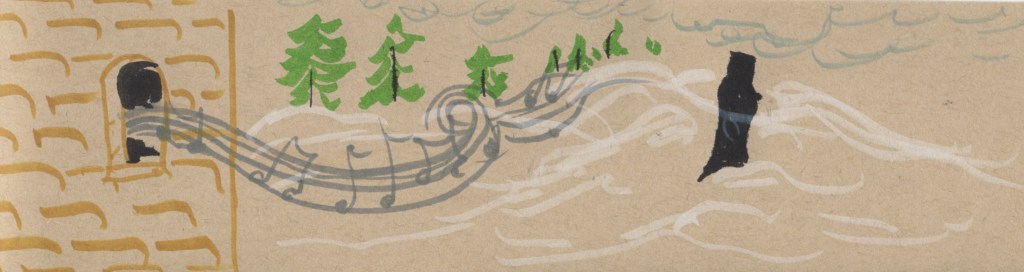
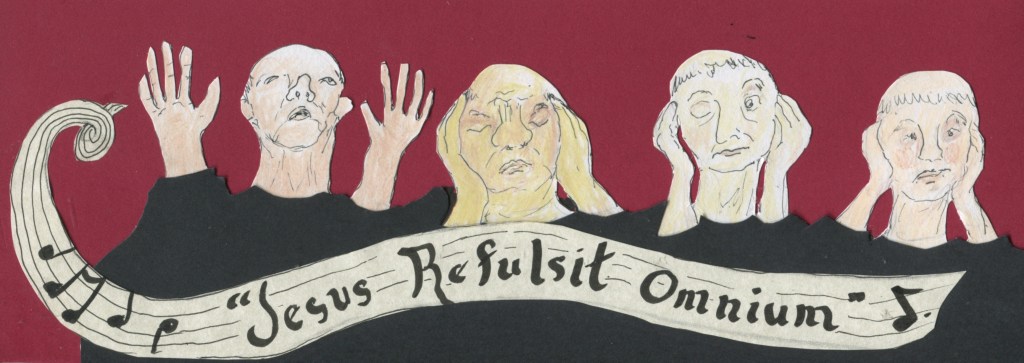
         “They all feared that the singing of the antiphons is what brought down the deaths because it was the whole choir it carried off; so Ceolfrith, in an effort to save the monastery, ruled against singing antiphons after the chanting of the psalms. Bede felt the loss of the lives of the monks, but also, he grieved for the music. [Footnote]

         “When I was brought here as a young child also, a new assemblage of monks was filling the emptiness and the music was fully restored.”

         “I can only imagine the grief he endured as a child, called to care for the dying, then losing the music from worship.”

         “Of course, what would a common scholar know of this? For someone ordained in holiness, the prayers and the music of worship surround us every day with the full witness of angels.”

         I am so tempted to argue from my place, oddly knowing this wider and deeper, but I say nothing. My years of chanting those same antiphons and that nearness of God is not just a privilege for brothers with tonsures shaven as crowns. People touched with the holy are everywhere.

Footnote: https://www.oca.org/saints/lives/2019/05/27/103796-venerable-bede-the-church-historian — retrieved 2-20-25.

(Continues Tuesday, October 28)

#73.10 Wednesday, October 22, 2025

Historical Setting: Jarrow, 793 C.E.

         I shouldn’t be surprised by the practice of placing children out and into situations for learning at an early age.  That is when a precocious nature of a child reveals itself. I’ve seen it happening through my own generations as a parent. I’ve seen infants sparked to learn new things by an insatiable curiosity. It does seem to be a gift of angels. Or in some places, with girl children particularly, it’s seen as a devil’s curse. When it is blamed on devils the spark for literacy in a girl child seems hardly a blessing.

         My wife, Ana, from another time, was such a girl child. Named Anatase, after a stone laid loose in the mines, she was given up by her mother to a pagan tribe for fear she was cursed because she was discovering, without any tutoring at all, the use of letter sounds on a sign posts. Her mother saw it as frightening and abnormal and gave her up to the pagans. 

         One son, from an earlier generation, found her with this pagan tribe and arranged for her to be the student and the assistant to his sister, my daughter, Eve, who was a gifted healer. I knew Anatase when she was a child, and she was a great help to Eve. Then I met Ana again in the generation when she was a young woman. We were wed, and she I had a very fine family of our own. Some of our children were precocious also. All of our children were literate, eventually, as Ana and I were able to bring them through the rigors of learning to read and write and reason sensibly. When they were in their teens they were able to choose their own paths, but we continued to gather often as family. We were fortunate. I know, even since the time of Samuel, as was told in the ancient scrolls, parents have surrendered children to be educated by priests.

         My frustration with the Benedictine Rule, (or here, just called “The Rule” as though the Celtic option never existed) is that it was designed for a bishop or an abbot to manage groups of young boys. It was not really about the wandering spirits of desert fathers in tune with God. The nurture of mysticism just happens by the grace of God and the redundant practices of worship. It is God who lets themself be known, regardless of human plans or the rule.

(Continues tomorrow)


#73.9 Tuesday, October 21, 2025

Historical Setting: Jarrow, 793 C.E.

         Apparently, my simple sentence of purpose in the librarian’s log book reveals my long past connection with Luxeuil. What I thought was standard manuscript lettering is now only one of several styles used by monks. The style of lettering used can reveal when and where a manuscript was copied so my flourishes and downstrokes belie my Merovingian years, and the spread of the ink reveals my time as a follower of Father Columbanus.

         As I explore the books on these shelves at Jarrow, I see there are several different manuscript styles and the style used by the monks here spaces the letters apart more for a simpler clarity, fewer down-strokes tapering off below the line all clean and simple but with beautiful curves, making for faster reading and faster copying. That may explain this vast collection of books here and multiples of the books this monastery is known to have inspired at Bede’s hand.

         I first asked for the book The Ecclesiastical History of the English People by the Venerable Bede. [Footnote] That’s the book that brought me here.

         The old librarian says, “Copies of the sixty-two-year-old text are here to be read by anyone using this library.”

         I place the book on a reading stand, and I am preparing to fill the curious little place in my wondering with a whole new history of things. It is a blessing not to have to learn about this land in these times through an interpreter reading runes chipped in stone.

         I see, in Bede’s list of chapters of this Book 1, that this history begins with the Roman emperors.

         Old Wilbert interrupts before I even read the list of chapters and he asks me to sit with him at the table in a private room.

         “So, Eleazar, it is good to see a student, who, by his own accord, chooses to read this work by my own teacher and spiritual guide.”

         “You knew Saint Bede in his lifetime?”

         “I did. When he was very old and speaking his last, I was the one privileged to be the scribe at his side.”

         “He was prolific I see by this vast collection of his works.”

         “And he always worked in the company of angels.”

         “As I supposed. How did you meet him?”

         “Like Bede himself, I was brought to the double monastery as a young child. He was only seven years old when he was delivered here for his education.”

         “Is it usual for children to be left here?”

         “Only as God commands it.”

[Footnote ]Bede, The Ecclesiastical History of the English People, The Greater Chronicle, Bede’s Letter to Egbert  is still available for anyone to read in modern English through Oxford World’s Classics, Oxford University Press, Rev. 2008, edited with an Introduction and Notes by Judith McClure and Roger Collins. No monks with quill, inks and parchment were needed for this blogger to have this opportunity to read it, thankful for the gifts of 2025.

(Continues tomorrow) 

#73.8 Thursday, October 16, 2025

Historical Setting: Jarrow, 793 C.E.
 

         Today I’m still owned by God, but that’s my secret. I’m dressed as a student, not a monk. I find Jarrow’s renowned library has a magnificent collection of books. It is well-known among the monastic communities and that reputation enables this monastery to borrow more and more books to be copied and added. A collection that began a century or more ago with one abbot’s books increased many times over with this sharing among the monasteries and the industrious work of the monks copying the borrowed volumes. This is also home to an author of history and hagiography, Bede, who lived his life as a monk here in St. Paul’s. I was told of him in Lindisfarne, and that’s why I came.

The librarian sits at the entryway with the log book for visitors.  He asks that everyone who uses the library put, not only their name, but also a brief statement of purpose.  Maybe putting down a purpose gives this librarian a way to be helpful in guiding the visitors to the books they’ve come to find. Or, it is simply a literacy test, to catch commoners and novices who would pretend to use the library when they can’t read or write. He watches carefully when I sign in.

It has been a long while since I’ve held a quill and inked anything on parchment so I take care that my penmanship is exactly as was required at Ligugé and Luxeuil.  “My purpose is to read the works of Bede.” And my name? I choose not to use the Roman version of Lazarus with all that weight of a biblical sign for a monastery to ponder. Instead, I write the Hebrew version, Eleazor, which seems a better fit for my new secular appearance as a young scholar.

The librarian, Wilbert, is hovering over every letter as I write. He looks closer and closer at my letters with a scowl that wrinkles between his brows and gathers at the top of his nose and draws his nostrils outward. Clearly my letters are more beautiful than the person signing in above me. So why does this call for such scrutiny?

 “Eleazor?” he asks. “Is that a Frankish name?”

“No, it is old Hebrew.” 

         “So, you are Jewish, yet educated at Luxeuil? Who would have thought?”

         “Why would you think of Luxeuil?”

         “You make your “e’s” “a’s” with two strokes of the pen in the Merovingian style.”

         “Yes, I am from Francia.”

(Continues Tuesday, October 21)


#73.7 Wednesday, October 15, 2025

Historical Setting: Monkwearmouth-Jarrow, 793 C.E.

Monkwearmouth-Jarrow is a double monastery with both monks and nuns under one abbot, living in separate communities but sharing in some things. It makes common use of books and inks and abbess, and sometimes church. St. Paul is on the River Tyne, and St. Peter, Monkwearmouth, on the Wear. It’s a good long walk from one to the other, crossing the river near the mouth on the sand at low tide. This pattern of a double-monastery was also known by the Irish missionary I remember from an earlier time. He is now called “Saint” Columbanus granted sainthood when he finally yielded the Celtic to the Benedictine Rule. I think God always knew him as a saint.

A young man who is a novice here at Jarrow is trading his commoner’s clothing for the black robe.

He says “I’m so glad the merchant finally came with robes and I won’t have to appear prideful walking among the monks in these common clothes.”

Apparently, these long, black, skillfully sewn, robes of finely spun wool are “less prideful” than the loosely home-spun wool of a farmer’s tunic and rag bands for leggings.

All day the merchant Cloothar makes trades, starting with only the black robes which I recognize as the booty rejected by the raiders of Lindisfarne. He trades with novices for common clothing and he always trades up, for better and better items.

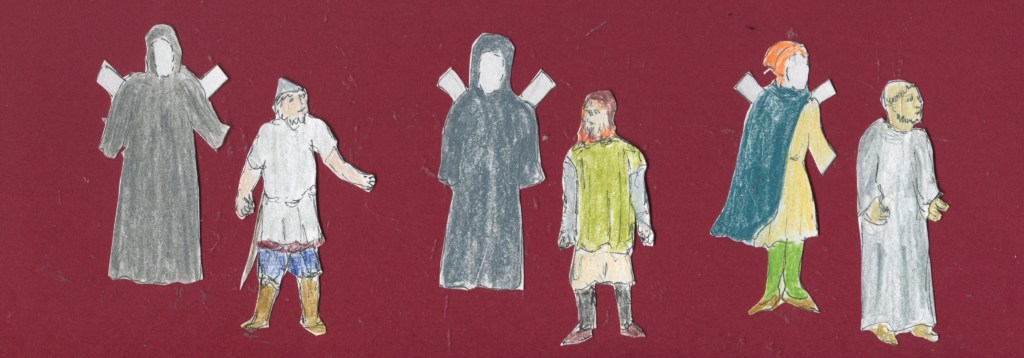
By the end of the day my own trade of the borrowed black robe provides me with a very “prideful” wardrobe: a linen tunic, leggings, a sash and shoes sewn in the new way, pointed at the toe, a brightly dyed hat, a traveler’s bag, and a fine wool cloak in a costly shade of blue.

Cloothar uses a coin for a room at an inn which he shares with me, in payment for helping with the rowing and the market. The innkeeper allows me the use of a vat of lye-water to launder my “new” garments. I spread everything out on the bushes to dry, but, as Cloothar warned, I’ll be wearing them damp all day tomorrow.

Dressed as I am now, I could be mistaken for a young scholar, a rising son of a newly wealthy commoner – prideful indeed.

In times of plague and wars, raids and thefts, material goods survive the first owners, and the heaps of these leftovers of lives become commodity. The humility of a monk’s robe fetches the highest price because having too much good stuff makes an odd paradox of wealth.

(Continues tomorrow)

#73.6 Tuesday, October 14, 2025

Historical Setting: Northumbria, 793 C.E.

         Here is this stout little fellow coming down from the village just now with a traveler’s pack over his shoulder. He’s wearing a loose linen tunic, just long enough to reach his bare knees, hiked up with a sash that his belly hangs over. His calves aren’t wrapped, I would suppose, so he can wade into the shallow water and push his boat away from the shore. This is surely that fellow Cloothar.

He sees me waiting here.

         “Aye, and there you are! I was told an ill-fitted monk was waiting for me to bring him a better habit.”

         “I was hoping to trade this robe for a layman’s tunic. But it looks like the selection is limited.”

         “Only temporarily, my man. No one is entering Lindisfarne anymore. But I’ll be going on to Jarrow where postulates are still abandoning their garb for the monk’s robe.”

         “To Jarrow? I’ve heard they have an excellent library there.”

         “Yeh, but the market for books is slim. Only them that writes, reads, so anyone who wants a book would already have written one.”

         “Do you need someone to help with the rowing on your journey to Jarrow?”

         “To Jarrow you would be faster walking there. It’ll take me a while to get there because as soon as we have a day with sun and fresh winds, I’ll be stopping off to air these wools on the rocks.  They need freshening before market.”

         “I can help you launder them if you wish.”

         “Launder? You mean soak all this wool in a tub of lye?  I think not. It would shrink them to felt and they’d be forever damp and moldy. No, a good airing will do.”

         “Whatever, I’d be glad to help you with it since I have to wait for you in Jarrow anyway to trade layman’s clothes for this robe.”

         So, it is a few days rowing the Jarrow. The mouth of the Tyne offers a harbor from the surf of the sea for this little boat. Up this river a short way is a flimsy little dock set over the sandy riverbank, apparently all familiar to Cloothar, where we unload the market goods. He sets up his booth as I’m sent up to the monastery to find his potential customers.

The sun shines today, brightening a shoreline said to be so often veiled in fog.  From the high view by the buildings, it seems the distant Sea is flat out drunk on the sweet azure of sky.

(Continues tomorrow)

#73.5 Thursday, October 9, 2025

Historical Setting: Northumbria, 793 CE.

         Here, in this Northumbrian village I do find some merchants’ stalls set out selling sacks of grains for winter stores, beets and chard; but today there is no one here dealing in fabrics. I ask at a wine seller’s stall where I can find Cloothar, the merchant who is known to provide black robes for monks. He casts his gaze up and down my ill-fitting robe, raising one eyebrow, finding my conspicuous need to be his entertainment.

         “Of course you are on a hunt for Cloothar. He must have had quite a lusty mead to fit you out like that. I mean, how hard can it be, to put a black robe on a monk?”

         “Indeed. How hard can it be?”

         “He’s been dealing in Viking loot these weeks.”

         “So, he is probably at the market places across the North Sea?” I ask.

         He gives me a sly eye, and leans in for a secret.

         “There is some Christian loot that won’t sell in the pagan markets, like monk’s garb, for example. So, I happen to know, Cloothar is, this very moment, meeting Norsemen’s ships in the Farne islands, making his trades with the Vikings before those Norsemen cross back to the markets at Jutland. He’ll be back on his way to Jarrow. Might you try a flask of wine while you wait?”

         “How long will I wait?”

         “No more than a week, I suppose.”

         “That would be a lot of wine.  I’d best beg bread from a baker while I wait.”

         I find a field of oats, ripened and late for harvest, and here the farmer welcomes my help in trade for shelter and straw for sleeping, and a fair share of gruel.

Here, I can watch the harbor for Cloothar’s so called “merchant ship” which, I am told, is nothing more than a leather currach. It is a week or more, and I begin to wonder if the dry goods merchant has chosen not to return to Lindisfarne after all. 

But now, on this Thursday, just such a craft is tied at the dock. It is a three-man boat with only two coracles for oars, and in the middle space, in a third rower’s place is a large bundle of monk’s robes, but no colors in linen or silks for any liturgical pomp.  This Viking booty has been picked over and the only things he has left wouldn’t be of value in the secular, pagan market.

         (Continues Tuesday, October 14)