Post #13.9, Wednesday, October 21, 2020

Historical setting: Remembering the First Century, Bethany

         I mentioned the Gospel of Luke used our family as characters in stories, but that author didn’t even know us.

          Nic says, “I did notice there was that part in Luke where your sisters squabbled and Jesus got in the middle of it. And of course one of your sisters, Mary, was a prostitute.”

         “What? That’s not true!  Not even Luke says that!”

         “Okay, Laz, don’t get riled, I was only kidding, sort of. It must have been a different Mary.” 

         “Please Nic, I really want to tell you about my father, because fathers matter to everyone’s life stories.”

         “Except that my father was dead before I was born.” Nic reminds me.

         “… And yet you bore his name and wore his armor, and marched in step with his fellow soldiers for all those years of your adult life.”

         “He marched, I rowed.”

         “Whatever. As I was saying, my father was a Pharisee. He was a Jew who followed the letter of the Law. He became wealthy making his lucrative trade with all sorts of visitors to Jerusalem. Some of these were devout pilgrims, others gentiles visiting Jerusalem because Jerusalem was a hub of business in that day. Every day he was in the porticos of the Temple selling and trading – making his deals. The gift for his success was his ability to respect and listen to all varieties of languages and ethnicities and to know people for who they were, not just for the social stereotypes.”

         Nic wonders, “I always thought Pharisees were aloof and just sort of stayed with their own ultra-righteous kinds.”

         “Some were like that I suppose. For my father though, his constant and mindful obedience to the Law allowed him an assurance of righteousness that couldn’t be shaken or flawed in dealings with pagans and all varieties of gentiles.  In a certain way, his narrow faith allowed him open-mindedness in dealing with so many peoples of foreign lands and so many languages of trade. It was his sharp mind and his ability to know people well that made him so successful. He called his flow of wealth ‘God’s blessing.’  But then, the blessing soured as will blessings measured by material wealth.”

         “What happened?”

(Continued Tomorrow)

Post #13.8, Tuesday, October 20, 2020*

Historical setting: Remembering the First Century

(*Looking for this post on Tuesday? Saving words digitally is clearly not as reliable as was once an ancient clay pot with papyrus scrolls stashed in a cave. Lazarus-Ink will be back on schedule this week.)

         Nic and I have set the conversation between us on my childhood  memories of Jesus.

         “Did he seem mysterious at the time you knew him?” he asked.

“Like, was he encased in a radiant aura, and was his voice distant, like thunder across the valleys?”

         “You’re kidding Nic.”

         “I’m just saying what I’ve heard.”

         “There was nothing weird about him. And at that time, there was nothing weird about me either. We were just like any other normal Jewish kids growing up in ancient Israel.  Can I tell you about our nighttime adventure when we sneaked off to party with the shepherds?”

         “How old were you then?”

         “We were maybe ten or eleven; an age of childhood that seemed to us complete, but apparently, the shepherds thought we were children and they sent us home.”

         “I really want to know about the very first time you met Jesus.” 

         “I don’t think we actually met. He was just always there as long as I can remember. We were both nearly the same age. Our fathers were good friends with one another already at the time we were born.”

         “Do you mean your father was friends with God or with Joseph?”

         “My father was a devout Pharisee so of course he was well-acquainted with God – the Law, the Word, the Creator of heaven and earth, but I was thinking of Jesus’s skin and bones father, Joseph. Of course Joseph was also a Pharisee. It seems now, looking back, it was an unlikely friendship. My family was wealthy and Joseph was more from the laborer’s class.”

         Nic assumes, “So it is as they say, he was poor?”

         “Not really poor, unless we were only seeing from my perch of privilege; I think his family was somewhere in the middle, able to live and also to give, at least while Joseph was living and when Jesus was learning the carpenter’s trade.”

         “So, how did your father and Joseph grow to be friends?”

         “Joseph, was working as an itinerate craftsman traveling often from his home in one of the villages in Galilee. You know, some of this is written in the gospels, so maybe I don’t need to repeat it. But I do want to tell you about my father because I feel our own family was maligned in misunderstanding by the writer of the Gospel of Luke and Acts.”

         “I didn’t even know any of the Gospels but John had anything at all of your family.”

(Continues tomorrow)

Post #13.7, Thursday, October 15, 2020

Historical setting: 563 C.E. Ascending into the Pyrenees

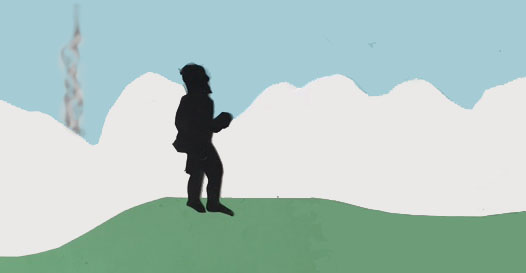
         Cloud shadows on the mountains seem to make the ever-still earth forms of rock rise and fall like the waves on a sea. We thought finding our way through this range would be the simple part going up to the mountain top then down into Gaul, but now we see it is necessary to think always of the risings and settings of sun to keep our direction toward the north. The ridges of this range undulate in angles and tilts of all directions.  We choose the ridges to follow because they are most level and we can also see off in all directions and keep our bearings with fewer ascents and descents to tire us with climbs.

         With all these pastures in every valley it is no wonder we see flocks of sheep – or are those simply flocks of boulders set into the mountains at a distance? We’ve ridden above several valleys of these rock statues, remembrances of sheep, and now we come upon what are surely living flocks. Yes, these are indeed sheep. They are moving across the hillsides in ever-morphing forms like murmurs of starlings in an evening sky. We stop on our horses to take a moment to wonder at these patterns.

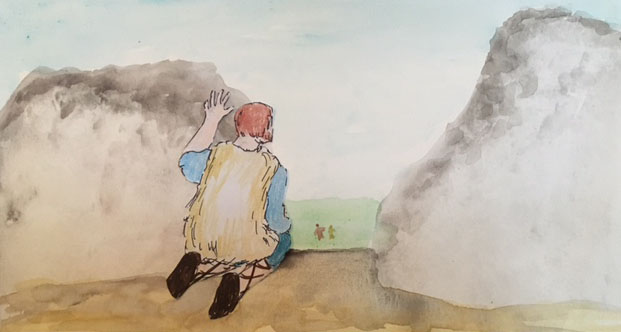
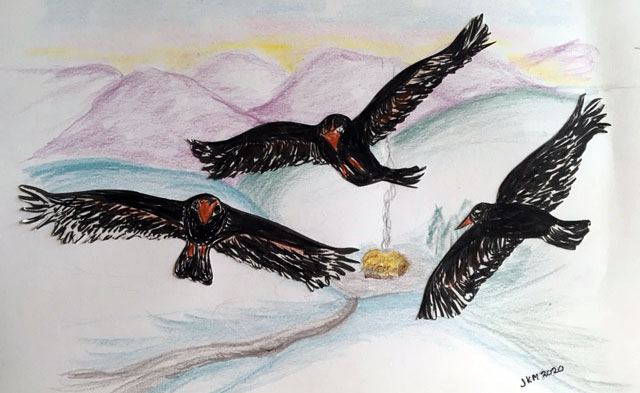
         “When I was a kid in my teens my best friend and I would sneak off at dusk to watch these ever forming shapes of moving sheep, and once we followed them so far we discovered the distant shepherds making their night fire.”

         Nic asks, “So Laz, Did you have your forever life then, before Jesus?”

         “There was never a ‘before Jesus’ in my knowing. But before my healing from first death, I was an ordinary kid. ‘Nothing strange about me at all, except, I might mention that this best friend leading me into these dares of childhood was Jesus.”

         “Do you mean Jesus the human person or Jesus the ethereal substance of invisible presence – the Christ?”

         “You jest. You know who I mean Nic. You and I share that same heresy.”

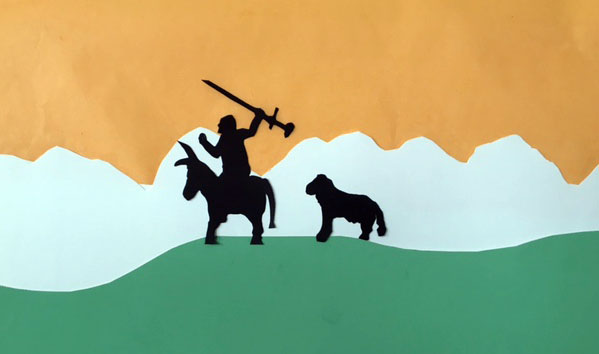
         We come to a creek so we dismount and we lead the horses and the donkey to water and take a bit of a rest before we cross over the icy flow to climb to a higher ridge.

         “I meant to ask an honest question. Was Jesus already holy when you met him?”

         “Of course.  We are all the Holy Creation of God, are we not?”

         “You know what I mean. Did he seem, you know,  ‘different’?”

(Continued Tuesday, October 20)

Post #13.6, Wednesday, October 14, 2020

Historical setting: 563 C.E. Ascending into the Pyrenees

         The fog clears. No words. Awe is a word too small. Dear God, was it your intention that human eyes would be given privilege to see so wide? Have we taken a step too far and now we see all of earth from a holy place? How is it that you can find any one of our human kinds in such a vast lay and yet you even know us each by name?

         Nic offers words, “This flask is a fine infusion of olive oil and Rosemary. We should use it now to rub the beasts.  The horses and the donkey have come this whole climb with us so far.”

         Psalm 8 speaks here in every language, and in the silence too.

         The garden fragrance of the oil seems earthy and soft rubbed onto the warm skins of our animals. And here are the rocks and the ridge of a mountaintop. But, also here is a spread of grasses sloping down both sides of this level ridge like a cloth lain onto a rough-hewn table.  We set the beasts to graze and the donkey’s burden is laid out on the rocks to dry in the sunlight. It is a moment to nap on our fleeces setting our faces toward the silent promenade of cloud forms and fantasies in all their billows across the heavens.

         “Laz, do you suppose the sky is so much bigger when we are on a mountain top just to remind us that even the great mountain we just conquered is but a tiny wrinkle in the fullness of Creation?”

         “Yes, I suppose.”

         “I mean think about it.  The eyes of our animals are set on their noses, casting their gaze at the grasses as they eat.  But our eyes are set on our faces looking out from the earth.  Do you suppose the Creator wants to be sure these human kinds of us see the whole panorama – where we are going — where we have been, and mostly the vastness of it all and maybe even the smallness of us ourselves?”

         “Yes, I suppose.” Thank you God for giving us perspective and not requiring any reality from our self-imagined excessive size of us. Amen.

         Tomorrow we will ride this ridge until another path to the north is before us.  This is a day to rest.

(Continues tomorrow)

Post #13.5, Tuesday, October 13, 2020

Historical setting:563 C.E. Foothills of the Pyrenees

         This new morning we are ready for the climb but an early rain dampens every leaf and twig and greases rocks for slipping. Horses, left to their own ideas would zig and zag upwards through this woods and so we learn from them how to ascend on all of our pairs of feet. It isn’t just the branches reaching all around us to snag us from our mounts, we choose this mode of walking and leading the horses so that each horse and man can get firm footing on this slippery slope and no one will come up lame.  The donkey doesn’t seem to mind the climb even though we have done nothing to lighten his burden. The climbs are slow but steady, first to the gee then to the haw, up and up through the wood in a path of Zetas. 

        Each time we reach what we thought was nearly the mountaintop the next turn only reveals a higher mountain. 

         Dear God, help us see that this ascent is doable. Amen.

         So now the fog has snuffed the long view and we can only see our journey one step at a time. I suppose this has relieved the anxiety caused by our attempts to look ahead for an end to this slope.  I should say “Thank you God for making our ascent seem doable” but I was hoping more for a holy answer in the form of a miraculous summit. The fog definitely focuses our aspirations onto only one single footfall at a time.  Stopping for a mid-day meal is fine on the slant, but for our night’s rest we will surely need something level.

         Now we are able to find a particular flatness of rocks wide enough for two men, two horses and a donkey. And we are near a grassy shallow for grazing. But we start this new day still smothered in fog.  One fine thing about a mountain is we don’t need to see where we are to gather our directions.  Up is up and down is down, and we have our minds set on going up at least until the earth under our feet gives us no other choice but down; and then we know we are at the top.  So does that mean that much talked about exhilaration of reaching the apex is simply a down-pointing position of the foot?

         Oh, wait a minute. Now I see.

(Continued tomorrow)

Post #13.4, Thursday, October 8, 2020

Historical setting: 563 C.E. Foothills of the Pyrenees

When is it ever that preparing for a long journey into winter is as joyful as this moment seems?

         Dear God, thank you!

         Here we are able to fit ourselves for a journey with substantial provisions. Nic has even purchased a donkey to take on the extra weight of these winter supplies. So we can take along The Rose’s favorite mix of oats and warm wools and fleeces for winter.

         The slopes we see to the north and east are wide and gentle before the torn silhouette of mountains edge onto the sky.

         “Have you gone this way before?” Nic asks.

         “No, I’ve only come to Hispania by sea.”

         “How will we find our way across the mountains?”

         “I would suppose we would just go up, and look across the valleys for the easy paths, then when we have gone up as far as we can go up, we should just go down. Isn’t that always the way with crossing mountains?”

         “Maybe so, Brother Laz, but I’ve never crossed mountains without an officer leading as though he knows the way.”

         “And yet, two of us are twice as brilliant as any one officer.  If we keep the sun on our right shoulder in the mornings, and our left before dusk, we will surely reach Gaul someday.”

         So it is this morning we begin a single journey that settles both of our wishes.

         The abbott and the monks offer prayers and advice.

         “Go with God, brothers, via con Dios.”

         This first day of the journey the mountains are a ragged line of shadow somewhere else, always seeming beyond us like the horizon itself but a ragged edge of particular peaks and places. I’m sure even the horses notice that this earth leads into mountains with every step a bit higher than the last — anticipation of a slow rising. The rivers run swiftly, and our campsite has a tilt to it that rolls us always on a downhill in our sleeps, a tilt we never even noticed when sitting by the fire.

(Continued Tuesday, October 13)

Post #13.3, Wednesday, October 7, 2020

Historical setting: 563 C.E. Villa turned Monastery

         It was Nic meeting with the abbot while I was waiting. Could it be that this is another amazing synchronicity? It seems likely Nic has already chosen to stay here and he is speaking with the abbot about that now.

         Now my turn. “Father, I just want you to know I can testify for Nic if he should need a recommendation from someone who knows him well. And I too, can see that he belongs here so now I must prepare to go on alone.”

         “Where will you go, Brother Lazarus?”

         “I’m looking to join a monastery with a scriptorium and I plan to cross the mountains before winter sets in to go on to Ligugé, near Poitiers.”

         “So you are finding Nic to be a burden and you would prefer to go on alone?”

         “No, not at all. Nic is a dear friend and fine companion. He has been my patron all this way. But all we’ve done is chase my dreams and meet my own needs. Now it’s time for him to have his own good life and I can see he’s happy here. I will miss him, but what must be is what must be.”

         “Is this what Nic wants?”

         “I’ll talk with him when I’m sure there is a place for him here.”

         “And you have already brought this plan to God in prayer?”

         “Of course.”

         “So what answer did you receive?”

         “Maybe God has answered with the synchronicity of this also being Nic’s wish?”

         “So God did not answer your prayer.”

         “God sometimes takes a while to answer but I don’t want to wait too long, or the winter will be in Gaul and make it hard traveling for one alone.”

         “Sometimes God’s answer is found in a letting go of our own manipulation of things — just letting things happen. I was just speaking with Nic.”

         “Yes, I saw.”

          “He told me he was noticing you seem happier here than he has ever seen you. He asked if he might sponsor you here, while he goes on alone across the mountains to Gaul where there is a monastery that has a scriptorium near Poitiers and they may take an elder novice such as Nic. If each of you wishes to cross over the mountains alone – there is plenty of room out there. But I think I’ve heard God’s synchronicity in both your wishes and neither of you welcomes a lonely parting.”

(Continues tomorrow)

Post #13.2, Tuesday, October 6, 2020

Historical setting: 563 CE, the old villa, as a monastery

         The table is set with plenty. Monasteries often consider hospitality to strangers as their mission. This one, particularly, is one on a path with many a wandering stranger seeking hospitality. The gardens and livestock are here to serve mostly guests as these monks would, when left with no guests, practice the fast.

         Nic has filled a hearty plate for himself and his comfortable grace and ease of language with these Gothic monks gives me the thought that he belongs here. Several of these monks are older men also. It is clear that Nic fits here and I know I don’t.

          The rule of silence begins after the meal so I can’t speak with Nic about my thought but it seems clear to me; this is where he has found a home.

         My prayer attempts seem to tilt epic. I’m telling my whole plan to God as though God were mindless. So I begin it again.

         Dear God, I know it is our human nature that prods our impatience and allows us to think we can read a plan you may have …

         No, surely that’s not a good prayer-start. If what I have to say is truly God’s plan, I should just stick with “Thy will be done.”

         Dear God, please consider Nic’s happiness if it is your will. Amen.

         Should I act on this? I know Nic belongs here so I can’t just expect him to go along with me on my journey across the mountains? What if God hasn’t yet told Nic or the abbot of the plan? Perhaps I should share my concern for Nic’s happiness with the abbot after prayers in the morning. I’m sure the abbot will be pleased to welcome this older man here to be a novice among these monks.

         When the silence is broken in the morning I wait to speak to the abbot. I can vouch for the goodness of Nic staying here, while I go on across the mountains into Gaul on to the monastery near Poitiers. When I was there before, I could copy scriptures in the scriptorium and yet keep a horse and serve as a messenger. I know I can be useful there and Nic seems to belong here. But I need to start my journey right away before winter comes down on the north side of the Pyrenees.

         So this morning I wait here on the bench outside the abbot’s cubical because the abbot is already meeting with someone.

(continues tomorrow)

Post #13.1, Thursday, October 1, 2020

Historical setting: 563 CE, at the family cemetery of the old villa

         “Brother Lazarus, her name was not Susannah; her name was Minerva.”

         The familiar sound of Nic’s voice plundered my moment of reverence as I knelt at the grave to place the flowers I had gathered. What does he know of my error in memory? Where has he been these days?

         I rise to my feet, and there he is with his same piercing and intended stare as when he found he had to accept that the recipient of his patronage was a Jew like Jesus. And now he has had to face a very strange dimension of identity of me, this person he has committed too. The last we saw each other he learned that I was indeed, as I had tried to tell him, the same man Lazarus who was Jesus’ own childhood friend.  All these years I have lived with so many deaths and resurrections and clearly, I’m not the young monk he promised to support.  I know the shock and disappointment sent him longing to soldier again.  What can I say?  What, even, can he say?

         We are locked in our stare that I wish were a simple hand-clasp or pat on the back — any kind of welcome gesture to accept that it is what it is.

         It’s not an easy resolution.

         My gaze on his elder face must speak of my longing for his acceptance, because his eyes soften to empathy then he looks away.

         I ask, “Do you mean I even remembered her with a wrong name?”

         He answers, “I’ve heard the hero stories of that war, not just in Bragda, but here, at the monastery. And yes, she was known as Minerva. But I have to tell you Brother Lazarus, I’ve pondered the notion that your grief has many names and I expect when we find Susannah, she will have a golden braid of hair also.”

         Dear God, thank you for such a friend as this. You must know my need for a friend.  Amen.

         Nic has given this his deepest thought. “Brother Lazarus, I wondered if my call was to be as Nicodemus, so that I would one day bring a heavy abundance of herbs and spices to a grave in grief for a younger man and spiritual guide, but now I understand it will be you who is left to grieve for me.”

         “May it be many years my friend, may it be a long time we have for this friendship.”

(Continued Tuesday, October 6)

Post #12.14, Wednesday, September 30, ’20

Historical setting: 563 C.E. remembering the villa

         I learned from the bishop what had become of the villa under the Goths. Besides the actual gold and jewels and riches of the Suebi family, the Goths took, as their war booty, the cult members who were still living. They sanctified the asceticism and declared a sacred burial place in the courtyard of the villa where they buried the dead of the cultists. 

         When these Goths, once pagan hoards, swept through Hispania a near century ago they were already Christianized with the Arian heresy. But like the Franks, they brought with them from their Pagan root the sanctification of the rotting remnants of sufferings. They were making the cultists into their saints.   

         I suppose, in the superstitious minds, the warrior Goths viewed their easy victory over the villa as the great and magical work of the Christian God. I mean, after all, they easily conquered the elderly Suebi don swinging at them with his one dull and tarnished sword.

         So, when I arrive at the villa tomorrow I can expect to see it is now a Gothic monastery as the bishop said it had become. And in the courtyard will be the burial places for monks and nuns and saints who have gone before. But I wonder if the family burial place will still be where I found it – at a traditional Roman distance from the villa. If I find it again, I will place flowers on the grave where I buried her with her family. That alone, seems to give purpose to this long ride.

         Dear God, Do you relish in the paradox? Is there ever an earthly place for your healing peace and forgiveness? Thank you God, for my own years of healing. May I never loose my vision of your relentless forgiveness and love even for those we humankinds may name as heretics and enemies. Amen.

         At sunset I find that pasture is still here where Umber may graze, and I may sleep in this autumn wither of grasses beside the still waters.

(Continues Thursday, October 1)

[A note about the order of this blog:  This continuing story posts three times a week, about 400 words at a time, Tuesday, Wednesday and Thursday in “Chapters” by the month. The “Home” page features an introduction to the new month’s Chapter and a recap of the necessary plot line to help followers keep their bearings. May our followers simply enjoy this on-going meander through ancient Christian history.]