Post #26.1, Tuesday, Nov. 2, 2021

Historical setting: 588 C.E. Forest Primeval

         A scream of terror pierces the night.

         Count Bert is screaming, “a dragon! A dragon is slithering through the wood right toward our camp!”

         It is the night of Samhain when the two plains, the immortal and the mortal of earth become one. “This was the case in the mythical period. This happens during the night of Samhain … the eve of the Celtic New Year. This night belongs neither to one year nor the other, and as it were, free from temporal restraint.” [Footnote]

         We are in a world where time and season isn’t counted in Roman numerals. And apparently we have encountered a dragon.

         A dragon is a mythical beast. Everyone has dragons. The Chinese, the Christians, the heretics we all have dragons. In our particular forest of Christendom the dragon is a metaphor for evil. For those who only live in a literal world without metaphor a dragon is a gigantic, rare reptile that breaths fire and fearing it serves as a welcome substitute for fearing actual evil, even for the literalist. The bible tells of aquatic leviathan serving fear also. But apparently these Gualish dragons aren’t swimmers. They don’t cross rivers, so rumor has it we are safe in our own land on the other side of the Loire. But this forest might well have dragons.

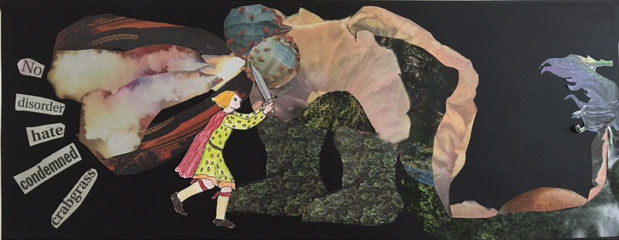
         So we are under this mysterious early moon of the pagan ceremony of Samhain, eight men with seven swords and a banner, standing ready to smite the dragon whatever that may be. Our leader, Count Bert caught a glimpse of its flaming tongue as it was slithering through the trees — a slimy formless worm. Swords drawn and yellow banner high we stare into the smoke of our fire trying to see whatever sent the Count into such a panic. With a whiff of breeze the smoke gives way, and here it is clearly before us! Yes indeed it is the evil we came to slay. It is the band of pagans with a flaming torch held high by the druid himself. Through the smoky dim they must have seemed a dragon.

         Daniel knows this little priest now holding high his tongue of fire. It is indeed the one we have come this far to slay. He speaks first.

         “So it’s you, Daniel, come all the way from the vineyards on the Loire to pay homage to the dead in the time of Samhain.”

[Footnote] Sjoestedt, Marie-Louise, Celtic God’s and Heroes, (Dover Publications, Inc.Mineola, reprint 2000.) p. 52.

(Continues tomorrow)

Post #25.12, Thurs., October 28, 2021

Historical setting: 588 C.E.

         This morning comes with a horse and an expectation that I too will ride with the count’s men. It is thought the pagans have taken back the borrowed child, burning the house, and murdering Eve.

         I’ve chosen not to carry a sword. I’m here simply to make the look of more men to gleam with the full awe of avengers riling with righteous rage for my daughter’s death. I offer to carry the banner. It’s a swath of yellow silk fabric leftover from making the count a new robe. He calls it the “golden flag.” I’m relegated to riding third in this fearsome line of raging young men. Daniel and the count go first. They lead because Daniel knows the way to the cooper where he met the pagan priest, and the count is nearer the front because he has a fancy white horse.

         Since we aren’t able to ford the river after yesterday’s storm we need to be ferried one horse and man at a time.  It takes most of the morning, but now we are ready to assemble our line again and make this fearsome swath through the forest. When Daniel comes up this way to buy barrels he takes two days to get to the cooper and back. And we’re already a half a day behind.

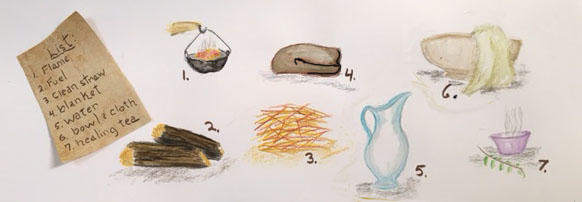
         Also, in this season, darkness falls faster and comes deeper into a forest, so we make camp amid the trees. Thole prepares a flame with the wicks he carries with the embers, while the others of us gather kindling and sticks — all is damp. The wads of nearly dry leaves we find under the wet make a smoky blaze but the flame is slow in finding the oaken sticks so we have lots of smoke and hardly a flame. The clearing autumn eve brings the hoary frost and seven of us crowd in a circle around our pitiful little spot of warmth with our stockings nearly in the ash. Seven we are, as the Count has made another trek to a more private place for his stink. He’s probably suffering the woes of fear in leading his men into battle.

         A few logs catch flame so we move back a bit, not for the heat of it, but for the billows of smoke rising making whispy fat pillows of gray, muffling the sharp moonlight’s corpuscular rays through the pillars of trees.

         Then comes the agonizing voice of terror screaming in the night!

(Continues Tuesday, November 2, 2021)

Post #25.11, Weds., October 27, 2021

Historical setting: 588 C.E.

         Thole has been waiting in the rain with the horses inviting me to ride with him to his father’s house. First we gather up the chickens binding their feet to take them along.

          We only go toward Tours as far as the road into the little village where Bertigan is the count. Jesse’s house is at the fork. It’s a cold little cottage with a walled enclosure for goats and a large stable with a shared wall with the house. I take the horses while Thole asks his father if I may stay as a guest tonight.

         Jesse has apparently become the count’s stable master. So here I see the count did go back and buy that stallion after all. I suppose Bert is raising his own horses now that he no longer fears a good gallop. Other than keeping horses for the count I see Jesse also keeps goats on this land, and now there will be chickens.

          Through the wall of the house I overhear Jesse’s raging voice reprimanding Thole for saying the name Lazarus – as though Thole was one who accepted the crazy “Christian myth” circulating as rumor at Ezra’s vineyard.  “So what does Ezra call him?” He asks his son.

         “He calls him ‘papa,’ Papa, as did Auntie Eve. Shall we call him Papa?”

         “Of course not! Call him nothing!”

         I can understand why in these times of lost metaphor, when sign and symbol are thought to be tangible fact people are believing that a banner or flag is the same substance as the people who follow it. And I know my name conjures a myth of new life. But I am a sign, a tale of something true, not a lie. In these times of confusion of truths and myths, and facts and lies, my son Ezra was once named after me, but now he calls himself ‘Ezra.’ I understand the apprehensions of myth.

         Thole comes out to tell me I am welcome as a guest at their table and I may sleep in the mow of this barn.

         “Thole,” I offer, “I heard your father through the wall here. Please know, you may call me Ezra. In my house father and son once had the same name. The son has chosen to call himself Ezra and so shall I.”

         Thole brightens with grin. “Thanks. Ezra.”

         Truth is that which doesn’t need to be said to be true. But lies only exist when they are spoken.

(Continues tomorrow)

Post #25.10, Tues., October 26, 2021

Historical setting: 588 C.E.

         An autumn wind brushes through the patch of rosemary wafting with the scent of broken stems setting a storm onto our patch of sky then drenching rain. With Eve’s house in ash there is no shelter. We are all, however we grieve, soaking in shared rain.

         The soft gray dust of what was once a place for healing now clings to my feet. Why do I wonder over the substance of angel’s wings? Are they only an artist’s plaster, or are they made of feathers, as the images and metaphors imply? Now I see the wings of angels are made of ash, and it is our tears that weigh them to earth and don’t allow the pneuma to come as wind and carry them off in a great swirl of dust to be one with God.

         Dear God, please see this face past the ravages of her earthly woes, the pox, the blindness, the wear of time, and know the beautiful daughter you loaned to teach me more of your love than I had ever known. Amen.

         Some foundation stones mark the house.  The hearthstones stand cold; the flame is gone. Candles she kept here are now dark stain on formless ash.

         Where there was the shed no animals are here. The mules were moved to the count’s stables months ago. I find here the iron tool that was once Nic’s own dagger that he had hammered into this child-sized sickle for Anatase. I tuck that into my bag.  Even the coop for the chickens is burnt up, yet three chickens are flapping free waiting for their daily dish of grain.

         A farmer comes from a neighboring cottage. He says he heard the screams and stepped out in the darkness to see. “They came up from the river. They were Persians, swarthy like the olive skin of the pagan woman they killed. They had broad swords flashing in the moonlight. Flames were already rising. One had the screaming, thrashing younger woman over his shoulder. The blind woman was groping after the screams wandering into the dark. One of the pirates went right up to her swinging his sword probably expecting the woman would run away, but she moved toward to sound of the sword slashing at the wind, calling the girl’s name into the darkness; so she was slashed on her neck and killed. She spoke no prayer. They ran off toward the river. I’m sure they were pirates.”

 (Continued tomorrow)

Post #25.9, Thurs., October 21, 2021

Historical setting: 588 C.E. leaving Ligugè

         We leave after morning matins. The rising golden sun, the alleluias of our lauds, even the early songs of the birds rising from the trees for their autumn pilgrimage – it all seems out of place in my own grieving. 

         Riding at an easy gait the young man Thole is a length ahead of me.

         Dear God, thank you for the crispy dawning. Please stay close. Let tragedy not be impetus for vengeance, but in your way, rescue us  to love. Help me through my hurt and rage. Amen.

         Eve is wrapped in a linen sheet. A grave was dug in that same place next to Eve’s and Ezra’s mother where Nic once laid my bones. I draw back the cloth from her face. My chin quivers. She is ashen and as always scarred with pox and hollows of hurts. The slash of a sword on her neck is the single blow of death I see. My tears drop onto her face as I kiss her forehead and pull the linen to cover her forever and after. Ezra’s hand is on my shoulder as he too weeps. She is laid in the grave, and the pages I scribed that Anatase enhanced with herbs are laid onto her. I add as many handfuls of rosemary as I can gather after the Christian practice.

         There are no pagan gifts given here to take her to their other world. She will have to die a Christian as she was born. Dear God, please take Eve’s spirit into the ever flowing river of your love — stay close. And thank you for the gift of her. Amen.

         Everyone has a grief in this. The strongest men of us, Thole, Ezra and Daniel, and I too weep silently.  Colleta brings the loud wailing of Christian muddle of sin and guilt. And here is Thole’s father, Jesse, cousin to Colleta, wracked with the passions of his second love lost. Thole said his father never stopped pleading with Eve for marriage, and she never relented in proclaiming against it. Now he is shouting his woes into a loud and raging rally for vengeance.  Count Bertigan and Celeste are standing further back with their children, good mannered, watching. And there are others here as well. Maybe they are the new tenants on this land, or people who have come to Eve for healing, or maybe so many are here simply drawn by the rumors of a violent death.

         Some mourners scatter to their homes. I stay here to wander the ashes with my plea to God for closeness.

(Continues Tuesday, October 26, 2021)

Post #25.8, Weds., October 20, 2021

Historical setting: 588 C.E. Ligugè

         I’ve just met this man who has come as a messenger bringing the sorrows we share. We both love Eve in our own ways. I’ve learned now that Eve was violently slashed by invaders outside her burning house. She was clutching her precious parchments on which Anatase had placed herbs for ‘reading’ in her blindness. Thole tells me the child was stolen, probably to be a young wife for some brutal heathen.

         I do know of this man Thole. All those years ago even before there was Nic, I was staying in the haymow of Eve’s cottage when I heard the farmer, Jesse, pounding at the door begging Eve to come help his wife in the midst of a difficult birth. (Blog posts #3.13 & #4.1) So it was an icy Christmas Eve when this man was born, and also when his mother died. The Christian mid-wives and even the whole family of his father, Jesse, on that night were celebrating the birth of Jesus at the Cathedral of the Saint. He could find no Christian to help with the birth so he walked all the way to Eve to summons a healer he thought was pagan. I heard him at her door, but I didn’t realize what was happening until near morning when I found Eve returning alone in the icy storm nearly frozen to death. This man Thole was born in a bed of sorrow that night, and now here we are strangers to one another, both grieving for a woman who was called by Christian’s  “pagan.”  But the chant she taught to fill that night with shouts and pleas was the Jesus prayer. She told me his father, who claimed the creed, didn’t even know the words to the Jesus prayer. She had to teach it to him so the cold silence of the death before the birth would be hallowed.

         I think at his birth this boy was named “Troll” by his father, to honor the pagan who came when no Christian would come. Now he is called “Thole” and I also know that as a small child he was Eve’s helper before she had Anatase.

         He remembers her. He says, “I could easily see why my father was so taken with her. My papa always wanted to marry her, I wish he had; then she really would have been my mother.  But she would never hear of it.”

         “I know.”        

         I show Thole to the guestroom. We will leave at first light.

(Continues tomorrow)

Post #25.7, Tuesday, October 19, 2021

Historical setting: 588 C.E. Ligugè

         The abbot tells me the messenger will stay the night, and in the morning I can go back to the vineyards with him. May we not be too late for Eve’s burial. The abbot said this fellow wanted to visit the grave of Old Nic so I can find him there.

         Brother August comes with me to the graveyard.

         Yes, I see this messenger is here. He is a slender young man with a shock of orange hair. Standing here in the breezy autumn twilight he is like a slender candle with a flickering flame. To bring me this news, and to know of Brother Nic he must know something of my family but I’ve never seen him before.

         “You are the messenger who has come for me?” (He nods with a curiously raised brow.) “And I’m Lazarus.”

         “Brother Lazarus? I was expecting someone older.”

         August intrudes, “This Lazarus is the son of Nic’s friend Lazarus.”

         The stranger speaks for himself, “I’m Thole, a friend of your family. Auntie Eve was like a mother to me.”

         Brother August is questioning. “How is it that you don’t know one another?”

         “It was a matter of timing, I suppose. I do know of this man Thole, he is the son of Jesse, Ezra’s wife’s cousin. Thank you for coming for me. I hope we won’t be too late for Eve’s burial. Maybe we should leave immediately rather than wait until morning.”

         “We won’t be late; they’re waiting for us. They knew we would have to rest the horses before we could return tomorrow morning. And travel by night would be inadvisable.”

          August goes on to vespers and Thole mentions, “Apparently, here they don’t know of your, shall I say, ‘gift’?”

         “Gift? You may call it that. It is simply more of a unique circumstance.”

         “I was a very young child staying with your daughter Eve, when Nic first came with your bones all wrapped and I watched him build a sepulcher as he waited for your rising. That was very interesting for me, as a young child.”

         “I imagine. Did Nic offer any worthy explanation?”

         “Not to my liking.  Of course I missed lots of what he meant for me to hear. He wanted to teach me to read and to know the Christian things. But Auntie Eve wasn’t a demanding enough tutor so I never minded my lessons.

(Continues tomorrow)

Post #25.6, Thurs., October 14, 2021

Historical setting: 588 C.E. The courtyard of Ligugè

         The abbot comes to me, grim faced with my old tunic and cowl across his arms, and on top of my once familiar clothing is a sword.

         “Brother Lazarus, a messenger has arrived from the vineyards on the Loire. They are calling all of the young men of your family to war.”

         “Why, what do you mean?”

         The abbot is blunt, “The messenger brought you a horse and a sword because you are called to battle against the heathen of the forest.”

         “I don’t understand. What is this about?”

         “A known pagan healer was murdered and her house was burned. And for some reason, maybe you can make some sense of, your Christian family has taken it upon themselves to avenge this horror.”

         I can’t speak, I can’t even catch my breath. I sit down next to the uncut stone. The abbot can see my pain and he lays the sword and clothing aside. Brother August reaches his hand onto my shoulder – it is strength. Dear God, are you near?

         The abbot answers in gentler voice, “I know you are not one to go warring; we can turn the messenger away for the sake of your Christian duty here.”

         “No. Eve is my family. Her house was my house. Is there news of the child?”

         “So you mean you know of these pagans and heathens? I’m sorry to bring you this sad news then.”

         My prayer is aloud so the abbot will know my heart, “Dear God, you know the prayers of this daughter Eve – she knows you well. You’ve heard her healing chants in Christian prayers. Through all her own pain she lets her empathy and love for others only increase. I’ve heard her whispering to you, ‘Dear Mother Creator God who is, let us be on earth as it is in your own heart of love, forever, and after Amen.’ Stay close to Eve, Dear God, stay close. 

         “Abbot, Father, what can I do now?  I’m a Christian, like Jesus and I can’t carry a sword or do harm to any so-called enemy. My duty is to love.”

         “Brother Lazarus, my son, some of the things Jesus taught are not relevant to our real lives. Maybe you can’t let this heathen enemy go unpunished. Your own family seems to own this battle.”

         “Did the messenger say anything of the child?”

         “The messenger is staying this night. You can ask him.”

(Continues Tuesday, October 19, 2021)

Post #25.5, Weds., October 13, 2021

Historical setting: 588 C.E. The courtyard of Ligugè

         But this is the day Brother August was delivered a great quarried stone of marble. Ligugè has a new commission. With Brother August’s eye and artist’s hand we are consigned a task to create a greater work of sculpture for a wealthy man’s garden than his neighbor’s Queen of Heaven statue. The huge stone comes on a flat bed with several axles, so that when the work is completed the wheels that brought the stone here can be put back, and mules can tow it to the place of its sponsorship.

         Brother August will chisel to mark a pattern of spaces to be hammered away by others monks helping in this work.  When the chisels are nearly deep enough to find the hidden mother and child Brother August will lay the next pattern; the artist always watching and choosing each lump of marble to be hammered off until the form is perfect and ready for polish. This statue will have symmetry and this time Mary will dress up like a queen. It was what the sponsor requested.

         “So how is it all so simple, Brother August?  You’ve always said your art is your prayer – as psalm calling for response your hands answer. Is your own creative work still the dialogue with the Creator herself?”

         Brother August answers, “Creative artwork follows the law of abundance as does prayer. The more you use it the more it is.”

         I know, “I know that law of creative abundance too, the more one creates the more ideas come. The more you love the more you love. So by that logical razor the earthly metaphor for the spiritual nature of love becomes lots of children. One seed becomes many in the next season; that’s the law of abundance.

         “But what does the law say of war? Doesn’t a small battle also yield a wider war?” I argue this dark side of abundance with Brother August. “And what of fears and hates? Do these destructive things also increase with use?”

         The artist answers, “There is only a guise of increase in these evils but that isn’t abundance. Soon the increase quills and we see it for what it is. War upon war ends in annihilation, not abundance. Just follow a thing to its fullness. And fear which often appears as hate, doesn’t increase with use, it self-destructs when seen in the full light of day.”

         We are interrupted by a frenzy of fast horses – one messenger with two horses.

 (Continues tomorrow)

Post #25.4, Tuesday, October 12, 2021

Historical setting: 588 C.E. Courtyard of Ligugè

         I fear our peaceful joy of Creative Spirit eternal in beauty and life may not be perceived as enough to satisfy unquenched longings for earthly wins. Earth and heaven seem further apart. When creeds and mouthed prayers twist and unravel with the sound of a Christian earthly achievement as “thank you God for our numbers and power” something tangible may be seen, but also, something mystical is lost. 

         Now as Ligugè dwindles in numbers and earthly importance we too, are unsure if we celebrating a lasting spiritual legacy or grieving an earthly loss. Ligugè really doesn’t have much shine on earth. Yet I do know God is still present with us. Thank you God. We still have songs and prayers and responses to calls. We simply have none of the earthly “mosts” of today’s monasteries.

         Brother August’s artistry has attracted a sponsor. A marble stone was quarried, and is being brought to us by a team of mules.

         I’m glad we haven’t taken to making our own wine so that I can see my son once in a while even though fewer guests drink less wine. So it is longer between visits from Ezra. And I know Ezra too, is a rich patriarch now.

         These are times for remaking the metaphor for the Jesus kind of joyful peace, “the kingdom of heaven.” Jesus always answered questions of an eternal heaven in the present tense. He said, “I am with you always.” And whenever I find I am in his midst and warmth even in these times he never says “if you achieve enough goodness to earn your way to heaven I will be with you only in some far off distant day to come.” He is with me now, still speaking.

         In our Jewish ways we shouted out psalms of lament and expected God to be a power present with us. Now the blessings from earthly priests seem shy in calling God directly into the hungers and hurts of earth. The priests say “one day there will be golden streets and castles in heaven for those who suffer on earth.”  But isn’t that place with many rooms, prepared for us by Jesus right here in our midst like the prayer caves for the desert aesthetic? [John 14:1-7] Or is the long wander always somewhere other than in life. Is it like the horizon, always within view but never present?

         Here, I would ask the artist.

(Continues tomorrow)