Post #15.14, Weds., December 30, 2020

Historical setting: 6th Century C.E. Somewhere in the Pyrenees

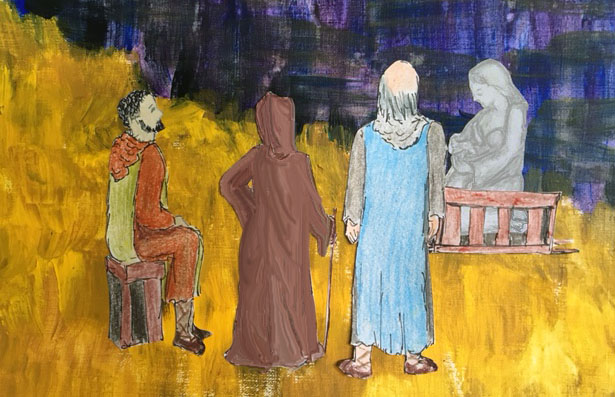
         We are here for a few days at this place where sandstone is sculpted into statuary, awaiting transportation for the sculpture of Mary and her baby. Nic paid a healthy sum to this man, Antton, to take this Christian work as a gift to the monastery near Poitiers where we are going.

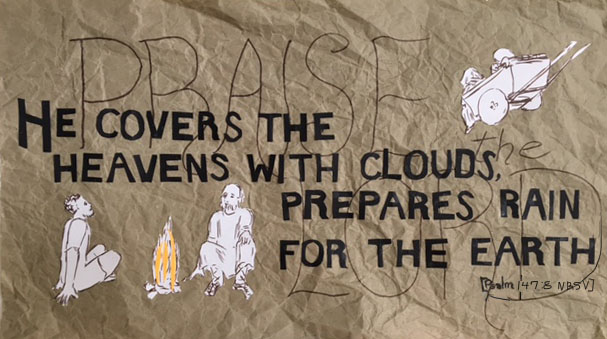
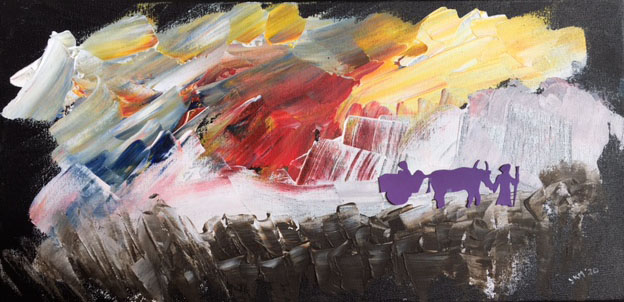
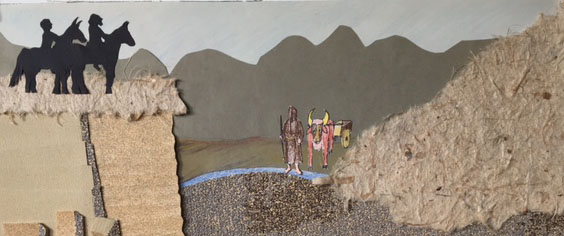
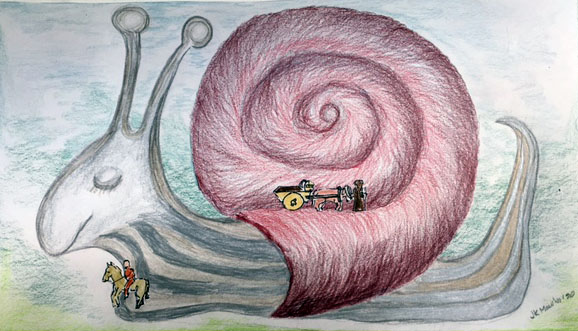
         A messenger who was sent to find an oxcart with a driver willing to make a long journey into Gaul has returned alone.  It seems an oxcart makes slow any journey and the driver who is willing to help us seems not to acknowledge timeliness. The messenger on horseback was impatient and rode ahead leaving the cart and driver alone on the slow path into these foothills.

         The messenger warns us we will be completely bored with this fellow August. “He never even speaks and he and the ox drudge onward only slow or slower.”

         Nic assures the messenger we won’t suffer from the silence. “Laz can talk on enough for the three of us.”

         “Thanks Nic. I thought you liked all my stories.”

         But it is true I am never short of story. Now memories of pilgrimages into wildernesses inform my extended chatter.

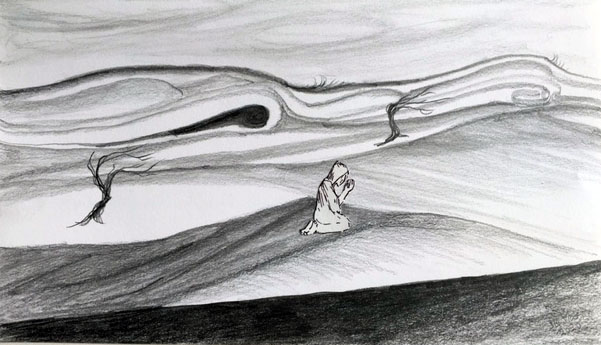
         “I have to tell you Nic, I’ve followed this lifestyle at times myself. For me, I’ve gone alone into desolate places in order to have uncountable days for healing both physically and spiritually.”

         Nic’s thought, “As for me, I think I would get lonely if it were just God and me forever, but then you probably wouldn’t be one to feel so alone; you would just keep on spinning your stories even if no human brother were listening and you would never notice that empty moment when even God seems far off.”

         I give Nic my most sympathetic moment of silence right here before I answer. I know he is one who thrives in community. It is his gift.

          Nic breaks the silence, “Maybe it has to be a personal thing.”

         “Yes, maybe it is personal and that’s how it is so different from the cults.  I find it is a commitment woven from many individual experiences of awakenings. And I know from talking to some of these desert fathers their reasons differ. Some go into the wilderness looking for penance while others are following the hints and flashes they have already seen of mystical illumination.  I also know of others who become lone pilgrims in order to enter into a lifestyle of God’s loving acceptance when the world around them seems so smudged in fears and hates.”

(Continues tomorrow)

Post #15.13, Tuesday, December 29, 2020

Historical setting: 6th Century C.E. Somewhere in the Pyrenees

         We’re guests at this place where statuary is carved from the quarried sandstone. Most of these works are icons for pagan ritual. But here amid the cacophony of Roman talisman is also a carving in a Christian theme of a common woman of Galilee with a beloved baby in her arms. Nic made a deal in gold to take this Christian statue to be a gift to the monastery near Poitiers. The arrangement includes the purchase of grain to fill our sacks and a payment to send a messenger into the wilderness to find the sculptor who has an ox cart and may be willing to help in transporting it to the monastery. Antton thinks the artist may have enough of an interest in seeing this work off to a Christian place that he would be willing to take on such a journey. We are told he is what is called a “Desert Father.”

         “Desert Fathers” I explain to Nic, “are ascetics who choose to devote their lives, or at least some years of their lives, to long hours of daily prayer and other spiritual practice.”

         “Spiritual practice?” Nic asks.

          “Some people find spiritual practice in fasting and ritual or maybe in mentoring others. Some are artists, writers and scribes, or keepers of books. Some simply pray for many long hours. One I knew was a carpenter. In these times they might choose a solitary life in a wilderness area like Egypt, hence the term ‘desert.’ Some live in caves or small huts often alone and isolated. Even though we knew Jesus to be a sociable sort, always showing up for the party this solitary practice was actually modeled after Jesus. Jesus often went alone into wilderness places for his own personal fasting and prayer and his most intimate hours with God. I knew that of him and it is written in the gospels as well.”

         Nic asks, “How is this extreme asceticism different from the cults of the heretics the councils of Hispania had opposed?”

         The answers are obvious. “It isn’t a cult. A cult functions with rules set down by the deceit of a charismatic leader making hoax of known truths, and it eventually it leads the followers to their deaths. The desert fathers practice an individual faith journey with promises  between God and that ascetic; it’s not about loyalty to a human leader based on lies and fear. True spiritual practice is often a twisting path but it leads to spiritual renewal and to life. It is not deadly.”

         The messenger returns without the desert father or the oxcart.

(Continues tomorrow)

Post #15.12, Thursday, December 24, 2020

Historical setting: 6th Century C.E. Somewhere in the Pyrenees

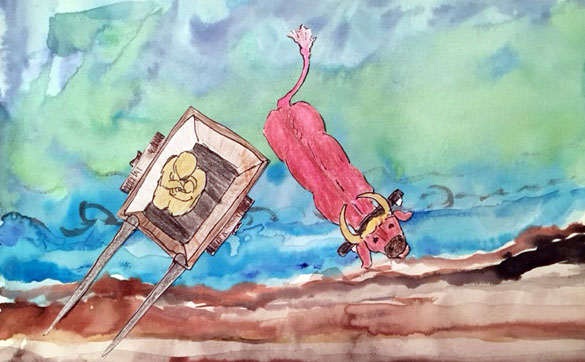
         Nic and I carried the statue of the mother and child into the adjacent ox shed and away from the pagan statuary so we could have a better look at the work. My thought, this would make a wonderful gift to bring with us to the monastery of Ligugé where we will be seeking our callings. Nic worries about paying a pagan price for Christian art, and anyway how would we carry it?

         But here we find ourselves in an ox shed on the Eve of the Christ Mass when the whole Christian universe is hearing this same story from Luke 2. The song of Hannah becomes the lyric of Mary to turn the world upside-down, to lift up the poor and send the pompous power mongers meekly groveling in the streets. Will this kind of justice ever be so? Is the Jesus love intended for the whole world, or just for one heart at a time?

         I knew nothing of that birth. I don’t know if Luke was just spinning a story to speak of the simplicity of holy justice. I can’t verify the tangible details of manger and angels. The truth of it, I can verify. Undoubtedly the gospel writer crafted it from tender metaphor of barn animals and wet and messy human birth in order to tell the universal truth of a simple and just God. This God is a mother’s love that cannot be shaken by any acts of her beloved Creation. It would be hard to offer up a story of the Creator of the wholeness that is love, life and spirit, the unspeakable unnamed God, without using the simple metaphor of a mother and a child. And I do know Jesus was born, somewhere, some way and lived as a child who learned a trade in order to create things with his own hands. And in my strange circumstance of life I did also know his mother. She was Jewish. Her riches were her children and her faith.  Well, faith is not a thing one keeps as a treasure. It is said to be more like a song; it lives as it is sung, and when it is not being sung it doesn’t exist. [footnote]  But Mary, his mother was always singing.

         We, Nic, the ox and I, are together here in the silence of our prayers for however long. The ox was at first, standing. When we came into its place the ox stepped back in apprehension of a huge load of stone it would need to drag somewhere. It was accompanied by these two human intruders who are us. Now the ox has folded his knees with us for his own peaceful night’s rest.

         … and to all a good night.

footnote – Pastor, the Reverend Doctor Kelly Brill of Avon Lake U.C.C., spoke this beautiful metaphor for faith like a song in a message on Matthew 14.  She said she is not the first to use that metaphor which makes faith nearly into a verb, and not a thing one can keep and own. Thanks Pastor Kelly.

(Continues Tuesday, December 29)

Post #15.11, Wed., December 23, 2020

Historical setting: 6th Century C.E. Somewhere in the Pyrenees

         We asked the one who markets stone carvings what artist created this sculpture of the baby Jesus and his mother.

         Antton explains, “We were at the quarry we use to cut the stone for this winter’s work when we discovered another man using our source. We thought we had our own place. But there were three of us and only one of him and he was of a diminutive stature, so we could’ve bruised him and sent him on his way but of course, I have a better sense for marketing than that and I happen to know raw stone is of no value to anyone but a sculptor. So I offered to allow him to use our stone pit if I could sell his works for a slight profit. We made a deal to trade stone for statue. The next time he arrived at our quarry he had this statue in his oxcart.”

         “So who is it who carved this?”

         “Maybe you would want to be asking what the price of this is. Christians seem to cling to poverty over wealth. So I think you will find I can sell it to you at a very low price and still glean my profit.”

         Now it seems Nic is negotiating for this thing he doesn’t even like.

         “Lazarus and I’ve looked upon this woman and her infant with my Christian eyes which tend to see things in ways different from Antton. So here we find a strange paradox, the very face of empathetic poverty from a gospel story we know well, here for sale amid all these pagan idols purposed for marketing hollow wishes and empty dreams of wealth and prosperity. I fear this lady is not a work that should be sold for gold or silver, but obviously she was created as a sacrificial gift by an artist whose work was an act of worship celebrating the Creator. I believe this should be gifted, and not sold for coin.”

         The seller of statues named a price anyway. Nic baulked. I suggested we move the mother and child away from the clutter of the other statuary so that Nic and I could see it more clearly for what it is.

         She is still in the wood base used for moving statuary and it isn’t hard for two men to carry her into the adjacent ox shed so that we can better see her in simplicity. And I think Nic will understand my affinity for this work as it is in a proper setting.

         But of course, the problem remains, what would two traveling Christians do with a statue?

(Continues tomorrow – On Christmas Eve)

Post #15.10, Tuesday, December 22, 2020

Historical setting: 6th Century C.E. Somewhere in the Pyrenees

         “Christian convicts you are? I understand.” Of course he says that. Antton is trying to sell Nic a stone statue.

         Nic explains, “Our thanksgivings are to the invisible God of all Creation.”

         “And that doesn’t seem to be working out for you very well, since you come here begging a sack of grain.”

          “We do have more use for grain than stone.”

         “But have you considered the possible powers of a sculpted stone goddess in the form of the Virgin Mother of the Christ? Just imagine it! Your mystical prayers to an invisible god could wend and weave with the fragrant smoke of sacrifice before the Christian goddess.  I can show you that sample too. Please don’t blame us for this workmanship. This one was not by the hand of our own artisan. There isn’t even any symmetry.”

         I really want to see this sculpture, though Nic is full ready to leave. The man shows us the so-called, “Christian goddess.” He points out the distinctive differences between the fertility goddess and this Christian “appeasement.”

         “In place of a cornucopia or bowl of fruits and grains she is holding a naked baby.” And, he notes, “The Christians seem to prefer their goddess leaner and from a distinctive caste of poverty. I don’t know why Christians want to turn everything upside down seeming to value the outcasts and the riff-raff the most. But no matter, I’ve got nothing against Christians if they have coin.”

         I see it. “This is beautiful! Look at her Nic! I think this draws us into a disturbing empathy with the ancient woman of Galilee. Surely this is the work of one who actually shares in the Spirit, someone who can see the holy shining through human poverty.”

         Nic adds, “I think you like it so much because she looks like you. She has your same nose and brows anyway, though a bit more gaunt with hunger, and of course, she is a woman.”

         “Yes, I suppose you would notice she is Jewish. But look at how she cherishes this baby. She shines a sense of joy, not from owning the plenty as the pagan goddess displays, but in sharing all she can give to nurture this infant.”

         “It’s a piece of carved stone, Laz.”

         “We have to ask Antton who this artist is.”

(continues tomorrow)

Post #15.9, Thursday, December 17, 2020

Historical setting: 6th Century C.E. Somewhere in the Pyrenees

         We stopped at a place with houses hoping to fill our grain sack, but we have been escorted into a most unusual world. In this place the people carve Roman pagan gods and goddesses from stone to be sold at a summer marketplace.

         Nic takes notice of a stone carving of a popular Gallo-Roman fertility goddess. She is a design of rounded, smoothed and meticulously polished spheres of stone. Her abundant thighs spread to hold a bowl of grain in her lap. Unfortunately for us who are seeking grain, it isn’t real grain; it is just a likeness of grain carved of stone. Her long tunic drapes across her knees to her ankles. The broadness of her arms and the fat of her chin and cheeks speak of plenty and of course, it can’t go unnoticed that her breasts are abundant.

         Just imagine the prayers that some lean and longing farmer may bring with his sacrifice to her amid a drought, bowing deep before her knees to speak his wish or at least a hope for a better harvest to come.

         Antton notices Nic’s interest. “If you would like to order such a carving it can be hewn in dimensions to fit your need, perhaps as a personal charm to carry with you in your travels.”

         Nic answers with his rural simplicity. “No need. It’s just that I’ve never seen this goddess so ample, and particularly in a time when I am the one who is hungry for the grain in her dish.” 

         “I understand. And such a carving would hardly be appropriate for a man on horseback. This one was made on order for a particular client — a man of great wealth who maintains a private temple in a distant villa. But she will just have to sit here until the weather is better for travel.”

         “Of course.”

         “If you order a goddess for your own wishes her bowl of plenty can contain whatever may be the benefits of fertility you long after: grain, fruits, whatever — and we can even render her tunic folded back in any style you wish.”

         “No, no. Any fuller revelations of this goddess would surely be disturbing to me. And of course we have no use for statuary. Laz and I are of the Christian conviction so we don’t make wishes on stone.”        

(Continues Tuesday, December 22)

Post #15.8, Wednesday, December 16, 2020

Historical setting: 6th Century C.E. Somewhere in the Pyrenees

         Our immediate search to replenish our supplies and our hope for hospitality led us on a path and into a community of round thatched houses in the style of the grass houses we see often in these mountain places. On hearing our horses, a man steps out of the larger central house.

         “Good morning Brother Stranger” Nic begins, “We are travelers on our way to Gaul, but just now we are looking to make a trade of two little winter furs for a sack of grain. Our supplies have run low.”

         “You should have thought of that when you started your journey.”

         “Of course. But we aren’t beggars. We come with a trade in furs or if you are one who values the likeness of the Emperor we can trade with coin.”

         “Coin, you say?”

         “Yes. We can trade in coin if you have use for coin.”
          “We do use coin. But we don’t trade in grain. We buy our grain, and we only buy for our own need.”

         “What is it that our coin may buy then?”

          “Oh, you are buyers.  My name is Antton, and in these winter months my family and our artisans create great works to sell in the summer markets. Sometimes we also take orders. So you can get anything you may wish for. Let me show you what we have!”

         We tie the horses, and follow the man walking passed a heavy-wheeled ox-cart parked now. It seems ready and waiting to use on this roadway paved in broken stone. It seems to be for larger loads than a sheep or two bound for a near-by summer farm market. We cross over a footbridge spanning a creek passed a row of strange, yet intentionally carved rocks – demons and devils — winged goddesses of Roman origin — legendary creatures of every ilk. The path takes us to a circular thatched portico surrounding an enclosure with benches and a central warming fire. All around us are the kinds of things that can turn a cave or portico space into a pagan temple with an altar honoring any random stone god or goddess who may be receiving sacrifices in exchange for wishes. In fact here is the complete soul-source of Roman temples still in the making.

         Nic seems awed by a very large statue of a seated woman flanked by two horses.

(Continues tomorrow)

Post #15.7, Tuesday, December 15, 2020

Historical setting: 6th Century C.E. Somewhere in the Pyrenees

         Our rain-soaked cloaks are nearly dry this morning, but now our tarp is ripped and muddied, flattened into the soft earth with the hooves of many sheep trampling across it. And we seem to have made another shepherd angry with our insensitive intrusion unto his traditional pathway for sheep.

         The shepherd passes by us muttering curses to pagan Roman gods. At least we know he speaks the vernacular. We’d hoped to find a person somewhere soon to make us trades and give us a night of shelter but we don’t seem to make friends easily in this way we’ve found. It’s as though all we are doing is plundering the middles of murmurs of sheep.

         “So Laz,” Nic starts with his teasing tone, “You were going to tell me all about the time when you and Jesus ventured off to meet some shepherds.”

         “We were kids.”

         “Sure, but I’d have thought with all your ancient wisdom and experience around sheep you could offer us some useful guidance for avoiding these mistakes.”

         “Well, really, we didn’t learn much back then about shepherding. We were of an age when simply seeing sheep and shepherds empowered us with attitudes of already knowing everything.”

         Now we heap our muddy things onto the horses and ride back over the same sheep trail we followed yesterday through this pass. Our hopes are of finding a source of human hospitality or at least a trade of useful grain for our two tiny furs. The ermine might have enough worth to feed us for a few days. I don’t suppose the rabbit skin to be of much value.

         This path will probably take us to the daytime pastures for these sheep. We are learning a few things of the patterns here, or at least we thought we were. We’ve caught up with the sheep and the shepherd now as they ford the creek we were following onto a path we hadn’t noticed when we came this way in the rain yesterday on the other side of the river. This path forks into a gated enclosure for the sheep to the left, and the right fork heads into a larger yard with several round thatched houses and a couple of open-sided shelters for the beasts. That seems it would be a better to take that path since we have already riled that shepherd.

(Continues tomorrow)

Post #15.6, Thursday, December 10, 2020

Historical setting: 6th Century C.E. Somewhere in the Pyrenees

         Mostly it’s rain, wind-driven rain, ice fringed rain, blinding, sleety rain always in our faces affirming we have chosen the northerly way. Ah, yes! We aren’t lost. Thank you God.

         We are watching for a sheltered lee to be a stopping place, but now The Rose has found a footing that seems was traveled before. The muddy slog is pocked with the tracks of a flock of sheep moving in this same direction. This trail takes us through a narrow pass with the creek on the west side of us, narrowing in the space between two vertical walls of stone into a faster flow, a swift current that leaps the rocks then froths with foam into rapids and falls.  This path was a very good find. For quite some time we follow it around the hefty base of a vertical rock. The rain is subsiding when we reach the spread of grasses and sky beyond the pass. We make our camp. Our outer wools need to be wrung out before we spread them over the winter-bare bushes to dry. And it doesn’t take a very large fire to melt our shivers and boil up a pot of the last of our gruel with the beets and parsnips added.

         Now, the dark, backsides of the clouds ravel apart exposing the naked depth of blue that is a peaceful afternoon sky. It was there all the time behind the storm. And right in the midst of our glimpse of late day sky is a white pearl moon, come early for night, a full round of brightness and quietude just waiting to dazzle the dark for these travelers drifting into peaceful rest.

         “Wake Lazarus! There are flocks of sheep coming down on us!  We have to move.”

          The morning light is a narrow glow of crimson under the clouds. Our fire is cold, but all these sheep aren’t at all shy about trampling our tarp, and they would have put their many hoofs onto our fleeces and blankets as well, had we not grabbed up these few things before them.  They come through our camp, each with curious glares, wondering what these human kinds are doing in the middle of their daily passage. At the last of this great march through our camp is another angry shepherd. He gives us an irritated glance as though we had sang a familiar psalm with a new tune. We seem always to be the intruders in some tradition that belongs here that we hadn’t noticed.  Didn’t we even think in the fog of yesterday’s rain this is a sheep’s path? 

(Continues Tuesday, December 15)

Post #15.5, Wednesday, December 9, 2020

Historical setting: 6th Century C.E. Somewhere in the Pyrenees

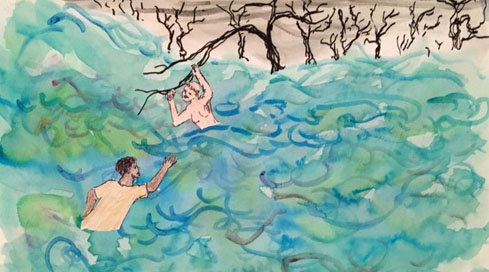
         Nic explains his amazing good fortune. “I went across the river to the snowy side of the valley. I was reaching for a stick for the fire which I had seen from the other side, when I caught a glimpse of something on the move. It was clearly a rabbit, a rabbit sliding on its side moving in jolts and jots, then still, not even perking ears toward me, but leaving a trail of red on the snow. I went closer to it, and still I wasn’t noticed. Then I realized this large and meaty rabbit is being dragged by its small captor — a weasel. It was hard to notice the weasel against the snow, nearly all in its winter white. The ermine was so much smaller than its prey it took all of its might and power to haul the large rabbit toward the opening of its den. So intent it was on keeping such a big prize for itself that it never even noticed a man the size of a tree watching it all happen. That weasel completely overlooked this giant human casting a monster’s shadow so I drew my sword. I collected that little white ermine fur with hardly a blade mark at the neck.”

         “I guess, Brother Laz, there is a lesson from the weasel for us all to heed. Let’s not become so wrapped in our riches we forget to take notice of the world around us.

           “So likewise, I was reminded that God’s priorities are not material wealth when I heard the farmer say that all my Roman coins, my lifelong work, is meaningless to those who don’t also trade in coin. I mean, think of it. Material wealth is null if the market has no imagination for it.”

         Dear God thank you for a wide view. Though our prayer aloud was “Thank you God, for this food that is enough for both of us this night. Amen.”

         Yes, the rabbit is plenty for us. And I have yet to eat a weasel. Hopefully I never will try that.

         It was a good night’s rest, and this new day comes with the north wind surging through our valley. We ready the horses and pack up to start headlong into the winter’s wind.

(Continues tomorrow)