Post #6.1, Tuesday, March 3, 2020

Historical setting: 562 C.E. The site of the Cathedral Fire in Tours

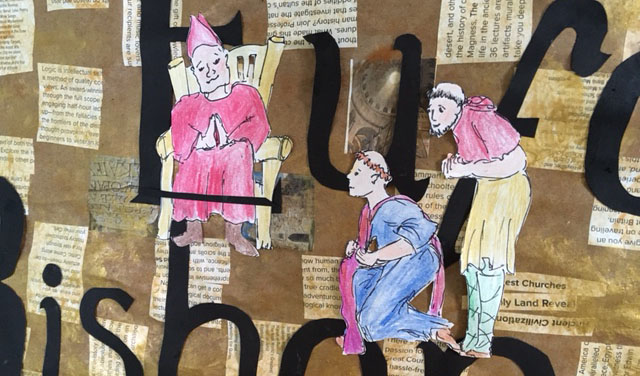
I have a suggestion for the young aristocrat. “If there is to be no rebuilding we could just turn this ash over with the clay saving the flowers of these weeds to make this place a great meadow of flowers! Imagine the wonder in that beauty! People will come here again for prayer and sanctuary where once there was only ash and here will be new life rising up, blooming beautiful, breathing life from light! Even the light and the life are metaphor for the invisible God.”

         “Fie, such heresy! An Arian merely humanizes the Christ. What heresy might this be called that sanctifies wild weeds and light?”

         “Really Friend George, we don’t need to summons a council of bishops to make another declaration of anathama. I’m not suggesting some kind of pantheism or pagan nature worship. Flowers are a metaphor. Of course, seeing the invisible through the metaphor of beauty requires opening one’s eyes to the power of symbol.”

         Dear God, why do I long to defend your free gift with an argument? Guide me to receive this insolent fellow in your way, with relentless love anyway. Amen.

         “I was just saying flowers would be beautiful here.  So, Brother George, what would you have me do to be useful here?”

         “We should take great care to preserve these ashes.”

         Then he draws from beneath his tunic a plethora of metal pieces — each noosed around his neck by chain or rope: first the familiar cross, then a bejeweled fleur de lis; a smithy’s rendering of a Chi-Rho with its prongs in all directions and a small but dazzling golden peapod. It is the pod he means to show me now. It is a locket that he would open if I cared to see his relic of dust of a “lesser-known source than could be these ashes;” and yet he tells me this relic has taken his father safely through trials, strengthened his mother against a flame and has miraculously preserved his own life from threat of dangerous bolts of lightening in a horrific storm. (Footnote)

         He adds, “It be here a true and blessed amulet empowered with the miraculous spirit of a saint. And here before us were a whole expanse of sacred ash.”

         I should just nudge him lovingly into fearless faith making need of charm pointless.  Dear God, guide me …

         (Come again tomorrow.)

 [Footnote: The young Frankish aristocrat in this fiction is drawn from a non-fictional source that includes this detail regarding the golden pea relic. This document was retrieved Oct. 19, 2019 https://sourcebooks.fordham.edu/basis/Gregory-hist.asp ] In 573 C.E. Gregory of Tours was ordained Bishop of Tours and his voluminous writings include historical tidbits about the Franks and much hagiography of his own times and before. At least three editors I have noted, for one: Alexander Callander Murray, editor and translator of the Gregory of Tours text published by Broadview Press, 2006, have questioned Gregory’s history. It is a reminder that history is neither standard nor stagnate. The dearth of provable fact is not just the flaw of a fiction writer’s imagination.

Post #5.12 Thursday, February 27, 2020

Historical Setting: 562 C.E. Gaul

         Speaking with young George, we find these fallen stones are a fine place for me to begin our chat.         “The bishop mentioned you had a interest in this place that was once a church and, like me, you are also a scribe. Maybe we can share gifts and find a common bond that will in one way or another serve God.”

         “Yes, Brother Lazarus the bishop hoped I be able to turn you away from your heresy and in gratitude you be setting your effort to check my writings for flaws in tenses. So now I shall banish your heresy.”

         “I grieve the loss of metaphor: ‘Word became flesh.’ Why must it be one or the other?” I wish to keep my heresy, but this child of Frankish nobility drills me, an ancient Jewish monotheist, on the nature of a three-in-one God. It’s the pointed ends of that infuriating triangle persistently prodding disagreement among Christians. Maybe it had a purpose once as a teaching tool to bring pagans, Romans and even these Franks, from notions of many deal-making gods into a new shape that is one God who rules with humanly unmanageable grace, in love with her whole Creation, not just the well-behaving Christians.

         “So common-laborer Lazarus, I shall teach you the righteous ways of the One True Faith. Are you prepared to listen and heed?”

         “I’m prepared for conversation to find our common ground. But if you only expect from me listening then we can both do that best in silence.”

         “Silence won’t fix things. My duty is to turn you from your heresy. You need to be humbled from your mighty notions of a God who would walk this earth in tatters as a man in order to befriend the likes of you.”

         Now the young gentry is standing and pacing as he continues to lecture me with his peculiar paradox. “You see, the God-head is a Mighty Emperor – Lord of all — Holy of holies — and not approachable by a mere un-ordained carpenter as yourself.” As he makes this grand proclamation he nearly gags himself lifting up a heavy cross on a chain around his neck. He comes uncomfortably close to me to put it exactly in front of my eyes.

         What can I say? “I fear you would have me turn my prayers away from the warm and ever-present love of God to pray to a cold and jagged symbol of Roman persecution.”

         “What?”

         “The cross. I see it as a symbol of suffering.”

         “Ah, as well you should!”

         “Then why would I pray to it?”

         (Come again Tuesday, March 3 Chapter, “Reliquary”.)

Post #5.11 Ash Wednesday, February 26

Historical Setting: 562 C.E.

“Oh No! Please. These ashes are sacred.”

         A tidily attired aristocratic youth struts with the flourish of an elder’s authority; or maybe it is simply the pomp of naive privilege. His accent and manor are conspicuously Frankish.

         “So you are young George, the one concerned over these ashes?

I’m Lazarus, here to offer myself as a builder.”

         “Are you Arian? See footnote You seem Persian and Persians are often of that heresy.”

         “And you seem Frankish. I’m not Persian by birth; I’m a Christian of Jewish heritage. And I might add my heresy is only of creed not of truth. I offer myself now as a builder so having an earthly friend who was a tangible human carpenter would seem an asset, would it not? And I consider myself to be a personal friend of Jesus.”

         “So that were a ‘yes.’ You admit you be a heretic of the heresy of Arius.”

         Young George easily reviews this one of my heresies. “Because speaking of Jesus as human friend denounces the sanctity of Christ as the same substance as the Father thus an equal in the Trinity; thus to say Jesus were of flesh there be no Trinity, therefore no one Catholic Church, therefore no Christianity, therefore you deny the one Church universal and of course God are to be on the side of the Church.”

          “Ah, my friend, you do know my heresy. But does that make me less useful as a builder? I find this church is in need.” I merely wave my arm to direct attention to the ruin in ash but he fears even my gesture.

         “Ah-ah! Don’t touch these ashes! They be a holy relic of sanctuary perhaps one day to fill amulets for devout Christians in need of God’s miraculous protection against the powers of woe.” 

         My argument plunders my restraint.  “A relic you would call this mess? How is a church in ruin a worthy sign of God’s grace? Ashes are a mere sign of penance. And a very ancient sign they are, even older than Jesus stories. They speak of the choice one makes to dismiss the old sins. Then the ash becomes the growing medium for the new garden. It is all here for the turning– the repenting – the new life from old hurt. Ashes aren’t magical. They are simply a reminder, a metaphor for our turnings.”

         From his sour face I have surely put my heel down right into another stinking heap of heresy.

 (Continues tomorrow)

footnote Arian?  Author’s note: In 326 C.E. the Council of Nicaea produced its creed defining Orthodoxy that included the anti-Arian statement that the Father and the Son are of one substance. Nuanced and politically divisive this had great bearing on both history and religion, though in the opinion of this blogwright had no affect on the true nature of God who is God. Among the many sources of details on the Arian controversy one that offers a readable historical context for this is Henry Chadwick’s, The Early Church [(1967) The Pelican History of the Church vol. 1, Penguin Books ltd. Harmondsworth, Middlesex England – pages 130-131.]

Post #5.10 Tuesday, February 25, 2020

Historical Setting: 562 C.E. Gaul

With the church building gone I hear the Bishop can be found at the basilica of the St. Martin shrine on this side of the river. But apparently 200 years ago Saint Martin didn’t notice political edges of Rome and planted the monastery on the other side of the river where Frankish armies owned the power. Gaul is mostly Frankish now. Warring cleared the random growth of old forest leaving in war’s wake,  stillness.  

         So I’m waiting to speak with the bishop. “Your Excellency, thank you for seeing me. I’ve come to offer my skills as a layman in the service of God. I would beg a place at a scribe’s bench as my work is to copy scriptures for the distant Christians. But now, with the old sanctuary in a terrible state I may serve better in the rebuilding.”

         “We have no plan for rebuilding. Where do you come from?”

         “My family is a day’s walk west. So I was hoping to stay at the monastery while I’m useful. If there are no monk’s cells available I have, on a previous pilgrimage, found shelter and solace in the caves.”

         “We find ourselves with a dearth of scribes these days. What skills have you in language?”        

         “As you may have noticed I’m fluent in Latin but also knowledgeable in ancient languages – Hebrew, Aramaic, Greek…”

         “You seem an answer to prayer for us here in such need of a scholar.”

         “So it would seem. But, in truth, my mission is to carry the Gospels to the outlying Christians not to the Orthodox.” Maybe I was too clear. He understands me exactly.

         “So you are a heretic.”

          “If you fear heresies Your Excellency, perhaps you will choose to use my skills for the rebuilding of the church?”

         I’m surprised he seems so fearless of heresy. He drums his fingers as though he is considering a use for me. Now he speaks.

         “Amazing synchronicity it is. We do have another layman among us, a young man, son of my own cousin in fact, who shares your  interest in preserving that old church. And like you, he has come to use our scriptorium. Maybe he will heal your heresy and maybe you will help him through his roguish use of Latin.”

         So it is, I arrange to meet the young noble, Georgius Florentius, in the pit of ashes.

          “Oh No! Please don’t touch anything here. These ashes are sacred.”

(Come again tomorrow on “Ash Wednesday.”)

Post #5.9, Thursday, February 20, 2020

Historical Setting, 562 C.E. Gaul

Closer yet to Tours now I pass the rock heap marking the plague pit. It is yet untouched since I found my way beyond this, outside these walls beyond the holy cremation of sanctuary, smothered under memorials of wilted flowers, heaped with remembered stench of plague and death, pagan and Christian, nameless and beloved, collected and buried with only death by plague our common bond – common grave.

         I have a clear view of the wall and yet there is the emptiness where church always was. The wall shows fresh mortar for it’s wound.

         Inside the gate…

These dampened ashes remember the fire — screaming earth, roaring, snapping, howling, leaving tangible outline of what was once the holy altar, the edges of apse, stalked under the great eternal Roman arch; we would enter from the back.  …all turned to ash in quiet flame, dwindled.  Intangible mystical whisper of gray smoke rising; clinging only as mist to crumbling order.

         Yes, this shadow in ash tells of the church fire at St. Maurice, the basilica built by the first bishop of Tours.Footnote

         Here it is spread out before me on the earth — a rectangle of rubble still hugging the city wall where sanctuary itself once nestled assuming safety.

The uniform yellow stones with their ordered geometry are randomly tossed by nothing but breath of flame, strewn onto the rectangular floor still marked in spaces for communicants and aisle for procession. Rocks in heaps— ashes of sanctuary I once knew so well.

         No one seems to take much notice of one lone wanderer amid this ash. Leaves of unplanted seed are already at work disrupting the old solace with new life. Yet no one has been here to stack the stones or dust away the remnants or even pull down the charred beam still standing. Is there no person who would begin this thing anew?

         The sun is dropping behind me into shadow. With the great structures of human making in shambles what is there but the sacred quiet? It is the quiet I came here to find.

         The stable is standing, so tonight I spread my cloak in a hayloft, and tomorrow I will look for the Christians who are surely making the plan to put this all together again.

         Thank you God, for this embrace of ever-presence, amen.

Footnote  https://en.wikipedia.org/wiki/Tours_Cathedral retrieved: 5-16-19

The first cathedral, dedicated to Saint Maurice, was built by Lidoire, Bishop of Tours from 337 to 371 (preceding Saint Martin). Burnt down in 561, it was restored by Gregory of Tours and rededicated in 590. Its location, at the south-west angle of the castrum, as well as its eastern orientation, resulted in the original access being through the late-Roman surrounding wall (such a configuration is quite rare).

(Continues Tuesday, February 25)

Post #5.8, Wednesday, February 19, 2020

Historical Setting, 562 C.E. Gaul

Well passed the shrine, ahead is the great wall of the city. But I see no church tower above the wall anymore.

          This road edges nearest the river across from the hills and the ancient caves. The devout still go to the caves for quietude. It’s wilderness dug in clay and I know it as the holy place where I spent a timeless forty days fasting and in prayer.

         I’ve come several times on my journeys back into life.

         The years after the rising of Jesus some of us who were close to him came into Gaul on the edge of the Great Sea to wait for the day. Then we were of the mind that Resurrection would be instant and tangible for everyone. The peace we found among the pagans of Gaul may not have been peace at all, but a shared fear of a common enemy — Rome. Then the Roman armies oozed into that edge of Gaul one little hamlet at a time. So I came here to the wilderness rocks and caves on the banks of the River Liger seeking the silence of a thin place where heaven and earth touch fingertips together. The tranquility that marks this place released my prayer into the flow of Spirit and set my psalm in tune with the beauty. Here prayer was the gentle exhale — the release — not the required order of the day. Thank you God.

         Then my sisters went east to live among the Christians of the seven churches. I visited there while Mary was yet living. Then when she was very old and needed a person of her family nearby I went again to Ephesus. When she passed away I went on deeper into Persia to settle with other Aramaic Jews and Christians escaping Rome amid the Zoroastrians of that land. But always earthly politic seems to plunder heavenly peace. In the year 326 Rome swallowed up Christianity. Emperor Shapur II saw the declaration and shifted his own fears. His leery eye was on his distant Roman enemy so he made all Christians his enemy. We who were Christian monks were arrested beaten and martyred out of political fears, our holy differences aside.

         Barely grasping life from death I made my way back here for the long and painful healing from that persecution.

(Continues tomorrow)

Post #5.7, Tuesday, February 18, 2020

Historical Setting, 562 C.E. Gaul

On this new day I set my sight on Tours or as the Romans used to call this area Civitas Turonorum about a day’s walk east of these vineyards of Ezra.

         Dear God, guide me into this new. Amen.

         The last time I traveled this road in this direction was twenty years ago when I was near death and desperate to find help for my children amid the withering plague. That day is burned onto my memory in random scattered pieces. But those mere fragments still rage and rave when I dredge them to consciousness from the froths of flaming fears. I fell into the coolness in the clay of these deep ruts beside this road.  Powerful hands with unimaginable empathy turned me to gaze skyward speaking gentle words of one innocent of plague’s ravages, ready to help me rather than run. I gathered strands of thought-to-word to be exact about the place I left my children. I begged him to leave me and save them. He had a beast and a cart. He could make good time to arrive for them. I prayed it loud. I said it. I shouted it! I don’t know if I made sense of it, but Ezra and Eve were discovered to have lived through it all anyway.

         I woke in a night lost from calendar time in the plague pit with the death stench. I was frail – a dry nub with no words. The healing of that was long and slow. I lived into that healing as an ascetic in the old caves near here across the river.

         The ruts are hardened this day with the dry freeze of winter so this road is an unsteady walk.

         Some miles along here is this low thatched house where a nanny goat and her kid are chained as a new wall is being stacked higher than a goat’s climb. The chained critter locks eyes with me in her remembrance of freedom as I stare back for a moment in my knowing also. Yes, I think I am aware of what house this is, so I can guess who is working there behind this wall to make a place for this nanny and her kid.

         I choose to continue on the road and set aside my encounter with this so-called “evil” Jesse for another day.

(Continues tomorrow)

Post #5.6, Thursday, February 13, 2020

Historical Setting, 562 C.E.

         At my last leaving, I was near death, so I went with a great purpose that these children could live. But now it is different. I’m not the useful and needed person among them so I’m wandering off to Tours that I may not be like the guy in the Luke Christmas story: the tax burden in the shadows who brings the lineage with the stem of ancient Hebrew patriarch and makes the whole perilous journey just to be counted by Rome.

         At the monastery if they won’t allow a true heretic among them scribing gospels in their scriptorium I can offer myself as a builder. I can repair the burnt church. And in that other way I’m also thinking of Joseph who gifts me with the carpentry skills I learned from Jesus when we were both so new to earthly skills. I first found Jesus a friend when as children we were shadowing that carpenter patriarch in our childish pretends for learning. Jesus learned a trade. I learned friendship.

         This day I’m also thinking of Jacob traveling to a place he knows already but wrestling through the night with the promises made to God when stacking stones in order to make peace of an earthly relationship. And God, wrestler, rescuer, breath of life moving among the stones, living presence in stones crying out, asks us only to choose if the touch we know so well is a hug or a wrestle.

         At this parting I take each of these my family, wrap them in my arms, feel their warmth and the beat of their life in tempo with my own heartbeat and the oneness of us.

         Ezra, my strong and lame son who prunes the vine and nurtures the root — his arms wrap me in belonging too as I draw him closer to me. Eve’s hug is awkward and Colleta’s contrived, dutiful, but shared. It is a simple habit for Daniel and Celeste; and Margey has never known a moment without the embrace of her loving family. It is as we all are stone-on-stone a cairn for the living breath of God to move among us always.

         When I visit my wife on the hill above us here, I will take her favorite yellow flowers again, and I will stack another stone on her grave, as is my own Jewish tradition for grieving the parting. Surely our love lingers.

         Dear God, keep watch among us while we are apart. Thank you.  I love you too. Amen.

(Continues Tuesday, February 18)

Post #5.5, Wednesday, February 12, 2020

Historical Setting, 562 C.E. Gaul

         We return to the cottage and Eve, with Margey in her arms is with Daniel and Celeste outside in the place where the garden is at rest, flat earth with a frosting of fresh snow. They made a running path in the snow with their footprints.  Tis “D” for Daniel we are told because the “C” for Celeste or the “M” or the “E” would mean one would need to turn around when making a track and the runners would run into one another. They choose the “D” so they could all run in the same direction and Daniel is delighted. It’s his explanation that makes sense of this race in a circle with corners.

         “Mama, GraPapa look! We are running in my name!”

         Colleta takes Margey into her arms and for that moment, maybe the first time ever Colleta doesn’t just take the baby without a word then step back to make a comfortable distance from the so-called troll. Instead, she stays near Eve to thank her for what she calls, “enchanting the children.”

         Eve speaks her concern as we walk back up to her cottage, “Ezra told me you were having a private chat with Colleta because her cousin Jesse plans to speak with you about arranging my troth. Papa, I don’t want to marry a man so near to grief for his wife. Please tell him no!  I don’t want to be so alone again as that poor woman was in that cold house where she died. That family has no bond of love. They would’ve sent Colleta off to be alone so far away down here for no other reason except that Ezra didn’t demand a dowry. It’s just her good fortune that Ezra is a kind and thoughtful man. And, of course, it is my good blessing too.

         “I’m glad to know your mind Eve. Of course I only want what is good for you.  I know you are making your family here of a sister-in-law and a brother and with nieces and little nephew whose name begins with a good letter for a snow path so the whole family can run in one circle.”

(The story continues tomorrow)

Post #5.4, Tuesday, February 11, 2020

Historical Setting, 562 C.E. Gaul

         To my surprise, words spent empowering an “essential peasant matriarch” with a mere candle of understanding brings her to tears.

         “Do you think Ezra is sorry to be burdened with me and my gossipy sisters and my arsonly evil cousin, and my father who shouts at the neighbor’s noises even when they are cries for help in the night? Ezra’s whole family, you and Eve, all three of you are always, helping people in need and never casting curses. I come with noise and chaos and evil judgments! And Ezra never even complains. He just says, ‘don’t be afraid.’ What is that supposed to mean?”

         “Maybe it’s the first three words of ‘don’t be afraid, I love you.’ That’s what the angels always tell us when they land in our midst and speak for God.”

         “Yes! Maybe he heard it that night when he saw the lights of the great horde of angels descending over the fields. Maybe he heard it even though he says they were all facing the other way?”

         “Yes, Colleta, maybe. But even before the angels since he was a tiny child he knew God’s love in the same way Daniel knows. Daniel speaks his prayers to God each night, does he not? Even though your son hears the imaginary stories people tell of creatures and curses and ogres he still knows it is God who is real, though invisible. Children just know these things. Ezra always knew. We who are adults either approve and nurture it or we fear it, and the child sees either the acceptance or the fear. The child learns from us either to speak freely of God and to God or to hide it away forever unspoken with pretend monsters and hollow creeds.

          “Colleta, when Ezra first told me he found a wife he was amazed that an orphan with a lame leg and barely a claim to a field could be so blessed to find a strong and beautiful woman as you are. You don’t have to be afraid that he harbors evil thoughts of you. Ask him. Make him speak it aloud. You would be assured you are his dearest friend. God dares us each to love one another even beyond our own fears of rejection. Make Ezra tell you. I think he will speak to you the words that come after ‘Do not be afraid.’”

         We walk in silence.

         Dear God, Help my words land more softly than a simple meddling papa’s pontification. Amen.

         We return to the door of the cottage.

(The story continues tomorrow)