Post #20.8, Wednesday, May 19, 2021

Historical setting: 584 C.E. The house of Eve,

         Anatase is reading from Nic’s pages about his first encounter with my family.

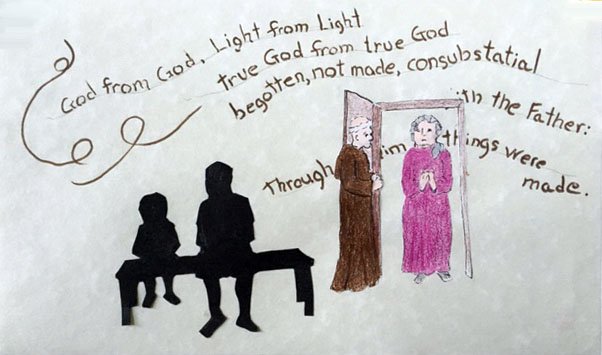
         “The old monk wrote, ‘Your daughter-in-law is gracious but she seems cautious of strangers, especially this one wearing a monk’s robe and tonsured.  She assures me that whatever else I have heard of Ezra’s family she and her children are devout and orthodox. So when faced with me, appearing to be holy man at her door she stiffens for proper clarity allowing no cloud of uncertainty whatsoever, in order to assure me she knows the creed by heart, every word of it; and she said she even knows the beg ottens and cons’…”

         I assist, “begotten and consubstantial”

         “Whatever.” Anatase continues reading, “’Colleta assures me, no matter what I may have been told by Ezra’s papa this family is Christian. And you know, Laz, my friend, she may not have any knowledge at all of the substance of God but she does know you very well, and she truly wants me to be sure to know she is not at all a heretic like you.’

         “You are reading all these words well, Anatase, keep going, I’ll bet it will get more interesting for you.”

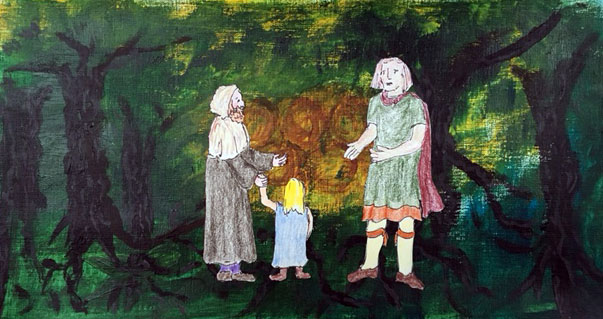
         “Yes this is the part about the children. He writes, ‘Colleta tells me the last time you were here, little Margey was still a suckling babe, and Daniel was only a knee-high and Celeste, was just learning laundry chores. I first came up here three years later than when you were last here and Margey was a toddler, fast on her feet in those days and little Daniel was visiting your daughter Eve for reading lessons every day. Ezra thinks Daniel needs to know how to read to deal with land grabbers and tax collectors who use a farmer’s ignorance to steal away their land in these times.’

         Anatase interrupts her own reading. “It’s hard to think of Celeste and Daniel as children. And does he mean to say my teacher could read back then? And who is Margey?”

         “Maybe Nic will tell us if you read on.” 

         But now I find I myself fearing these same unknowns. In these pages before us there may be sadness. Maybe these pages shouldn’t be read by this child’s voice. 

         So I asked Anatase how she came to be living here. 

         “Well,” She begins her own story, “When I was four…”         

(Continues tomorrow)

Post #20.7, Tuesday, May 18, 2021

Historical setting: 584 C.E. The garden of Eve, pagan healer

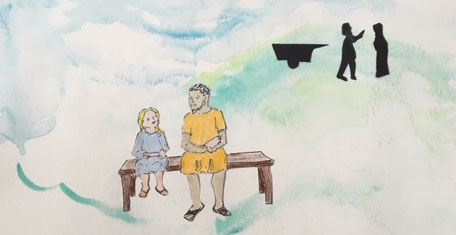
         Everyday now, I find I’m stronger and more useful. First I was able to do normal things for myself. I could eat at the table with the others, and now in this season of the fullness of springtime nearly into summer I am able to help Anatase and Eve with chores so there is more time for Anatase to read aloud from the pages left by Nic.  Eve calls it the reading lesson when Anatase and I sit outside on a bench in the garden and Anatase unrolls the bundle of trimmed off ends of parchment on which Nic lettered his journals of these missing years.

         Anatase said she wasn’t living here yet when Nic came up the first time. With her being only eight-years-old now, I mention she wasn’t even born yet. That makes no sense to a child whose lifetime in her mind is all of known time. No wonder it’s a youthful thing to believe life beyond death is an unexplored truth; then history, even with its indelible imprint on our physical world, seems only a fabrication. Of course, believing in history does require imagining those who went before us then mustering our empathy for another’s mortality. So she dutifully reads Nic’s explanation of laying out strips of linen in the shape of a man next to the very gravestones I once heaped onto Susanna’s grave myself. Anatase drudges through the squiggles of letters word-for-word to tell how Nic created the dome of wattle and daub as the sepulcher we have all seen torn away so recently.

         Anatase much prefers reading Nic’s words about meeting my family here when they were so young all those years ago. So that is what she reads today.

         “Page 2, Your Family.” He wrote about what all these people were like in the old times when he first came here. He said, ‘Your son Ezra is a true master of the vineyard here. Every decision made – from where to plant the yellow flowers I brought, to the perfect placement among your family graves for your rem…[peach pit] – all have to be approved by him and he is really too busy most of the time to bother with this guest who I am. Mostly while I’m awaiting Ezra’s various permissions, I’m sitting at his house and being hosted by the matron of these peasants, Colletta. Yes, your daughter-in-law is gracious but she seems cautious of strangers’.” Anatase adds,  “He didn’t know about me, or Celeste’s children then. This page must be very old.”

(Continues tomorrow)

Post #20.6, Thursday, May 13, 2021

Historical setting: 584 C.E. The house of Eve

         “First Page: ‘How I saved your bones for you to use again’.”

         Little Anatase is reading the journal pages that Nic left with her so I would know things when I awoke all these years later.

         “He wrote, ‘Brother Laz, it was a very bad start. You were a foot under a huge stone and those who sorrowed with me could only see it as a memorial to the dead. When I was finally able to retrieve the rem…n-a-n-t’”

         “remnant” I intrude into the child’s reading. “You’re a good reader Anatase, but that’s a strange word.”

         “Remnant?” she asks.

         “It’s like a peach pit, the leftovers that could become a tree if planted.”

         “Oh, I see. So he wrote, ‘When I was finally able to retrieve the [peach pit] there was so little left of you. I wrapped your [peach pit] in your cloak and put you in the cart. I was able to borrow a horse collar and reins, and it turns out your brown horse was willing to dress up for the work of towing.  We would have made much faster time coming this far had we known the brown horse would pull the cart. But then you would have had to ride the ox.’” Here, now a burst of laughter from this young reader.

         “The old monk was so funny.” She adds.

         And together this child and I grieve for Nic’s simple humor. Such a strange mix of joys and sorrows is grief.

         “’I left The Rose in Bordeaux. When I pulled away I think he was concerned I was leaving him for another.’ Who is this rose?”        

         “The Rose was the name of his horse.”

         “Oh, he goes on. ‘At an easy trot it only took two days to get to Ligugé where I left the stone woman and I met the abbot. I told him I would return with the others when Brother Joel was able to travel. He was grateful for the gift of the mother and child and said Christian art is a popular addition at some of the new monasteries in these days but more often the images are even on both sides and dressed up in finer garb.’

         “Is this interesting to you, or shall I skip some of these pages.”

         “It’s best to read it all.  But if you are tired of reading now, we can do this another time.”

         “Thanks, I think I will play my flute for you.”

         “That will be fine.”

(Continues Tuesday, May 18)

Post #20.5, Wednesday, May 12, 2021

Historical setting: 584 C.E. The house of Eve, pagan healer

         Now every rising is grief. It was Nic who understood my circumstance of life and life again and he noticed that would give me so much practice in loosing loved ones I would become “good at grief.” I assured him no one is “good at grief.” And now his death has proved me right.

         Dear God, please don’t allow me push aside my remembrances of our good times in all this hurt. Keep me opened to the shared spirit so his friendship will deepen and sweeten all friendships that may come for me ever and ever. Give me strength not to bury my good thoughts of him just to save myself the tears. Help this hurt become the stretch of new healing. Amen.

         Yea, I’m not good enough at grief to make that a true prayer from my heart. For now it’s just a pale aspiration.

         My real prayer, Dear God, stay near me in this sorrow. Amen.        

         The tray placed by me is a rich feast for a morning meal. I expected fresh bread because the yeasty scent through the house last night told me Eve still takes her sorrows to the kneading board. But these foods speak also of hens and a nanny goat.

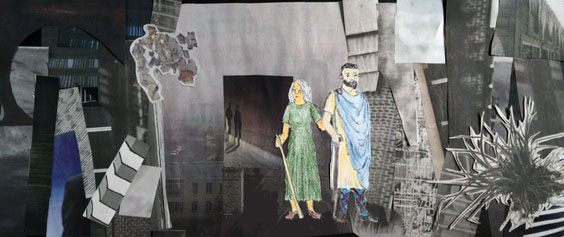
         Today I’m able to rise from the bed myself and to stand with no one guiding me on these quivering legs. Nic’s cane has been left near, so now I have the new superpower to rise up and walk just as Nic’s spirit is taking flight. I wonder if the feathers of his wings are in rainbows as I’ve seen in the paintings of Gabriel or simply in pure pale.

          Eve and Anatase are outside in the new, hanging out linens in the sunshine. Anatase with her little scythe has shorn the tall herbs and grasses to nubs. Now the breeze can’t even flatten the grasses as it passes by showing off the great footprints of the invisible master of all that grows green.

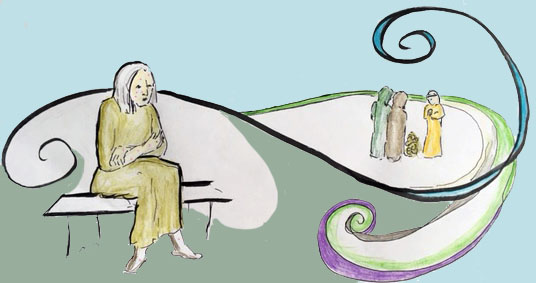
         Anatase finishes her chores and hurries in taking a seat on the bench next to me. Whether it’s the flute or the pages I’m happy she’s here.

         “I shall read for you from the pages of the old monk.”

         “Thank you Anatase.  I look forward to it.”

         “How do you know that? You don’t even know what he wanted you to hear about in all those years. Maybe you will regret. You don’t know.”

         “You are right. So read it to me.”

(Continues tomorrow)

Post #20.4, Tuesday, May 11, 2021

Historical setting: 584 C.E. The house of Eve, pagan healer

         I see Anatase has cut bundles of herbs with her new blade, and as they are leaving she nearly smothers Nic’s body for his journey to the burial.

         Dear God stay close to Nic on this long journey. Amen.

         Now Anatase is sitting here by this bed wafting with sweet fragrance of herbs, grinning with a child’s pride of accomplishment.

         “Now I know when I am supposed to read the old monk’s papers to you. It is supposed to be now that he died, just as he said it would be.”

         She brandishes the gleaming scythe still in her hand.

         “Be careful with that!” I warn her, as though I were a trustless elder.

         “This was a gift just to me from the old monk. He had his iron shirt and his sword hammered into a plow blade and a hoe for my teacher’s gardens when he was first coming up here.  Then when he found me here he had his dagger made into this little scythe so I could cut the herbs clean from their stems, and also root out the weeds. He taught me to use it to cut grasses and herbs and bundle them into sheaves, and then he showed me how to sharpen the blade so it is always ready when I need it. Did you see me today when I needed it to cut the herbs?”

         “I saw.”        

         “The old monk said Christians who follow Jesus Way might do for the dead as Nicodemus did for his friend Jesus. He said the man in the Jesus story brought one hundred pounds of herbs to the tomb of his friend. So, don’t you suppose I cut at least a hundred pounds of herbs for the old monk?” [John 19:39]

         “At least.”

         “He told me that when he brought you up here he didn’t need to cut the herbs from their roots for you because you would not ever be stinking of death; and so he decided to put you in our garden with all the living herbs. That was a good thing wasn’t it, because here you are alive.”

         “Yes, a very good thing. Thank you Nic.” Thank you, God.

         Eve is at the door. “Anatase, please let him rest now.”

         “Of course. When you are done with resting I will bring the old monk’s pages and I will read to you.”

         “Thanks Anatase, I’ll be waiting to hear it.”

(Continues tomorrow)

Post #20.3, Thursday, May 6, 2021

Historical setting: 584 C.E. The house of Eve

         I see that miss-fit white tunic so carefully stitched by my daughter-in-law’s rigid fingers of orthodoxy. It’s folded neatly by the door ready to be returned to its maker, Colleta, with my rejection.

         “Wait Eve. Let us slide the white tunic over his arms. It will help support his groping stiff limbs folded over his heart forever in prayer, at least until his spirit wanders off.” And of he will need the gapping back for his wings were angels really beset with wings, as maybe they are.

         So Eve and I dress Nic as an earthly notion of angel preparing him for his flight into God’s embrace of forever. Surely Nic’s spirit will smile when the abbot unties his woolen robe and finds him fit out in the fullness of angel as I always knew him to be. When the abbot speaks the eulogy and echoes the psalm everyone who listens will know he was, for this friend who knew him well, the true patron saint.”

         When did it happen that all saints are dead? When Paul wrote of saints he was naming living people. So did saints become always dead when the first saints died? I know the naming of saints wrankled local bishops who argued over the power to bestow. So now it seems the rule of the Church that all saints must be dead and they best be martyrs. Dead saints isn’t a teaching of Jesus or Paul, or even a God thing. It’s a Church thing [Footnote] offering the added assurance that no saint may yet sin.

         Ezra and Daniel are here to take Nic’s body back to Ligugé where he will be buried as he always wished. I can only sit on the bench and watch out the door as they take him. And now, there is little Anatase with a new gleaming scythe cutting bundles of fresh herbs and filling the wagon with the fragrant bouquets.

         Daniel comes back to walk with me back to the place I’ve been assigned by Eve.

         “Thank you Daniel, but please know, I will soon return to my full strength and I will be useful to you and your papa.”

         Anatase comes in completely fragranced in rosemary and lavender buds.  She sits down by me to tell me what she has been up to.

Footnote – The Fourth Century need to standardize canonization of saints is well-documented and easily available in Wikipedia.  https://en.wikipedia.org/wiki/Canonization#Historical_development

(Continues Tuesday, May 11)

Post #20.2, Wednesday, May 5, 2021

Historical setting: 584 C.E. The house of Eve

         While I am sitting here on the edge of the bed ready to dance the celebration of this healing Eve is in the doorway preparing a bed of sorrow.

         “Are you awake Papa?”

         “Awake? Yes, and I am sitting here on the edge of the bed, ready to bound into a full life very soon.”

         “Papa, last night when the fire went to embers I heard a sigh from your friend Nic. I went to take him a cover for the cold, and I found the breath had gone from him.  I didn’t wake you then. There was nothing to be said or done. I sent Anatase to bring Ezra and Daniel with the wagon so they can return him to the monastery for the prayers and the burial. It is where he told us he would be buried if he didn’t live for your waking.”

         “But he did.” Thank you God, that I am able to see him off from this earth and into your hands.  “I’ll go with them to help with the burial.”

         “No, Papa. Ezra and Daniel have plenty to do as it is.”

         So, I won’t be a help to them. “I understand. But let me help you prepare him for his journey.”

         “Very well, Papa. Let me walk with you to the bench that is beside his bed.”

         And she is right. Today I still need a person walking with me, even though I can nearly stand alone now, and I’m so strong I can nearly not crumple to floor with the pain of it all. Were Eve not my strength just now I would surely be slithering along the earth. It is an arduous journey all the way to the bench near the fire where I see Nic is sleeping in the tranquility of his newly found place in death.

         My beautiful daughter, a healer, though now blind, has memorized every motion of filling a basin, gathering cloth rags for washing the body, and preparing everything that is needed then bringing all these things to this bench for me to have a part, spilling not a drop.  As I do the motions of this preparation I thank Eve for thinking of my need to help. I can do this for my friend. She prepares now to dress him back in his monk’s garb, but wait…

(Continues tomorrow)

Post #20.1, Tuesday, May 4, 2021

Historical setting: 584 C.E. The house of Eve, pagan healer

         A long night of sleep into this waking with graying skies, and now it is late morning.  Yesterday I was listening to Nic talking on and on to let me know I’ve returned to a world of ever-changing human life. Thank you God, for allowing me to be alive while splayed onto this bedsheet in the stillness of listening. Thank you God for such a friend as Nic who is telling me of this world I was returned into alive again.

         Today, I am able to move, thank you God.  I can move my mortal human form as was intended in creation, stretching now a hand and a foot and one-by-one each part of me once nearly bare bone, now a new painful stretch of sinews forming.

         I’m thinking of Ezekiel seeing the valley of all the dry bones. Was it an ancient war? Was it just a time forgotten? Why was it so distinctly a valley? Or was it a plain that felt like a valley? Was it his valley alone with a whole earth of dry bones? Human spirit wanders the valley we see and touch and long to find the Spirit of universe in the pain of stretching in a way of growing anew.

         The prophet doesn’t mention the length of time it takes for the sinews to return to the bones, for the breath of life to be shared among those rising up, for the stretches and the pangs of new life to howl then sing, then rise and dance. Why did the hand with the inks copying these pages of Ezekiel’s valley for us to read in this new day fail to keep the part about the pains of each growing into new strength — the rising first on elbows only up from the clay and then to sitting on the edge with new strength barely noticed, but rising above the dust cloud. Was there no word left in the story telling us it was a very long time to wait before the dancing? Rising is so slow and painful even in the meager measure of human years.  Healing seems to make itself a story with too slow a plotline, an eternal continuation, an ox journey that needs editing …

         Eve is in the doorway with a sorrowful continence.

(Continues tomorrow)

Post #19.13, Thursday, April 29, 2021

Historical setting: 584 C.E. The house of Eve, pagan healer

         “Yes indeed,” Nic goes on, “the world has changed. The Church has changed. Even life in a monastery edges toward a standard practice now. And it isn’t about the Jesus words. We still copy the same words of gospel over and again perfectly in the changeless vernacular of St. Jerome. We shape each letter of it for every wealthy church patron who can sponsor a bible. The bible stays the same but the world skews anew.  I’m too tired to tell it again after I wrote it in those pages. I thought you needed to how to fit into the world when you awoke. I didn’t think I would be here then. And anyway, I’m too tired to tell it all just now. Please, dear Brother, stay close to God for ever and always.”

         He didn’t hear my “Amen.”

         Eve listens nearby and has come to take Nic to the place she has prepared for him near the fire so he can rest.

         Alone now, my prayer pours from spirit in a thundering deluge of thanksgivings.

         Dear God, thank you for staying near me in this time of strange reunion. Thank you for the generations of my family, here and forever. Thank you, especially for such a good friend to let Jesus love be our bond even greater than his Roman military lessons teaching fear and calling it hate of the Jews like me and like Jesus. These are so many redundant thank you’s cascading from my thoughts of Nic. Thank you for the life gifts even to the mortals, and for the strange welcome back to life with people who once loved me are trying to hobble love together just now. And need I tell you, I noticed Ezra’s wife Colletta, is still struggling with metaphor in her Christian faith. She made an angel’s robe for my rising. It’s not sized for my earthly bones and has a huge gapping space for wings I never expect will emerge from my mortal again meat of man. She set the arms in upside-down, so I could forever raise my arms in praise, or be flying. She hears of angels and has no mind for spiritual metaphor – then an artist who brings metaphor to literal image plasters a winged angel unto a wall of a sanctuary and Colleta believes angels have this exact visage. Thank you God for the inspiration for her plan, for all of this and everything more. So be it.

(Continues Tuesday, May 4)

Angel’s clothes, metaphor, artist’s imagination, family love obligations, inspiration, changes,

Post #19.12, Wednesday, April 28, 2021

Historical setting: 584 C.E. The house of Eve, pagan healer

         Nic is telling me how my bones were saved from a forever memorial under the stone that fell.  He rambles on, “August tried using the winches adding to them the stronger pulleys retrieved from the crane arm but to no avail.  So on the third day he had the stone-cutters split the stone in two to managed with strong men and winches.  On the fourth day we found you were indeed badly crushed and broken into uselessness like the crane was also. If you don’t mind me saying it so bluntly, you were very definitely dead – though not stiff with death or stinking yet.  That was the surprise. We all thought you would be stinking by this time.  There were all sorts of theories flying around about how come you were not stinking after four days dead. No one believed the ‘Lazarus theory’ even though your own blood sisters had the same wonder back in the day. [John 11:39  — best from the KJV for the use of that rare word “stinketh”]

         “We were able to remove what was left of you. I wrapped you in your cloak and laid you onto the cart next to the lady of stone. Brother August wasn’t pleased with that. It was his cart and it was messy. I knew enough to bring you up here, and we didn’t have to travel at ox speed.  It seems your patient brown horse was willing to wear a yolk and harness. I made it in good time while everyone else in Bordeaux was worrying over the broken crane wheel. That heap of wooden crane curves never did heal in all these twenty years. The new basilica never rose to the heights of the older Roman buildings. The whole world it seems is coming to grips that the empire has indeed fallen. Well, except for the pope in Rome who is still battling Arian heretics. I wrote all that stuff in some history pages I gave to the little girl, Anatase, who is as good at reading as she is playing the flute.  I thought she could read you the events of these years when I’m gone.

         “And I have to tell you, my dear friend and brother, when I am gone, I promise I will stay gone. I won’t leave you all with near on a two decades of hopes and wonders caught in a limbo between the possibilities of death-stench or life-stench.”

         I speak my apology. He doesn’t hear me.

(Continues tomorrow)