Post #17.7, Tuesday, February 16, 2021

Historical setting: 564 C.E. The Gaul Side of the Pyrenees

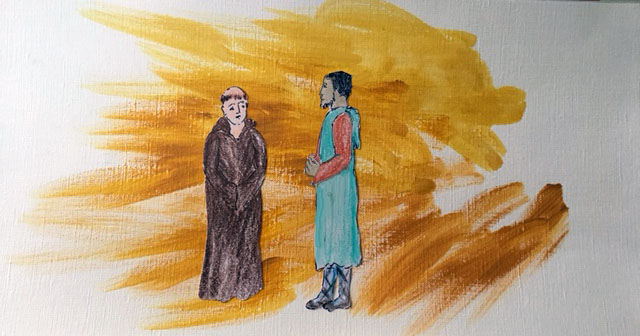
         We are trying to decide if we should take Brother Joel on a day long ride in an ox cart to find a city with a surgeon, or if Nic should just apply his blade and skill and take this man’s agonizing dead foot from him right here and now.

         Brother Joel answers,  “I am willing to try both things you’ve offered. Your kindness has let me know I‘m ready to leave this solitude here for a time of physical healing.  So let me try to manage the ride to Bordeaux and if I cannot endure the journey, I will beg the cut of your blade, Brother Nic.”

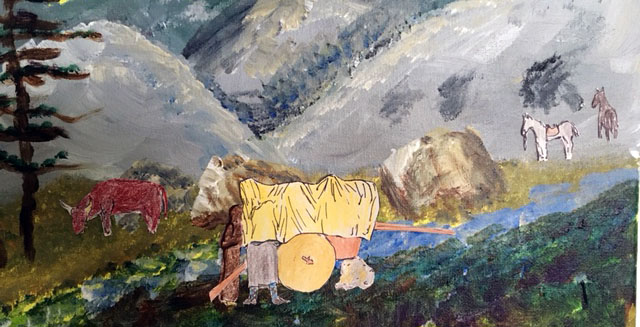
         So we set out on a day’s journey to Bordeaux now with August and the ox first and Nic walking, leading The Rose behind the ox cart in order to keep a watchful eye on Brother Joel who is lying next to the cool stone of the statue of the mother in the cart.

         I’m left to be the scout, escouter, for our direction ahead so I gather instructions from August to follow this creek then turn west at a larger river and follow that river into the city.

         Umber seems grateful for a faster pace so our ride alone has a welcome freedom though my heart and my prayers are with the others. There is always that tug between solitude and belonging with people and it isn’t just for the ascetic monks living as hermits in wilderness places. I seem trapped in the paradox of longing for the tranquility of isolation then when I’m alone, I yearn for the company of others.

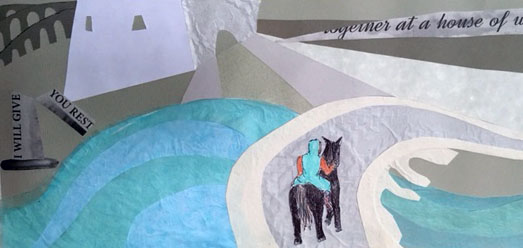
         I’ve only followed the larger river a few miles to the west when I come upon an ancient Roman bridge spanning this widening meander in this otherwise empty place in sight of an ancient city wall. This crumbling bridge has endured centuries of wars no doubt. Surely any booming civitas has shrunken away from this edge of city wall as the roaring numbers of urban humans has been shrinking over the years with each war or round of plague.

         I take the dare and test the strength of the bridge, first on foot, then on horseback.  I’m sure this bridge can maintain the weight of the ox cart in case I would find no other bridge to take us across to Bordeaux.  And now I see there isn’t another bridge so this is where we will cross.

(Continues tomorrow)

Post #17.6, Thursday, February 11, 2021

Historical setting: 564 C.E. The Gaul Side of the Pyrenees

         On this new morning even the most magnificent beams of dawn can’t pale the long darkness we’ve spent. The elder monk lay the whole night in the place August prepared for him in the bed of the cart, driven, as he has been, back from death into life by raging fever. August sat with him, Nic and I prayed quietly with whispers yet our prayers were heard easily because God’s Holy Spirit hovers close by, and now the elder monk has set his face this morning toward the continuation of his tangible, physical life. The elder desert father has more clarity than fever this morning.

         Thank you God.        

         He tells us he is called “Brother Joel.” We can see that if he would choose to continue on his humble walk with God he will surely have only one physical foot to walk upon. He tells us what we feared we would need to tell him, that he may loose his foot along this way.

         August knows of an ancient Roman city on the path before us. “It was once a Roman city and now the Franks are rebuilding it and calling it Bordeaux. The Frankish kingdom is asking the church to name a bishop so that it may become the whole archdiocese of the Frankish kingdom.”

         I know something of this land. “I doubt a Frankish archdiocese could ever find root in an earthly city like Bordeaux when the great power of the dead Saint’s relic are ever beckoning Christians to Tours.”

          “I’m just saying,” August explains, “Surely in a city we will find a proper surgeon who can see to the needs of Brother Joel. We could be there before nightfall. I know this path we are on and that city is very near.”

         Nic draws his dagger. “If a day’s jostle in the bed of an oxcart  doesn’t kill him, surely a stranger’s blade would. I have a soldier’s training and years of observance of these things; and Brother Lazarus has proven himself an adequate craftsman at making a crutch from a stick of wood. If we did this here and now, he can heal in his own familiar cave. We will stay with him until he is able to fetch water for himself.”

         So I ask the subject of this debate, “What do you say, Brother Joel?”

         “I think with your kindness and the grace of God I shall have it both ways.”

         (Come again Tuesday, February 16)

Post #17.5, Wednesday, February 10, 2021

Historical setting: 6th Century Gaul

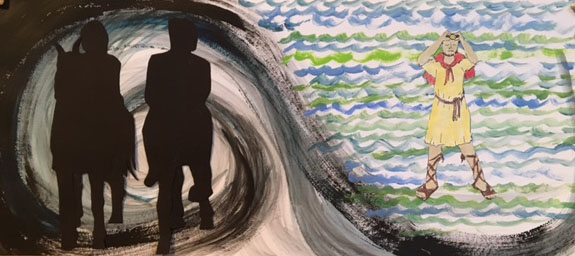
         The monk we have found in his cave near death whispers to us of “thin places.” What does this mean? Explanations of thin places are only spoken through whispers as poetry.

         One preaches of the thin places she noticed in a story of Elijah. She said, “Sometime you might hear the mystics talk about the thin places. Thin places are where the boundary between the spiritual realm and the physical realm is so thin it practically disintegrates. Thin places … [are] the marshy edge that runs along the shoreline between the beach and the sea. … In the thin places, earth spills into heaven, and heaven spills into earth. In our own lives, the thin places make us tremble with their beauty. But watch out! These are the very regions that harbor the precariousness between, between life and death, so there’s nothing safe about them. It’s no wonder they make us tremble!” [footnote]

         Nic lays this withered ancient man over his outstretched arms like a precious child found sleeping in a place where people are to busy for quiet, and he brings him down the hillside to a soft fleece laid into the narrow space left in the oxcart right against the stone mother and her child. Nic looks across the cart, passed the monk and the stone mother and her child toward the stone carver and he asks August if he has ever known of thin places.

         “That’s what I was seeking when I left the cities with all their constructions of churches made of thick stones of earth. I left my family and people to find the edge between earth and spirit. It was something I thought was always somewhere I wasn’t. So I went away into the clay cave seeking solitude.” August asks for his own answer. “Is a cave what you would think was this thin place the old monk mentioned?”

         Nic is thoughtful in his answer too.  “So it is something you would look for somewhere else from where you are?”

         “Yes, I would say when I was looking for it, yes. It always wasn’t where I was. Until, it was all there was. So I made tools of iron and the hardest rock and went back to my craft of chipping away at earth stone until it was spirit, too. As an artist, a sculptor, I don’t know if the art is holding on to the tangible, or letting go of the rock that hides the Spirit.”

         The old monk spoke again. “It is the wonder between.”

(Continues tomorrow)

[footnote] The preacher? Rev. Mariah Marlin-Warfield from a sermon delivered to the “Church of Peace U.C.C.” on November 1, 2020. This blogger is celebrating the beautiful, trembling, thin place of that preacher’s birth on this date in 1980. Thank you, Dear God, for all this time I have to see Mariah grow from infant to woman.

Post #17.4, Tuesday, February 9, 2021

Historical setting: 564 C.E. The Gaul Side of the Pyrenees

         August investigates the deeper of the caves in the steep bank of the river. He takes a lit lamp and the alms the villager gave. Now Nic and I have been waiting here, and August emerges with only an empty earthen water jar.

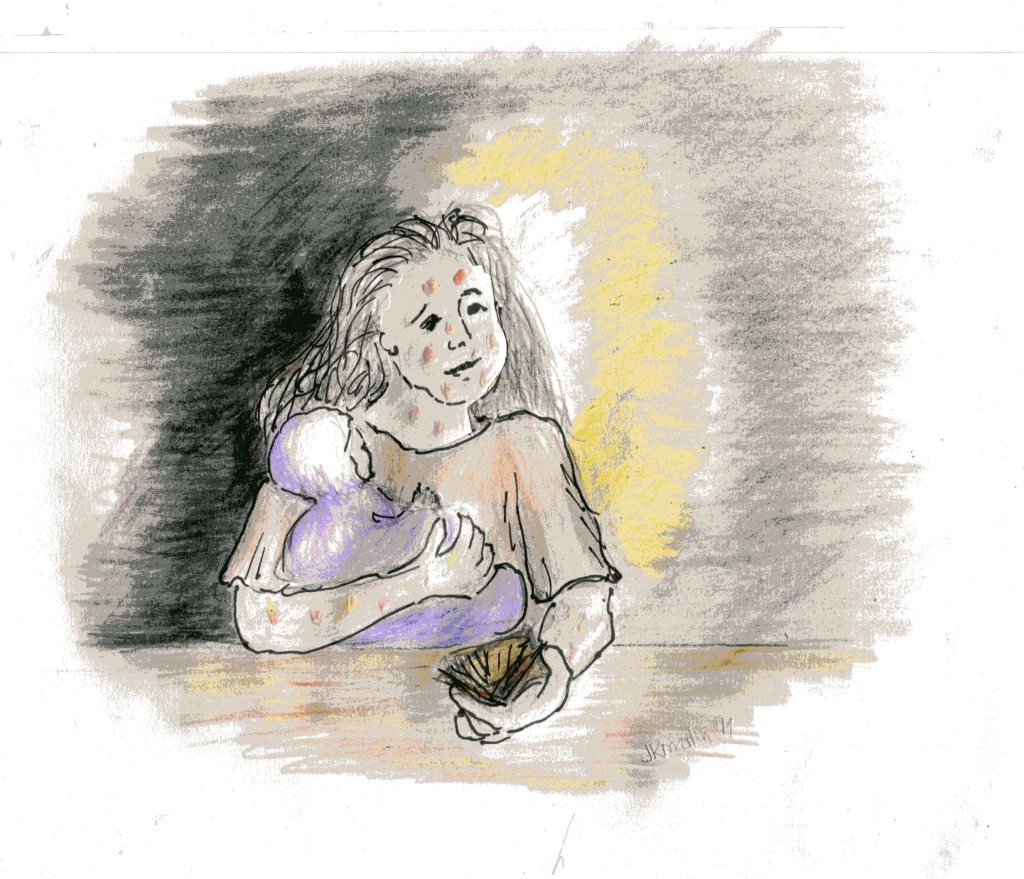
         “Brother Lazarus” August reports, “Those shoes you made are too small. The monk’s feet are already darkened from the freeze though all the rest of him is the pale of death. His body is sparse and thin but still the shoes would not cover his feet and he needs warm shoes. At first sight I was sure his soul had long fled the bones so I covered what was left of him in the wool. I thought I was wrapping his body for a burial, but then he stirred and then he shivered. He was sleeping nearly breathlessly as in a deep trance of prayer. So when he awoke I offered him a sip of water from a cup I found nearly empty. He was grateful, and said his feet could no longer take him down to the creek and he asked that we fill his jar before we travel on.”

         August adds that he thinks we need to bring him out of the cave and take him on with us to the monastery where he can get proper care for his damaged feet.

         “Is that what he is asking?” I wonder. “He might be one who seeks spiritual perfection in abandoning the physical world, so placing him in a oxcart for a long journey to find physical healing would only intrude on his spiritual journey even if it takes him beyond this earthly life.”

         “What are you saying Laz?” Nic argues, “that we leave him here to die alone simply because he can’t walk to the creek for water?”

         “We need to ask him.” August offers that pragmatism and goes back into the cave with Nic following close behind and now I choose to follow also.

         While we are deciding his need the monk has pulled himself closer to the front of the cave, so when we find him again he is hiding his eyes from the glare of sunlight beaming into the entrance. Having heard our conversation he is ready with his answer. Now I can see I was quite wrong to suggest he would choose to abandon his bones to nurture spirit alone. He spoke of the thin places but not of death or even of a heaven without earth.

(Continued tomorrow)

Post #17.3, Thursday, February 4, 2021

Historical setting: 564 C.E. The Gaul Side of the Pyrenees

         We’ve walked all day in search of a particular cave said to be dug into the bank near this creek. Nic scouted out the river bank  ahead of us and said he did locate some caves a few miles ahead but they seem uninhabited. At least we know we have a way to go yet. So we choose to pitch our tarp and make the night fire now rather than go on. There is still a bit of daylight and a ruby sunset with a promise of a good day tomorrow.

         The promise is kept by the old adage of red sky at night. It is indeed a beautiful morning to continue our journey to Ligugé, and more immediately our search for a monk in need of the alms the villager has provided.

         It is still morning when we reach the abandoned caves Nic told us were here. Here we stop to investigate for signs of a monk. There is a pale silence about this clay bank. Three caves are dug into the hillside. One of the caves has rubble and rocks pushed across the entrance, a common way a cave is sealed at the discovery of a monk who has passed away. We approach the second cave with reverence and trepidation. It’s a shallow dig, containing nothing, probably the source of the rubble in the first cave.

         The third cave is deeper, and investigation of it requires someone to enter with a lamp. August wants to go in alone in case a monk is present and deep in prayer. Brother August goes down the hillside to fetch the alms and flame in the lamp from the embers we carry. Nic and I wait outside. The cave sends out only the fragrance of damp deep earth. There is no smell of death here, and the life smells are only our own, so we guess Brother August surely won’t find a needy monk here or would he find anyone here at all. Even our prayers are silent as we wait. Then whispers echo from the gaping dark hole – sounds in the voice of eunuch or angel or August.

         Brother August emerges from the darkness alone without even the beam from the flame.

(Continues Tuesday, February 9)

Post #17.2, Wednesday, February 3, 2021

Historical setting: 564 C.E. Village on the Gaul Side of the Pyrenees

         Last night we slept in comfort in the loft of the stable. We learn we are now in Gaul.

         I was telling Nic and Brother August of the priest’s message to the villagers who thought the statue was Lot’s wife turned to a pillar of salt in the desert. August enjoyed the twist of story; Nic wonders if we should turn the statue to face front. But it survived mountains and flood why change it? And besides, the villagers needed the Father’s message of Christian duty to care for outcast rather than judge them. If the villagers assumed the stone woman was dauntlessly holy, like the Virgin mother of Christ no one would have mentioned it. It would seem sanctified and out of touch requiring a holy and silent distance.

         This morning one of those who saw our procession and heard the sermon returns with gifts for the “needy desert father walking with the ox.” Along with a small sack of grain the kindly woman brings a cut of black wool said to be a better size than the larger hooded garb the monk is wearing.

         As the villager leaves Brother August complains, “Why is it people are always trying to dress me up in clothes that don’t suit me?”

         I know he is also bemoaning the required shoes. But I’m still glad we are demanding shoes on this icy journey. 

         The priest suggests we take these gifts on with us, and that we look for a particular ascetic, Brother Joel, who is known to live in a cave along the river where we will be traveling. He said a monk came this way recently and mentioned that this desert father in that cave is aged and frail and he may be in need of a warm wool and a supply of food soon. So maybe these gifts have the synchronicity of miracle that was intended by the villager who brought them.

         After our morning prayers and the feast to break the night’s fast we set out on our journey to find that particular cave. Following the river, moving only at an ox’s pace we are not likely to pass by a cave without taking notice but Nic rides ahead to scout it out anyway. By this time when he returns the sun is already sending tall shadows, anticipating dark. He brings news that there are some caves dug into a hillside, but they don’t appear to be occupied.

(Continued tomorrow)

Post #17.1, Tuesday, February 2, 2021

Historical setting: 564 C.E. A Small Village in Southeastern Gaul

         Stopping at a small village church, the stone woman in the oxcart captures the imaginations of villagers who are now demanding the priest retell the Genesis story they’ve heard before – the one where Lot’s wife turned back while running from the mayhem. Maybe it is that we placed the statue in the cart with the mother facing backwards, or maybe it’s just that people like to hear stories of smashing, flaming, punitive, holy justice instead of a promise of a simple mother’s love.

         The priest begins his sermon likening the Genesis dialogue with God and Abraham to the Matthew visitation of an angel to Joseph. How is it a worthy comparison?

         He explains, “Like that Genesis story this begins when God comes, as God does come as an angel or a dream to speak of love beyond justice. In the Matthew story God sends Gabriel in a dream to the carpenter, descendant of that Genesis man Abraham.”

         “No. Tell us the other story! The one where the mob begs to rape the angels!”

         “Tell the story where Lot offers the raging men his own daughters!”

         “Tell us again, how God’s judgment came down on Sodom and Gomorrah as molten rock and ashes crashing down from heaven!”

         “Tell us how Lot’s family ran away but Lot’s wife looked backwards to her old life burning behind her and she was turned to a pillar of salt.”

         The priest answers, “This story begins where God speaks to the earthly father with possibility for reconciliation for those whom the human measure would judge as evil. The human voice of judgment calls for Joseph to break his betrothal to Mary, because she is already pregnant. But God’s question is the same one God asked of Abraham. ‘Who is worthy of rescue’? We remember in this that God loves even the outcast.” The villagers know they have heard a sermon.

         Besides the small size of the oratory space inside the church, the other unusual feature of this place was the very large and accommodating stable welcoming travelers more than it is a display holy artifacts as in a wealthy city’s basilica.

         Nic and August missed this sermon because they were in the stable behind the church putting the animals in for the night. But I was listening.

(Continues tomorrow)

Post #16.12, Thursday, January 28, 2021

Historical setting: 564 C.E. A Small Village in Southeastern Gaul

         The villagers argue:

         “This is no statue, Father!”

         “A statue is an image of an emperor or a hero!”

         “A statue is like a pagan god trapped in the stillness of stone!”

         “Of course we have seen statues, and this is not a statue!

         “This is a common woman!” 

         “See for yourself! This is Lot’s wife, solid salt, always looking backwards.”

         And that is the spirit of the mob now gathering around the carved stone on the cart near the front of the church.

         The father preaches, “Really, my friends, this is not that woman from the story in Genesis! This is a Christian statue cut into solid earthen rock by the humble hands of a desert father! It was made as a prayerful act. But never was it a real woman; it was always stone and now it is art!

         “Listen, now, dear sheep of this parish! You know well Christians don’t worship statues of emperors or idols of pagan gods. We don’t worship tangible gods! Christian art is creative works by human hands though sometimes driven by the intangible and invisible God through inspiration.” The priest’s complexity of sermon seems to pass by their ears, favoring what their eyes see. 

         He continues, “This art is like the songs sung by ancient shepherds that inspire all of us in wars and peace to give us courage and lead us to thanksgivings before the true Creator of earth and heaven. We sing songs and share in poetry with our human voices, our fears, our humor, our imagination, always reflecting our human being as image of Creator. So why wouldn’t an artist share the Creative Spirit with the work of his hands carving stone?”

         One of the mob shouts, “Songs are never of salt or stone, they are like whispers of wind that fade away!”

          “Please, all I am saying is that stone images do not replace the Creator. They inspire us to notice the invisible. And so this image of a poor mother caring for her child inspires our human knowledge that like children we are beloved by God.”

         The crowd still calls for the other story, “So tell us the true story of the woman driven from her home by the angry God. We want to hear of the justice where the fire and ash reigned down from heaven and destroyed the wicked city.”

         “Always you want to hear of the ruin.”

(Continues Tuesday February 2)

Post #16.11, Wednesday, January 27, 2021

Historical setting: 6th Century A Small Village in Southeastern Gaul

         We’ve stopped in this small village to for the night’s. The priest recognizes August even with the hood that covers his face. Their warm greeting includes the introduction of us fellow travelers. Then the priest takes a long ponder in awe at the stone woman and her baby in the oxcart ignoring the curious on-lookers of villagers who gather.

         “So this is what you do for so many months in the mountain cave?” The priest asks.

         “It is what my hands are doing while my heart and my voice are in prayer.” August answers.

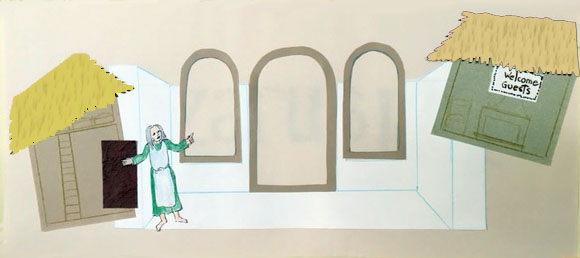
         This church building is barely a stone heap topped with thatch, hardly more than a dessert cave. It has two rooms, one for worship and prayer if the community at worship is no more than four, and the other is the priest’s sleeping quarters. He has no fire center inside so in the back is a wide opening with a covering tarp as a tent would be, and the fire circle is outside.

         I’m tending the fire while Nic and August take our beasts to the large stable prepared for guests and their animals. I can hear the voices of villagers who are now a larger group in front of the church discussing the stone statue.

         Apparently, the people were rallied by rumor that this is not a carving, but the actual woman turned to salt in the desert. I can overhear a mottled piecing of the Genesis 19 story after Abraham and God negotiated the rescue of Lot and his family from the destruction of Sodom and Gomorrah. In recalling the story the villagers have hobbled together their account of the likely sins that wrought this horrific judgment on the towns, but I hear no mention of the part where Lot offers the unruly mob his own daughters in place of his visitors. Its odd the things people remember most. Surely the Genesis story was history told by the ones who lived to tell it without mention of their own sins. So was Lot’s goodness the reason why the wrath of this punitive, judgmental God left Lot’s family living? Were they really more righteous than those who died? When I hear these old stories of the God of vengeance people love to imagine, making the world more just by distributing disasters, mostly they point out some non-descript virtue of the survivors who live to tell.

          The priest shouts above the ruckus. “This is not a woman turned to salt! Has no one seen a statue before?”

(Continues tomorrow)

Post #16.10, Tuesday, January 26, 2021

Historical setting: Pyrenees Mountains, 6th Century C.E.

         Nic is arguing with August over August’s commitment to walk this winter journey barefooted.

         Nic tries another plea. “Possibly you believe that God will see your suffering as a way in which you are superior to your fellow travelers. But because your own frosting toes are not hidden from us it becomes our suffering too by way of our empathy. So you have no virtue in denying us our kindness born in empathy. You must wear shoes on this journey.”

         I try to ease the demand. “You may remove the ermine tails if you wish not to make a display of wealth.” And so he tears the tails from the shoes as he defiantly puts the leathers onto his feet like a two-year-old, disappointed with an authoritative parent overriding his “no”.

         I’m sure he sees our demands as patronizing. It’s a sensitive issue.

         “At least you look to have a man’s feet now.” Nic adds this last word as August stares down at the furs now separating his human flesh from the beloved cold breast of earth – cold earth that would undoubtedly devour his toes in frostbite.

         The winter is hardening as we set our faces again toward the north. The monk and the oxcart with the stone mother of Jesus are in front, and me and my brown horse at the rear. Nic and The Rose stretch to varieties of trots and cantors back and forth often going far ahead of us.

         It is early afternoon when Nic brings news of a small cluster of farms ahead. Here we are finding August already knows this path. He tells us just beyond the farms is a small community that holds a town fair in the summertime. They have a church and the priest of that parish is known to keep traveling monks informed of the well-being of Christian ascetics in this region. So we choose to pass by the farms and go on to the small root of a village.

         The dark of the winter’s afternoon draws us closer together on the road as we come into the village apparently appearing as something of a parade. Villagers come out of their houses to watch us pass by. August is mostly interested in hearing news of others of the lone ascetic monks and is going straight to the church ignoring the attention of the villagers toward the woman in his cart.

(Continues tomorrow)