Post #16.9, Thursday, January 21, 2021

Historical setting: Pyrenees Mountains, 6th Century C.E.

         This icy freeze was late in coming this year, but the flood that washed out the creek we followed sent the three of us wet and shivering, waiting for our wools to dry and giving us time to scrape the leathers and mend the fabrics. The various small furs we have gathered along the way are cleaned and patched together to give extra warmth to our clothing. I stitched a pair of shoes for August with ermine tails for trims. But of course I suppose such luxury is an offense to August’s holy commitment to poverty and personal suffering.

         I can understand fasting as a spiritual practice. I do practice the fast at times when I feel sated in earth’s abundance and numbing to the spiritual. It’s a natural suffering that when done prayerfully encourages empathy for the poor and enriches my prayers of gratitude even for small portions. But when it becomes a display of unction in order that I may stand apart as superior to the community of Christians sacrifice separates me from true prayers to God and honest love of neighbor. I was blessed to see Jesus’ example of this, personally. [Luke 5:16 for example] And I know there is only a slender thread between true spiritual practice and an outward display of righteousness. Yet this narrow edge is always visible to God even when it is hard for human eyes to see. And surely, no human can be a worthy judge of the motives of another’s spiritual practice. So who am I to say that God doesn’t love the bare feet of August walking in the winter snows? Perhaps the freezing of the feet is a true sacrifice and it’s possible it brings August into the divine presence in a way Nic or I could never know. While I am cobbling together an analytical acceptance of the bare feet, Nic just issues an order.

         “August, you are not alone with God in your cave just now. You are part of a journey of the three of us so you are in community with others who are also bound by the love commandment. Lazarus has stitched for you some warm shoes. You must wear them.”

         “My bare feet are not for you to judge. It is something between me and my God.”

         Nic argues, “My God is the same God you are calling your God and that God calls us to care for the suffering of others.”

(Continues Tuesday January 26)

Post #16.8, Wednesday, January 20, 2021

Historical setting: Pyrenees Mountains, 6th Century C.E.

         This campsite we made in the haste of rising water will serve us well for a few days while the wools dry and the small furs we have gathered can be soaked in herbs and scraped and pounded clean for use or trade. A newly formed spread of the creek into small ponds is now filled with some large fish trapped in the flood so we feast on fish.

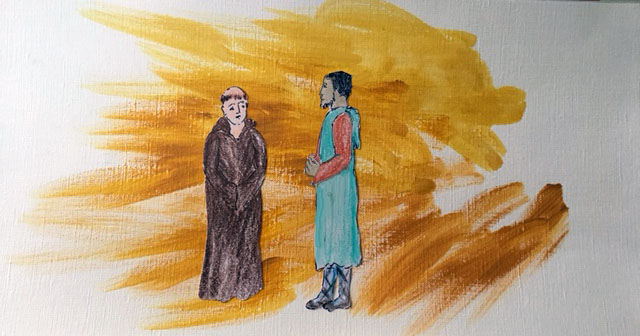
         Nic offers August his suggestions for remaking the robe. It’s obvious August feels misunderstood. August takes a pause before responding to Nic and leans in towards the campfire poking at the flame with a twig.

         “If it’s suitable for a man, it’s suitable for me,” August says. 

         Nic misses the point completely and offers a naïve soldier’s thoughts on remaking the robe into a garment he explains as “more suitable for a woman.”  He lays out the fabric on the ground with a cinctured waist and strangely bold pockets for some imaginary gigantic breasts between the arms as only a chaste soldier could imagine a woman. 

         My loud laugh at Nic’s idea of woman is clearly inappropriate as neither Nic, nor August thought a strangely breasted monk’s robe was funny. My guffaw, and August’s silence and clenched jaw lead Nic to offer his defense.

          “But you’re a woman!” Nic is clearly confused.

         August answers with empathy for Nic having encountered this kind of ignorance before and maybe even with less accepting company. “Only my body is of a woman. I’ve been living a man’s life since I was a child and have always been more comfortable this way. Tailoring my robe into a woman’s garment would make others see me as how I am physically defined, not who I am as a person and how I see myself. Aside from the complications of living a monastic life as a woman, people would treat me much differently if they perceived me as such. That is not what I want. Regardless of my body, my soul is a man’s, and I give grace to God each day when I affirm that.” [footnote]

         Nic offers his pensive awareness. “I surely know what it is to have the soul of a monk clad in the armor of a soldier. I just never thought of the soul of a man, a stone carver, a monk with the physical person of a woman. But clearly it is so, Brother August.”

[footnote] Thank you Vic Heitzman, for writing August’s words into this conversation.

 (Continues tomorrow)

Post #16.7, Tuesday, January 19, 2021

Historical setting: Pyrenees Mountains, 6th Century C.E.

         This morning the creek is slowed, the flood withdrawing, but we will have to wait a little longer to scour the tangles left after the washout before we can search for August’s wools.

         Waiting here by the fire August tells of his life.

         He was set free to be who he is by a fearless and loving family who would surely need to receive news if he were washed away in a flood. The monk tells us of a childhood, always at one building site or another as his father was an itinerate craftsman — a carpenter who helped set up the crane for lifting huge stones. In these times, the stones being laid are the walls of churches and monasteries.

         August says he has a twin sister, nothing like him. But he was the first born accepted as a son into his family of mostly. As firstborn, August believed his father was particularly proud of him. He went with his father to the work sites and watched the various craftsmen at their tasks. He tells us as a youth he observed creative human hands working with stone and wood. And at the same time, these work places were the holy places where the voices of the monks echoed the psalms and prayers of ancient worship. As he explains it, his childhood was “fully blessed with the magnificent mingle of earth-stuff and Spirit.” This creative bond – earth and Spirit  — became his longing in life. And so he became an artist in stone as he committed his life to holy purpose.

         The receding creek waters reveal a great unraveling of land debris and water’s dregs twisted together in muddy dams now re-shaping the diminished flow of the creek. We walk creek-side, downstream in search of the robe. Nic has his sword drawn and is using it to turn over debris bundles in the murk. He retrieves the carcass of a marmot to rescue the fur; then he sets free a rat still tangled in debris. August goes ahead of us and reports a glimpse of the robe attached to a tendriled root stuck mid-stream. Wading into the creek Nic is able to retrieve slathers of waterlogged wool. It appears August will be borrowing my cloak for a few more days. Meanwhile I’m warding off the shivers with the fleeces we pack along. Maybe marmots have warm fur also. We’ll learn of that soon.

 (Continues tomorrow)

Post #16.6, Thursday, January 14, 2021

Historical setting: Pyrenees Mountains, 6th Century C.E.

         Add a deluge of rain to our tendril of a creek and now it foams and roars. It is well out of the banks, and surely it is a very deep river even as the storm lets up.  We decide to set our camp on higher ground in case the water rises further; then we can go in search of Augusta’s monk’s robe whenever it happens that the water recedes back into its banks. We make our night fire, even though it is early yet. We have a pot of porridge for our meal. Now that she is known to be a woman, Augusta joins us for this.

         I mention that I have known of women ascetics before, often hiding gender and identity in men’s clothing in order to escape a brutal father or a wrong marriage. I ask Augusta if she is in fear of being hunted by her family. We really need to know if there is danger now that Nic and I know her secret.

         And she says she also knows of some of the desert ammas who dress in men’s clothing to hide their identities in order to start life anew.  She said her own spiritual guide was a woman who wanted to live in the caves of Tours in order to be near the Shrine of the Saint, but her father found her and returned her to her family near Chartres. Eventually she escaped and once again returned to Tours. [Footnote]

         Augusta explains she isn’t one who must run away from her family. It’s more like she is walking toward the life she is called to. And she asks us to call her “August.” So we will. August says he dresses in a man’s robe because that is what he believes is his holy calling. Of course all three of us can easily imagine the inconvenience of visiting Antton’s quarry as a woman who cuts stone. His banter would be relentless. But August wants us to know who he is. And now that we can accept August, with a woman’s voice, our vesper psalms have three parts. Our music certainly pleases heaven this night.

(Continues Tuesday January 19)

[Footnote] The Forgotten Desert Mothers, Sayings, Lives, and Stories of Early Christian Women by Laura Swan, Paulist Press, New York/Mahwah. N.J. Copyright © 2001 Saint Placid Priory is a collection of  histories of women from whom this fictional character was drawn.

Post #16.5, Wednesday, January 13, 2021

Historical setting: Pyrenees Mountains, 6th Century C.E.

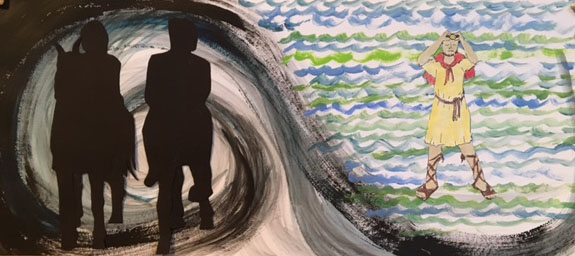
         Caught in the current, the little monk, with all his strength is able to stop himself from the pull of raging river by grabbing onto a low tree branch rooted to the opposite bank. The ribbons he was wrapped in flow loose and twist and coil on with the fury. But the pale naked human form is clinging to the tree limb with quivering strength. I leave my cloak and horse and discover the icy water with the relentless power of current. The little monk has courage and fortitude enough to trust me and let go of the limb allowing me to take him with an arm around his neck to keep his head up, and together we float downstream as I can only make slow progress with swimming for the two of us in the raging water to reach the bank. Umber wanders near to where we land with my cloak still lain across his back.

         I wrap the shivering monk in my rain soaked wool but now I have seen the naked breasts that the ribbons were meant to bind. And now, I hear her prayer aloud, thanking God with the clear and strong voice of a woman. “Thank you God, that the ox is in the care of a good man. And now, Dear God, may my rescue back to life be of service to you alone. Amen.”

         August, or I guess I should call her Augusta, still has strength enough to sit astride my horse as I walk them back upstream to Nic and the oxcart. Nic is rinsing thick mud from the knees and belly of the grateful ox. I see our rope of hemp is tied to one horn of the soldier’s saddle on The Rose, and Augusta and I both can see that Nic is indeed a very good man and he does have knowledge of oxen. Nic and The Rose were able to free the ox from the deep mud and offer it the comfort and assurance Augusta entrusted to Nic in her prayer aloud of thanksgiving.

         The little monk pulls the hood of my cloak over her head to hide her face from Nic, but Nic has already had a glimpse.

         Nic greets the shivering wools with his amazement. “So that is why we never see your tonsured head!  You are so young yet and you haven’t even a hair of a beard!  I see now this August, our desert ‘father’ is but a child!”

         I am the one to say it, “Our desert ‘father’ is a desert mother, an amma.”

(Continues tomorrow)

Post #16.4, Tuesday, January 12, 2021

Historical setting: Pyrenees Mountains, 6th Century C.E.

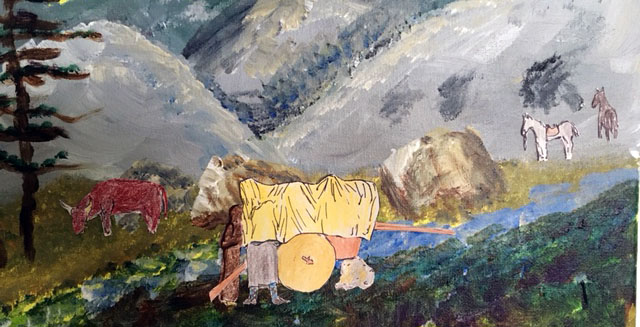
         For a few days into this journey now, we’ve been following a slender twig of a creek taking us on a flattened plain northward ever inching toward Gaul. The still of winter has a clarity allowed to go unnoticed by those who wish to curl in fleeces and wools and cluster by ember as we do each night on our way. Well, Nic and I stay near the fire at night.  August still chooses to stay in his cart with the watchful mother in stone set onto the oxcart still crated in wood with handles for lifting and moving.

         In the morning, the last coil of smoke of the dying embers wends its way skyward, tickling the fat belly of rolling grey clouds, an impending winter’s rainstorm. Our tarp and fleeces are barely strapped onto the horses when the storm lets loose a deluge. It is the long cleansing and soaking rain Nic mentioned in his hopes for companions with better fragrance.

         But in the torrents we find we are on the wrong side of the creek, and the swift flowing turbulence seems to worsen by the moment.  So we choose to cross over while we can. The horses prance in two giant leaps, getting only our feet into the froth, but the ox and the cart are not so nimble. The ox is nearly mired in mud and the cart and the statue are caught in the turbulence pulling at the ox’s yoke.  Quickly, August releases the yoke pins freeing the ox from the load, and leaving the three of us with all our strength to roll the cart onto the dry bank. Nic, then turns his attention to the panicked and bellowing ox sinking into the mud as August is swept away in this instant into the deepening flow midstream.

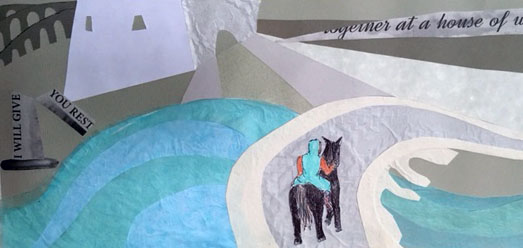
         An air pocket has made his huge wool a fast floating bubble, but surely it will soak through and pull the little monk as quickly underwater as he is now floating downstream. I mount Umber and follow the floating father downstream until the heavy wool sinks away.  And now, spinning on the current is a slender pale being apparently wrapped up with ribbons wound around his chest.

(Continues tomorrow)

Post #16.3, Thursday, January 7, 2021

Historical setting: Pyrenees Mountains, 6th Century C.E.

         We are crossing through the hills beyond the mountains into  Gaul — two men on horseback and a lone monk with an oxcart — moving at the speed of one man walking beside his ox. From time to time Nic and The Rose go ahead of us and scout out the next grassy lee or a quiet creek for a stopping place. The little monk has chosen to take this winter’s walk without shoes. It is a monkish sort of thing to do, I know, and gratefully, the earth is not yet frozen solid. I also notice, whenever we stop for rest he quickly wraps his tiny pale feet up in his wools. We all know frozen toes could cause a long healing.

         We find the foothills of the mountains have many more fine places to pitch our camp than the steeper climbs of the range we’ve already crossed. So this night the tarp is slung and the fire built in a near perfect setting. Tonight for our vesper prayers August has withdrawn to the privacy of his cart for his own prayers. But Nic and I choose to sing a psalm we both know as a call and response.

         I shout the first phrase, “Praise the Lord!”

         Nic sings his answers from Psalm 147, “How good it is to sing praises to our God; for he is gracious, and a song of praise is fitting.” …

         “God determines the number of stars…” I shout.

         Answers Nic, “God gives to all of them their names.” …

         Our joyful song of psalm goes on blessing all of Creation, the snow, “like wool” and frost “like ashes” and even the hail reminds the psalmist of manna from heaven.

         It is Nic’s echo, “who can stand against his cold?”

         And I sing “He sends out his word, and melts them”

         Nic’s voice sings the psalmist’s response, “he makes the wind blow, and the waters flow.”

          Maybe we have a secret hope that August will find a blessing in hearing others at worship. I wonder if he may be so concerned maintaining his Christian piety that he hasn’t noticed it is something he shares with us also. And of course, we may be so concerned about showing off Christian piety to him that we ignore his need for solitude. So be it.

         The night is beautiful, but crisp with winter. Thank you, God.

(Continues Tuesday January 12)

Post #16.2, Wednesday, January 6, 2021

Historical setting: Pyrenees Mountains, 6th Century C.E.

We are on our journey, two horses a good distance behind the ox cart with the pace set by the little desert father and the ox. We are sent on our way most rudely this morning by the seller of Gallo-Roman stone gods and goddesses because we rejected Antton’s invitation to stay for his party. But surely our own dedication to a teacher who celebrates with the poor and outcast would have made us unfit guests for Antton’s festival of the Solar New Year. I do hope he finds some guests. It’s a bleak beginning to a year with having the very dregs of possible guests turn you down.

         Nic mentions, “I hope August didn’t hear that awful language. I mean in some ways the truth of it just made it so much worse. I too notice the stench of that little fellow but that’s not a reason to use such filthy slurs.”

         “As I said Nic, I’ve spent many long and peaceful times in prayer alone in wilderness places, and sometimes I’ve been with others of these ascetics and I know that baths and sweet scented oils are the stuff of personal wealth and vanity. So desert fathers are known to separate themselves from worldly bliss by making a deliberate effort to show devotion in this way.”

         “You mean you are saying August accepts that he stinks?”

         “Yes. In fact he may see it as a sign of his pious commitment to his life of prayer. And, after-all, it is us, asking the favor of him that he give up his cave and solitude and take this journey with us. I mean, alone in a cave with his ox and with God, who probably loves all smells of Creation, he surely doesn’t require the ancient Nicodemus’s hundred pounds of fragrant herbs to enhance a cave. He is who he is.”

         Nic adds a wayward hope. “But if the heavens took pity on these two fellow travelers who are riding with him, perhaps the clouds would let loose a great torrent of cleansing rain and we would all just smell of  clean wet wool together.”

         Today, the sky is gleaming cobalt for a new, unblemished year marked by the sun’s journey.

         Dear God, the beauty of this new morning seems a gift way beyond any intentions of humility.  The paradox of poverty in a beautiful world is the gracious gift of Creation we all share.  Thank you God, Amen.  And may it ever be so.  

(Continues tomorrow)

Post #16.1, Tuesday, January 5, 2021

Historical setting: Pyrenees Mountains, 6th Century C.E.

         The elfin monk wanders pensively among the Roman statues as we had done at first, seemingly lost in a maze of promised pagan fixes. He is gazing into the laughing face of the fertility goddess with her huge bowl of too much grain. Maybe he too is wondering what the prayers to such a goddess would sound like. Or is he simply studying the workmanship of another sculptor’s hand? We know he is wondering what has become of the Christian subject by his own hand.

         Nic offers answer, “We’ve moved the Christian sculpture into a more sacred space. She is in the oxen shed.”

         The hood and robe of August return a nod of gratitude and he follows Nic to the shed. He looks on it as a stranger as though he has never seen his own work before, but isn’t that the experience of every artist – step back for moment — see it with empathy with the eyes of the stranger seeing it for the first time. First there is a moment of surprise, then the search for the flaw. It’s a persistent dialogue of the artist to himself, “how does it look to others?” “If only I had …”

         I interrupt his wonder, “She is beautiful, isn’t she; just like the author of Luke must have seen her in his thoughts, a woman of poverty and simplicity yet she is holding the richest gift ever given to humankind.”

         The shoulders of the wool robe melt in a human moment, then the little monk brushes off my assessment, a compliment, adroitly skipping over any appearance of a prideful sin, bowing silently and prayerfully.

         We lift the statue onto the ox cart and prepare to start the slow walk to Ligugé, when host Antton comes along, not to wish us well on our journey, but to insist we are rude for leaving before his great festival of the New Year. Apparently his Gallo-Roman guest list has failed him.  Nic offers our most well-mannered rejection but rejection is rejection, and Antton handles it with a heap of flaming language following us out his lane and onto the public path. His words surely include the complete thesaurus listing for Hell.  It ends with “… and furthermore the little priest smells like a cur in heat!” Maybe August is already walking the ox far enough ahead of us and didn’t hear it, or maybe he just turned away and let the jeering roll off his back.

(Continues tomorrow)

Post #15.15, Thursday, December 31, 2020

Historical setting: 6th Century C.E. Somewhere in the Pyrenees

         In these days of waiting for the oxcart and driver, Nic and I decide to take a morning ride to give the horses a stretch and explore the various paths going out from this place possibly to find our direction on toward the north.

         The river we were following cuts deep into a valley with sandstone cliffs which is apparently the quarry being used to source the stone for the carvings.  Now, around a bend we come upon another thing, the monk with the oxcart waiting here these same days that we have been waiting at the thatched houses. Of course! This is the meeting place he knew of when making his transactions with Antton. Surely this would be the meeting place.

         “Good Morning Brother August! We’ve been waiting for you in the wrong place! Come along, follow us to the houses.”

         The messenger was right. He doesn’t speak. He’s a little fellow, in too-large a hooded monk’s robe made of rough wool. The hood is pulled over his head and covers his face completely.  The very long robe is drawn up with a sash at the waist so that his very small and pale bare feet are nearly completely exposed. Since he is a stoneworker it is something of a wonder how such a tiny creature would manage large pieces of stone. But now we see the cart is constructed with winch and ropes along with an extra layer of flooring that can be let down and bolted to the cart as a ramp.

         He easily slips the single yoke over one side of the ox’s head, then the other, then drops the pin in place to hitch the cart. Nic is offering to help, dismounting and leaving me to hold the rein of The Rose. He did tell me once he was more comfortable with oxen than horses.

         Nic offers. August holds the hood of his robe at the chin to get a peak out at Nic, then shakes his head, rejecting the help, gesturing the scar on Nic’s cheek.

         “No, no” Nic answers, “I am really accustomed to oxen. My scar is from a knife fight, not from an ox horn. Really I can be helpful.”

         But he is shooed back to his horse with a kind of grandfatherly back of the hand gesture as one would use to send children off to play.

(Continues Tuesday, January 5, 2021)